Rental Reimbursement Coverage in California: Your 2026 Guide
Your car gets hit on the 405 on a Tuesday. The body shop says they can take it, but they can't promise a quick turnaround. You still need to get to work, pick up groceries, drive the kids, and deal with life in California, where being without a car is usually a major problem, not a minor inconvenience.
That's why Rental Reimbursement Coverage matters.
I'll be blunt. If you rely on one car and you'd feel the hit from paying for a rental out of pocket, this is one of the smartest add-ons in a California auto insurance policy. It's not flashy. It won't impress anyone. But when your vehicle is in the shop after a covered claim, it can keep your week from turning into chaos.
It also fits into a bigger California insurance conversation. Auto insurance handles the damaged vehicle. Home insurance and renters insurance matter when wildfire risk affects where and how you live. Life insurance protects your family if the worst happens. But for everyday disruption, few small auto coverage choices are as practical as this one.
Your Guide to Rental Reimbursement Coverage
Your car is undrivable after a claim, the shop is backed up, and your week starts falling apart fast. In California, that happens all the time. Parts delays, crowded repair schedules, and wildfire losses can keep drivers off the road longer than they expect.
That is why rental reimbursement coverage deserves more attention than it gets.
Rental reimbursement coverage helps pay for temporary transportation after a covered claim leaves your car unusable. For a California driver, that can mean the difference between keeping your routine intact and paying out of pocket for a rental, Uber trips, or both.
Its value is not theoretical. It shows up on ordinary weekdays in LA traffic, school pickup lines in Orange County, long Bay Area commutes, and evacuation situations where your household cannot afford to lose access to a vehicle. If your family runs on one main car, this add-on is a smart buy.
Why California drivers should pay attention
California makes transportation gaps expensive. Public transit works for some drivers, in some neighborhoods, for some trips. For a lot of people, it does not cover the full day. Rideshare can fill the gap, but the bill adds up fast if you use it to commute, get kids around, or handle basic errands for a week or two.
Repair timing is another California problem. Even a modest claim can turn into a long wait if the body shop is booked out or a part is on backorder. A wildfire claim can be worse. If your vehicle is damaged by fire or falling debris during a covered event, you may need a replacement ride while the claim is sorted out and local demand for rentals is high.
My advice is simple. If losing your car for several days would force you to scramble, add this coverage. It is one of the most practical small upgrades in an auto policy because it protects your cash flow during the exact moment life gets inconvenient and expensive.
The details matter, and the next section covers how the limits work and what triggers the benefit.
How Rental Reimbursement Works
You file a covered claim after a crash on the 405 or a fire-related loss during a wildfire event. Your car goes to the shop, or it is declared a total loss. Rental reimbursement steps in to help pay for temporary transportation while that claim is being handled.
It only applies when the loss itself is covered under your policy. Routine repairs, maintenance, breakdowns, and mechanical problems do not trigger this benefit.
The two numbers that matter
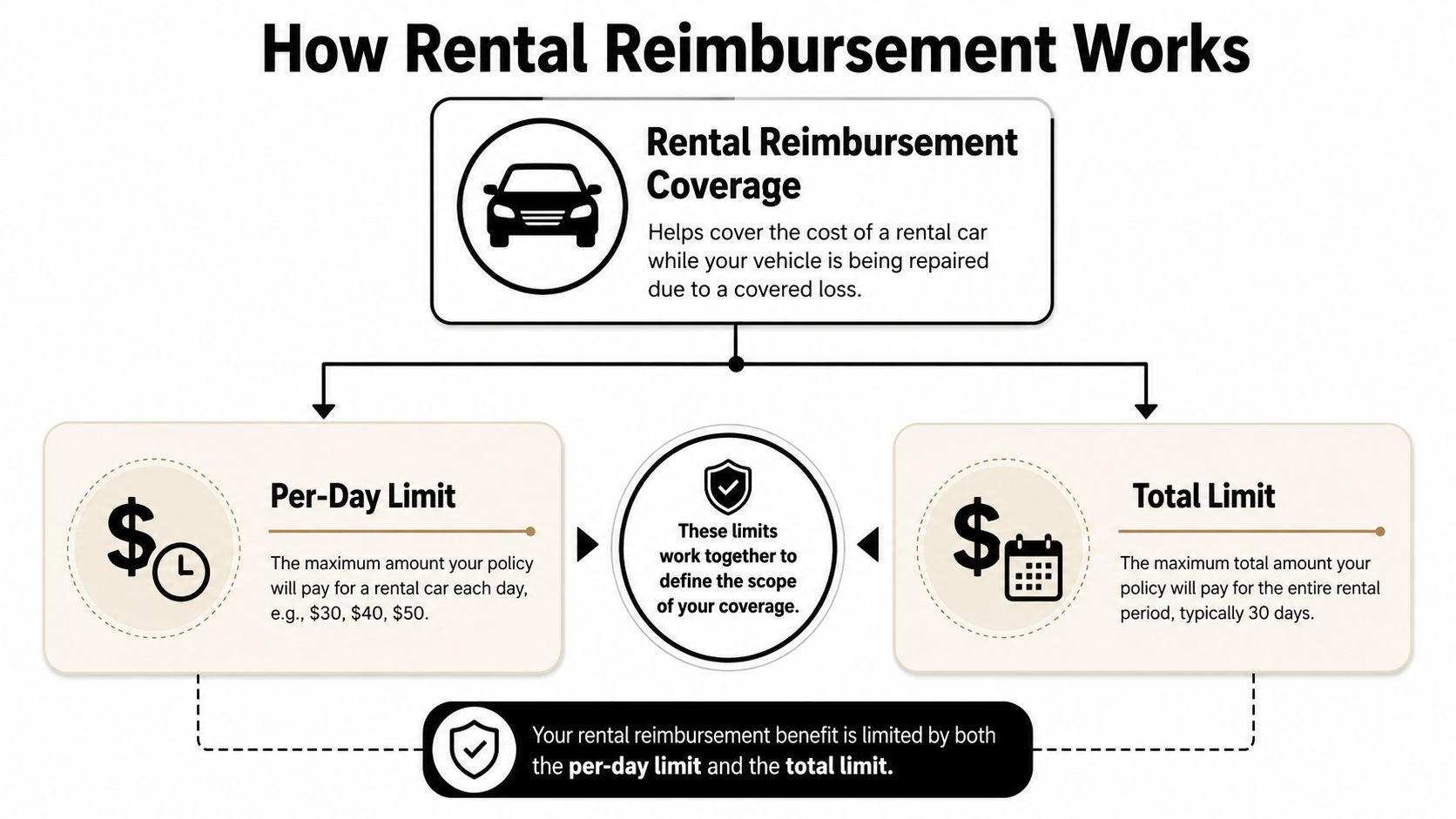
Rental reimbursement usually comes down to two limits, and both matter in California.
- Daily limit: The most your policy pays per day for a rental car or other covered temporary transportation.
- Total limit: The most your policy pays for the full claim.
A common setup is something like $30 per day up to a fixed total. That sounds fine until you check real rental prices, especially in high-demand areas or after a regional disaster. If the rental costs more than your daily limit, you pay the difference. Once you hit the total cap, the benefit stops.
That is why I tell drivers to review this coverage alongside their broader California car insurance policy options, not treat it as an afterthought.
What triggers the coverage
The rule is straightforward.
- You have a covered claim.
- Your car cannot be driven because of that claim.
- You already added rental reimbursement to the policy.
- The insurer pays within the daily and total limits.
Payment usually starts once the claim is accepted and your car is in repair status, or after a covered total loss, subject to your policy terms. The exact timing matters. If repairs stall because a body shop is backed up or parts are delayed, your coverage does not become unlimited. It still stops at the cap you bought.
That is a real issue in California. Parts shortages, crowded shops, and wildfire-related claim volume can stretch repairs longer than drivers expect.
What it pays for, and what it does not
This coverage helps with temporary transportation costs while your own vehicle is unavailable because of a covered loss. In many cases, that means a rental car. Some policies may also allow other transportation options, but you need to check the wording before you assume rideshare trips will be reimbursed.
Do not confuse this with the insurance offered at the rental counter. That is separate coverage for damage to the rental car itself.
The practical takeaway is simple. Rental reimbursement is a small add-on that can save you from paying out of pocket for days or weeks of transportation when your car is suddenly out of service. In California, where commutes are long and repair delays are common, cheap limits can leave you stranded.
California Auto Insurance Considerations
California makes this coverage more useful than many drivers realize.
You already know how dependent most of the state is on personal vehicles. But the bigger issue is what happens after the claim. Repairs can stretch out. Shops get backed up. Parts can take time. In dense areas like Los Angeles and the Bay Area, even a straightforward claim can leave you juggling transportation longer than you expected.
Why the California context changes the value
In a compact city with strong transit, some people can limp along without a rental. In much of California, that's not realistic. Your commute may cross multiple cities. Your child's school may be nowhere near your office. Your grocery run may require a car even if your job doesn't.
Then add wildfire exposure. If a covered claim takes your car off the road due to a wildfire event or evacuation-related disruption, transportation becomes more than convenience. It becomes part of your household resilience.
That's where I see drivers make a mistake. They buy the minimum auto coverage they can tolerate, but they don't think through what happens during the claim itself. A strong policy doesn't just repair or replace damage. It helps you function while the claim is active.
If you're reviewing your broader California auto insurance options, this endorsement deserves a serious look alongside collision and additional vehicle damage protection.
Watch the limits, not just the checkbox
A lot of drivers ask only one question: “Do I have rental reimbursement?” That's not enough.
The better questions are:
- How much per day does it pay?
- What's the total limit per claim?
- Would that amount realistically cover the kind of transportation I'd use?
- What happens if my repair takes longer than expected?
California is exactly where modest limits can become a problem. A low daily cap may push you into paying out of pocket from day one. A low total cap may disappear before the vehicle is ready.
Don't buy this coverage just to say you have it. Buy limits that match your actual transportation habits.
How this fits with other California insurance decisions
This is auto insurance, but it connects to the rest of your protection plan.
If you live in a wildfire-prone area, your home insurance or renters insurance may already be part of a larger risk strategy. You may also be reviewing Fair Plan options, earthquake concerns, and how to protect property if you need to leave quickly. In that world, access to transportation matters. If your vehicle is damaged in a covered event, rental reimbursement can reduce one layer of stress while the larger claim picture unfolds.
I wouldn't call it mandatory for every driver. I would call it a smart default for most California households that depend heavily on their cars.
Analyzing the Costs and Benefits
My neutrality ends here. For many drivers, the math favors adding the coverage.
The reason is simple. The premium is usually modest, but the out-of-pocket exposure can be annoying fast. The mistake is focusing only on the cost to add it and ignoring the cost of being without it.
The limit structure decides whether it really helps
Most insurers use a two-part cap. You get a daily amount and a maximum per claim. Market examples commonly show daily limits around $30 to $50, with total caps often around $900 or 30 days, while some carriers offer broader ranges up to $100/day and $3,000 maximum. Some insurers also handle payment by direct billing to a preferred rental agency, while others reimburse after you submit receipts, as outlined in Kin's guide to rental car reimbursement coverage limits and payment methods.
That tells you two things:
- Coverage varies more than people think.
- A weak limit can still leave you paying a chunk yourself.
Sample Rental Reimbursement Coverage Tiers
| Coverage Tier | Daily Limit | Total Limit | Estimated Monthly Cost | Covers a... |
|---|---|---|---|---|
| Basic | $30/day | $900 total | Often relatively low cost | Smaller rental budget for short claims |
| Standard | $40/day | 30 days | Varies by insurer | Mid-range temporary transportation need |
| Enhanced | $50/day | 30 days | Higher than basic options | Better fit if local rental rates run higher |
| Broad | Up to $100/day | Up to $3,000 maximum | Usually the priciest tier | Drivers who want more room before paying out of pocket |
I'm being careful with the cost column because precise monthly pricing depends on the carrier and your policy. What we can say confidently is that the endorsement is generally positioned as a low-cost add-on compared with paying the full temporary transportation bill yourself.
Who gets the best value
Rental reimbursement coverage usually makes sense if any of these sound like you:
- Single-car household: You don't have a backup vehicle.
- Long commute: Missing your car means missed work time, extra rides, or family logistics problems.
- High-demand routine: School drop-offs, appointments, and errands depend on driving.
- Cash-flow protection: You could pay for a rental, but you'd rather not absorb that surprise expense.
Who may skip it?
- Second vehicle available: Your household can function fine without the damaged car.
- Transit-friendly lifestyle: You already use public transportation or rideshare most days.
- Strong emergency fund: You're comfortable self-insuring a temporary transportation gap.
My recommendation on choosing limits
Don't automatically choose the cheapest daily amount. Choose the lowest option that still feels realistic for your area and your routine.
If your lifestyle requires a car every day, low limits can disappoint you at the worst moment. If you work from home, have a second household vehicle, or live near strong transit, a smaller limit may be enough.
The goal isn't to maximize coverage. It's to avoid a bad mismatch between your policy and your actual life.
How to Use Your Rental Reimbursement Benefit
When a covered loss happens, don't wait until you're standing at the rental counter to figure this out. The easiest claims are the ones where the driver confirms the process early and follows it in order.
Start with claim approval
Rental reimbursement coverage typically applies only after a covered non-collision or collision loss, and insurers commonly require that you carry both collision and non-collision coverage before this benefit is available, according to State Farm's explanation of how rental reimbursement coverage works.
That means your first job is not renting a car. Your first job is getting the claim opened and confirming that the loss is covered.
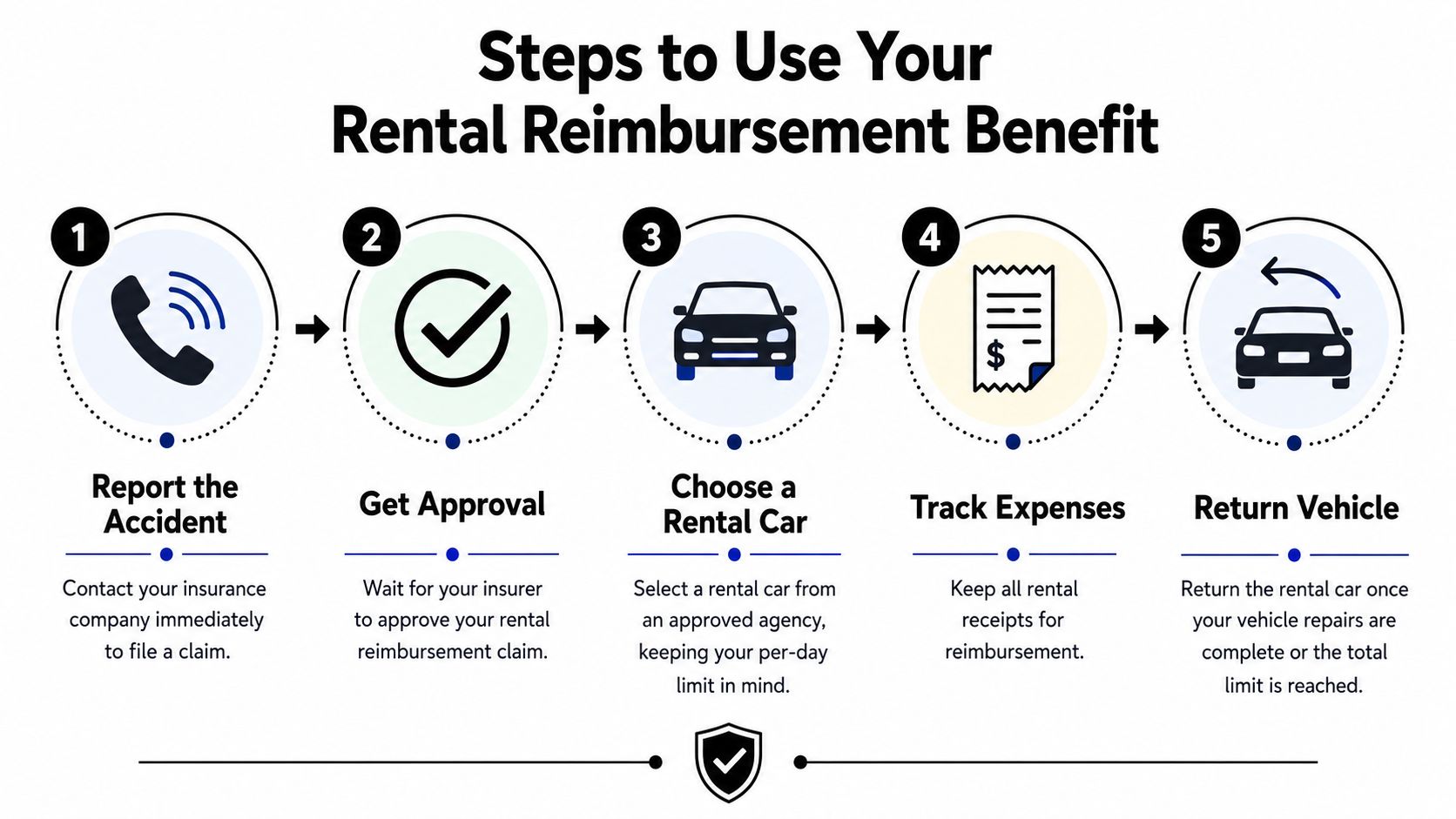
Use this order:
- Report the accident or loss quickly. Give the insurer the facts, photos if available, and the location of your vehicle.
- Ask whether rental reimbursement is active on your policy. Don't assume.
- Confirm the daily and total limits. You need those numbers before choosing a vehicle.
- Ask whether direct billing is available. This can save you from paying everything upfront.
If you need a quick place to start the process, getting a California insurance quote or policy review can also help you verify whether your current policy includes the endorsement before a loss ever happens.
Choose the rental carefully
People often overspend.
You're usually free to select a rental vehicle, but your policy only pays within the stated limits. If you choose something above the daily allowance, the overage is yours. Don't let the rental counter talk you into a nicer car unless you've already decided to cover the gap yourself.
A practical checklist helps:
- Match the car to your need: Commuter sedan, compact SUV, or whatever your household requires.
- Verify billing method: Preferred agency direct billing is easier than reimbursement.
- Keep every receipt: If reimbursement is required, missing paperwork slows everything down.
- Track the repair timeline: Your benefit doesn't become unlimited because the shop is delayed.
Ask the adjuster one direct question: “What exactly will you pay per day, and what amount becomes my responsibility?”
Keep documentation tight
Good documentation keeps a routine claim from becoming a frustrating one.
Save:
- Rental agreement
- Receipts
- Claim number
- Repair shop contact details
- Any written insurer approval
If your insurer reimburses after the fact, sloppy recordkeeping can delay payment. If the insurer pays the agency directly, still review the bill. Direct billing reduces hassle, but it doesn't erase the possibility that add-ons or upgrades land on your side of the ledger.
The smoother you handle this, the faster you get through an already stressful week.
Alternatives and Common Exclusions
Rental reimbursement coverage is useful, but it isn't universal and it isn't magic. Some drivers are better off with alternatives. Others buy it without understanding the gaps and then get irritated when it doesn't cover expenses they assumed were included.
When another option may be better
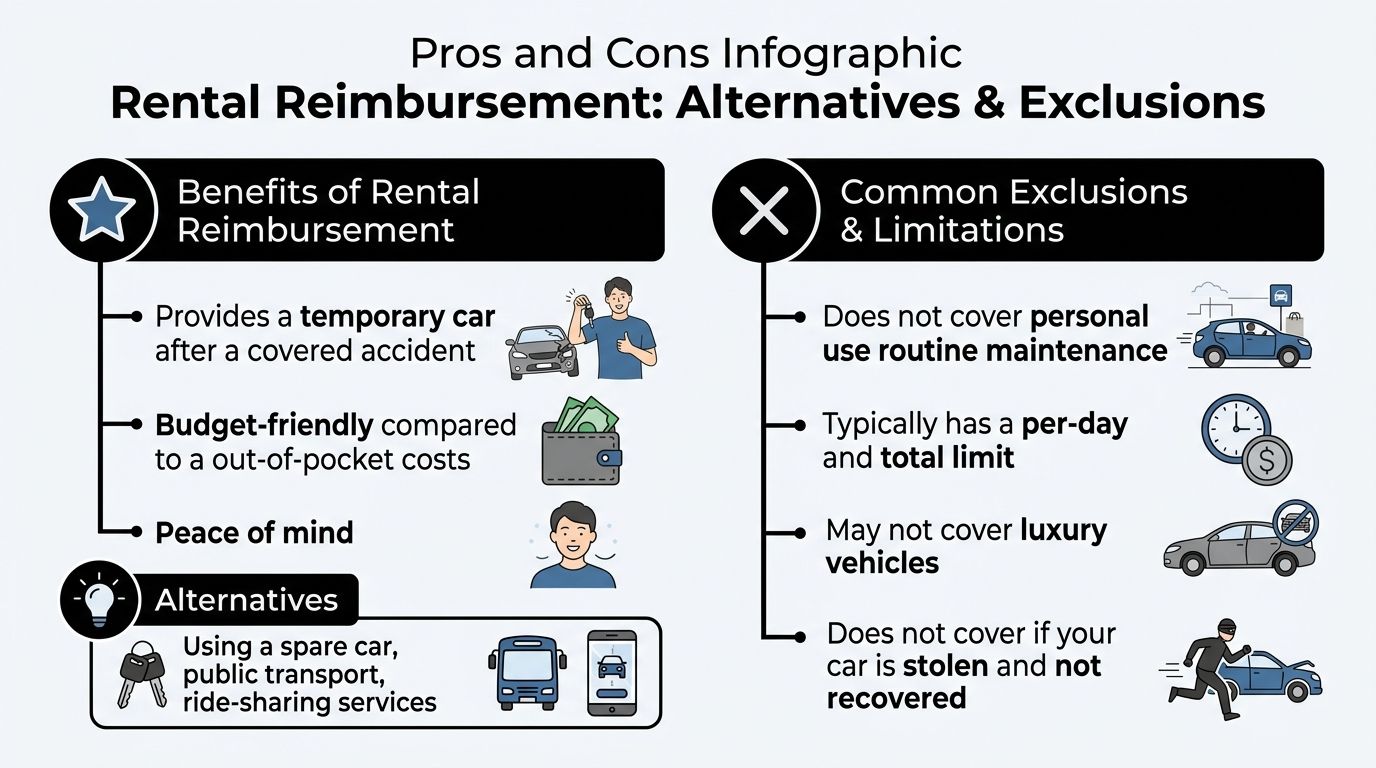
Some insurers describe broader extended transportation expenses that can cover public transportation or car service, and the practical value of rental reimbursement depends on whether you rent a car, how often you use rideshare, and how long you can absorb disruption. For some drivers, self-insuring may be the better move, as noted in Allstate's discussion of rental reimbursement and transportation expense choices.
That matters in California because transportation habits aren't uniform.
A Glendale commuter with one family car has a different need than a San Francisco renter who uses transit most days. A remote worker in Costa Mesa may decide a rideshare budget is enough. A household with a second car may not need this endorsement at all.
You should compare the endorsement against your real backup plan, not against a vague idea of “peace of mind.”
For renters who are already reviewing broader household protection, it's also smart to look at how transportation risk fits into your overall budget alongside California renters insurance choices.
Common exclusions people miss
Here's where expectations go wrong. Rental reimbursement coverage generally does not function as an all-purpose car rental wallet.
Typical pain points include:
- Routine maintenance: Oil changes, brake work, and unrelated mechanical repairs usually don't trigger it.
- Non-covered losses: If the underlying claim isn't covered, the rental benefit usually doesn't activate.
- Extras at the counter: Supplemental products, upgrades, and incidental charges may become your responsibility.
- Fuel and similar operating costs: The coverage is about temporary transportation expense, not every cost attached to using the rental.
The fastest way to hate this coverage is to expect it to do more than it was built to do.
My opinion on alternatives
If you rarely drive, live near dependable transit, or have easy access to another household vehicle, self-insuring can be reasonable.
If your life falls apart without a car, skipping this add-on to save a little premium is usually false economy.
California Driver FAQ and Decision Checklist
The right call depends less on theory and more on your daily life. I'd rather see a driver make a clean yes-or-no decision than carry confusion on the policy for years.
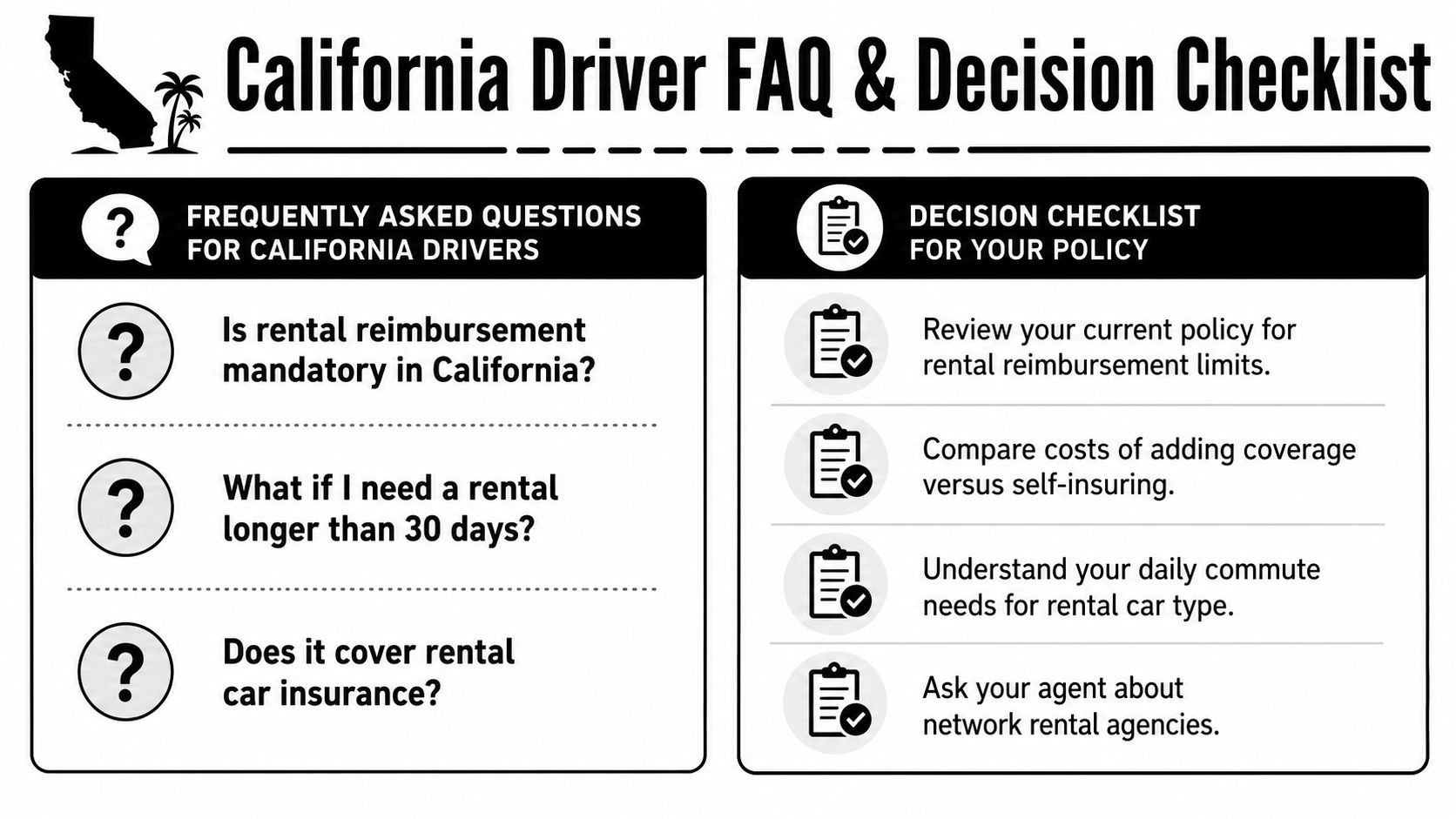
Questions California drivers ask all the time
Is rental reimbursement coverage required in California?
No. It's typically optional.
Can I rent a nicer car than my limit supports?
Yes, but you'll usually pay the difference yourself.
Will it pay forever if the shop is delayed?
No. Your policy limit still controls.
Does it replace rental car insurance from the rental counter?
No. This benefit helps pay for temporary transportation after a covered loss involving your own vehicle. It is not the same thing as insuring a rental vehicle itself.
What if I don't want a rental car?
Depending on the insurer and policy, another transportation option may fit better. But you need to confirm that before assuming rideshare or transit will be covered.
Decision checklist
Run through this list thoughtfully.
- You rely on one vehicle: Add the coverage.
- You commute regularly by car: Add the coverage.
- You have kids, appointments, or caregiving duties that depend on driving: Add the coverage.
- You have a second household vehicle and can manage without the damaged car: You may be fine skipping it.
- You already use public transit or rideshare for most trips: Compare the endorsement against self-insuring.
- You're carrying collision and physical damage coverage anyway: This add-on is often a logical companion.
- You hate surprise expenses: This is exactly the kind of coverage that reduces them.
My bottom-line recommendation
For most California drivers with one primary car, I recommend Rental Reimbursement Coverage. Not because it's exciting, but because it solves a boring, expensive problem before it lands on you.
If you're a homeowner, renter, or family already trying to balance auto insurance, home insurance, renters insurance, and life insurance, this is the kind of practical policy choice that keeps your whole financial picture steadier. It won't fix every claim issue. It will make a covered loss easier to live through.
If you want more guidance on related coverage questions, review the California insurance FAQ resource.
If you want help reviewing your current policy, comparing rental reimbursement options, or building a better overall protection plan for your car, home, rental, or family, talk with Mai & Associates. Their licensed California team can help you compare coverage choices, spot gaps, and find an option that fits your budget without overbuying.