Ran Out of Gas on Highway: What to Do Next
You merge onto the 405 during rush hour, glance at the fuel gauge, and realize the needle has fallen faster than expected. Then the engine sputters on a long uphill grade. Trucks are closing in, your car is losing power, and the search phrase “ran out of gas on highway” suddenly feels less like research and more like an emergency.
Running out of fuel is both a mechanical problem and a judgment test. The safest response depends on where the vehicle stops, how far it sits from moving traffic, whether it's dark, and which California assistance service can reach you. The steps below focus on those decisions, including the one most generic checklists handle poorly: whether you should stay in the car or walk for fuel.
What Just Happened on the Freeway
A modern vehicle often gives you a brief warning before it becomes completely immobile. The engine may hesitate, the accelerator may stop responding normally, and the car may coast while power-assisted systems gradually become less effective. Treat that loss of power as an immediate roadside hazard, not as an opportunity to keep driving for one more exit.
A driver on the 405 might still have enough momentum to reach the shoulder. Another driver on a rural stretch of I-5 might face a narrow edge, poor lighting, and fast-moving traffic. Those situations look similar on a fuel gauge, but they demand different choices.
The first objective isn't finding gasoline. It's creating distance between your vehicle and moving traffic.
AAA reports that 24 million American drivers, or 11% of drivers surveyed, continue driving after the low-fuel warning light comes on. The same AAA guidance on empty fuel tanks reports that 135,473 Automobile Club of Southern California members ran out of gas in one year. Those figures explain why an empty tank remains a recurring roadside problem rather than an unusual fluke.
The risk can rise when fuel prices increase, drivers postpone refueling, or commute distances stretch. AAA-linked reporting also described rising empty-tank assistance calls in several markets, including 1,275 calls in April and 1,651 in May, plus more than 450 additional calls in June in one covered market. The lesson is practical: fuel exhaustion follows behavior as much as vehicle condition.
This guide treats the incident as a safety event first, an assistance question second, and an insurance question third. Get clear of traffic, identify your location, make the right call, and only then decide whether waiting or walking makes sense.
Pull Over and Make the Car Disappear From Traffic
A sputtering engine gives you only a short window to create space from traffic. Switch on the hazard lights, keep both hands on the wheel, and steer smoothly toward the right side of the roadway. As engine power fades, steering and braking can become heavier, so avoid sudden lane changes or hard braking.
If the car still has momentum, take the nearest safe pull-off. Do not cross several lanes for an exit that is not immediately reachable. At the same time, do not keep driving toward a distant gas station while the engine is failing. A controlled roll beyond a dangerous merge can be safer than stopping in a live lane, as long as the vehicle remains responsive.
Get every tire off the travel lane
A paved shoulder is common on many urban California freeways, but rural sections may offer only dirt, gravel, or a narrow emergency edge. Aim to place all four tires fully off the travel lanes. If the ground is stable, position the vehicle beyond a guardrail transition or behind a substantial roadside barrier. Do not trade traffic exposure for unstable terrain.
Keep the hazard lights flashing. Turn on the parking lights in darkness or poor visibility. If you have a reflective vest, put it on before opening the door. Exit only through the side farthest from moving traffic.
California safety guidance favors getting away from active lanes when leaving a disabled vehicle is necessary. The California Highway Patrol and 511 Freeway Assist information explains that drivers with a stalled vehicle or empty tank can call 511 for help. Use emergency services when the vehicle creates an immediate danger, someone is injured, or traffic cannot safely pass.
Visibility matters, but exposure matters more
Do not stand behind the car waving at approaching drivers. Do not walk along the shoulder to search for a better stopping point. If leaving the vehicle is unavoidable, move to the side away from traffic and stay behind a barrier when one is safely accessible.
A shoulder stop may be hard to see around curves, crests, and interchanges. Make the vehicle noticeable without placing yourself in the traffic stream. Hazards, parking lights, reflective clothing, and an accurate assistance call work better than roadside improvisation. If the shoulder is narrow or traffic is moving quickly, staying inside with your seat belt fastened is usually safer than opening the door.
Pinpoint Your Location and Call for Help
A dispatcher cannot send useful help to “somewhere near Los Angeles.” Report the highway, direction of travel, nearest exit or mile marker, vehicle color and type, and the number of occupants. Tell the dispatcher immediately if anyone is outside the vehicle or walking on the shoulder.
Use more than one location clue. Read the green mile marker, note the nearest cross street or exit number, and compare the scene with Google Maps or Waze. GPS can drift near canyon walls, tall buildings, and complex interchanges. Visible signs, landmarks, and the direction of travel provide a stronger confirmation.
Choose the right California number
Dial 511 for California freeway assistance only when the vehicle is safely stopped and no one needs urgent medical care. California's 511 Freeway Assist system can connect you with a live operator who identifies your location and helps arrange assistance. Service availability depends on the corridor and operating hours, so confirm what help is available rather than assuming every freeway receives the same response.
After hours, a disabled vehicle may be handled through the CHP Rotational Tow Program at standard rates. That distinction matters when you have run out of gas. The roadside response may locate you or arrange a tow, while fuel delivery and payment can depend on the service provider and your coverage.
Call 911 if the vehicle is dangerously positioned, occupants face an immediate threat, a crash occurred, or anyone needs medical assistance. Use 511 for a disabled vehicle that is safely clear of traffic and does not present an immediate emergency.
Give the dispatcher a usable script
Say: “I'm on [route], traveling [direction], near [mile marker or exit]. My vehicle is [color and type]. It's fully on the shoulder. [Number] people are inside, and [nobody or someone] is walking on the shoulder.”
Keep your phone charged. Share your location through a trusted safety tool when possible, and review this safer response app list before a breakdown so emergency contacts and location-sharing options are ready.
For questions about roadside benefits, exclusions, and possible out-of-pocket costs, use this California home and auto insurance resource. Your policy may address towing without promising fuel delivery, so verify the details before relying on it.
Stay in the Car or Walk for Fuel
“Stay with your car” is good general advice, but it isn't a complete California decision rule. Walking for fuel can be reasonable in daylight beside a low-speed urban road with a visible exit station nearby. It can be reckless on a dark rural freeway where traffic moves quickly, lighting is poor, and the shoulder is barely wide enough for a person.
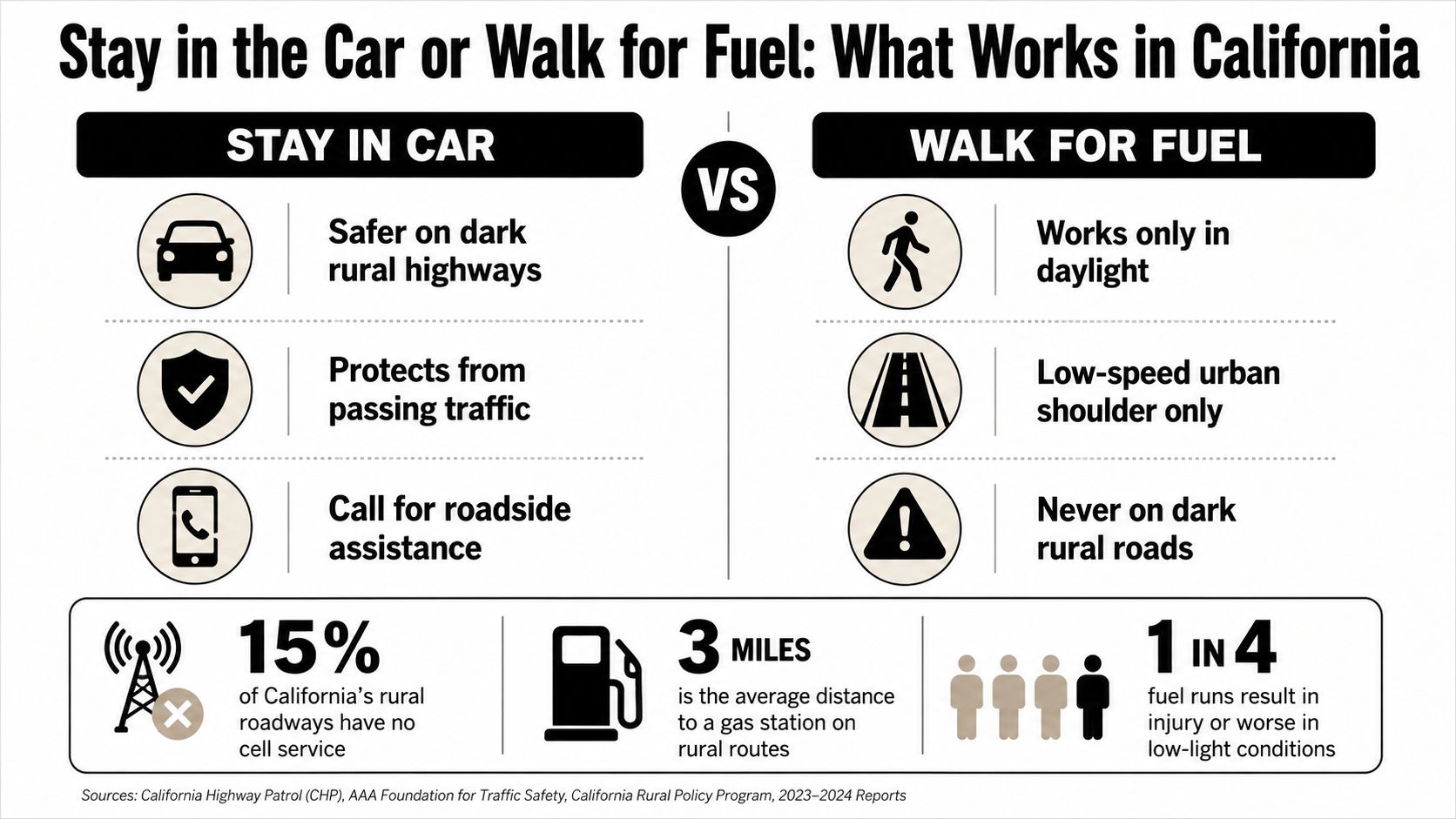
Use a strict decision test:
- Stay inside: Choose this when traffic is moving at highway speed, the posted limit is 55 mph or higher, visibility is poor, the shoulder is narrow, or the nearest exit is more than a mile away.
- Consider a short walk: Only consider it in daylight, on a broad and clearly separated urban shoulder, with an exit station close enough to reach without walking beside travel lanes.
- Never walk the freeway: Don't walk along the traffic lanes, cross ramps, climb barriers, or accept a ride from an unknown driver.
At night on I-5 or I-80, stay in the vehicle with your seatbelt fastened and hazards operating unless remaining inside creates a more immediate danger, such as smoke, fire, or a collision risk. A car provides some protection from passing traffic and makes it easier for responders to find you.
A tow or fuel delivery is inconvenient. Being struck on foot is catastrophic. Choose the inconvenience.
If the shoulder feels unsafe, call 911 or CHP rather than attempting self-rescue. California roadside safety guidance also recommends staying with the vehicle instead of walking along the highway, particularly when traffic remains active.
For more preparation advice, review these practical California insurance and roadside guides before your next long drive. Know the answer before you're standing beside an empty tank.
What Insurance and Roadside Coverage Pay For
Running out of fuel is usually a roadside disablement, not an insured loss. A standard liability-only California auto policy generally won't pay for fuel delivery. Liability coverage pays for injuries or property damage you cause to others, not gasoline, towing, or roadside help for your vehicle. California's updated standard minimums are 30/60/15, meaning $30,000 for bodily injury or death per person, $60,000 per accident, and $15,000 for property damage per accident, according to the California Department of Insurance. Those limits do not cover an empty tank.
Collision coverage does not apply unless a covered crash caused the damage. The coverage to check is a roadside assistance or towing-and-labor endorsement, if you bought one.
Compare the options before you need them
| Coverage Source | Fuel Delivery | Typical Limit | Out-of-Pocket Cost |
|---|---|---|---|
| Liability-only auto policy | Usually not included | No fuel-delivery benefit | Driver pays for service |
| Collision coverage | Not for an empty tank | No roadside benefit | Driver pays for service |
| Roadside assistance endorsement | May include limited delivery | Policy-specific | Premium and possible service limit |
| AAA membership | Fuel delivery may be included | Membership-tier terms apply | Membership fee and applicable limits |
| Manufacturer or credit-card program | Program-specific | Contract-specific | May be included or subject to terms |
Roadside endorsements usually provide a defined service allowance for each disablement. Some policies reimburse a set amount, while others arrange delivery or towing directly. Read the declarations page and endorsement language. “Roadside assistance” does not promise unlimited fuel, towing, or distance.
AAA membership benefits also vary by tier. AAA Classic, Plus, and Premier list fuel delivery as a benefit, while towing limits differ. AAA Plus commonly provides up to four miles of free tow, and Premier lists up to 200 miles, subject to membership terms and eligibility. Your membership must be active when you call. Confirm the benefit through AAA roadside service information before relying on it.
Manufacturer warranties, credit-card benefits, and separate roadside programs can help, but each follows its own contract. Check whether the vehicle, driver, location, and service type qualify before treating the program as your backup plan.
The practical question is which roadside option you should carry before the tank reaches empty. Adding roadside assistance to your policy or maintaining a suitable membership is usually more predictable than hiring a private tow operator during a stressful breakdown. Review the details in this California auto insurance coverage guide.
How to Stop Running on Fumes
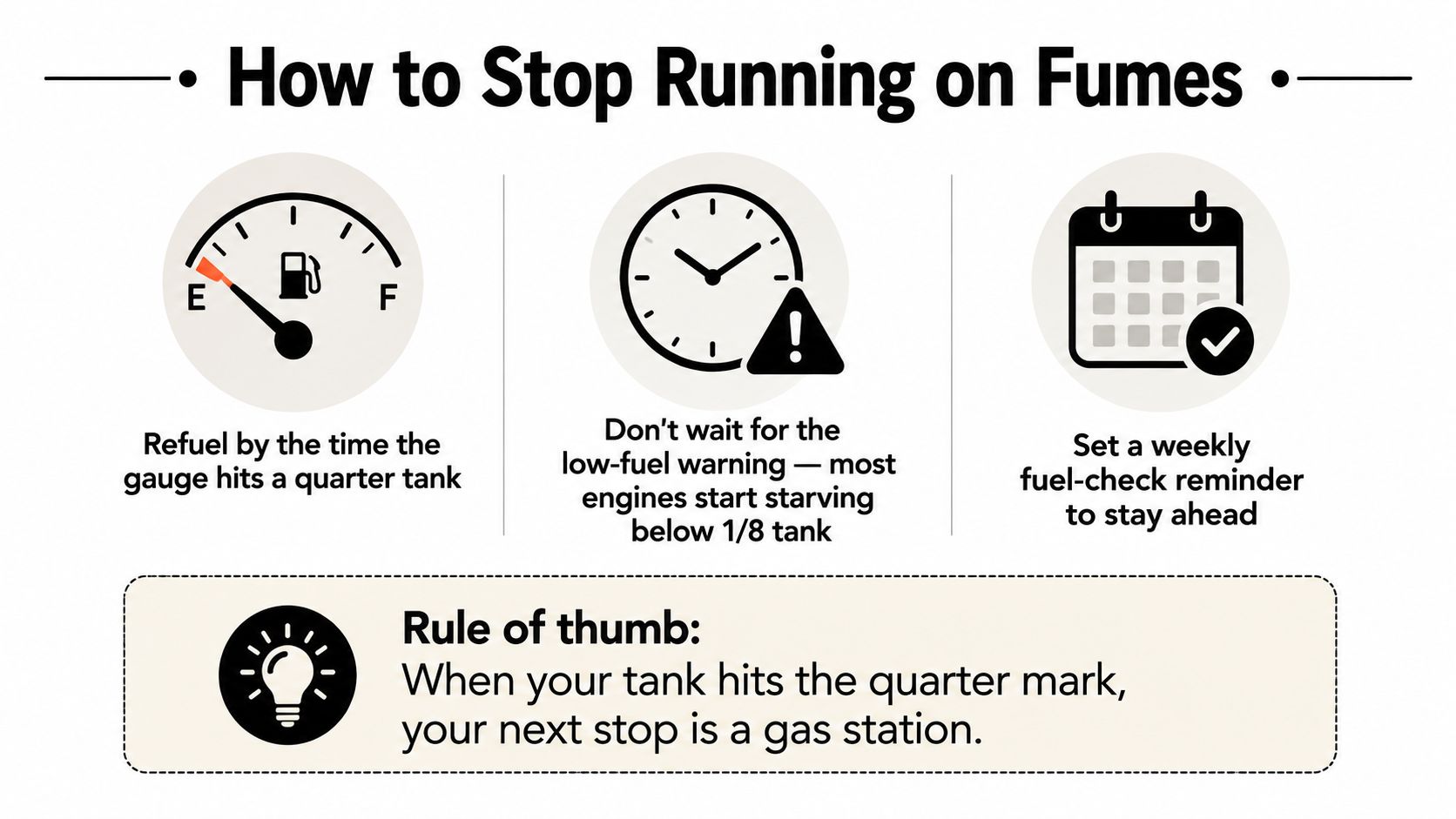
Waiting for the low-fuel warning is a poor highway strategy. Refuel when the gauge reaches a quarter tank, especially before long drives across grades and remote stretches. Treat the distance-to-empty display as a rough backup, not a promise, because driving style, air-conditioning use, elevation, traffic, and weather can reduce the remaining range.
The quarter-tank mark is your refueling signal, not an invitation to calculate how far you can stretch the tank.
Build habits around route planning rather than panic. On a long freeway trip, enter the next gas station into Google Maps, Waze, or your vehicle's navigation before the tank drops below half. GasBuddy and automaker fuel-mapping systems can help identify stations and compare route options, but don't let a low displayed price persuade you to pass a convenient safe stop.
Keep a one-gallon fuel can in the trunk for genuine emergencies, sealed in a bag to control fumes and handled according to the container and vehicle manufacturer's safety directions. It should be a backup for a safe local situation, not a reason to walk beside a high-speed freeway.
Check tire pressure monthly. Underinflated tires increase rolling resistance and can reduce fuel economy, leaving less usable range than the dashboard suggests. Use the pressure listed for the vehicle, not a number guessed from the tire sidewall.
Tape this short checklist inside the fuel door:
- Quarter tank: Refuel before the gauge falls further.
- Long route: Mark the next station before entering remote freeway stretches.
- Emergency kit: Carry a suitable sealed fuel container and a phone charger.
- Vehicle check: Verify tire pressure monthly.
- Coverage check: Confirm roadside fuel delivery and towing terms before traveling.
A Calmer Ending and a Smart Next Step
Running out of gas on a California highway is usually not an insurance claim. Treat it as a safety emergency first: leave the traffic lane, make the vehicle visible, report your exact location, and do not walk beside fast-moving traffic.
Save California's 511 assistance information, then review your policy for roadside fuel delivery and towing. Screenshot the declarations page and roadside endorsement before traveling, so you can confirm the terms without trying to read them on a shoulder.
Review the rest of your protection separately. Auto insurance should fit your driving exposure, while home, renters, and life insurance address different financial risks. California FAIR Plan policyholders should know that the FAIR Plan is not a full homeowners policy. The California Department of Insurance says separate coverage is needed for water damage, property liability, and other standard protections, as explained in its FAIR Plan coverage update.
Life insurance applications also require accuracy. California policies generally become incontestable after two years during the insured's lifetime, with stated exceptions including nonpayment of premiums and certain supplemental benefits, under California Insurance Code Section 10113.5. Keep applications accurate and review beneficiaries and coverage regularly.
Pull over, stay visible, call for help, and let trained professionals deliver fuel or tow the vehicle. Before your next trip, request a no-obligation insurance quote and compare coverage options with Mai & Associates, including roadside assistance and broader auto, home, renters, and life protection.