Your Guide to Property & Casualty Insurance in California
Think of property & casualty insurance as a two-part shield for your financial life. It’s designed to do two crucial things: protect your stuff from being lost, damaged, or stolen, and protect you from being held financially responsible for accidents that hurt other people or damage their property. In California, this most often takes the form of auto insurance, home insurance, and renters insurance.
It's one of a common type of California insurance, but the name can be a little confusing. Let's break it down into simple, real-world terms.
What Exactly Is Property & Casualty Insurance?
Imagine all the assets you've worked hard for—your home, your car, your savings. Now, imagine a safety net stretched beneath them. That's P&C insurance. If a sudden disaster like a car wreck, a house fire, or an unexpected lawsuit threatens to send everything tumbling down, that net is there to catch you and prevent a complete financial catastrophe.
This broad category is really made up of two distinct types of coverage that work in tandem. To build a solid protection plan here in California, you really need to understand both.
To quickly see the difference, here's a simple breakdown.
Property vs. Casualty Insurance at a Glance
| Insurance Type | What It Protects You From | Common Examples in California |
|---|---|---|
| Property | Financial loss if your physical belongings are damaged, destroyed, or stolen. | Home Insurance, Auto Insurance (for your own car), Renters Insurance |
| Casualty | Financial loss if you are held legally responsible for injuring someone or damaging their property. | Liability coverage in your Car Insurance or Home Insurance policy, Personal Umbrella Policies |
While they are sold together in policies like auto insurance and home insurance, thinking of them as separate jobs helps clarify what your California insurance is actually doing for you.
Protecting Your Property
The "property" side of the equation is the most straightforward. It covers the things you own. This starts with your biggest investments, like a house or a vehicle, but it also extends to just about every other physical possession you have.
For most people in California, property coverage looks like this:
- Home Insurance: This protects the actual structure of your house as well as your personal belongings inside it from perils like fire, theft, or a burst pipe.
- Auto Insurance: The property part of your car insurance (often called Comprehensive and Collision coverage) pays to repair or replace your own vehicle after a crash, or if it's stolen, vandalized, or damaged by something like a falling tree.
- Renters Insurance: Even if you don't own the building, you own everything inside it. Renters insurance in California covers your furniture, electronics, clothes, and other valuables against loss or damage.
Protecting You from Liability
The "casualty" half of P&C insurance is all about protecting you from financial responsibility to others. This coverage, better known as liability insurance, steps in if you are found at fault for an accident that causes bodily injury or property damage to someone else.
In plain English, casualty insurance is what stands between your personal savings and a potentially devastating lawsuit. It's designed to cover legal defense fees and pay for judgments or settlements, shielding your assets and future income.
For instance, if you accidentally cause a pile-up on a busy California freeway, the casualty portion of your auto insurance would pay for the other drivers' medical bills and car repairs, up to the limits you chose for your policy. Similarly, if a guest slips on a wet tile in your kitchen, the liability coverage in your home insurance policy helps cover their medical costs.
You can dive deeper into specific terms in our detailed insurance glossary, but the core idea is simple: it’s your defense against financial ruin.
It's also worth noting that while P&C insurance covers your assets and liability, life insurance is a completely different—but equally important—product. Life insurance in California is there to provide for your family's financial future when you're no longer around, making sure they have the resources they need to carry on.
Decoding Your California Auto and Home Policies
Your auto and home insurance policies can feel like reading a legal document, full of jargon and fine print. But at their core, they’re just contracts that spell out how your financial safety net works. Understanding what’s inside is the key to making sure your property & casualty insurance will actually be there for you when a crisis hits.
So, let's pull back the curtain on what these policies are really made of, starting with the two main jobs of P&C insurance.
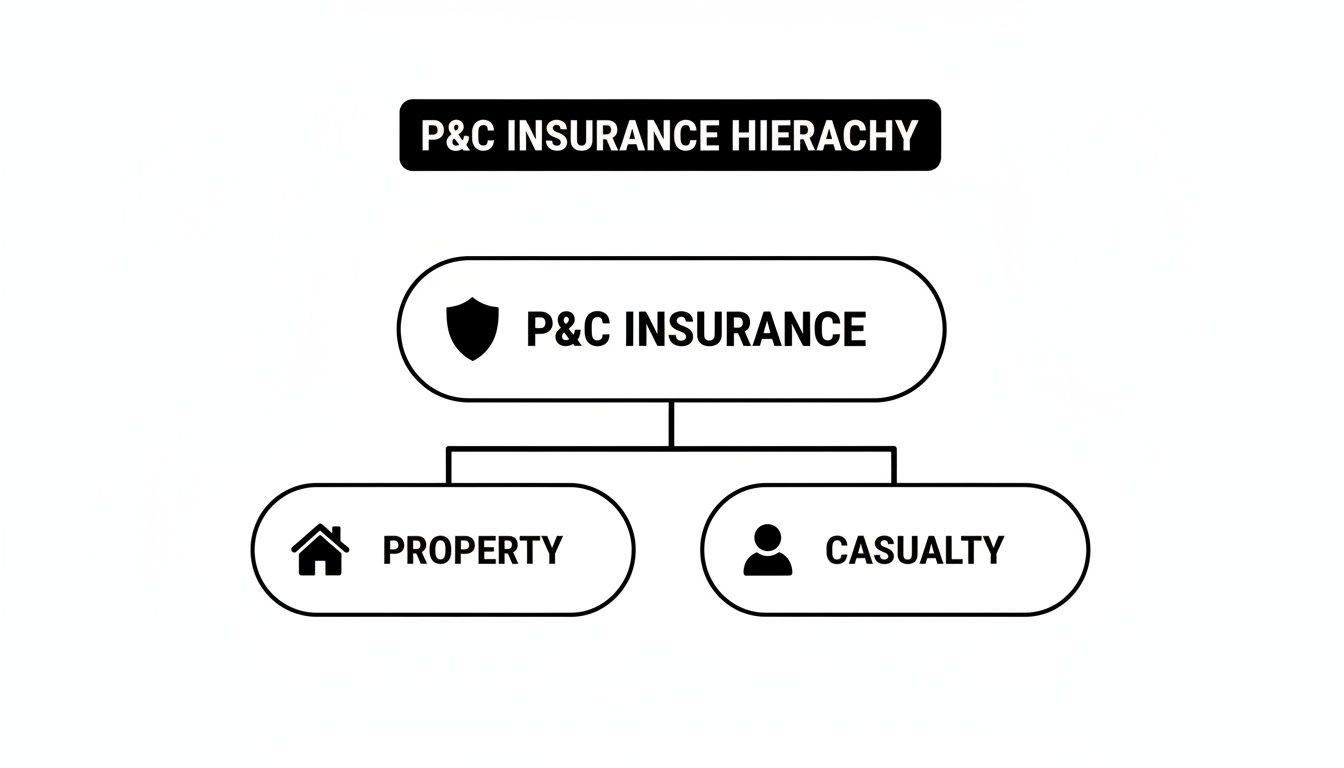
As you can see, it all comes down to two things: protecting your physical stuff (property) and protecting you from financial harm if you're held responsible for an accident (casualty). A good California insurance policy does both.
Your California Auto Insurance Policy Explained
Here in California, a standard auto insurance policy isn't one single thing—it's a package of different coverages, each designed to handle a specific risk.
- Liability Coverage: This is the foundation and the only part legally required by the state. It's not for you; it's for other people. If you cause an accident, this coverage pays for their medical bills and damage to their property.
- Collision Coverage: This is what pays to fix or replace your own car after an accident, whether you hit another vehicle or back into a pole. It applies no matter who was at fault.
- Comprehensive Coverage: Think of this as protection from everything else. It covers damage from non-collision events like theft, vandalism, fire, hail, or even a tree limb falling on your car during a storm.
A critical add-on every Californian should consider is Uninsured/Underinsured Motorist (UM/UIM) coverage. With a significant number of drivers on the road lacking adequate insurance, this coverage protects you by paying for your medical bills and car insurance repairs if you're hit by a driver with little or no insurance.
To get a better handle on picking the right limits and options, our guide on auto insurance in California goes into much greater detail.
Understanding Your Home and Renters Insurance
Your home insurance or renters insurance policy is built on the same principle: different parts working together to create a shield around your home, your belongings, and your financial life.
Key Coverages for Homeowners and Renters in California:
- Dwelling Coverage (Homeowners Only): This is the heart of a homeowner's policy. It covers the physical structure of your house—the roof, walls, and foundation. If a fire or another covered disaster hits, this provides the money to rebuild.
- Personal Property Coverage: This covers all your stuff. For both homeowners and renters, it protects your furniture, electronics, clothes, and other personal items from threats like theft or fire.
- Liability Protection: Just like with your car insurance, this covers you if someone is hurt on your property (think a slip-and-fall accident) or if you or a family member accidentally damage someone else's property. It helps pay for their injuries and your legal defense.
- Additional Living Expenses (ALE): This coverage is an absolute lifesaver. If your home becomes unlivable after a covered event like a wildfire or a major pipe burst, ALE pays for you to live somewhere else temporarily, covering costs like a hotel or rental.
When you're buying a home, it’s important to know the difference between your own policy and other protections like Lender's Title Insurance, which is designed to protect your mortgage lender's financial interest. By understanding each of these individual components, you can see exactly what you're paying for and make sure your P&C coverage truly fits your life in California.
Navigating California’s High-Risk Insurance Landscape
Anyone who lives in California knows it's a place of incredible beauty, but that beauty comes with a unique set of risks. Our stunning landscapes are also prone to some serious natural disasters, namely wildfires and earthquakes. It's a hard lesson to learn, but assuming your standard home insurance policy has you covered for these events can be a financially devastating mistake.
The reality of living here demands a smarter approach to California insurance. A typical policy is built for common problems like a kitchen fire or a break-in—not for a seismic event that shakes an entire region or a wildfire that sweeps through a whole community. Insurers view these as catastrophic risks, so they are almost always excluded from a standard policy. To be truly protected, you have to seek out separate, specialized coverage.

Why Wildfire and Earthquake Coverage Is Separate
It all comes down to how insurance companies manage risk. A standard home insurance policy works because the costs of isolated claims (like a burst pipe or a fallen tree) are spread across a large pool of policyholders. But a catastrophe is different. It causes massive, widespread damage all at once. If an insurer had to pay to rebuild thousands of homes after a major earthquake, the sheer volume of claims could put them out of business.
To stay solvent, they separate these high-impact events into specialized policies:
- Earthquake Insurance: This is almost always sold as a separate policy or an add-on (endorsement). It’s specifically designed to cover the immense cost of rebuilding your home, replacing your possessions, and covering living expenses if an earthquake forces you out.
- Wildfire Coverage: While a standard policy typically covers fire, the game changes in high-risk zones. Insurers may simply refuse to offer a policy at all, forcing homeowners to find other solutions built for wildfire-prone areas.
The financial scale of these disasters is staggering. In the first half of 2026, global insured losses from natural catastrophes soared to around $100 billion, with a huge portion of that damage right here in the United States. This trend, detailed in a mid-year industry analysis report, shows the growing strain on the property and casualty insurance market and directly impacts the cost and availability of California insurance for every homeowner.
The California Earthquake Authority (CEA)
For earthquake protection, most Californians rely on the California Earthquake Authority (CEA). The CEA is a not-for-profit, publicly managed organization that provides the vast majority of earthquake policies in the state. It was formed after the devastating 1994 Northridge earthquake, which caused so many losses that private insurers began pulling out of the market.
You don't buy a policy directly from the CEA. Instead, you get it through participating private insurance companies—often the same one that provides your homeowners or renters insurance. It's the go-to mechanism for protecting your home and finances from seismic damage.
What Is the California FAIR Plan?
As wildfires have grown more frequent and destructive, many traditional insurers have stopped writing new home insurance policies in areas they deem too risky. If you've received non-renewal notices or been denied coverage, it can feel like you've run out of options. That’s where the California FAIR Plan comes in.
The California FAIR Plan is a state-mandated insurance pool designed to be an insurer of last resort. It offers basic fire insurance to high-risk homeowners who can't get coverage on the open market. It’s not a government agency, but an association funded by all licensed property insurers in California.
However—and this is critical—it is not a replacement for a comprehensive home insurance policy. The FAIR Plan was created to be a basic safety net, and its coverage is extremely limited.
FAIR Plan Limitations:
- Fire Only: The basic policy only covers damage from fire, lightning, and internal explosions. It does not cover water damage, theft, or liability.
- No Liability: If a guest slips and falls on your property, the FAIR Plan will not cover their medical bills or your potential legal fees.
- No Theft Coverage: If your home is burglarized, the FAIR Plan provides no coverage for your stolen items.
- Limited Coverage Amounts: Payouts for both your dwelling and personal property are capped.
To fill these massive gaps, you have to buy a separate "Difference in Conditions" (DIC) policy from a private insurer. This secondary policy "wraps around" the FAIR Plan to add back essential coverages like liability and theft. Putting these two pieces together correctly creates a more complete solution, but it can be complex. Working with an experienced California insurance agent is the best way to make sure you're not leaving yourself exposed.
How California Insurance Rates Are Really Calculated
Ever wonder how your insurance premium gets decided? It can feel like a random number, but there's a real method behind it. For your property & casualty insurance, California carriers are essentially trying to predict the future—specifically, how likely you are to file a claim.
The great thing is, you have more control over this number than you might think. By understanding what really moves the needle on your auto insurance and home insurance rates, you can make informed choices that might just save you some serious money. Let’s pull back the curtain on how these crucial calculations actually work.
Key Factors Driving Your California Car Insurance Rates
When it comes to car insurance, California plays by its own set of rules. Unlike most other states, insurers here are not allowed to use your credit score to set your premium. Instead, the focus is squarely on factors that relate directly to your life on the road.
Primary Rating Factors for Car Insurance in California:
- Your Driving Record: This is, without a doubt, the biggest piece of the puzzle. A clean record free of accidents and tickets shows you're a low-risk driver, and you'll be rewarded with the best rates. On the flip side, a major violation like a DUI or an at-fault accident can send your premiums soaring for years.
- Annual Mileage: It’s a simple numbers game: the more you’re on the road, the higher the odds of an incident. We’ll ask for your estimated annual mileage, and a lower number—say, if you work from home—usually leads to a lower premium for your auto insurance.
- Years of Driving Experience: There's no substitute for time behind the wheel. A driver with 20 years of clean history is seen as a much safer bet than someone who just got their license.
A quick word of advice: always be upfront about these details. It might be tempting to lowball your mileage, but if an inaccuracy is discovered during a claim, it could lead to a denial or even have your policy canceled. Honesty is the foundation of a good relationship with your insurer.
What Determines Your Home and Renters Insurance Premiums
For home insurance or renters insurance, the calculation shifts to your property itself. Insurers look at everything from the studs in the walls to the zip code to figure out the risk of a potential claim and how much it might cost.
Here are some of the biggest factors we look at:
- Location, Location, Location: Your home’s specific address matters immensely. Is it in an area with a higher crime rate? More importantly in California, is it in a designated high-risk wildfire zone? Being near known hazards like earthquake fault lines or fire-prone hillsides will directly impact your rate for home insurance in California.
- Construction and Age: What your home is made of plays a huge role. A newer home built to modern code with fire-resistant siding will almost always be cheaper to insure than an older property with aging plumbing and electrical systems.
- Property Value (Replacement Cost): This isn't about what you could sell your house for; it's about what it would cost to rebuild it from the ground up. The higher the cost of materials and labor to replace your home and belongings, the higher your coverage needs to be, which in turn affects your premium.
- Protective Devices: Taking proactive steps to protect your home can pay you back. Installing a monitored security system, smoke detectors, or even just solid deadbolts on your doors can often earn you valuable discounts on your California insurance.
The Financial Power of Bundling Your Policies
Looking for one of the most straightforward ways to lower your California insurance costs? It’s called bundling. This just means you get multiple policies—like your auto insurance and home insurance, or even life insurance—from the same company.
Insurers love this kind of loyalty and reward it with multi-policy discounts that can often save you hundreds of dollars a year. Beyond the savings, it just makes life easier. You have one point of contact, one agency to call, and fewer bills to track. It's a smart way to build a complete financial safety net while keeping more money in your pocket.
Choosing the Right P&C Insurance Policy in California
Feeling overwhelmed by insurance options? You're not alone. When you’re faced with a sea of choices for auto insurance, home insurance, and even life insurance in California, trying to find the perfect fit can feel like putting together a complex puzzle. But it doesn't have to be so stressful.
Think of it as a step-by-step process. It's all about understanding what you really need, weighing your options intelligently, and getting smart about how you shop. Here’s a practical action plan to help you secure the right property & casualty insurance without the headache.

Assess Your Unique Risks
First things first: take a good, hard look at your life. The "right" policy is never a one-size-fits-all product; it's a plan built specifically around your situation. Anything less is a recipe for discovering dangerous coverage gaps when you can least afford them.
Start by asking yourself a few straightforward questions:
- What assets do I need to protect? Go beyond the obvious like your car insurance or home insurance. What about valuable jewelry, art, expensive home office equipment, or even your savings?
- What is my risk exposure? Do you have a long daily commute in heavy traffic? Is your home in a high-risk wildfire zone? Do you own a swimming pool or have a newly licensed teenage driver?
- What is my budget? Be realistic about your monthly premium, but also think about what you could truly afford to pay out-of-pocket if a disaster happened tomorrow.
Taking an honest inventory of your risks is the foundation of smart insurance shopping. It transforms you from a passive buyer into an informed consumer who knows exactly what kind of protection you need to ask for.
Insurers in California consider a property's unique risk profile when setting rates. Embracing proactive lossprevention strategies can show carriers you're a lower risk, which can sometimes help your premiums. By knowing your own risks, you can focus on getting the California insurance coverage that genuinely matters.
Understand the Deductible and Limit Trade-Off
Once you know what needs protecting, it's time to get into the nuts and bolts of the policy itself. Two key components—deductibles and limits—give you direct control over both your level of coverage and how much you pay for it.
- Deductible: This is your share of the cost that you pay out-of-pocket before your insurance coverage starts paying. Choosing a higher deductible usually leads to a lower monthly premium, but it means a bigger upfront expense if you need to file a claim.
- Coverage Limit: This is the absolute maximum amount your insurance company will pay out for a covered loss. Lower limits can definitely reduce your premium, but you could be personally on the hook for any costs that go above that limit after a major accident.
Finding the right balance here is deeply personal. It's a trade-off between your monthly budget and how much financial risk you’re comfortable taking on yourself. An independent agent can be a huge help here by modeling different scenarios to find your sweet spot.
The Power of Comparing Quotes
Here’s a golden rule of insurance shopping: never, ever accept the first quote you get. The California insurance market is incredibly competitive, and that works in your favor. Rates for the exact same coverage can easily vary by hundreds, or even thousands, of dollars from one company to the next.
The world's top 50 property and casualty insurers saw their collective revenues grow by 8.3% to $1.62 trillion in 2025, with State Farm holding its spot as the largest P&C underwriter. This massive market, especially in U.S. private auto insurance, creates a competitive landscape. For California homeowners and drivers, this means you have options. You can see a full global P&C insurer performance analysis to see how these trends affect the market.
This is where an independent agency like Mai & Associates really shines. Instead of you spending hours calling a dozen different companies, we do the heavy lifting for you. We instantly compare policies from multiple top-rated carriers to find the best blend of price and protection for your needs. With same-day quotes for auto insurance, home insurance, and renters insurance, and multilingual support, we make a confusing process feel simple and empowering. To learn even more, check out our collection of insurance guides.
Is Life Insurance Part of P&C Insurance
It’s a great question we hear all the time: "Where does life insurance fit into my protection plan?" It's easy to get them mixed up, but the answer is simple: life insurance is not part of property & casualty insurance. However, it’s just as essential for a complete financial safety net.
The two types of California insurance are designed to solve completely different problems. The easiest way I explain it to clients is this: property & casualty insurance is all about protecting you and your things while you're here. It gets your car back on the road, rebuilds your home after a disaster, and protects your assets from a lawsuit. Its entire job is to put you back where you were before something went wrong.
Protecting Your Stuff vs. Protecting Your People
Life insurance has a totally different mission. It's designed to protect your family and loved ones after you're gone. It creates a financial cushion to help them manage without your income. While P&C is guarding your physical assets, life insurance in California is guarding your family’s future.
At its core, the difference is that simple:
- Property & Casualty Insurance: Protects your things (like your home and car insurance) and your wallet (from liability).
- Life Insurance: Protects your people (your family’s ability to live and thrive financially).
A solid financial plan absolutely needs both. Without P&C coverage, a single house fire or car insurance claim could drain your savings in an instant. But without life insurance, your family could be left struggling to pay the mortgage, cover everyday bills, or save for goals like college.
Creating a Complete Financial Shield
Even though they're separate products, these policies work hand-in-hand to build a wall of security around your family. Think of your auto and home insurance as the policies that protect your lifestyle today. Life insurance is the policy that ensures your family can maintain their lifestyle tomorrow.
When you see these policies as two sides of the same mission—protecting your present and securing your future—you start to build a financial plan that truly covers all your bases.
One of the biggest advantages people miss out on is bundling. Just like you can get great discounts by combining your home and auto insurance, adding a life insurance policy with the same agency can often unlock even more savings. More importantly, it makes your life so much easier.
Having a single, trusted agent for all your coverage means you can review everything at once, spot gaps, and make adjustments as your life changes. If you want to see how this could work for you, our team can show you your options for life insurance in California and how it integrates with your existing P&C policies. It's the most efficient way to make sure you're truly covered from every angle.
We've covered the big picture of property and casualty insurance, but you probably still have some questions. That’s completely normal. California insurance can feel complex, and getting straight answers is the only way to feel confident about your coverage.
Let's dive into some of the most common questions we hear from our clients right here in California.
How Much Car Insurance Am I Required to Have in California?
California law has a set minimum for liability auto insurance you must carry to drive legally. It’s the absolute floor, not a recommended level of coverage.
The current state minimums are:
- $15,000 for injuring or causing the death of one person.
- $30,000 for injuring or causing the death of more than one person in an accident.
- $5,000 for damage you cause to someone else’s property.
Here's the honest truth from an agent's perspective: these limits are dangerously low. Think about the cost of new cars and medical care in California. That $5,000 for property damage might not even cover a bumper on a modern vehicle. A serious accident could easily blow past these minimums, leaving you on the hook for tens or even hundreds of thousands of dollars. We almost always recommend carrying significantly higher limits to properly protect your savings and future earnings with your car insurance in California.
What Is an Insurance Deductible and How Does It Work?
Simply put, a deductible is your share of the cost when you file a claim. It’s the amount you agree to pay out of your own pocket before your insurance policy kicks in to cover the rest.
Let's say you have a $1,000 deductible for your auto insurance. If you have a covered accident that results in $5,000 worth of repairs, you pay the first $1,000, and your insurance company handles the remaining $4,000. The same idea applies to claims on your home insurance or renters insurance.
You can often lower your monthly premium by choosing a higher deductible. Just remember it's a trade-off. You need to be sure you can comfortably pay that higher amount if you ever have to make a claim.
Does My Credit Score Affect My Insurance Rates in California?
This is a great question, and the answer depends on the type of California insurance.
For car insurance, the answer is a clear no. California is one of the few states that bans insurers from using your credit score to calculate your premium. Instead, they focus on factors directly related to risk on the road, like your driving record, the miles you drive each year, and your years of driving experience.
When it comes to home insurance or renters insurance, the rules are different. Some insurance companies may look at a credit-based insurance score as one of many factors when setting your rates.
It also helps to understand the larger forces at play. The global P&C insurance market is massive and always changing. In 2025, worldwide premiums reached €2,424 billion, growing 7.7% in a single year. North America is a huge part of that, with +8.2% growth and making up over half the global market. As things like urbanization and population changes reshape property and liability risks, the industry has to adapt. If you're curious, you can read more about these global insurance trends to see how the market is evolving.
At Mai & Associates, our job is to make all of this simple. We give you clear answers and shop the top carriers to find the right protection for your specific needs and budget. Whether it's for your car, home, or future, we're here to help you get covered with confidence. Get a no-obligation quote by visiting us at https://cahomeauto.com.