Understanding Personal Property Coverage in California
When you think about your California home insurance, your first thought is probably about the house itself—the roof, the walls, the foundation. But what about everything inside? That's where personal property coverage comes in, and it’s one of the most crucial parts of your California home insurance, renters, or condo policy.
This coverage is your financial backstop for all your stuff—the sofa you relax on, the laptop you work from, the clothes in your closet, and even the pots and pans in your kitchen. It's designed to protect your belongings from a whole host of problems, like theft, fire, or a nasty windstorm, providing a critical safety net alongside your auto insurance and other policies.
Your Possessions Under a Protective Bubble
Think of your personal property coverage as an invisible, protective bubble that surrounds your belongings. It doesn't just cover them when they're safely tucked away at home. This protection often follows them when you travel, so if your laptop gets swiped from your car or your luggage is stolen from a hotel room, you're not completely out of luck.
Let's say a kitchen fire ruins your appliances and fills your living room with smoke, or a thief breaks in and makes off with your expensive electronics. This is exactly when your personal property coverage kicks in. It provides the money to help you repair or replace what was lost, which is absolutely critical for getting back on your feet after a disaster in California.
Given that property damage and theft make up a staggering 97.3% of all homeowners insurance claims filed in the U.S., it’s easy to see why this coverage isn't just a "nice-to-have." It's an essential piece of your overall financial protection, just like auto insurance or life insurance.
To give you a clearer picture, here’s a quick breakdown of what personal property coverage is all about.
Personal Property Coverage at a Glance
| Covered Items | Protected Events (Perils) | Where It Applies |
|---|---|---|
| Furniture, electronics, clothing, jewelry | Fire, theft, vandalism, water damage | Inside your home |
| Appliances, kitchenware, home décor | Windstorms, lightning strikes, smoke | In your car or with you while traveling |
| Sporting goods, tools, books, art | Explosions, damage from aircraft/vehicles | In a storage unit (limits may apply) |
This table is just a snapshot, but it shows how this coverage helps you recover the tangible parts of your life after a loss.
What Does This Coverage Typically Include?
So, what exactly falls under this protective umbrella? A good rule of thumb is to think about everything you’d take with you in a move.
Here's a look at what most standard home insurance and renters insurance policies cover:
- Furniture: Your couches, tables, beds, desks—all the big stuff.
- Electronics: TVs, computers, tablets, and smartphones.
- Clothing & Accessories: Everything from your work wardrobe to shoes and handbags.
- Appliances: Any appliance that isn't built-in, like your microwave or coffee maker.
- Household Goods: Kitchenware, linens, rugs, and all the decorative items that make a house a home.
The core purpose of personal property coverage is to restore your day-to-day life after a covered disaster by providing the funds to replace the essential and cherished items you’ve lost.
Why It Is a Non-Negotiable for Californians
Living in California comes with a unique set of risks, from city break-ins to the ever-present threat of wildfires. This makes having solid personal property coverage as part of your home insurance or renters insurance non-negotiable.
While it's a standard part of most policies, how much you get isn't one-size-fits-all. For homeowners, this limit is often calculated as a percentage of your home's structural coverage—typically between 50% and 70%. If you're a renter, you'll need to choose a specific dollar amount based on a careful estimate of what your belongings are worth.
Getting these details right is the first step toward real peace of mind. When you know your policy accurately reflects the value of your possessions, you can feel confident that you’re prepared for whatever comes your way in California.
What Your California Insurance Policy Actually Covers and Excludes
Think of your personal property coverage as a rulebook for your stuff. It spells out exactly what's protected and, just as importantly, what isn't. Knowing these rules before you need to make a claim can save you a world of headaches and financial pain.
At a high level, this coverage is for the things that make your house a home. We're talking about your sofa, the TV, your clothes, the kitchen gadgets—all the movable items you own. If a fire, a break-in, or another covered disaster strikes, your home insurance or renters insurance policy is designed to help you get back on your feet by replacing these belongings.
But the devil is in the details. The real question isn't just what is covered, but how it's covered. This all comes down to whether your policy is based on "named perils" or "open perils." It's a critical difference for any California homeowner or renter.
Named Perils vs Open Perils Policies
A named perils policy is like a VIP list for disasters. If a specific event, or "peril," is on the list in your policy documents, your stuff is covered. If it's not on the list, you're out of luck.
Common named perils usually include things like:
- Fire and lightning
- Theft and vandalism
- Windstorm and hail
- Damage from the weight of ice or snow
- Sudden and accidental water damage from burst pipes
On the flip side, an open perils policy (sometimes called "all-risk") works in reverse. It covers damage from any cause, unless that cause is specifically written on the exclusion list. This offers far broader protection because it can cover strange, one-off events you'd never think to list.
The Bottom Line: An open perils policy is generally the stronger choice for your personal property. It flips the script—instead of you having to prove a loss was caused by a covered event, the insurance company has to prove it was caused by an excluded one.
This diagram helps show where your personal property fits into the bigger insurance picture.
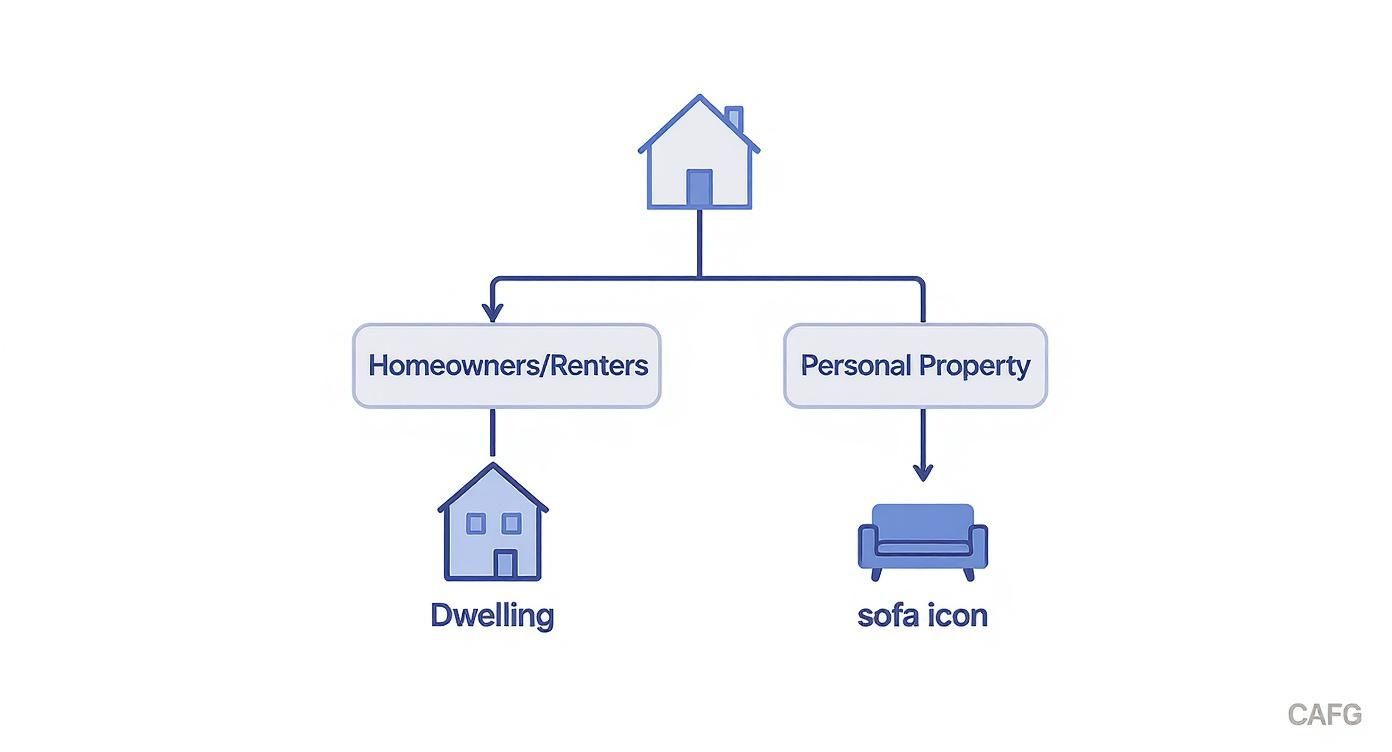
As you can see, your belongings are a separate category from the structure of your home (the dwelling), and that's why they need this specific type of protection within your California insurance plan.
Common Exclusions and Special Limits
Even the most comprehensive policies have their limits. Understanding the exclusions is just as crucial as knowing what's covered. Certain disasters are almost universally excluded from standard home and renters insurance policies here in California.
The big ones to watch out for are:
- Floods: Damage from rising water isn't covered. You need a separate flood insurance policy for that.
- Earthquakes: Shaking and other "earth movement" is a standard exclusion. This requires its own dedicated earthquake policy.
- Neglect or Wear and Tear: Insurance is for sudden and accidental events, not for things that break down from old age or lack of maintenance.
- Pest Infestations: Damage caused by termites, rodents, or other pests is typically not covered.
Beyond these major exclusions, you need to be aware of special limits, or sub-limits, placed on high-value items. This is where many people get a very unwelcome surprise after a loss.
For instance, your policy might have a $1,500 sub-limit for the theft of jewelry. If a burglar steals your $10,000 engagement ring, the policy will only pay out $1,500. That's it. You're left covering the remaining $8,500 yourself. Similar caps often apply to firearms, fine art, collectibles, and even cash. This is a vital detail for anyone to check, especially when looking at renters insurance in California, where valuable collections can be stored in one place.
To properly protect these items, you'll need to add an endorsement to "schedule" them for their full, appraised value. We'll dig into that more later, but knowing about these limits now is the first step to making sure your coverage is truly up to the task.
How Your Insurance Values Your Belongings
When it's time to file a claim for something that's been damaged or stolen, your insurance company won't just hand over a blank check. They have a specific method for calculating what your stuff is actually worth, and this formula is one of the most important—and often misunderstood—parts of your personal property coverage.
The valuation method written into your policy directly controls how much money you’ll get back. This choice can be the difference between getting enough cash to buy a brand-new replacement or just a small fraction of what you truly need. For Californians especially, this isn't a small detail; it’s a critical decision that defines your financial safety net. It all boils down to two very different approaches: Actual Cash Value and Replacement Cost.
Actual Cash Value (ACV)
Think of Actual Cash Value (ACV) as the "garage sale" price of your belongings. It pays you for what your item was worth the moment before it was lost. The formula is simple: Replacement Cost - Depreciation = ACV.
Depreciation is the value your item loses over time due to age, wear and tear, or just becoming outdated. A five-year-old laptop, for instance, is worth a lot less today than when you first bought it. Policies with ACV usually have lower premiums, but the smaller payout can be a real shock when you're trying to buy new items at today's prices.
Replacement Cost (RCV)
Replacement Cost (RCV) is much more what people expect from their insurance. This coverage gives you the money to buy a new, similar item at its current price. It completely ignores depreciation. The goal here isn't to pay you for your old stuff; it's to make you whole again.
While RCV policies cost a little more, the peace of mind is enormous. You won't have to raid your savings to cover the difference between what your old TV was worth and what a new one costs. This is exactly why we almost always recommend Replacement Cost coverage for homeowners and renters here in California.
Your policy’s valuation method is the rulebook for your reimbursement. RCV aims to restore your lifestyle by replacing your old items with new ones, while ACV simply pays you for the used value of what you lost.
Let's break this down with a real-world example to see just how different the outcomes can be.
Imagine someone steals your five-year-old laptop. You originally paid $1,500 for it, and a new, comparable model today still costs $1,500. Because of its age, your insurance company calculates that your old laptop had depreciated by $1,200.
Here’s a side-by-side look at how ACV and RCV would handle the claim.
Actual Cash Value (ACV) vs. Replacement Cost (RCV)
| Valuation Method | How It Works | Example Payout | Best For |
|---|---|---|---|
| Actual Cash Value (ACV) | Pays for the new cost minus depreciation. ($1,500 - $1,200) | $300 | Budget-focused individuals who can cover the replacement gap themselves. |
| Replacement Cost (RCV) | Pays the full cost to buy a new, similar item. | $1,500 | Anyone wanting to fully recover financially without out-of-pocket costs. |
As you can see, the difference in the payout is a massive $1,200. With an ACV policy, you're on the hook for finding that extra cash just to get back on your feet. With RCV, your insurance gives you the funds you need to do it. Making the right choice on your personal property coverage valuation is the key to ensuring you can actually rebuild after a disaster.
A Practical Guide to Creating Your Home Inventory
Knowing how an insurance company values your stuff is one thing, but proving what you owned in the first place? That's the real challenge.
Imagine trying to remember every single item in your home after a devastating California wildfire. It’s an impossible, heartbreaking task. This is exactly why a home inventory is the single most powerful tool you have for getting the most out of your personal property coverage within your home insurance or renters insurance policy.
A good inventory turns a gut-wrenching emotional process into a simple business transaction. It’s your proof. Without it, you're just guessing, and you could be leaving thousands of dollars on the table. Honestly, the mental strain is so intense that many people just give up and accept whatever the insurance company offers first—which is often far less than what they’re truly owed.
Don't let that happen to you. Creating a home inventory is easier than ever, and it's the best investment you can make in your own financial recovery.

Modern Methods for a Simple Inventory
You can forget about tedious pen-and-paper lists. Today’s tech makes creating and storing your inventory fast, simple, and completely secure.
- Use a Dedicated App: Apps like Encircle or Sortly are built for this. They walk you through the process, letting you snap photos, scan barcodes, and upload receipts right from your phone. It’s incredibly efficient.
- Take a Video Tour: This is often the easiest and best way to start. Just walk through your house with your smartphone and record everything. Open closets, pull out drawers, and scan the contents of every cabinet. Talk while you record—describe what you’re seeing, like, "This is our 4K TV we bought last year for about $800."
- Create a Photo Album: Go room by room and take clear, well-lit pictures. Start with wide shots of the entire room, then zoom in on valuable items like electronics, furniture, art, and appliances. Pro tip: always get a shot of the serial number on the back of your electronics.
Think of your home inventory as the ultimate receipt for your entire life's possessions. It’s the concrete evidence that backs up your claim and ensures you get the full, fair settlement you're entitled to.
What to Document for Maximum Impact
A detailed inventory is a strong inventory. The more information you provide, the smoother the claims process will be. For your most significant items, try to capture these details:
- Description: A quick note is fine (e.g., "Brown leather sectional sofa").
- Brand and Model/Serial Number: Absolutely essential for appliances and electronics.
- Purchase Date and Price: Dig up old receipts or check your credit card statements if you can.
- Estimated Replacement Cost: A quick Google search can give you a good idea of what it costs today.
- Photos or Video: Visual proof is everything. It's non-negotiable.
And don't just focus on the big-ticket items! The value of your clothes, kitchen gadgets, books, and tools adds up faster than you can imagine. These "small things" often make up a huge chunk of a personal property coverage claim. For more practical advice, you can check out our comprehensive insurance guides at https://cahomeauto.com/guides.
Storing Your Inventory Safely
An inventory is worthless if it burns down with your house. Saving it to your desktop computer is a recipe for disaster. You need a secure, off-site way to store it.
- Cloud Storage: This is your best bet. Upload everything—videos, photos, spreadsheets—to a service like Google Drive, Dropbox, or iCloud. It’s secure, you can access it from anywhere, and it's completely safe from physical disasters.
- Email it to Yourself: A super simple method is to just email the files to yourself and maybe a trusted family member for good measure.
- Physical Copy Off-Site: If you're old-school and prefer a hard copy, put a USB drive or printed list in a safe deposit box or leave it at a relative's house.
Taking one afternoon to create your inventory is a small task with a massive payoff. It puts you in control of the claims process, cuts down on stress when you need it most, and makes sure your California insurance policy does what it's supposed to do: make you whole again.
Navigating California's Unique Insurance Challenges
Living the California dream comes with a unique set of risks that can turn that dream into a nightmare if you're not prepared. Standard home insurance or renters insurance policies often fall short when faced with the state’s biggest threats—wildfires, earthquakes, and even urban theft.
Simply having insurance isn't the same as having the right insurance. The insurance world is reacting to our changing climate, and it's getting tougher and more expensive to secure good coverage. The global property and casualty insurance market has ballooned to roughly $2.4 trillion, largely because of the increasing cost of disasters like the wildfires we've come to know all too well. This financial pressure means higher premiums and fewer options for many Californians. You can get a broader perspective by reading up on global P&C insurance market trends.
When it comes to protecting your home and belongings, a proactive approach isn't just a good idea; it's your best defense.
The Growing Threat of Wildfires
For anyone living outside the major city centers, the threat of wildfire is a constant, lingering worry. The good news is that a standard home insurance or renters insurance policy does cover fire damage, including the loss of your personal belongings. The bad news? In areas now labeled as "high-risk," many insurance companies have simply stopped writing new policies, leaving homeowners in a tough spot.
This is where the California FAIR Plan becomes essential. Think of it as the insurer of last resort, a state-mandated program that provides a safety net when you can’t get basic fire coverage anywhere else.
But you have to know what you're getting with the FAIR Plan:
- It Covers the Basics: It’s designed to protect your home and personal property from fire, lightning, and internal explosions.
- It's Not a Complete Policy: The FAIR Plan does not cover common risks like theft, liability, or a burst pipe. To get that crucial protection, you'll need to buy a separate "Difference in Conditions" (DIC) policy to wrap around it and fill in the gaps.
Getting set up with the FAIR Plan can feel a bit complicated, but for thousands of Californians in high-risk zones, it's the only lifeline available to protect their personal property from a wildfire.
Earthquakes: The Critical Exclusion
Let this sink in: your standard home, condo, or renters insurance policy will not cover earthquake damage. This is, without a doubt, the single most significant and widely misunderstood gap in coverage for Californians. An earthquake can level your home and destroy everything you own in seconds, and without a specific earthquake policy, you won't see a dime for your personal belongings.
To protect your stuff from the violent shaking of a quake, you must buy a separate earthquake insurance policy. Most people get this through the California Earthquake Authority (CEA) or a private carrier. This policy is built from the ground up to cover your house, your personal property, and the cost of living elsewhere while you rebuild.
In California, assuming your home insurance policy has you covered for an earthquake is a potentially catastrophic financial mistake. It's a separate risk that demands its own dedicated policy.
Protecting Your Property in Urban Areas
Beyond the major natural disasters, theft is a real and persistent risk, especially in our denser cities. Your personal property coverage is your financial backup after a break-in, but a little prevention goes a long way. Things like security systems, solid deadbolts, and a safe for your most precious items can not only deter thieves but also sometimes earn you a small discount on your premium.
More importantly, this is where a detailed home inventory proves its worth. After a theft, you’re not just dealing with the emotional violation; you’re also facing a claims process. An inventory gives the police a detailed list of what was taken and provides your insurance adjuster with the concrete proof they need to settle your claim quickly and fairly. It's how you make sure your California insurance policy can do its job when you need it most.
How to File a Personal Property Claim
Dealing with the aftermath of a fire or a burglary is incredibly stressful. Your head is spinning, and it's hard to know where to even begin. But knowing what to do right away can make a world of difference in getting your life—and your finances—back on track. Filing a personal property coverage claim doesn't have to be another source of anxiety if you know the steps.
It's no surprise that the global personal property insurance market was valued at around USD 1,163.85 billion back in 2021 and has only grown since. This isn't just a number; it represents millions of families looking for a financial safety net when disaster strikes. You can read more about the home insurance market at Straits Research to see just how crucial this protection has become.
Before you do anything else, make sure you and your family are safe. Once the immediate danger has passed, you can start tackling the claim with a clear mind.
Your Immediate Action Plan
Before you even pick up the phone to call your agent, a few immediate actions will set the stage for a much smoother claims experience. Think of these as the foundation for getting a fair and fast settlement.
Stop the Bleeding & Secure the Property: If it’s safe, do what you can to prevent things from getting worse. This could mean boarding up a smashed window after a break-in or throwing a tarp over a fire-damaged roof to keep the rain out. Hang on to every single receipt for these temporary fixes—they're usually covered by your policy.
Become a Crime Scene Photographer: Your smartphone is your best friend right now. Take photos and videos of everything. Get wide shots of the rooms to show the overall extent of the damage, then move in for close-ups of every single damaged or destroyed item. Visual evidence is powerful and much more compelling than just a written list.
Call the Authorities: If a crime was committed—theft, vandalism, you name it—file a police report right away. Your insurance company will ask for the report number or a copy. It’s the official record of what happened and when.
Navigating the Claims Process
With your initial evidence gathered, it's time to officially get the ball rolling with your insurance company. This is all about clear communication and giving them the proof they need to understand and value your loss.
This is where that home inventory you created becomes your MVP. It’s the detailed proof—the what, when, where, and how much—that the insurance adjuster needs. Here in California, there's been talk about making it easier for wildfire survivors to get paid without a complete list, but for now, having that inventory is absolutely essential for your home insurance or renters insurance claim.
An adjuster's job is to verify your loss. When you hand them a detailed inventory, clear photos, and a police report, you're not just helping them—you're helping yourself get paid faster.
The adjuster will take all your documentation, inspect the damage in person if needed, and check it against your policy. They’ll be looking closely at your personal property coverage limits and whether you have ACV or RCV. From there, they’ll put together a settlement offer.
Don't just accept the first offer without looking it over carefully. If the number feels low, you have every right to ask them to walk you through how they calculated it. You can push back with your own evidence, like repair estimates from contractors or printouts from websites showing the cost to replace your destroyed items. Stay organized, be persistent, and you’ll be in the best position to receive the full amount you're entitled to.
Your Personal Property Questions, Answered
Insurance policies can feel complicated, and it's only natural to have questions. We get a lot of them about personal property coverage, so we've put together some straightforward answers to the most common ones we hear from our California clients.
Getting these details right is crucial for making sure your home insurance, renters insurance, or even your auto insurance policy has you properly protected. Let's tackle some of the biggest head-scratchers.
Is My Laptop Covered if It's Stolen From My Car?
Yes, it almost always is. This is a classic "what if" scenario that confuses a lot of people. Your personal property coverage isn't just for things inside your house; it includes what insurance pros call “off-premises” protection.
So, if a thief smashes your car window and grabs your laptop, your homeowners or renters policy is what you'll turn to for the stolen computer. Your car insurance would handle the broken window under its comprehensive coverage, but not the items inside.
Just be aware of two key things: Off-premises coverage is often capped at 10% of your total personal property limit, and your policy deductible will still apply.
How Much Personal Property Coverage Do I Really Need?
There isn't a single magic number, but we have some solid guidelines. For homeowners in California, a good rule of thumb is to set your personal property limit at 50% to 70% of your home's dwelling coverage.
For renters, the best approach is to actually sit down and create a home inventory. It might sound tedious, but it's the only way to know for sure what it would cost to replace everything you own.
Most of us are shocked when we add it all up. Your clothes, furniture, electronics, kitchen gadgets... it accumulates fast. When in doubt, it’s far better to be a little over-insured than to find yourself short after a total loss.
What Is a Scheduled Personal Property Endorsement?
Think of a scheduled personal property endorsement as a VIP pass for your most valuable items. It’s an add-on (or "rider") to your policy that gives special treatment to things like fine art, jewelry, or high-end collectibles.
Your standard policy puts strict, low limits on these items—often just $1,500 for your entire jewelry collection. Scheduling an item insures it for its full, appraised value. If you're curious about other insurance terms, our California insurance glossary is a great resource.
But here’s the best part: an endorsement doesn't just raise the dollar amount. It often expands what's covered. For example, a scheduled ring is typically covered for accidental loss (like if it slips off your finger and disappears), something a basic policy won't touch.
Figuring out the ins and outs of personal property coverage is a lot simpler when you have an expert in your corner. The licensed agents at Mai & Associates are here to look over your current California home insurance, renters insurance, or auto insurance policy, spot any gaps, and find the right protection for your budget. Contact us today for a free, no-obligation quote and policy review.