Your Guide to Personal Auto Insurance in California
Let's face it, driving in California is unlike anywhere else. You've got sprawling freeways, tight city streets, and scenic but tricky backroads. Think of personal auto insurance as your financial co-pilot for that journey, a crucial part of your overall California insurance strategy.
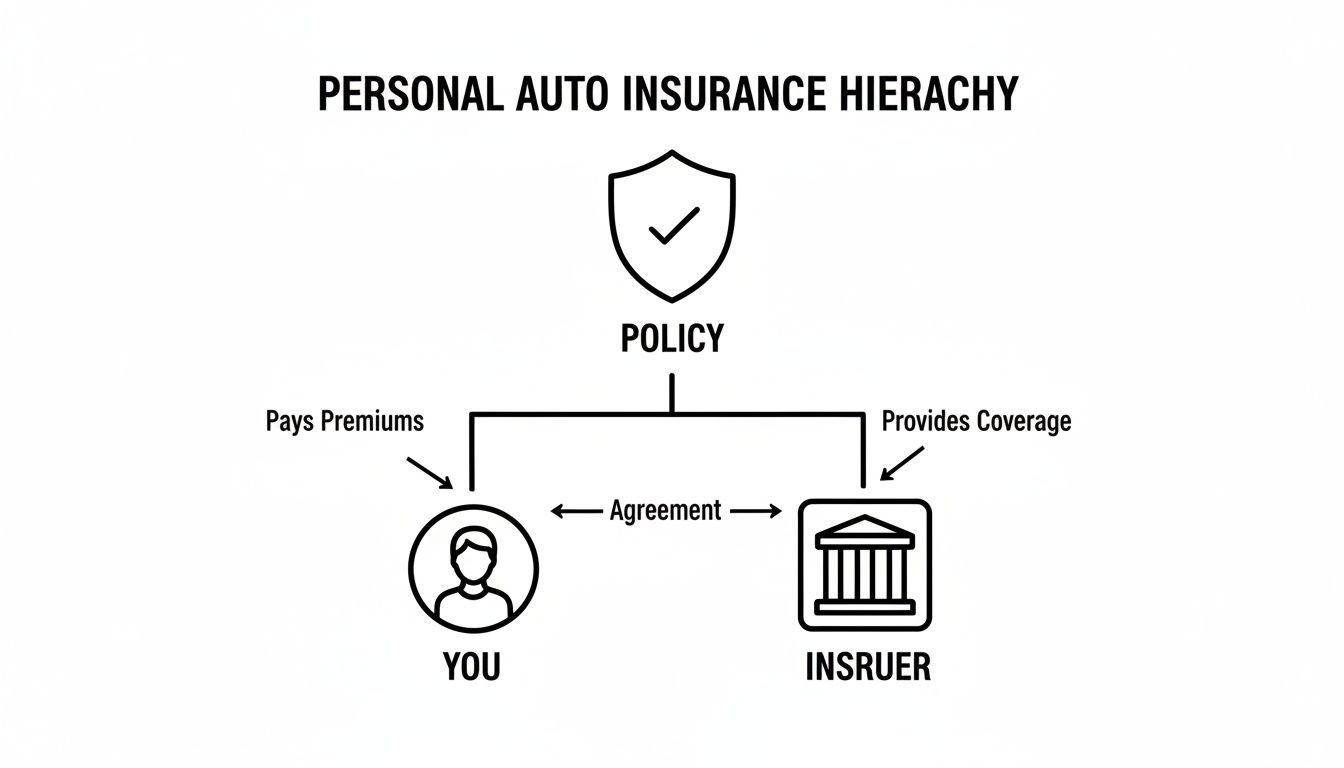
At its core, auto insurance is a simple agreement. You pay a regular fee (your premium) to an insurance company. In return, they promise to step in and cover specific costs if you get into an accident or something else happens to your car. It’s not just about ticking a legal box; it's about protecting yourself from the financial fallout of a bad day on the road.
Why Do I Really Need Car Insurance in California?
Imagine causing a fender bender on the 405 during rush hour. Without the right car insurance, you'd be on the hook for everything—the other driver's car repairs, their medical bills, and maybe even legal fees. A single accident could put your savings, your home, and your financial future at risk. It’s a heavy burden to carry alone.
With nearly 36 million vehicles registered in the state, the odds of an incident are very real. A solid personal auto insurance policy acts as a financial shock absorber, taking the hit so your life doesn't get thrown off course. It’s a smart investment in your own peace of mind.
To make this crystal clear, here’s a quick breakdown of what a policy really does for you.
California Personal Auto Insurance at a Glance
This table simplifies the main ideas behind a personal auto policy, so you can see how the pieces fit together.
| Concept | What It Means for You | Why It Matters in California |
|---|---|---|
| Premium Payment | The regular fee (monthly or yearly) you pay to keep your policy active. | This predictable cost prevents you from facing a massive, unpredictable expense after an accident. |
| Coverage Limits | The maximum amount your insurer will pay for a specific type of claim (e.g., $50,000 for bodily injury). | With high repair and medical costs in CA, choosing the right limits is key to being fully protected. |
| The Agreement | Your policy is a legal contract that transfers the risk of a large financial loss from you to the insurer. | It gives you legal and financial backing on some of the busiest and most expensive roads in the country. |
Essentially, the whole system is built on a trade-off. You pay a small, manageable premium to avoid a potentially devastating bill down the line.
An insurance policy shifts the burden of a large, uncertain loss from you to the insurance company. Instead of facing a potential $50,000 liability claim on your own, you pay a predictable premium to have an insurer step in and cover it for you.
This isn't just a California thing. It's a fundamental part of modern life. The global automobile insurance market is expected to surge from USD 940.4 billion in 2025 to over USD 1,276.1 billion by 2035, which shows just how crucial this protection has become worldwide.
Your Partner in Protection
Trying to figure out California insurance—from auto insurance and home insurance to renters insurance and even life insurance—can feel overwhelming. How do you know you're getting the right coverage without overpaying? This is where working with an independent agent makes all the difference.
Instead of calling a dozen different companies yourself, an agent does the legwork for you. They shop the market, compare policies from multiple carriers, and find the one that truly fits your life and budget. Our comprehensive guide to auto insurance in California dives deeper into how this works.
At Mai & Associates, our job is to make this easy. We provide clear, multilingual support and can get you quotes the same day you call. We want to turn a confusing process into a simple, confident decision, helping you see insurance not as a burden, but as the essential tool it is for protecting your financial future.
What's Really Inside Your California Auto Insurance Policy?
Think of your personal auto insurance policy less like a single product and more like a customized toolkit. Each tool—or "coverage"—is designed to fix a different financial problem that can pop up after a car accident. Knowing what each tool does is the first step to building a policy that actually has your back on California's busy roads.
At its core, your policy is just an agreement between you and an insurance company. That agreement bundles together the specific coverages you choose to create your financial shield.
Let's break down what that shield is made of, starting with the one piece everyone must have.
The Foundation: Liability Coverage
Liability is the non-negotiable part of every car insurance policy in California. It's not for you—it’s for everyone else. If you cause an accident, liability coverage pays for the injuries and property damage you inflict on other people. A solid understanding of what liability insurance covers is ground zero for any driver.
Liability is split into two key parts:
- Bodily Injury Liability (BI): This is for people. It covers the medical bills, lost income, and even pain and suffering for anyone you injure in a crash.
- Property Damage Liability (PD): This is for stuff. It pays to repair or replace the other driver's car, or anything else you might hit, like a fence, a light pole, or a garage door.
California law mandates minimum liability limits, known as 15/30/5. This shorthand translates to:
- $15,000 for injury to one person.
- $30,000 total for all injuries in one accident.
- $5,000 for all property damage.
A Word of Warning on State Minimums: Relying on the state minimum is a huge gamble. A $5,000 property damage limit won't even cover a fender bender on most modern cars. Imagine you cause a collision that totals a $40,000 SUV. Your insurance pays its $5,000 limit, and you're on the hook for the remaining $35,000. That's a life-altering bill.
Protecting Your Own Ride: Collision and Comprehensive
While liability protects others, these next two coverages are all about protecting your own car. If you have a car loan or lease, your lender will almost certainly require them.
- Collision Coverage: This is your "oops" coverage. It pays to fix or replace your car if you get into an accident, no matter who was at fault. It applies whether you hit another vehicle, a pole, or even just roll your car.
- Comprehensive Coverage: Think of this as the "life happens" coverage. It handles almost everything besides a collision. This includes theft, vandalism, fire, cracked windshields, hitting a deer, or damage from a storm. If your car is stolen or a tree branch smashes your roof, comprehensive is what you’ll use.
Together, Collision and Comprehensive are the one-two punch that protects the value of your vehicle. You can find simple definitions for these and other key terms in our handy California insurance glossary.
Filling the Gaps: Other Key Protections
A few other coverages address some very common—and very expensive—scenarios you might face on the road. They fill critical gaps left by standard liability and physical damage policies.
Uninsured/Underinsured Motorist (UM/UIM) Here's a scary truth: despite the law, a significant number of California drivers have no insurance or not nearly enough. If one of them hits you and you're injured, this coverage becomes your lifeline. It steps in and acts like the at-fault driver's insurance, paying for your medical bills and, depending on your policy, lost wages.
Medical Payments (MedPay) This one is simple: it helps pay medical bills for you and your passengers after an accident, regardless of who is at fault. MedPay is great for covering immediate costs like ambulance rides, health insurance deductibles, and co-pays, so you can get treated without worrying about the upfront expense. It’s an affordable add-on that provides a fantastic layer of protection, especially for those who also have home insurance or life insurance and want a complete financial safety net.
How Your California Car Insurance Rate Is Calculated
Have you ever looked at your car insurance bill and wondered where that number actually comes from? It’s not just pulled out of thin air. Think of it less like a fixed price tag and more like a personalized score based on your unique circumstances. Every detail about you, your car, and your driving habits helps the insurance company calculate the risk of insuring you, which in turn determines your premium.
Once you understand what goes into this calculation, you can start to see where you have control. More importantly, you'll see how a good insurance agent can find savings you might have missed. Let's break down exactly how carriers build your price.
Your Personal Driving Profile
The first thing an insurer looks at is you. Your driving history is the single biggest clue they have to predict your future behavior on the road.
- Your Driving Record: This is the big one. A history of at-fault accidents, speeding tickets, or other moving violations flags you as a higher risk. On the flip side, a clean record is your best asset, opening the door to lower car insurance rates and significant "Good Driver" discounts.
- Your Driving Experience: How many years have you been licensed? In the eyes of an insurer, experience matters. A driver who has been on the road for decades is statistically less likely to file a claim than a teenager who just got their license.
Think of your driving record as the story of your life behind the wheel. Every accident or ticket is a chapter suggesting you might cost the insurer money in the future. A long, quiet story builds trust and earns you a much better rate.
Your Location and Vehicle Details
Next, insurers zoom in on the specifics of what you drive and where you drive it. These factors paint a picture of the everyday risks your car faces.
Where You Live and Drive Your home ZIP code plays a surprisingly large role in your California insurance premium. If you live in a dense urban center like Los Angeles, you’re surrounded by more traffic, theft, and vandalism. That means you’ll likely pay more for both auto insurance and home insurance than someone in a quiet, rural town where those risks are lower.
The Car You Drive The make and model of your car directly affect your rate, and it comes down to a few key things:
- Repair Costs: Fixing a luxury SUV with complex sensors is a lot more expensive than patching up a basic sedan after a fender bender.
- Theft Rates: Some cars are magnets for thieves. If your vehicle is on that list, your comprehensive coverage will cost more.
- Safety Ratings: Cars packed with top-tier safety features, like automatic emergency braking, can often earn you a nice discount.
- Performance: A high-powered sports car is statistically more likely to be in a high-speed crash than a family minivan, and premiums reflect that reality.
Broader Economic and Industry Trends
Finally, factors completely outside your control also play a part. Auto insurance rates are on the rise across the board, thanks to the soaring cost of repairing technologically advanced cars and a general increase in the number of claims. As inflation pushes up the price of parts and labor, this trend is likely to continue. You can discover more insights from Aon’s 2025 market overview to understand these global shifts.
This is precisely why having an expert in your corner is so valuable. A great agent knows how all these pieces fit together—from your driving record to global market trends—and can help you bundle your auto insurance with home insurance or renters insurance to find every possible saving. For more details on how these factors affect you, take a look at our other California insurance guides and resources.
Finding Discounts and Steering Clear of Costly Policy Gaps
Knowing what goes into your premium is one thing, but actively lowering it is where the real work begins. The goal with any personal auto insurance policy is to strike that perfect balance: locking in every discount you can get without accidentally creating dangerous gaps in your protection.
Think of it as a two-sided coin. On one side, you have savings. On the other, you have security. Let's make sure you’re winning on both.
Your Practical Discount Checklist
Saving money isn't about luck; it's about being proactive. Many of the best discounts don't just fall into your lap—you often have to ask your agent to hunt them down for you.
You might be surprised by how many of these can stack up. A quick chat with an expert can often uncover savings you didn’t even know you were eligible for.
- Good Driver Discount: This is the big one in California. If you’ve kept your driving record clean for the last three to five years (no at-fault accidents or major tickets), you're in line for some serious savings on your car insurance.
- Multi-Policy Discount: This is usually the easiest win. When you bundle your auto insurance with your home insurance, renters insurance, or life insurance from the same company, you can often knock 10% to 25% off each policy.
- Vehicle Safety Features: Your car’s modern safety tech can pay you back. Insurers love features like anti-lock brakes, airbags, anti-theft systems, and newer driver-assistance technologies, and they’ll often lower your rate for having them.
- Good Student Discount: Got a young driver on your policy who's hitting the books? If they maintain a "B" average or better in high school or college, they can qualify for a discount. It’s a great reward for their hard work.
Avoiding Costly Exclusions and Coverage Gaps
While discounts feel great, they're only half the story. The other half is tucked away in the fine print of your policy, in a section detailing exclusions—these are the specific situations your insurance will not cover. Ignoring them can lead to a denied claim and a bill that could derail your finances.
Think of exclusions as the boundary lines of your policy. Assuming you're covered for absolutely everything is one of the most common—and most expensive—mistakes a driver can make. An expert review is key to spotting these hidden risks before they become a real-life problem.
Here are a few common situations where a standard personal auto insurance policy will almost certainly leave you unprotected:
- Ridesharing and Delivery Driving: If you drive for Uber, Lyft, DoorDash, or any similar service, your personal policy stops covering you the moment you turn the app on. You’ll need a special rideshare endorsement or a separate commercial policy to be truly protected.
- Intentional Acts or Racing: This one is straightforward. Any damage or injury you cause on purpose is not covered. The same goes for any organized or impromptu street racing or performance driving events—if you damage your car, you’re on your own.
- Business Use: Using your personal car for regular business activities, like running a courier service or hauling heavy equipment to job sites, likely crosses the line. A standard policy isn't built for that, and you’ll probably need a commercial auto policy.
Juggling discounts and exclusions really shows why having an expert in your corner matters. A skilled agent at Mai & Associates can perform a full review of your current policies, making sure you get every discount you've earned while closing any critical gaps in your coverage. To see how your policy compares, you can get a quick insurance quote online, and our team will put together a no-obligation comparison for you.
Navigating Unique California Insurance Challenges
Driving in California comes with a few curveballs you won't find in other states. Between wildfire seasons that stretch longer each year and specific rules for high-risk drivers, your personal auto insurance has to be built for what life is actually like here. Getting a handle on these local issues is the first step to making sure you're truly covered.
This is exactly where having a local expert in your corner makes all the difference. A generic, one-size-fits-all policy often misses the mark. A good agent, on the other hand, understands the nuances of the Golden State and can help you build a policy that stands up to real-world California risks.
Wildfire Risk and Your Auto Insurance
When you hear "wildfire," your mind probably jumps straight to home insurance. It’s an obvious connection. But what many people don't realize is how much these fires affect your auto insurance, too. Insurers are paying close attention to the fact that where your car is parked can put it at significant risk.
If you happen to live in an area designated as a high-risk wildfire zone, your insurer sees your vehicle as more vulnerable to damage—even when it's just sitting in your driveway. This perception can directly impact your rates, particularly for the comprehensive portion of your policy, which is what covers fire damage. A car that's caught in a wildfire is a total loss, and that elevated risk gets priced into your premium.
This is why we always take a big-picture view of your coverage. With offices in Glendale, Westlake Village, Escondido, and Costa Mesa, our agents specialize in navigating the complexities for clients in high-risk zones. We don't just sell you car insurance in a silo. We look at how it fits with your other needs, like reviewing home policies through programs such as the California Fair Plan, to make sure all your assets are properly protected.
Demystifying the SR-22 Requirement
Beyond the environmental challenges, California has some specific legal hurdles for certain drivers. One of the most common—and most confusing—is the SR-22.
An SR-22 isn't insurance. It’s simply a certificate that your insurance provider files with the California DMV to prove you’re carrying at least the state-required minimum liability coverage. Think of it as your insurer officially telling the DMV, "We've got this driver covered."
The DMV or a court will order you to get an SR-22 for a handful of specific reasons. It’s never voluntary.
- After a DUI or DWI conviction: This is the number one reason people need an SR-22.
- For driving without insurance: If you're caught on the road without coverage, you'll almost certainly need an SR-22 to get your license back.
- Following a major at-fault accident: A serious crash that results in significant injury or property damage can trigger the requirement.
- Accumulating too many points on your license: A string of serious moving violations can also land you with an SR-22 mandate.
Getting an SR-22 filed might seem like a huge hassle, but it doesn't have to be. An experienced agent can handle the entire process smoothly because they know exactly what the DMV is looking for. The team at Mai & Associates makes it simple, finding an insurer who will file the form for you and getting you back on the road with the right California insurance quickly and legally.
How We Make Your California Insurance Journey Simple

Let’s be honest: navigating the world of California insurance can feel overwhelming. After diving into the details of different coverages, pricing factors, and unique local risks, you might be wondering where to even start. This is where we step in. Instead of leaving you to juggle confusing quotes from a dozen different companies, we bring everything together under one roof.
At Mai & Associates, our entire mission is to provide clarity and confidence. We achieve this by giving you instant rate comparisons from a whole network of top-rated insurance carriers. In minutes, you can see your best options for personal auto insurance side-by-side, cutting out all the usual legwork and frustration.
Your Advocate for Better Coverage
Finding the right policy is about so much more than just grabbing the lowest price. It’s about securing the right protection for your actual life, and that's where our hands-on approach truly shines. We don't just sell insurance; we build relationships.
Our licensed agents take the time to understand what makes your situation unique. Are you a homeowner? Do you have a newly licensed teen? Do you occasionally use your car for work? By asking these crucial questions, we can spot potential coverage gaps you might have easily overlooked.
A policy gap is a risk you don’t know you're taking. Our job is to shine a light on those gaps—whether it’s insufficient liability limits or a missing endorsement—and help you close them before you ever need to file a claim.
This careful review process makes sure your auto insurance, home insurance, renters insurance, and even life insurance all work in harmony. By bundling these policies, we not only create a stronger financial safety net for you but also unlock some serious multi-policy discounts, making sure you're getting the best value for your money.
Service That Speaks Your Language
We firmly believe that great service starts with clear communication. That’s why our team is proud to offer multilingual support in English, Spanish, Armenian, Russian, and Vietnamese. You deserve to understand every detail of your policy in the language you're most comfortable with.
Here’s what you can always expect from us:
- Same-Day Quotes: Get fast, no-obligation quotes to see exactly how much you can save.
- 24-Hour Agent Response: A licensed professional will be in touch within one business day to answer your questions.
- Expert Guidance: We handle the tough stuff—from SR-22 filings to wildfire risk assessments—so you don’t have to.
Keeping an eye on market trends is also part of how we serve you. For instance, current industry data shows that after a period of rate hikes, personal auto insurance premiums are projected to increase by another 5% in 2026 as carriers aim to restore profitability. Knowing this makes now an ideal time for Californians to lock in a competitive rate. You can review these personal auto insurance market forecasts to stay ahead of the curve.
With offices in Glendale, Westlake Village, Escondido, and Costa Mesa, we’re right here in your community, ready to provide local, expert advice. Let us show you a simpler, smarter way to protect what matters most.
California Auto Insurance FAQs
Got questions about your car insurance? You're not alone. Let's cut through the confusion with some straight answers to the things we hear most often from California drivers.
How Much Auto Insurance Do I Really Need in California?
This is the big one. While California has its legal minimums, treating them as a suggestion rather than a real safety net is a huge gamble.
The state only requires $5,000 for property damage. Think about that for a second. That barely covers a fender bender on a new car, let alone totaling one. If you're at fault in a serious accident, you’re on the hook for every dollar your insurance doesn't cover.
A smarter way to think about it is to match your liability coverage to your net worth. The whole point of insurance is to protect what you've worked hard for—your savings, your home, your future. Don't let one bad day on the road put it all at risk.
Can I Get Insurance with a Bad Driving Record or an SR-22?
Yes, absolutely. Having a less-than-perfect record or needing an SR-22 after something like a DUI puts you in a "high-risk" category. Some big-name insurers might turn you away, but that doesn’t mean you're out of options.
This is exactly where an independent agent shines. At Mai & Associates, we partner with a wide range of insurance companies, including many that specialize in helping high-risk drivers. We can find a carrier that will not only cover you but also file the necessary SR-22 paperwork for you, getting you back on the road legally and without breaking the bank.
What Are the Fastest Ways to Lower My Insurance Bill?
You have more control over your premium than you might think. Here are three of the quickest and most effective ways to find some savings:
- Shop Around: Never take the first offer. Rates can vary wildly between companies for the exact same coverage. We make this easy by instantly comparing quotes from dozens of carriers at once.
- Bundle Your Policies: This is probably the easiest win. If you have home insurance, renters insurance, or even life insurance, putting them under one roof with your auto insurance almost always unlocks a significant discount.
- Ask About Discounts: Insurance companies have a whole menu of discounts, but they don't always apply them automatically. Be sure to ask about potential savings for being a good student, having an anti-theft system in your car, or taking a defensive driving course.
Ready to see how simple and affordable your California insurance can be? The team at Mai & Associates is here to help you compare rates, find discounts, and build a policy that fits your life. Get your free, no-obligation quote today at cahomeauto.com!