California Non Owners Insurance Explained for 2026
Ever found yourself needing car insurance, but you don't actually own a car? It's a common situation for a lot of folks in California, and the solution is something called non-owner car insurance.
This isn't your standard auto policy. Instead of being tied to a specific vehicle, a non-owner policy is tied directly to you, the driver.
What Is California Non-Owners Insurance?
Think of it as personal, portable car insurance. A standard policy covers a car you own, but a non-owner policy gives you liability protection any time you get behind the wheel of a car you're borrowing or renting. It's built specifically for drivers who don't have a car registered in their name but still drive occasionally.
This type of coverage comes in handy more often than you'd think. Maybe you frequently borrow a friend's car, use services like Turo or Getaround, or—a very common reason—you need to file an SR-22 with the California DMV to get your license back but don't own a vehicle. A non-owner policy is your ticket to meeting the state's financial responsibility laws, a key part of the overall California insurance landscape.
How It Protects Your Finances
At its core, non-owner insurance is all about liability. If you cause an accident while driving a borrowed car, this policy steps in to cover the costs for the other people involved. It's crucial to understand that this is different from renters insurance or home insurance, which protect your belongings but do nothing for you in a car accident.
A non-owner policy will typically cover:
- Bodily Injury Liability: Helps pay for the medical bills of anyone injured in an accident you're at fault for.
- Property Damage Liability: Pays to repair the other driver’s car or any property you damaged.
A non-owner policy acts as your personal liability shield. It ensures that a mistake made while driving someone else's car doesn't turn into a personal financial catastrophe by covering the damages you cause to others.
Key Differences From Standard Auto Insurance
It's easy to get the two confused, but a non-owner policy and a traditional auto insurance policy serve very different functions. Standard insurance is all about the vehicle; non-owner insurance is all about the driver.
This fundamental difference shapes everything from the price to what's actually covered. To make it crystal clear, here’s a quick comparison. If you want to dive deeper into any of these terms, our glossary of insurance terms is a great resource.
Non-Owner vs. Standard Car Insurance at a Glance
This table breaks down the main distinctions between a non-owner policy and a typical car insurance plan.
| Feature | Non-Owners Insurance | Standard Car Insurance |
|---|---|---|
| Primary Focus | Covers the insured driver when operating a non-owned vehicle. | Covers specific, listed vehicles owned by the policyholder. |
| Liability Coverage | Yes, covers bodily injury and property damage to others. | Yes, covers bodily injury and property damage to others. |
| Collision/Comprehensive | Not available. Does not cover damage to the car you are driving. | Available as optional coverage to protect your own vehicle. |
| Vehicle Ownership | Designed for individuals who do not own a car. | Required for individuals who own one or more vehicles. |
| Cost | Generally more affordable due to lower risk profile. | Typically more expensive, as it covers a physical asset. |
As you can see, the non-owner policy is a specialized tool. It fills a critical gap for California drivers who need to stay insured and legal but don't have a vehicle of their own. It's a smart, budget-friendly way to maintain continuous coverage without paying for a full auto policy you don't need.
How Your Non Owners Policy Actually Protects You
So, what does a non owners insurance policy actually do for you in a real-world situation? Think of it as your personal financial backstop when you're behind the wheel of someone else's car. Its entire purpose is to cover the costs of bodily injury and property damage you might cause to other people if you're at fault in an accident.
Let's walk through a common scenario. Say you live in Los Angeles and borrow your friend's car to grab some groceries. You misjudge a left turn and end up causing a fender bender, damaging another car and giving its driver a case of whiplash. This is the exact moment your non owners policy proves its worth.
Understanding Primary vs. Secondary Coverage
Here’s how it plays out: in almost every case, the insurance policy on the vehicle itself is considered the primary coverage. That means your friend's auto insurance is first in line to pay for the other driver's medical bills and car repairs, up to their policy limits.
But what happens when the accident is serious? Medical costs and vehicle repairs add up fast. If your friend only carries California's minimum property damage limit of $15,000, but the accident caused $25,000 worth of damage, there's a $10,000 shortfall. Without your own policy, you'd be on the hook for that difference out-of-pocket.
This is where your non owners insurance becomes your financial lifeline.
Your non owners policy acts as secondary coverage. It’s designed to kick in after the primary insurance on the car has been maxed out. It then pays the remaining liability costs, up to the limits you selected for your own policy.
This secondary protection is the key benefit. It stops a bad accident from becoming a personal financial disaster, especially if the car's owner was underinsured. For anyone who regularly drives cars they don't own, this is a critical safety net.
What Non Owners Insurance Does Not Cover
It’s just as important to know what your policy doesn’t cover. A non owners policy is a specialized tool, and misunderstanding its limitations can leave you with some dangerous and expensive gaps in your protection.
Here’s a simple breakdown of what’s typically excluded:
- Damage to the Car You Are Driving: This is the big one. Your policy won't pay to fix the car you borrowed or rented. That falls on the car owner's own physical damage coverage (Collision), assuming they have it.
- Your Own Medical Bills: A standard non owners policy is about protecting others from harm you cause, not covering your own injuries. For that, you’d need to rely on your personal health insurance or see if you can add optional Medical Payments (MedPay) coverage.
- Business Use: If you're driving for work—whether it's for a rideshare service like Uber or making deliveries for your job—your personal non owners policy won't apply. You need a commercial auto policy for that kind of risk.
- Vehicles in Your Household: The policy won't cover you while driving a car owned by someone you live with, like a spouse or roommate. It’s strictly for occasional use of vehicles outside your home.
You might also want to add Uninsured/Underinsured Motorist Coverage to your policy. This protects you if an at-fault driver hits you and has little or no insurance of their own.
Ultimately, a non owners policy offers focused liability protection. It’s the perfect solution for specific situations, but it’s not a substitute for a standard, full-coverage auto insurance plan.
Solving the SR-22 Puzzle with Non Owners Insurance
For many drivers in California, getting a notice about an "SR-22" can feel daunting. It usually comes after a serious violation like a DUI or driving without insurance, and it often seems like a complicated roadblock to getting your license back. The good news is, non owners insurance provides a surprisingly simple and direct path forward.
First, let's get one thing straight. An SR-22 isn't insurance. It’s a Certificate of Financial Responsibility—basically a form your insurance company files with the California DMV to prove you have the state's required minimum liability coverage. Think of it as a report card telling the state, "This driver is officially insured."
Why Non Owners Insurance Is the Ideal SR-22 Solution
So, what happens when the DMV tells you to get an SR-22 to reinstate your license, but you don’t own a car? This is the exact situation where a non owners policy becomes your best friend.
You can't buy a standard auto insurance policy without a car to list on it. A non owners policy neatly solves this by attaching the necessary liability coverage directly to you as a driver, not to a specific vehicle. This is what allows an insurer, like us at Mai & Associates, to issue a policy and file that crucial SR-22 form with the DMV for you.
It's a clean, two-step process. You secure the non owners policy, and your agent handles the SR-22 filing. For a driver without a car, this is almost always the cheapest and fastest way to meet the state's demands and get back on the road.
The Filing Process and Staying Compliant
Once your policy is active, your insurance company handles the rest by electronically submitting the SR-22 filing to the California DMV. This confirms you're compliant and starts the clock on your required monitoring period, which usually lasts for three years.
Staying continuously insured during this time is absolutely vital. If your policy lapses—even for a day—your provider is required by law to file an SR-26 form. This form cancels your SR-22 and alerts the DMV, which will likely suspend your license all over again and force you to start from square one.
For anyone who has to file an SR-22, understanding how it fits with other California insurance rules is non-negotiable. These filings, often simply called SR-22s, are a fundamental part of staying legal.
A non owners policy with an SR-22 filing just makes sense:
- Simple and Direct: You get the exact liability coverage you need to be legal without paying for a full car insurance policy on a car you don't have.
- Affordable: Since it doesn't cover damage to a physical car, non owners insurance is almost always cheaper than a traditional policy, even with an SR-22 filing.
- Fast and Efficient: A good agent can get you insured and file the SR-22 on the same day, which means you can get your license back that much sooner.
By choosing non owners insurance, you satisfy the state's requirement, maintain your proof of insurance, and take the most efficient route to restoring your driving privileges. If you have more questions about your specific circumstances, you'll find plenty of answers in our comprehensive FAQ section.
Choosing the Right Coverage for Your Situation
A non owners insurance policy is a fantastic tool, but it's important to know exactly what it does—and what it doesn't do. To be truly protected, you need to understand how it fits with other common policies. Thinking they overlap can lead to some expensive and stressful gaps in your coverage.
One of the most common questions we get is about rental cars. You're standing at the counter, the agent is offering you their insurance, and you're wondering if your non owners policy has you covered.
Here's the short answer: Your non owners policy provides liability protection when you rent a car. If you cause an accident, it helps pay for the other driver's medical bills and vehicle repairs. But here’s the crucial part: it does not cover damage to the rental car itself.
Non Owners Insurance vs. Rental Car Insurance
The insurance sold at the rental counter almost always includes a Collision Damage Waiver (CDW), sometimes called a Loss Damage Waiver (LDW). This is what pays for repairs if the rental car is damaged or stolen while you have it.
Your non owners policy doesn't include this kind of physical damage coverage. So, while it handles the liability side of an accident, you still need a way to protect the rental vehicle. You can either buy the CDW from the rental company or check if the credit card you’re using to pay for the rental offers this benefit. The golden rule is to never assume—always verify you have coverage for the car itself.
A Refresher on Standard Auto Insurance
It's also helpful to see how a non owners policy stacks up against a regular auto insurance policy. A standard policy is tied directly to a vehicle you own. It’s designed to cover that specific car, along with providing liability protection when you or a permitted driver are behind the wheel.
A non owners policy, by contrast, is for people who don't own a car. The policy follows you, the driver, not a vehicle. The moment you buy a car of your own, you'll need to switch over to a standard car insurance policy. You can dive deeper into the details in our complete guide to auto insurance in California.
Where Renters Insurance Fits In
Now, let's talk about a policy that often gets confused with auto coverage: renters insurance. These two policies protect completely different things, but they work together perfectly.
Think of it this way: a renters insurance policy protects your personal "stuff"—your laptop, furniture, clothes, and other belongings—from theft or damage. This coverage even applies if your things are stolen from a car, not just your apartment. What it absolutely does not do is provide any liability coverage if you cause a car accident.
Imagine you borrow a friend's car and get into a fender bender. Your non owners policy would step in to cover the liability costs for the other driver. If your laptop was in the back seat and got damaged in the crash, your renters insurance policy is what would help you replace it. They’re two separate pieces of your financial protection plan, just like home insurance or life insurance.
To make it even clearer, let's look at how these policies apply in a few common situations.
Which Insurance Covers You When?
See which policy applies in different common scenarios, from driving a borrowed car to protecting your personal property.
| Scenario | Non Owners Insurance | Rental Insurance (with CDW) | Standard Car Insurance |
|---|---|---|---|
| You damage another car while driving a friend's vehicle. | Covers This | Not Applicable | Not Applicable |
| You damage the rental car you are driving. | Does Not Cover | Covers This | Not Applicable |
| Your personal laptop is stolen from a borrowed car. | Does Not Cover | Does Not Cover | Not Applicable (Renters/Home Insurance would apply) |
| You cause an injury while driving your own car. | Not Applicable | Not Applicable | Covers This |
Understanding how these policies from an agency like Mai & Associates interact is the key. By combining the right coverages—like non owners insurance and renters insurance—you can build a solid defense against life's what-ifs without overpaying for redundant protection.
Finding Affordable Non Owners Insurance in California
Trying to find a good deal on non owners insurance in California can feel overwhelming, especially if you're dealing with an SR-22 filing. The good news is, it's often much simpler and more affordable than people think. You just need to know what to ask for and where to look.
Let's walk through exactly how to get it done, from gathering your info to finding a rate that fits your budget.
What You Need to Get a Quote
Getting a quote is surprisingly quick—much faster than applying for a regular policy on a car you own. Since the insurance isn’t attached to a specific vehicle, you won't need to dig up a Vehicle Identification Number (VIN).
Here’s the short list of what an agent will need to find your rate:
- Your California Driver's License Number: This is the main tool we use to look up your driving record.
- Your Full Name and Address: Where you live matters. Your zip code directly impacts your premium, as insurers see different risk levels in Sacramento versus San Francisco or Los Angeles.
- Your Driving History: Be ready to talk about your record. Any recent accidents or tickets are the biggest influencers on your final price, so it's best to be upfront.
With this information in hand, you’re ready to shop around. The easiest way to do this is by working with an independent agency like Mai & Associates. We can pull quotes from several top-rated companies at once, saving you the hassle of calling them one by one.
Factors That Shape Your Premium
No two non-owner policies are priced exactly the same. California insurance carriers weigh several factors to figure out your risk profile and calculate what you’ll pay.
The two most important pieces of the puzzle are your driving record and how much liability coverage you choose. A driver with a spotless record just wanting the state minimums will pay a fraction of what someone needing an SR-22 and higher protection will.
These are the key variables that move the needle on your premium:
- Driving Record: A clean history gets you the best rates. A DUI, at-fault accidents, or even a few speeding tickets will push your costs up.
- Your Location: High-traffic, high-theft, and high-accident zip codes in California carry higher insurance rates.
- Liability Limits: You can stick with the state minimums or choose higher limits for more protection. More coverage means a slightly higher premium, but it can save you from financial disaster.
- Age and Gender: These are demographic factors that insurers use based on broad statistical data to assess risk.
This flowchart helps visualize when a non-owner policy makes sense compared to other options.
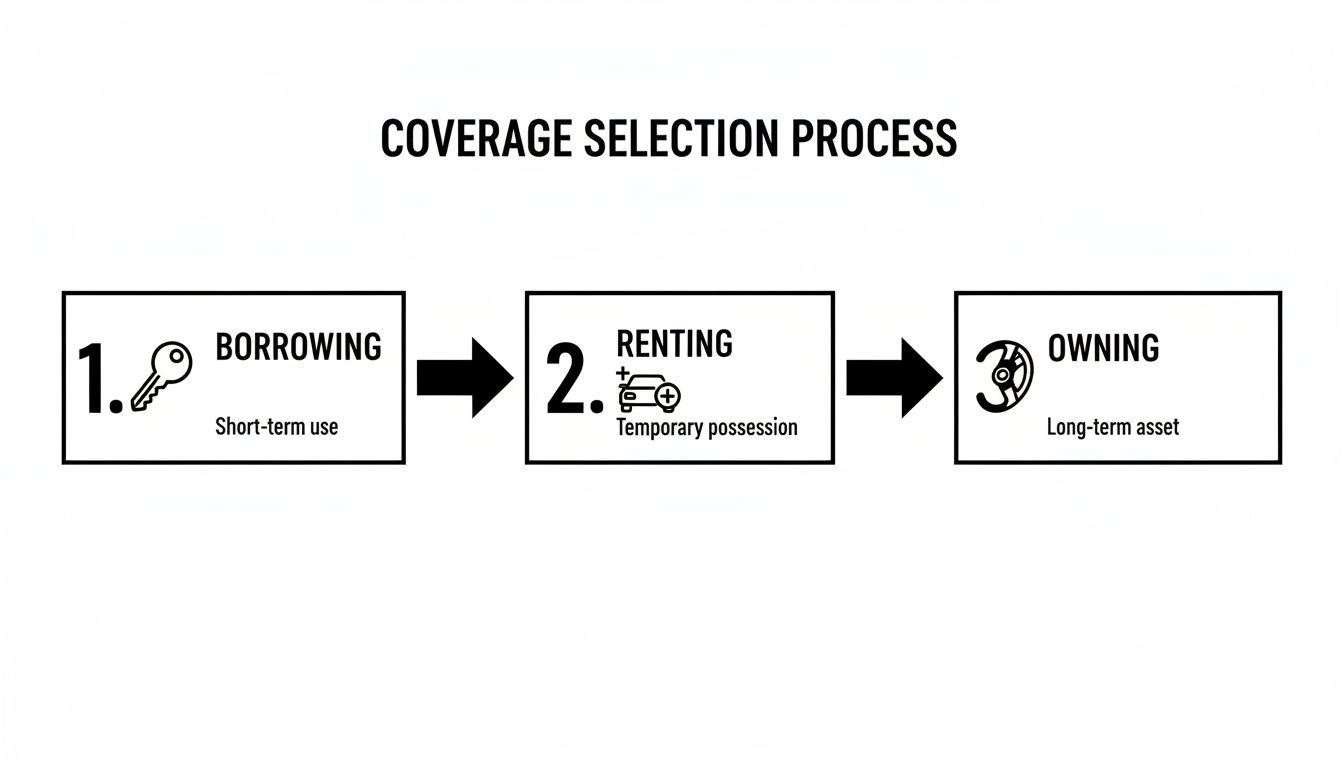
As you can see, it’s the perfect fit for drivers who borrow cars but don't own one themselves.
Actionable Tips for Lowering Your Costs
Even if your driving record isn't perfect or you're in a high-risk category, you still have options to bring your premium down. It never hurts to ask your agent what savings you might qualify for.
Try these strategies to get a more affordable rate:
- Ask About Discounts: You might be surprised what's available. Carriers sometimes offer discounts for things like being a good student or taking a defensive driving course.
- Bundle Your Policies: This is one of the most powerful ways to save. If you have renters insurance or home insurance, bundling it with your non-owner policy can unlock a significant discount. Some companies even let you bundle with life insurance.
- Maintain a Clean Driving Record: This is the long-term solution. Every year you drive without a ticket or accident, you get closer to qualifying for the best rates in the market.
Realistic Price Ranges
So, what should you actually expect to pay? A non-owner policy is almost always cheaper than a standard car insurance policy because the insurer isn't on the hook for a physical vehicle. Still, prices can vary widely.
For a California driver with a clean record, a basic non owners insurance policy usually lands somewhere between $25 to $50 per month. It's a really cost-effective way to get a liability safety net.
On the other hand, if you need to file an SR-22 because of a DUI or another major violation, you're looking at a higher cost. A non-owner SR-22 policy typically runs from $50 to $100 per month, and sometimes more depending on the violation.
These are just ballpark figures, of course. The only way to know your exact cost is to get a personalized quote based on your specific details. At Mai & Associates, our licensed agents can run the numbers with multiple carriers to find your best option, often on the same day.
Ready to see how affordable your policy can be? Let us help you get a fast, no-obligation insurance quote today and get the protection you need.
Frequently Asked Questions About Non Owners Insurance
Even with a good grasp of the basics, you probably have a few “what if” questions rattling around. That’s completely normal. To help you get total clarity, we’ve gathered the most common questions we hear from clients across California.
Can I Get Non Owners Insurance With A DUI In California?
Yes, you can. In fact, if you don't own a car, a non-owner policy is often the simplest and most affordable way to get the SR-22 you need after a DUI. It’s a very specific tool for a very specific problem.
Instead of hitting a wall trying to buy a standard policy without a car to list on it, a non-owner policy attaches the required liability coverage directly to you, the driver. Once that policy is in place, your insurance provider can immediately file the SR-22 form with the DMV for you. This is the crucial step that gets you back on the path to reinstating your license.
Does Non Owners Insurance Cover The Car I Am Borrowing?
No, it does not, and this is the single most important thing to understand. A non owners insurance policy covers your personal liability only.
That means if you cause an accident, it helps pay for the other person's medical bills and the damage to their property. It provides zero physical damage coverage (collision or comprehensive) for the car you are actually driving. If you crash a friend's car, their car insurance policy is what has to cover the repairs—not yours.
Your non owners policy protects others from damage you cause. The car owner’s policy is what protects their actual vehicle. Never get behind the wheel assuming your policy will pay to fix a car you don't own.
What Is The Difference Between Non Owners And Renters Insurance?
It's easy to mix these up, but they protect completely different things. Think of it this way: non owners insurance provides liability coverage for you while you're driving. Renters insurance protects your personal belongings—your laptop, clothes, furniture—from things like theft or fire.
So, if you borrow a car and someone smashes the window to steal your gym bag, your renters policy would help replace your stolen gear. But if you then accidentally rear-end someone at a stoplight, your non owners policy would step in to handle the liability for that accident. They work in tandem, much like home insurance and life insurance do for a homeowner, to create a complete safety net.
How Does Non Owners Insurance Work With An SR-22?
For a driver who doesn't own a car, a non-owner policy is the key that unlocks the SR-22 requirement. Remember, an SR-22 isn't insurance itself—it's just a certificate your insurer files with the California DMV to prove you're carrying at least the state-minimum liability coverage.
The problem is, you can't get that proof without an underlying insurance policy. If the DMV or a court tells you to get an SR-22 but you don’t have a vehicle, you're stuck. A non-owner policy neatly fills this gap, giving you the liability coverage needed so your agent can file the SR-22 and you can start the process of getting your license back.
What Should I Do If I Buy A Car?
The moment you buy a car, your non-owner policy is no longer the right fit. You need to call your insurance agent right away to switch over to a standard auto insurance policy.
A non-owner policy is specifically for people who do not own a vehicle and won't cover any car that's registered to you or anyone in your home. Your agent will help you set up a new policy that lists your car and includes all the necessary coverages—from legal requirements to optional collision and comprehensive coverage that protects your new investment. Don't delay, as making this switch promptly ensures you have no gaps in your coverage.
Is Non Owners Insurance Cheaper Than Regular Insurance?
Yes, by a significant margin. A non-owner policy is almost always cheaper than a standard auto insurance policy for one simple reason: the insurer's risk is much lower. They are only on the hook for your liability, not for the cost of repairing or replacing a specific vehicle that could be worth tens of thousands of dollars.
Since there's no physical car to insure, the premiums are a fraction of what you'd pay for a policy that includes comprehensive and collision. Your driving record, location, and chosen liability limits will still influence the final price, but it’s a very cost-effective way to stay insured without owning a car.
Ready to get the answers and protection you need? The licensed agents at Mai & Associates are here to help you navigate your options and find the perfect coverage. We offer multilingual support and can provide a fast, no-obligation quote to protect you on the road.