Your Guide to Non Owner Car Insurance California
Navigating California's roads without a car of your own can feel like a tricky insurance situation. That's where a non owner car insurance policy comes into play. Think of it as your personal financial shield, a policy that follows you from car to car, offering crucial liability protection whenever you borrow or rent a vehicle. This type of specialized car insurance is a key part of the broader landscape of California insurance solutions.
What Is Non Owner Car Insurance and Who Needs It in California?
Standard auto insurance in California is tied to a specific car. It protects that vehicle and anyone who drives it. Non-owner insurance flips that idea on its head. This policy is attached directly to you, the driver, not a car.
Its main purpose is to cover the costs of injuries or property damage you might cause to others if you're at fault in an accident while driving a car you don't own. It's a specialized tool, not meant for every driver, but it fills a critical gap for a specific group of people in California. If you're car-free but still drive regularly, this could be exactly what you need.
Who Benefits Most from This Coverage?
So, who should really be looking into a non-owner policy? This isn't just a "nice-to-have" for some; for many, it's a vital financial safeguard. Let's break down a few common scenarios where it makes perfect sense.
You're a prime candidate for a non-owner policy if you:
- Frequently Rent Cars: Always renting for work trips or weekend getaways? A non-owner policy can be significantly cheaper in the long run than buying the rental counter's expensive liability coverage every single time.
- Use Car-Sharing Services: Relying on services like Zipcar or Turo is convenient, but their included insurance often only covers California's bare-minimum liability limits. A non-owner policy gives you an extra, much-needed layer of protection.
- Need to File an SR-22: If the DMV requires you to file an SR-22 to get your license back, a non-owner policy is often the simplest and most affordable way to prove financial responsibility when you don't own a car.
- Want to Avoid a Coverage Lapse: Insurance companies don't like to see gaps in your coverage history and often penalize you with higher rates. Maintaining a non-owner policy keeps your record continuous, which can save you a lot of money when you do decide to buy a car.
In California, non-owner car insurance is a smart, affordable solution for drivers without a vehicle who still need liability protection. Based on recent data, the average cost for a non-owner policy in the state is around $491 a year, which works out to be about $41 per month.
To give you a clearer picture, here’s a quick summary of who really stands to benefit from this type of coverage.
Who Should Get Non Owner Insurance in California
| Driver Profile | Primary Reason for Coverage | Key Benefit |
|---|---|---|
| The Frequent Renter | Needs liability coverage for rental cars. | More affordable than buying insurance from rental agencies. |
| The Car-Sharer | Uses services like Zipcar or Turo often. | Supplements the minimal coverage provided by the service. |
| The SR-22 Filer | Required by the DMV to prove financial responsibility. | The cheapest way to meet legal requirements without owning a car. |
| The In-Between Driver | Sold a car but plans to buy another soon. | Prevents a costly lapse in insurance history. |
| The Regular Borrower | Often drives a friend or family member's car. | Ensures personal liability protection beyond the owner's policy. |
Ultimately, this policy is all about making sure you're legally compliant while protecting your personal assets from the massive financial fallout of an at-fault accident. It’s peace of mind for the California driver who’s always on the move, but never in a car of their own.
Understanding What Your Non-Owner Policy Actually Covers
So, what exactly are you buying with non-owner car insurance in California? It's crucial to get this right. Think of it less like a full-body shield and more like a specialized safety net designed for one key job: protecting you from liability claims.
Simply put, it’s your financial backup if you’re at fault in an accident while driving a car you’ve borrowed or rented.
This policy provides what’s known in the industry as secondary liability coverage. This means it only kicks in after the car owner's primary insurance has paid out its maximum limit. If you cause an accident, the vehicle owner's policy is on the hook first. But if the damages are more than their policy can handle, your non-owner policy steps up to cover the rest, keeping your personal assets safe from a lawsuit.
The Core Components of Your Coverage
Every non-owner policy in California is built around two fundamental liability protections—the same ones legally required for every driver in the state. Getting a handle on these is key to knowing what you're paying for.
- Bodily Injury Liability (BI): This is the part that covers medical bills, lost income, and even pain and suffering for other people you injure in an accident you cause. It’s usually split into two limits: a maximum amount per person and a total maximum for the entire accident.
- Property Damage Liability (PD): This pays for the damage you do to someone else's property. Most of the time, that means their car, but it could also be a fence, a mailbox, or even the side of a building.
The diagram below gives a great visual of the folks who typically get the most out of this kind of specialized liability coverage.
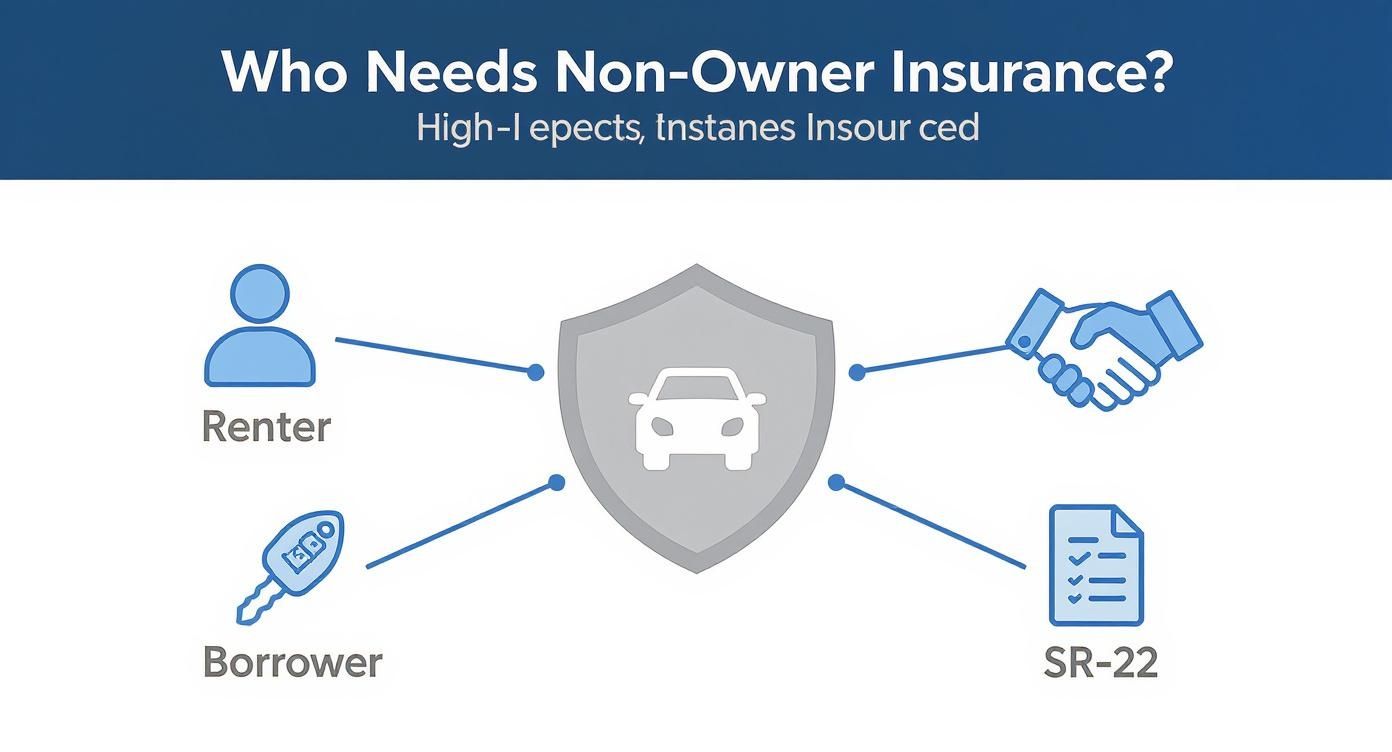
As you can see, whether you're constantly renting cars, borrowing from friends, or have to file an SR-22, non-owner insurance is the liability backstop you need.
What Is Not Covered by a Standard Policy
Let's be clear about what this policy doesn't do. Since it isn't attached to a specific car, it leaves out several types of coverage you'd find in a typical auto policy. If you want to dive deeper into these terms, our California insurance glossary is a fantastic place to start.
Here's what a standard non-owner policy will not cover:
- Damage to the car you are driving. The coverages that pay for repairs to the car you're in—Collision and Comprehensive—aren't part of the deal.
- Your own medical bills. A basic policy won't include Medical Payments (MedPay) for your own injuries. That's a separate add-on.
- Theft of your stuff. If someone breaks into the borrowed car and steals your laptop, that's a job for your renters insurance or home insurance policy, not your non-owner auto insurance coverage.
- Driving for work. Using the car for business, like delivering for DoorDash or driving for Uber, is a definite exclusion.
Key Takeaway: A non-owner policy is your personal liability shield. It protects you from claims others make against you, but it doesn't cover the car you're driving or your own injuries unless you add optional coverages.
Expanding Your Protection with Optional Coverages
While the basic policy is all about liability, most California insurers let you beef up your coverage for more well-rounded protection. These add-ons can plug some of the major holes in a liability-only plan.
You should seriously consider adding:
- Medical Payments (MedPay): This helps pay for medical expenses for you and your passengers after a crash, no matter who was at fault. It’s a huge relief when you just want to focus on getting better.
- Uninsured/Underinsured Motorist (UM/UIM): This one is a big deal. It protects you if you get hit by someone with no insurance or not enough insurance to cover your medical bills. Don't skip this.
Adding these will nudge your premium up a bit, but the financial security they provide is more than worth it. Once you understand the strengths and the limits of non-owner car insurance in California, you can build a policy that gives you exactly the protection you need for your situation.
Meeting California’s Legal Requirements and Handling SR-22 Filings
Let's be clear: following California's insurance laws isn't optional for any driver. If you don't own a car but still get behind the wheel, a non-owner car insurance California policy is your ticket to staying legal and protected.
This policy is designed to do one thing really well: provide the liability coverage the state requires. It’s your proof of financial responsibility, showing you can pay for damages if you cause an accident, even in a borrowed car.
Staying Above California's Minimum Liability Limits
The Golden State sets a baseline for liability coverage that every driver has to meet. This is often called the “15/30/5” rule, and a non-owner policy is built to satisfy these minimums.
Here’s a simple breakdown of what those numbers mean:
- $15,000 for Bodily Injury Liability: This is the most your policy pays if a single person is injured or killed in an accident you cause.
- $30,000 for Bodily Injury Liability: This is the total payout for all injuries or deaths if multiple people are hurt.
- $5,000 for Property Damage Liability: This covers repairs to someone else's car or property, like a mailbox or fence, that you damage.
Meeting these numbers keeps you legal, but think about this for a second. That $5,000 property damage limit can disappear in a flash after a minor fender-bender with a newer car. A non-owner policy gives you the freedom to choose higher limits for much better real-world protection.
What Exactly Is an SR-22 Filing?
This is where a lot of people get tripped up. One of the most important jobs of a non-owner policy is helping with the SR-22 process. So, what is it?
An SR-22 is not insurance. It’s a certificate, a piece of paper your insurance company files with the California DMV to prove you have active liability coverage.
Think of it as a note from your insurer to the state saying, "We've got this person covered. They're legal to drive." If the DMV requires you to have an SR-22 on file and your insurance ever cancels, your provider has to tell the DMV right away.
Who Needs an SR-22 in California?
The state doesn't hand these out for just anything. The DMV mandates an SR-22 for drivers who've had serious violations. It’s a mandatory step toward getting your license back.
If you find yourself in this situation but don't own a car, a non-owner policy is often the most direct and affordable way forward.
You'll likely need an SR-22 for things like:
- Driving Under the Influence (DUI/DWI): This is the most common reason.
- Getting caught driving without insurance.
- A reckless driving conviction.
- Causing an at-fault accident while uninsured.
- Racking up too many points on your driving record.
For a driver in this boat, getting traditional auto insurance is a non-starter because there's no car to insure. This is exactly where non-owner car insurance California becomes a lifeline. It provides the liability coverage needed for an insurer to file the SR-22, which in turn satisfies the court and DMV. It's the key that unlocks your suspended license and gets you back on the road legally.
How Much Non Owner Car Insurance Costs in California
Figuring out the exact price of non owner car insurance in California isn't a simple, one-size-fits-all answer. Think of it less like a fixed price tag and more like a custom quote tailored just for you. While it's almost always cheaper than a standard auto policy, your final premium is a unique reflection of the risk an insurance company takes on when they cover you.
The good news? Since these policies aren't tied to a specific vehicle, they're much easier on the wallet. Insurers don't have to factor in a car's make, model, age, or repair costs, which immediately brings the price down. But your personal details—like your driving history, age, and where you live in California—are what really shape the final number.

Key Factors That Influence Your Premium
When an insurer in the Golden State calculates your rate, they're looking at a few key parts of your profile. If you know what they're looking for, you can get a much better idea of what to expect.
- Your Driving Record: This is the most important piece of the puzzle. A clean driving history is your ticket to the lowest rates. On the flip side, if you need a non-owner policy because of an SR-22 filing, be prepared to pay quite a bit more, as you'll be considered a higher-risk driver.
- Your Age: Statistically, younger drivers—especially those under 25—are involved in more accidents, which means higher premiums. Rates tend to drop as you get older and gain more experience behind the wheel.
- Your ZIP Code: Where you park your shoes at night matters a lot. Insurers analyze everything from local traffic congestion to accident and theft rates in your neighborhood. A driver in a busy city will almost always pay more than someone living in a quieter, rural town.
How Location Impacts Your California Non Owner Policy
Geography plays a huge role in what you'll pay for any type of auto insurance in California, and non-owner policies are no exception. The cost of living, average car repair bills, and even local medical care expenses all get factored into your premium. It just makes sense—a driver navigating the dense traffic of Los Angeles faces a completely different set of risks than someone in a less crowded city like Bakersfield.
To give you a better idea of how much your address can swing your rate, take a look at the average costs in different California cities.
Average Non Owner Insurance Rates Across California Cities
| City | Average Monthly Premium | Average Annual Premium |
|---|---|---|
| Los Angeles | $45.50 | $546 |
| San Jose | $27.90 | $335 |
| Fresno | $27.80 | $334 |
| San Diego | $34.50 | $414 |
| Sacramento | $31.25 | $375 |
As you can see, the difference is significant. Drivers in Los Angeles might pay over $200 more per year than someone in Fresno for the exact same coverage.
Remember, these numbers are just averages to give you a ballpark figure. Your actual quote will depend on your unique circumstances. The only way to find out your true cost is to get a personalized insurance quote. This is the smartest step you can take to compare real numbers and find coverage that fits your budget and your needs.
How to Find the Right Non-Owner Policy in California
Finding the right non-owner policy in California isn't some big secret; it's just a matter of following a few smart steps. Think of it as a playbook that takes you from gathering your info to locking in a policy that actually fits your life and budget.
Let's start by getting organized. Before you can get a quote, any insurer is going to need some basic details to figure out your risk profile. It’s like prepping your documents before a big meeting—having everything ready makes the whole process faster and more accurate.

Step 1: Gather Your Essential Information
To get a real, accurate quote for non-owner car insurance in California, you’ll need to have a few key things handy. Insurance companies use this info to build your driver profile and calculate your rate.
Here’s what you should have ready to go:
- Your California Driver’s License Number: This is the most important piece. It’s how insurers look up your official driving record.
- Your Full Name and Address: Where you live matters—your ZIP code plays a big role in setting your premium.
- Your Driving History: Be upfront about any accidents or tickets. They’re going to run your record anyway, so it’s best to be honest from the start.
Once you have these details, you’re ready for the most crucial part of the hunt: shopping around.
Step 2: Compare Quotes from Multiple Carriers
You wouldn't buy the first car you test drive, right? The same logic applies to insurance. Don’t just take the first quote you're offered.
Interestingly, you won't see many major companies advertising non-owner policies on their websites. This often means you’ll need to pick up the phone and speak directly with an agent. This is where working with an independent agency like Mai & Associates really pays off—we can pull quotes from multiple carriers at once, saving you the legwork.
Comparing quotes is, without a doubt, the best way to make sure you're not overpaying. The price for the exact same coverage can vary wildly from one company to the next, so a little bit of research can translate into serious savings.
Step 3: Ask the Right Questions
Okay, so you have a few quotes in hand. Now it's time to look beyond the price tag and really dig into what you’re getting. A good agent can walk you through the fine print, but it helps to come prepared with your own questions.
Knowing what to ask is just as important as knowing where to look. Always ask about discounts, coverage limits, and how they handle SR-22 filings if you need one. This is how you avoid nasty surprises later on.
Here are a few questions I always recommend asking:
- What are my liability limit options? How much more does it cost to get coverage above the bare-minimum state requirement?
- Are there any discounts I might qualify for?
- Can I bundle this with my renters insurance for a multi-policy discount?
- If I need an SR-22, how fast can you get it filed with the California DMV?
That question about bundling is a big one. Many people who need non-owner auto insurance in California are also renting their homes. Combining your non-owner and renters insurance policies is one of the easiest ways to get a significant discount on both. It’s a simple move that covers your major liability risks and can save you a surprising amount of cash.
By following these steps, you can confidently navigate the process and choose the best non-owner car insurance California has to offer for your unique situation.
Common Myths and Smarter Alternatives
Navigating non owner car insurance in California can feel tricky, mainly because of a few stubborn myths. Let's clear the air on what this coverage actually does so you can figure out if it's right for you, or if another option makes more sense.
The single biggest misunderstanding? People think a non-owner policy will pay to fix the car they’re borrowing if they get into an accident. That’s not what it’s for. Think of it as a personal liability shield—it’s designed to cover the costs for the other person's injuries and vehicle damage, protecting you from being sued. It does not cover the car you're actually driving.
Is a Non-Owner Policy Always the Answer?
While a non-owner policy is a great fit for many people, it’s definitely not a one-size-fits-all solution. Depending on your specific situation—like how often you drive and whose car it is—you might be better off with a different kind of coverage. It’s worth taking an honest look at your driving habits before you sign up.
For example, if you mostly drive a car that belongs to someone you live with, a non-owner policy isn't the right tool for the job. In fact, most insurance companies will insist that you be officially added to that person’s policy. This leads us to a much more common and practical alternative.
Alternative 1: Becoming a Named Driver on Someone Else's Policy
If you regularly use a car owned by a family member or roommate, the correct (and often required) move is to be added as a named driver on their auto insurance policy.
This is a totally different setup from a non-owner policy:
- Direct Coverage: As a named driver, you’re explicitly covered to drive that specific vehicle under that policy.
- Full Policy Benefits: You get access to all the policy’s protections, which can include collision and comprehensive coverage to repair the car itself.
- Cost-Effective: While adding a driver does nudge the premium up, it's almost always cheaper than paying for two separate policies when you’re really just sharing one household car.
This is the perfect solution for a college student using their parent's car on weekends or partners who share a single vehicle. It keeps everything neat, tidy, and properly insured under one roof.
Alternative 2: Using Rental Car or Credit Card Coverage
What if you only get behind the wheel a couple of times a year to rent a car for a trip? A full non-owner policy might be more than you need. Many people in this boat simply opt for the insurance sold at the rental counter or rely on the coverage that comes with their credit card. But be careful—this approach can leave you with some serious blind spots.
Relying solely on rental counter insurance or credit card benefits can leave you dangerously underinsured. These options often provide only the bare-minimum liability coverage required by California law, which may not be enough to protect you in a serious accident.
Here’s a quick breakdown of how these options stack up:
| Coverage Option | Protects You from Lawsuits (Liability) | Covers Damage to the Rental Car | Who It's Best For |
|---|---|---|---|
| Non-Owner Policy | High, customizable limits to protect your assets. | Not included. | Frequent renters and car borrowers. |
| Rental Agency Insurance | Usually just state-minimum liability. | Yes, if you buy the Collision Damage Waiver (CDW). | Very infrequent renters who need a quick fix. |
| Credit Card Benefits | Almost never includes liability coverage. | Often includes secondary CDW coverage. | Drivers who already have liability coverage elsewhere. |
As you can see, a non owner car insurance California policy shines when it comes to liability protection. It fills the huge gap left by credit cards and the often-skimpy policies from rental agencies, making sure your personal assets are safe. At the end of the day, that’s the most important job insurance has.
Frequently Asked Questions About California Non-Owner Insurance
Even after you've got the basics down, a few specific questions always seem to pop up about non-owner car insurance. Let's tackle some of the most common ones we hear from California drivers to iron out any lingering confusion. Think of this as your quick-reference guide.
Navigating Household and Work-Related Scenarios
A lot of the confusion centers on cars you might have access to at home or for your job. Getting this part right is critical.
People often ask if they can get a non-owner policy when someone in their house—a family member or a roommate—has a car. The short answer is almost always no. If there’s a vehicle you can use regularly under your own roof, the insurance company will expect you to be listed as a named driver on that car's main policy. A non-owner policy is built for people who truly don't have routine access to a specific vehicle.
Another key area is driving for work. It's important to know that a standard non-owner car insurance California policy will not cover you for any commercial driving. That means no coverage for running business errands in a borrowed car, making deliveries, or driving for a rideshare service like Uber or Lyft. Those activities demand a completely separate commercial auto policy.
Coverage Specifics for Rentals and Cancellations
Now, let's get into a couple of practical questions we get about renting cars and managing your policy.
Will a non-owner policy cover a rental car? Yes, it will. It provides the liability protection you're legally required to have to drive a rental in California. But here’s the crucial part: it will not pay for any physical damage to the rental car itself. To cover dings, dents, or a total wreck, you'll still need to buy the collision damage waiver (CDW) offered at the rental counter.
Finally, what's the process for canceling a policy? You can usually just call your insurance provider or handle it online. A word of caution, though: if your policy is linked to an SR-22 filing, canceling is a bigger deal. Your insurer is legally obligated to inform the California DMV that you've dropped coverage, which could lead to your license being suspended all over again if you don't have another policy ready to go.
Have more questions? We've answered plenty more on our extensive California insurance FAQ page.
Ready to find the right protection without owning a car? The licensed agents at Mai & Associates are here to help. We are experts in all forms of California insurance, including auto insurance, home insurance, renters insurance, and even life insurance. We'll compare quotes from top carriers to find you an affordable non-owner policy that meets your exact needs. Visit us at https://cahomeauto.com for a no-obligation quote today.