Multi Policy Discounts in California: A Practical Guide

You've bundled your California auto insurance and home insurance because the quote promises a substantial discount. The bill looks better, the policies renew together, and one agent handles everything. Then a wildfire risk review changes your homeowners pricing, an earthquake endorsement sits outside the package, or a FAIR Plan becomes necessary. Suddenly, the percentage on the quote matters far less than the total cost and the coverage you have.
That's the central rule for multi policy discounts in California: judge the bundle by net value, not the headline percentage. A lower combined premium can be useful, but only if the auto, home, renters, umbrella, earthquake, and life insurance pieces still protect your household properly.
Why California Drivers and Homeowners Are Rethinking Bundle Savings
A Sacramento household recently faced the kind of problem that makes bundle math unreliable. The family had combined auto and home insurance under one carrier after seeing an advertised 22% discount. On paper, the package looked efficient and affordable. After the carrier reassessed wildfire exposure in the household's ZIP code, however, the home policy was non-renewed.
The replacement option was a California FAIR Plan policy costing three times the prior premium. The auto policy still existed, but the original home-and-auto discount no longer produced the expected value because the household's property coverage had significantly changed. The family had saved money on the initial quote, but the coverage structure and renewal risk created a much more expensive outcome.
That example exposes the weakness in “bundle and save” advertising. A discount applies to the carrier's price, not to some universal California insurance rate. If the underlying homeowners premium is high, a percentage reduction can still leave the household paying more than it would have paid by placing auto insurance and home insurance with separate carriers.
Wildfire exposure changes the equation
California homeowners in wildfire-prone areas need to evaluate more than a standard homeowners quote. A non-renewal, restricted underwriting appetite, or move to the FAIR Plan can change the property side of the package while leaving the auto side untouched. Earthquake coverage introduces another complication because it generally requires separate consideration rather than assuming it comes with ordinary home insurance.
The FAIR Plan also has important limitations. It doesn't include earthquake coverage, and flood coverage isn't automatically included either, according to this California FAIR Plan coverage explanation. Its optional Extended Coverage endorsement can address certain additional perils, but it still doesn't provide personal liability, water damage, theft, or earthquake protection.
California rule: A bundle is only a good deal when the combined price and the coverage structure both survive local wildfire and earthquake realities.
This guide focuses on the practical questions that generic national articles skip: how insurers calculate multi policy discounts, which pairings qualify, how umbrella and earthquake policies affect the package, where FAIR Plan coverage breaks the usual bundle model, and how to compare a bundled quote against the best standalone alternatives.
What Multi Policy Discounts Actually Are and How They Are Calculated
Multi policy discounts are premium reductions offered when one insurer writes multiple eligible personal insurance policies for the same household. The familiar pairing is auto insurance with home insurance, but carriers may also recognize renters insurance, condo insurance, umbrella liability, life insurance, or earthquake-related coverage.
Most carriers calculate the credit as a percentage applied to one or more policy lines. Advertised ranges commonly fall between 5% and 25%, depending on the insurer and the coverage combination, as explained by Nationwide's multi-policy discount guidance. Some carriers can instead use a flat dollar credit, but the declaration pages should show exactly how the insurer applied the adjustment.
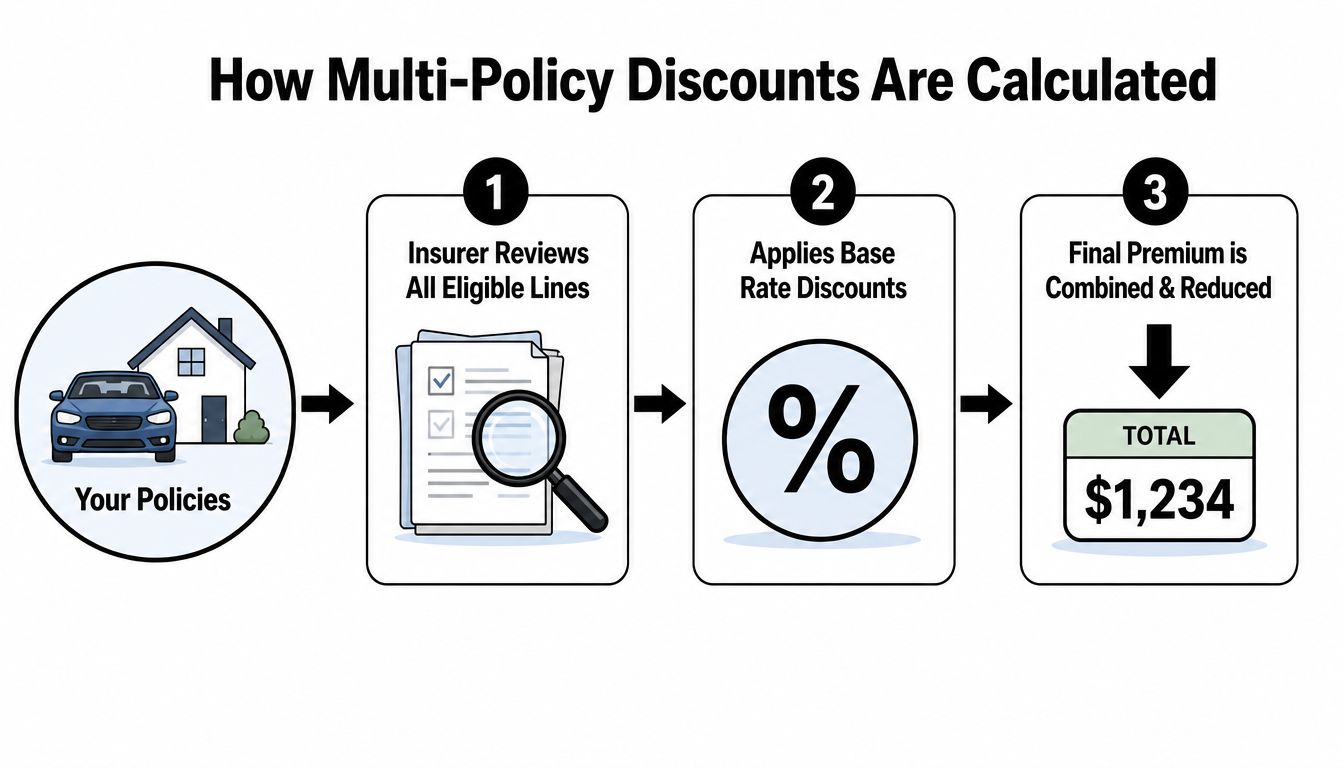
Run the calculation line by line
Use this sequence:
- Identify the base premium. Separate the annual auto premium from the annual home or renters premium before discounts.
- Apply the eligible credit. The carrier may use one percentage for auto and another for home.
- Add the reduced premiums. The result is the bundled annual cost.
- Compare the result with separate quotes. A discount isn't automatically a lower total price.
For example, assume annual auto insurance costs $1,800 and annual home insurance costs $2,400. If the carrier applies a 10% auto credit and a 7% home credit, the auto savings equal $180 and the home savings equal $168. The combined annual savings are $348, leaving a bundled total of $3,852 before any other adjustments. The same math works with renters insurance, although the dollar savings may be smaller because the underlying renters premium is usually lower.
Read the declarations page carefully
Paperless billing, paid-in-full, safe-driver, claim-free, affinity, and autopay credits may apply before or after the multi-policy adjustment. The order can affect the final premium, so don't rely on a verbal percentage. Ask for itemized premiums showing the base rate, each separate discount, and the final amount.
Households tracking several policies can also use AI-powered family budget tools to organize renewal dates and annual costs. For insurance terminology, keep the California insurance glossary available while reviewing declarations pages.
The Bundle Mixes That Qualify and the Eligibility Rules Behind Them
California carriers don't treat every combination as an equal bundle. Auto plus home usually receives the strongest attention because both policies represent substantial personal-lines relationships. Auto plus renters, auto plus condo, auto plus life, and home plus umbrella can also qualify, but the credit depends on the carrier's underwriting rules and the exact policy forms.
The table below gives practical market ranges rather than promises. A carrier can price outside these bands, and the final premium still matters more than the percentage.
Common California Bundle Mixes and Typical Discount Ranges
| Bundle Mix | Typical Discount Range | Key Eligibility Rule |
|---|---|---|
| Auto plus home | 5% to 25% | Same household and eligible homeowners policy |
| Auto plus renters | 8% to 15% | Renters and auto policies must share the qualifying address |
| Auto plus condo | 5% to 25% | Condo policy must meet the carrier's eligible form requirements |
| Auto plus life | Qualifies with some carriers | Life policy must be issued by the same insurance group |
| Auto plus home plus umbrella | 17% to 25% | Underlying auto and home liability limits must meet umbrella rules |
| Home plus umbrella | Carrier-specific | Umbrella may require home coverage with the same insurer |
Carriers commonly require the policies to use the same named insured and billing address. Some require all policies to remain active for 30 to 90 days before the discount appears, and some require the same agent of record. Confirm the effective date because a quote can show a projected credit that hasn't yet attached to the policy.
What can disqualify a household
Commercial auto generally won't qualify for a personal-lines package. A motorcycle-only account may not qualify without an eligible personal auto policy, and an out-of-state property can prevent the carrier from recognizing the home-and-auto relationship. A partner-carrier arrangement may look like one bundle in an advertisement while the policies are underwritten by different companies.
Renters should compare the full package through a California renters insurance resource, especially when the renters policy is being added only to obtain an auto credit. The added policy must provide useful personal property and liability protection, not merely function as a discount trigger.
Comparing Bundle Discounts Across Major California Carriers
A headline percentage means little until it becomes an annual dollar amount. The broad market illustrates why. A 2026 analysis of 13 large insurers found an average bundling discount of 14%, equal to about $671 per year or $56 per month, while another industry summary placed common discounts between 5% and 25%. The same analysis reported average bundle discounts of 19% for Nationwide, 18% for State Farm, 11% for Progressive, and 6% for USAA, showing how sharply the offer can vary by carrier. These figures appear in this 2026 analysis of home-and-auto bundling.
A separate 2024 carrier ranking reported savings ranging from 6% at USAA to 23% at State Farm, with dollar savings ranging from $185 to $787 depending on the insurer. It listed American Family at 18% and $486, Farmers at 18% and $732, Allstate at 18% and $497, Nationwide at 15% and $516, Travelers at 11% and $484, and Progressive at 7% and $226. The 2024 multi-policy discount ranking makes the important point: similar percentages can produce very different dollar outcomes.
A practical comparison frame
| Carrier | Headline Bundle Discount | Approx. Annual Savings ($2,400 auto + $1,800 home) | Notes for California |
|---|---|---|---|
| State Farm | 18% to 23% | Depends on line-level application | Strong headline offer, but review property underwriting |
| Nationwide | 15% to 19% | Depends on line-level application | Compare the home base rate before accepting the credit |
| Farmers | 18% | Depends on line-level application | Itemize other credits and property endorsements |
| Allstate | 18% | Depends on line-level application | Confirm whether all advertised discounts apply together |
| Progressive | 7% to 11% | Depends on line-level application | A smaller percentage can still win with a lower base premium |
| USAA | 6% | Depends on line-level application | Eligibility and final standalone pricing remain decisive |
The table uses the required $2,400 auto and $1,800 home comparison frame, but a valid quote must show how each carrier applies the discount to each line. California auto insurance and California home insurance also respond differently to underwriting and regulatory conditions, so identical percentages won't necessarily create identical household savings.
Request a side-by-side quote through a California insurance quote request, then compare the annual total. Don't choose the carrier with the biggest number in the advertisement. Choose the carrier whose bundled total beats the best separate auto and home combination without weakening coverage.
California-Specific Bundle Considerations Wildfire Earthquake and Fair Plan
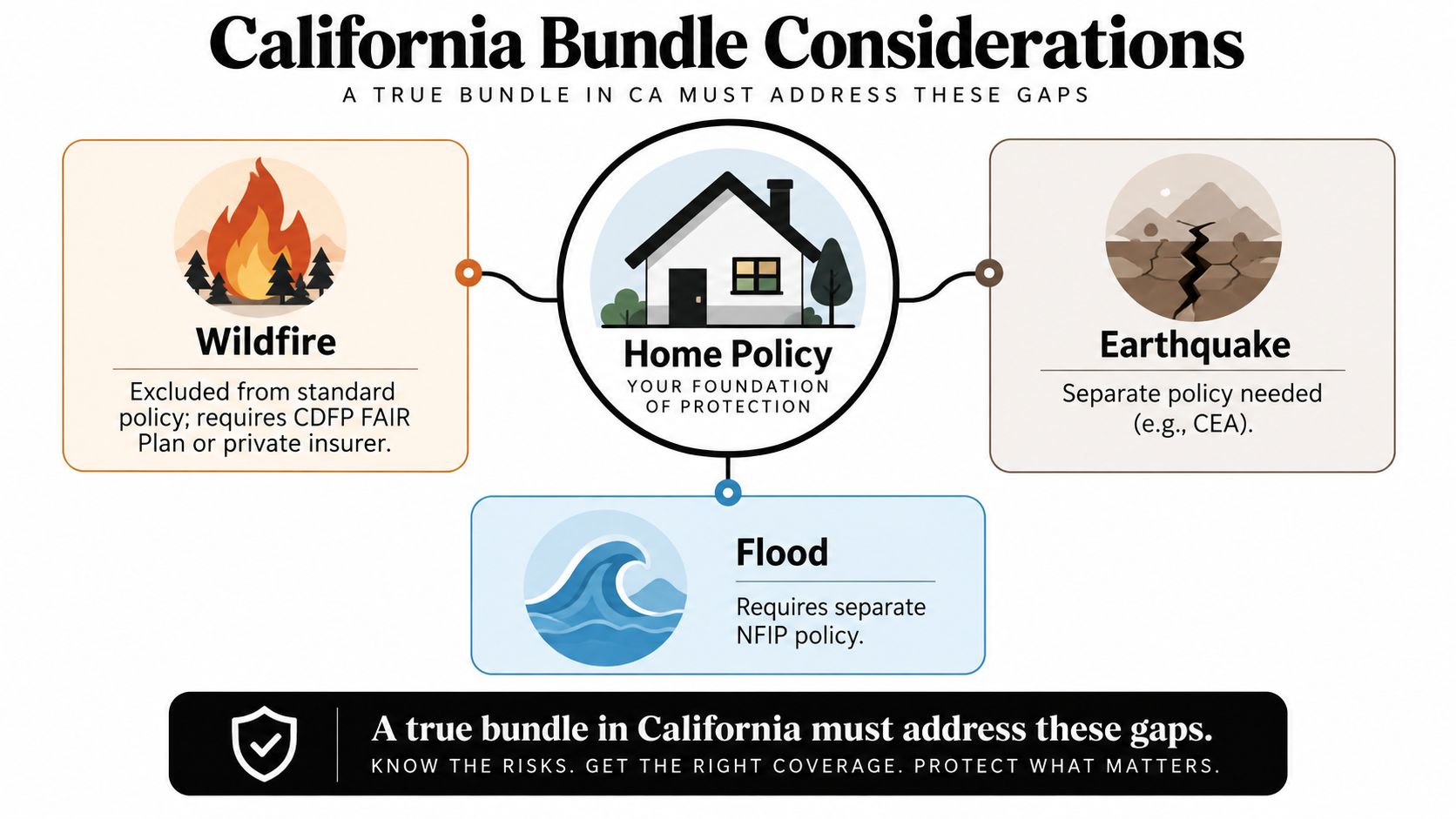
California bundle decisions often fail on the home side, not the auto side. A standard homeowners policy may not solve every earthquake, wildfire, or flood exposure, and a carrier can price or exclude those risks differently from one ZIP code to another. Adding a California Earthquake Authority policy, an endorsement, or a difference-in-conditions policy can change both the protection and the bundle eligibility.
Mercury's California bundling page gives a useful illustration of policy-form differences. It lists 14.5% savings for HO-3 only, 17.9% for HO-3 with California Earthquake Authority coverage, 18.8% for HO-3 with umbrella, and 19.6% for HO-3 with both CEA and umbrella. For renters, it lists 4.0% for HO-4 only and 8.8% for HO-4 with umbrella. These California-specific tiers appear on Mercury's California bundling page.
FAIR Plan coverage doesn't create a normal bundle
The California FAIR Plan can provide a critical property solution after a standard insurer won't write or renew coverage, but it isn't a substitute for a complete homeowners policy. The FAIR Plan generally doesn't provide earthquake coverage, and flood protection must be addressed separately. Its optional Extended Coverage endorsement can add certain perils, but it still leaves important gaps, including personal liability, water damage, theft, and earthquake protection.
That means an auto policy with one carrier and a FAIR Plan policy through another arrangement may not receive the ordinary home-and-auto credit. The household may need to accept unbundled auto pricing while adding separate liability, earthquake, or difference-in-conditions protection. Review the full structure through a California home insurance coverage guide, not just the FAIR Plan premium.
Umbrella coverage can improve the package when the underlying auto and home limits satisfy the umbrella carrier's requirements. Some California carriers also recognize umbrella relationships for renters, but the eligibility rules vary. Ask whether the umbrella creates a real additional credit or makes the overall protection more coordinated.
When the Biggest Discount Hides the Worst Deal Pitfalls to Watch For
The biggest advertised discount is often the most distracting number on the quote. A carrier can offer a generous credit while charging a high base premium, removing standalone discounts, or requiring limits and deductibles that don't fit your household. The only meaningful result is the all-in annual cost for comparable coverage.
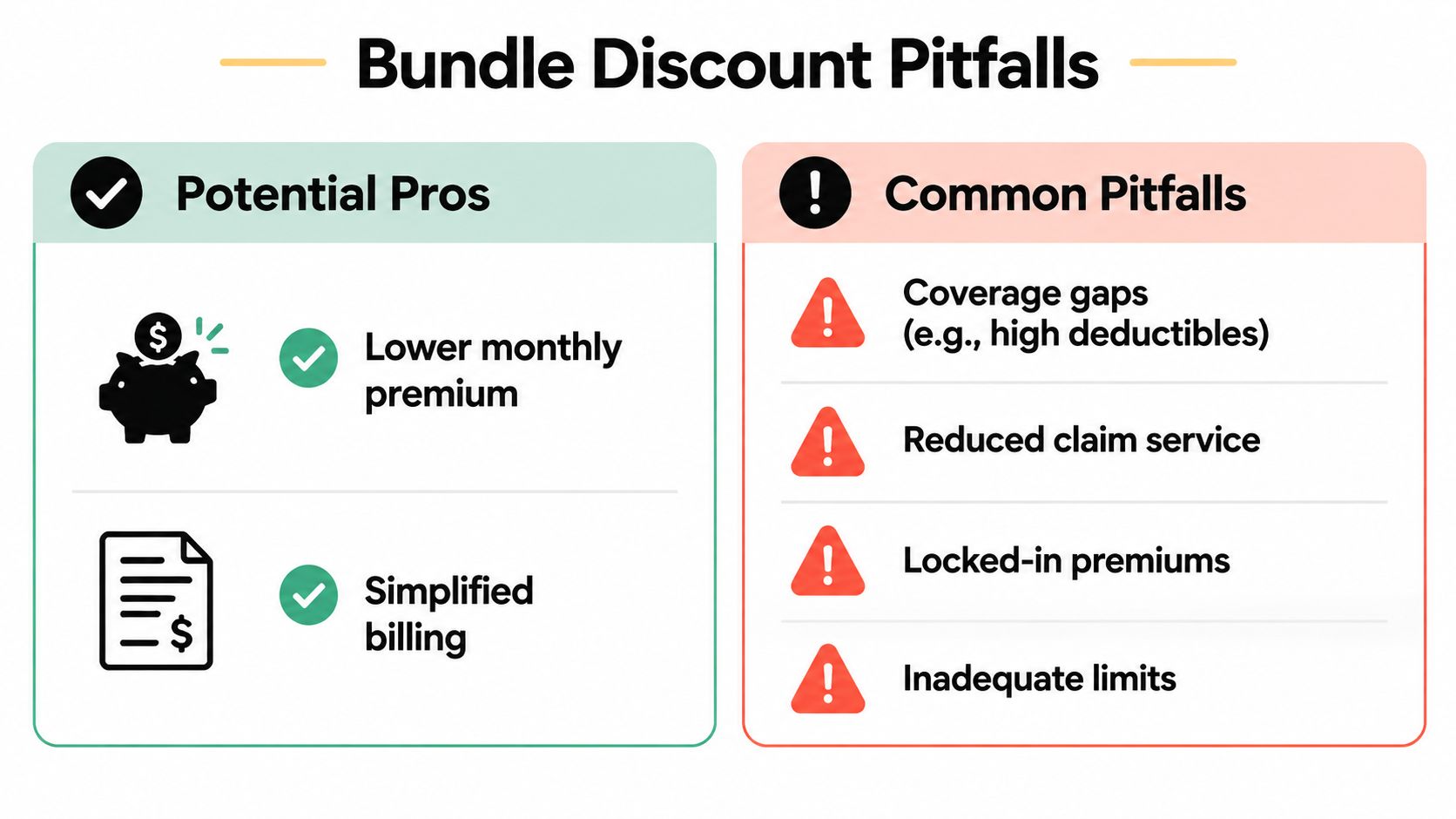
Four problems appear repeatedly
- Lost standalone credits: Paperless, paid-in-full, safe-driver, claim-free renewal, and affinity credits may disappear when policies are rewritten. Ask the agent to identify every credit on the old and new declaration pages.
- Weakened limits: A quote can look cheaper because the home liability, personal property, replacement-cost, uninsured motorist, or auto liability limits are lower. The discount didn't create the savings. Reduced protection did.
- Restricted renewal flexibility: Some packages can make switching more cumbersome, especially when the household depends on one carrier for several lines. Review any binding restrictions, renewal conditions, or cancellation implications before moving coverage.
- FAIR Plan confusion: Pairing a California FAIR Plan fire policy with an auto policy may look like a bundle, but the arrangement may not qualify for a conventional multi-policy credit. Treat the policies as separate unless the carrier confirms otherwise in writing.
A California Department of Insurance filing demonstrates why consumers shouldn't assume one universal discount. One filing lists a homeowners multi-policy discount of up to 24% when associated with auto, landlord, earthquake, or umbrella policies, while another lists 30% for homeowners policies and 10% for other policy forms when auto is insured with the same company. A CSE Safeguard rule applies the discount differently when auto, homeowners, and umbrella policies are combined, with a 12% discount described for a particular auto-and-home arrangement. Those examples are documented in the California Department of Insurance filing.
The test is simple: compare the bundle against the strongest separate policies with matching limits, deductibles, endorsements, and claims protections.
Don't treat a large percentage as savings until you subtract the value of any coverage that disappeared and any standalone discount you lost.
A Practical Checklist to Maximize Your Multi Policy Savings in California
Run the comparison like an insurance audit. Gather the documents first, then make each quote match. If the limits differ, the price comparison isn't valid.
Pull every declarations page. Collect auto, home, renters, umbrella, life insurance, FAIR Plan, earthquake, and related endorsement documents. Record liability limits, deductibles, dwelling or personal property limits, vehicles, drivers, and renewal dates.
Request two versions from each carrier. Ask for a bundled quote and separate standalone quotes using the same information. The agent should show the base premium, each discount, and the final annual cost rather than only stating an “up to” percentage.
Calculate the net annual difference. Subtract lost paperless, paid-in-full, safe-driver, claim-free, and affinity credits from the advertised bundle savings. Include any new premium for earthquake, umbrella, difference-in-conditions, or supplemental FAIR Plan protection.
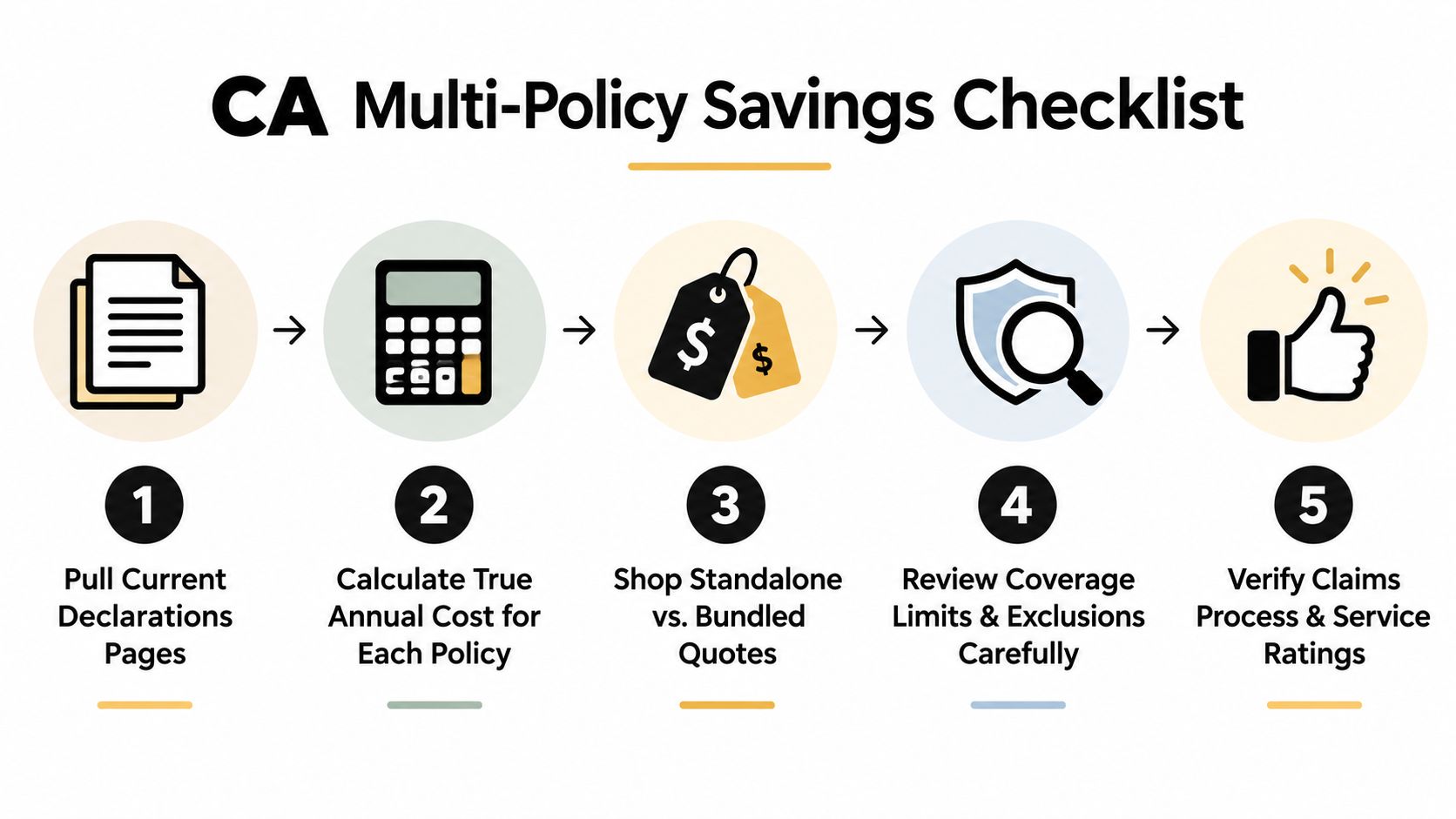
Match the protection. Confirm that both versions use equivalent liability limits, deductibles, replacement-cost treatment, personal property limits, rental reimbursement, uninsured motorist protection, and relevant endorsements. Don't accept a cheaper package that only works because the coverage is thinner.
Check the exit terms. Ask about binding restrictions, cancellation charges, renewal practices, and any multi-year rate lock. You need to know how easily you can unwind the package if a homeowners non-renewal or auto rate change alters the math.
Evaluate umbrella placement separately. An umbrella through the bundle may be convenient, but a separate surplus lines carrier can sometimes provide a more suitable structure for households with unusual assets or higher liability needs. Compare the total protection and underlying-limit requirements.
Re-shop at renewal. A bundle that worked after a home purchase or vehicle change may not remain competitive. Review both bundled and split options whenever the household, property, drivers, claims history, or wildfire exposure changes.
The right outcome may be one carrier for auto and home, auto plus renters with a separate umbrella, or a split structure involving FAIR Plan and earthquake coverage. Make the decision from the written numbers and coverage forms.
How Mai and Associates Helps You Bundle the Right Way
A California household shouldn't have to choose between a single-carrier package and a blind online comparison. Mai & Associates can review declarations pages, compare bundled and standalone structures across multiple carriers, and calculate the net annual difference after available credits. The agency handles auto insurance, home insurance, renters insurance, life insurance, umbrella considerations, California FAIR Plan reviews, earthquake coverage options, and wildfire protection planning.
The useful part of this process is the side-by-side analysis. An advisor can identify whether auto and home should stay together, whether renters insurance creates a sensible package, whether life insurance is eligible for a multi-line relationship, or whether an umbrella policy belongs with another carrier. That review matters most when a FAIR Plan, CEA coverage, or a high-risk property changes the normal bundle assumptions.
Mai & Associates serves California through offices in Glendale, Westlake Village, Escondido, and Costa Mesa, with support in English, Spanish, Armenian, Russian, and Vietnamese. A written comparison should show the current policy costs, proposed bundled costs, standalone alternatives, discount mechanics, limits, deductibles, exclusions, and any remaining California-specific coverage gaps.
Don't accept a bundle because the percentage looks impressive. Ask for a comparison that answers the only question that matters: after matching coverage and accounting for every lost or added cost, how much will the household save?
Mai & Associates offers California bundle reviews that compare auto, home, renters, life, umbrella, FAIR Plan, and earthquake coverage instead of relying on a headline discount. Visit Mai & Associates to request a written comparison of bundled and standalone options, including the annual savings and any coverage gaps that could change the decision.