California Minimum Auto Insurance Demystified
In California, every driver is legally required to carry what's known as minimum auto insurance. You'll often hear it called "15/30/5," which is just shorthand for the maximum dollar amounts your insurance company will pay out if you cause an accident. This is the absolute bare-bones coverage you need to legally get behind the wheel, but it's just one piece of the larger California insurance puzzle.
Decoding California's Minimum Car Insurance

Trying to understand car insurance can feel like decoding a secret language, but the basic idea is pretty straightforward. California law requires every driver to have liability coverage so they can help pay for the damage they cause to others. Think of it as a basic financial safety net.
These minimums aren't just arbitrary figures; they're the foundation of the state's financial responsibility laws. The whole point is to make sure that if you're at fault in an accident, there's a policy in place to help the other person recover their losses, so they aren't left holding the entire bill themselves.
Understanding the 15/30/5 Rule
So, what do those numbers—15/30/5—actually mean? They represent three distinct liability limits that form the core of your required coverage. Let's break down each piece of the puzzle.
$15,000 for Bodily Injury Liability per Person: This is the absolute most your insurance will pay for a single person's medical bills and related costs if you injure them in a crash.
$30,000 for Bodily Injury Liability per Accident: This is the total cap your policy will pay for all injuries combined in one accident, no matter how many people were hurt.
$5,000 for Property Damage Liability per Accident: This slice of coverage pays to repair or replace the other person's property that you damaged—most often, their car.
Here's a quick look at how those minimums break down.
California's Minimum Liability Insurance Requirements
| Coverage Type | Minimum Required Limit | What It Covers |
|---|---|---|
| Bodily Injury Liability (per person) | $15,000 | Medical expenses for one person injured in an accident you cause. |
| Bodily Injury Liability (per accident) | $30,000 | Total medical expenses for all people injured in a single accident you cause. |
| Property Damage Liability (per accident) | $5,000 | Costs to repair or replace another person's vehicle or property you damage. |
Meeting these state minimums keeps you on the right side of the law, but it’s so important to recognize their limits.
A single fender-bender with a newer car or a minor accident involving a couple of people can easily blow past these amounts. When that happens, you’re on the hook for every dollar that's left over.
California's Requirements in a National Context
While every state has some kind of financial responsibility law, the required coverage amounts are all over the map. To put things in perspective, the national average for minimum liability coverage is closer to $25,000 for bodily injury per person, $50,000 per accident, and $25,000 for property damage.
This shows that California's requirements are actually on the lower end compared to many other states. It’s a crucial detail because it highlights the major gap that can exist between being legally insured and being truly protected. For a deeper look at what this all means for drivers in the Golden State, you can explore our full guide on auto insurance in California.
The True Cost of Driving Uninsured in California
It can be tempting to skip car insurance to save a few bucks, but in California, that's a gamble you can't afford to take. The reality is that the fallout from one single traffic stop can cost you far more than years of paying for a basic insurance policy.
The moment an officer pulls you over and you can't show proof of insurance, the consequences hit hard and fast. For a first-time offense, you’re not just looking at a simple ticket. You’re facing fines and penalty assessments that can easily balloon to over $1,000.
Worse yet, the police can have your vehicle impounded right there on the spot. Suddenly, you're stranded, and your car is racking up daily storage fees at an impound lot. Getting it back means paying every last cent of the fines, towing charges, and storage costs—turning a momentary lapse in judgment into a serious financial drain.
When Penalties Escalate
If you get caught driving uninsured a second time, the penalties get exponentially steeper. The fines and fees can double, potentially costing you nearly $2,000. More importantly, a repeat offense puts your very ability to drive at risk.
The California DMV can suspend your driver's license, making it illegal for you to get behind the wheel. Getting your license back isn't easy; it’s a long and expensive ordeal involving extra fees and requirements that can keep you off the road, impacting your job and daily life.
The cycle is a punishing one: fines lead to impoundment, which leads to a possible license suspension. What started as an effort to save a little money can quickly spiral into thousands of dollars in penalties and years of headaches.
The SR-22 Requirement: A Major Financial Setback
One of the most lasting consequences of driving uninsured, especially if you’re in an accident, is the dreaded SR-22 certificate. A lot of people think an SR-22 is a type of insurance, but it’s not.
Think of an SR-22 as a "proof of insurance" form that your insurance company files directly with the DMV. It essentially puts a red flag on your driving record, letting the state know you're now being monitored as a high-risk driver.
Having an SR-22 filed on your behalf has a huge impact on your insurance rates. Here’s what it means for your wallet:
- Massively Increased Premiums: Insurance companies now see you as a much bigger risk, and your premiums will shoot through the roof. It’s common for rates to double or even triple.
- Fewer Company Options: Not every insurer is willing to take on the hassle of filing an SR-22. This shrinks your pool of choices, making it that much harder to find affordable coverage.
- Long-Term Financial Strain: The SR-22 isn't a short-term problem. You’re typically required to keep it on file for three consecutive years. If your policy lapses for even a day during that time, the three-year clock starts all over again.
The financial burden of an SR-22 alone makes the cost of a minimum liability policy look like a bargain. If you're wondering about specific violations or requirements, we've put together a resource to help. You can find answers by exploring our frequently asked questions about California insurance.
In the end, carrying at least the state minimum car insurance isn't just about following the law—it's about protecting yourself from a devastating chain of penalties that can throw your life off course for years.
When Minimum Coverage Isn't Enough
Getting the minimum auto insurance required by California law is the first step, but let's be honest—it's just a starting point. Being "legal" and being financially protected are two very different things. The gap between the state's required 15/30/5 limits and the actual cost of a moderate accident can be massive, potentially leaving you on the hook for tens of thousands of dollars.
Think about a typical fender-bender on a packed California freeway. The moment your car hits another, a financial clock starts ticking. With a property damage limit of just $5,000, you could burn through that entire amount before the tow truck even shows up, especially if you hit a newer SUV or luxury car.
These days, a single modern headlight assembly can run over $2,000, and a bumper replacement loaded with sensors can easily top $3,000. If your accident involves two other cars, that $5,000 limit disappears in a flash. Anything beyond that comes directly out of your pocket.
A Real-World Accident Scenario
Let's break down how quickly things can spiral. Imagine you cause an accident that injures two people and totals their car. The costs will likely blow past what a minimum policy can handle.
Here’s a realistic look at the bills:
- Medical Bills (Person 1): Their hospital stay and physical therapy add up to $22,000. Your policy covers the first $15,000, leaving you to pay the remaining $7,000.
- Medical Bills (Person 2): The passenger has less severe injuries, but their medical costs still hit $10,000. Your policy’s $30,000 per-accident limit has $15,000 left after the first claim, so this is thankfully covered.
- Vehicle Repairs: The other car, a common mid-size sedan, needs $11,000 in repairs. Your property damage limit is only $5,000, which means you are personally responsible for the $6,000 difference.
In what seemed like a moderate crash, you are now personally liable for $13,000 ($7,000 in medical + $6,000 in car repairs). That's money you have to find on your own, and it shows just how fast the bills add up.
This infographic breaks down the steep penalties for driving with no insurance at all—and these fines are often just the beginning of the financial pain.
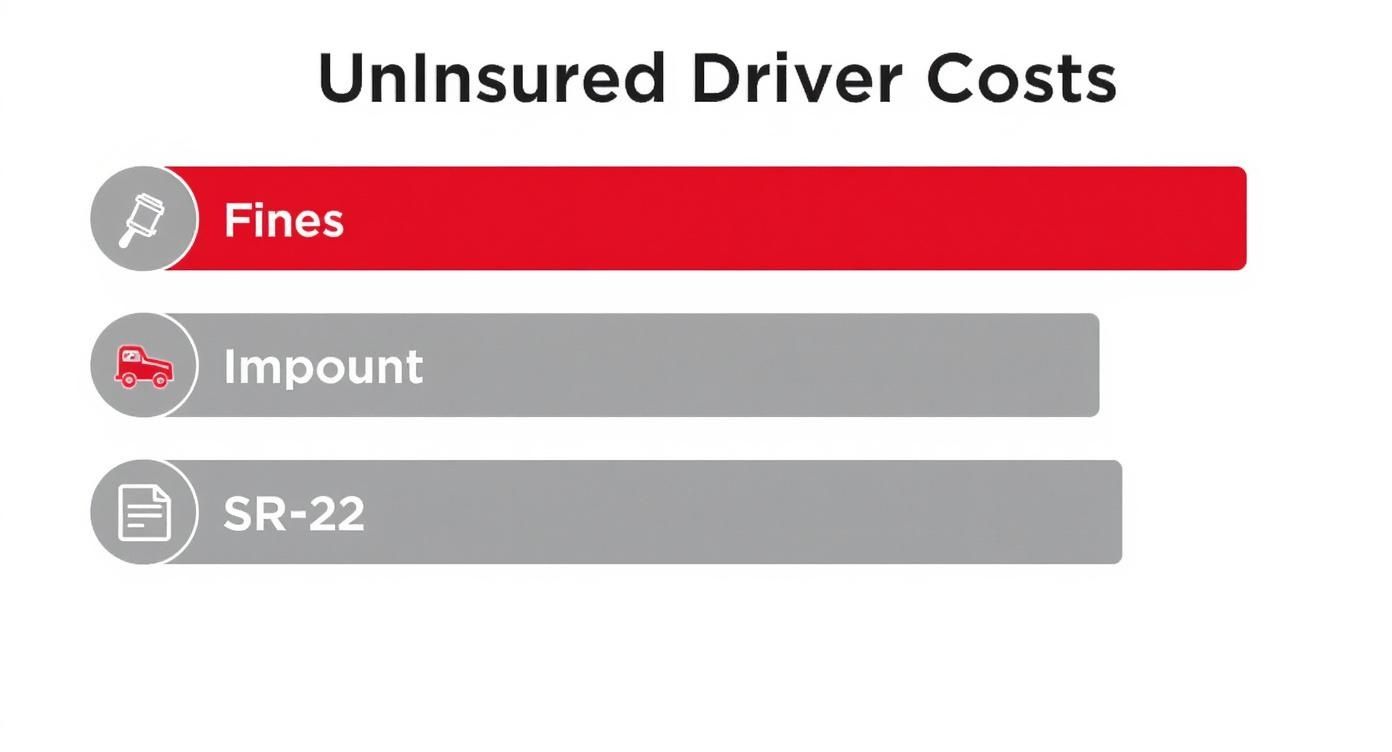
As you can see, even the legal fines for being uninsured create a major financial headache. This makes staying insured critical, but it also highlights why having enough insurance is just as important.
Protecting Your Personal Assets
When accident costs go beyond your policy limits, the other party's lawyers don't just give up. They will come after you for the rest, putting your entire financial life on the line. This is where personal liability becomes a real-world nightmare.
To settle the debt, a court can go after your personal assets, including:
- Your savings and checking accounts
- Your future income through wage garnishment
- Your home, vehicles, and other valuable property
Suddenly, that cheap minimum policy doesn't feel like such a great deal anymore. It's more like a paper-thin shield that shatters on impact, exposing everything you've worked hard for.
The goal shouldn't be just to carry a piece of paper that makes you legal. It's about having a real safety net that protects you, your family, and your financial future. Shifting your mindset from being merely "legal" to being genuinely protected is one of the smartest moves you can make. To learn more about building a smarter insurance plan, check out our other Mai & Associates insurance guides for California residents.
Building a Smarter Insurance Policy
Now that you understand the serious risks of driving with only minimum auto insurance, let’s talk about building a policy that actually protects you. We're moving beyond simply being legal and into being smart. This isn't about paying for extras you don't need; it's about closing the dangerous gaps that a bare-bones policy leaves wide open.
By choosing the right optional coverages, you get to control your financial future after a crash, instead of leaving it all up to chance. Think of these options as extra layers of armor for your finances, your health, and your car.
Shielding Yourself From Uninsured Drivers
So, what happens if a driver with zero insurance plows into your car? California’s minimum liability won't pay a dime for your injuries or vehicle repairs. Your only options are to sue the at-fault driver (who probably can't pay anyway) or cover everything yourself.
This is exactly why Uninsured/Underinsured Motorist (UM/UIM) coverage is so crucial—it’s your personal safety net for this exact situation.
- Uninsured Motorist (UM): This kicks in to cover medical bills for you and your passengers if you're hit by a driver with no insurance at all.
- Underinsured Motorist (UIM): This helps when the other driver has insurance, but their skimpy liability limits aren't nearly enough to cover your hospital bills.
In a way, UM/UIM is like buying insurance coverage for yourself that stands in for the policy the other driver should have had. With so many drivers on the road with little or no coverage, it’s one of the most important upgrades you can make to your policy.
Covering Medical Bills Immediately
After an accident, medical bills can show up fast—long before anyone decides who was at fault. Your health insurance might help, but you're still on the hook for deductibles and co-pays, which can add up to a mountain of debt. Medical Payments (MedPay) coverage is designed to provide immediate relief.
MedPay is simple and works on a no-fault basis. It helps pay medical costs for you and your passengers right away, no matter who caused the crash. This lets you get the care you need without having to wait weeks or months for an insurance investigation to wrap up.
Think of MedPay as a first-aid fund for your finances. It covers things like ambulance rides, ER visits, and physical therapy up to your chosen limit, giving you breathing room to focus on getting better.
Protecting Your Own Vehicle
Let’s be clear: California’s minimum liability insurance only pays for damage you cause to other people's cars and property. It does absolutely nothing to fix or replace your own vehicle. If you want to protect your investment, you need two key coverages that work together as a complete shield.
Those coverages are Collision and Comprehensive.
Collision Coverage Explained
Collision coverage is pretty straightforward. It pays to repair or replace your car if it's damaged in a crash with another object—whether it's another vehicle or something stationary like a pole or a guardrail. Most importantly, it covers you regardless of who is at fault.
Comprehensive Coverage Explained
Comprehensive, sometimes called "other than collision," is your defense against all the unpredictable things life can throw at your car. It protects you from damage caused by a whole host of non-accident events, including:
- Theft or vandalism
- Fire and explosions
- Falling objects (like a tree branch)
- Floods, hail, earthquakes, and other natural disasters
- Hitting an animal, like a deer
Together, Collision and Comprehensive are the one-two punch that protects your vehicle itself. While the law doesn't require them, they are absolutely essential if you can't afford to just go out and buy a new car tomorrow.
Making these smart additions is how you turn a simple piece of paper into a powerful tool for financial security. To see how these options fit your budget, you can get an instant insurance quote and explore personalized plans that give you real peace of mind.
Finding Affordable California Auto Insurance
Let's be honest, nobody wants to overpay for car insurance. The good news is, you don't have to. Finding quality coverage that goes beyond the bare minimum and still fits your budget is entirely possible—it just takes a little know-how. It's less about luck and more about being smart with your choices.
Think of it this way: insurance companies have a long list of things they look at to decide your rate. By understanding that list and taking control of the parts you can influence, you can find that perfect balance between solid protection and a premium that doesn't make you wince every month.
The Power of Independent Agents
You could spend your entire weekend calling different insurance companies one by one, repeating the same information over and over. Or, you could make one call to an independent insurance agent. There's a huge difference.
Agents who work for a single company (often called "captive" agents) can only sell you that one company's products. Independent agents, on the other hand, partner with many of California's top-rated carriers. They shop the market for you, comparing dozens of quotes and policies to find the best value. They do all the legwork, and because they know the market inside and out, they often find deals you'd never spot on your own.
Your Checklist for Common California Discounts
Insurance companies have a ton of discounts available, but they don't always volunteer them. You have to ask! You'd be surprised how many people qualify for savings they didn't even know existed.
Next time you're getting a quote, run through this list:
- Good Driver Discount: This is the big one. A clean driving record is your ticket to some of the most significant savings out there.
- Multi-Policy Bundles: Already have renters insurance or home insurance? Insuring your car with the same company can knock a serious percentage off your total bill. Even bundling with life insurance can offer savings.
- Vehicle Safety Features: Your car’s safety gear—like airbags, anti-lock brakes, or an anti-theft system—can often earn you a nice little discount.
- Good Student Discount: If you have a full-time high school or college student on your policy with at least a "B" average, make sure the insurance company knows about it.
- Low Mileage Discount: Don't drive much? Maybe you work from home or take the train to work. Let your agent know, as you could qualify for a low-mileage discount.
Never assume the agent knows every detail about your life. It always pays to ask, "Are there any other discounts I might be missing?" You could easily be leaving money on the table if you don't.
Factors You Can Control
While you can't change your age or where you live, there are a few major factors that are firmly in your hands. First and foremost is your driving record. Nothing keeps rates low like a history free of accidents and tickets. It's truly the most powerful tool you have.
The car you choose to drive matters, too. A practical sedan is almost always going to be cheaper to insure than a flashy sports car or a high-end SUV. Insurers know exactly what different models cost to repair, how often they're stolen, and how they perform in crash tests.
It's also worth noting that wider market forces play a role. For example, recent global insurance market trends from Aon show that while some markets are getting cheaper, auto coverage in North America is holding steady due to higher risks and repair costs. You can't control the global market, but by focusing on your driving habits and your vehicle choice, you can put yourself in the best possible position to find an affordable rate.
Ready to Get Covered? Let's Find Your Quote.
You’ve done the homework. You now see that California’s minimum auto insurance is just the bare-bones legal requirement—a starting line, not a finish line. The next step is turning that knowledge into action and getting coverage that actually fits your life.
Real peace of mind isn't about just being legal. It’s about knowing that if something goes wrong, you have a real safety net to protect your family, your savings, and your future. Finding that sweet spot between solid protection and a price that makes sense is exactly what we do here at Mai & Associates.
Finding the Right Policy Is Easier Than You Think
We take the guesswork and hassle out of shopping for car insurance. Our licensed agents are on standby to get you fast, same-day quotes from some of California's most trusted insurance carriers. We do the heavy lifting and compare the options for you, so you know you’re seeing the best rates out there.
Choosing insurance is a big deal. We want to be the team you trust to help you protect what you’ve worked so hard for, with a plan that fits both your life and your budget.
Whether you just need auto insurance, want to save by bundling it with home insurance or renters insurance, or are thinking about life insurance, we've got you covered. To make sure nothing gets lost in translation, our team can help you in English, Spanish, Armenian, Russian, and Vietnamese.
Don’t risk your financial future on a generic policy that might not be there for you when you need it most. Let us help you put a smarter plan in place today. Our experts will look at what you need and find a policy that gives you real security and value, so you can drive with confidence.
Reach out to Mai & Associates for a personalized, no-pressure quote and see how easy it is to get better protection for you and your family.
Frequently Asked Questions
When you start digging into the details of minimum auto insurance, it's natural for questions to pop up. Let's tackle some of the most common ones we hear from California drivers to help you get a clearer picture of what you're really buying.
Does Minimum Auto Insurance Cover My Car If I Cause An Accident?
Plain and simple: no, it doesn’t. Think of California's minimum liability coverage as protection for other people from accidents you cause. It's designed to pay for their medical bills and car repairs, not yours.
If you want your own car protected, you'll need to add Collision and Comprehensive coverage. Without them, any repairs—or even replacing your car entirely—will have to come straight out of your own pocket.
If I'm Hit By An Uninsured Driver, Does My Minimum Policy Help?
This is a really common point of confusion, and the answer is again, no. Your basic liability policy only kicks in when you're the one at fault. It offers you zero financial help if an uninsured driver hits you.
This is exactly why Uninsured/Underinsured Motorist (UM/UIM) coverage is so important. It’s an optional add-on that steps in to cover your medical bills and other expenses when the other driver can't. Without it, you could be facing a mountain of medical debt on your own.
What is "Full Coverage," Really?
You'll often hear people talk about having "full coverage," but it's not an official type of policy. It's just a casual term for a robust policy that bundles liability, Collision, Comprehensive, and usually UM/UIM coverage together. It’s a package that provides far more complete protection than the state-required minimums.
Can My Insurance Rate Increase If I Only Carry Minimum Coverage?
It might sound strange, but sticking with just the minimum auto insurance can sometimes cost you more down the road. Insurance companies often see drivers who carry only the bare-bones coverage as a higher risk. Why? Because they know you're one moderate accident away from a financial disaster.
If you cause a crash and the damages exceed your low policy limits, you’re on the hook for the rest. That financial instability makes insurers nervous, which can translate into higher premiums at renewal time. A clean driving record paired with more sensible coverage limits often leads to better, more stable pricing in the long run.
At Mai & Associates, our licensed agents are experts at finding that sweet spot between solid protection and a price you can afford. We'll help you compare all your options for auto insurance, home insurance, renters insurance, and life insurance so you get the coverage you actually need. Reach out today for a free, same-day quote.