A Guide to Manufactured Home Insurance in California
Think of manufactured home insurance as a custom-fit suit. While a standard homeowners policy is like an off-the-rack option, an HO-7 policy is tailored for a factory-built home. It provides the financial protection you need for your home, your belongings, and your liability, but it's designed with the specific construction and risks of manufactured homes in mind. This specialized coverage is a key part of a comprehensive California insurance plan, alongside other protections like auto insurance and life insurance.
What Is Manufactured Home Insurance
Let's use a simple analogy. You wouldn't use the same insurance policy for a sedan as you would for a custom-built RV, right? The same logic applies to houses. Manufactured home insurance is specialized coverage, distinct from traditional home insurance.
Because a manufactured home is built in a factory and then moved to its location, it faces a different set of risks than a home built on-site. This is what an HO-7 policy addresses. For Californians, where housing options are diverse, getting this distinction right is the first step to properly protecting your home.
Core Pillars of Protection
At its core, any good manufactured home insurance policy stands on three pillars. These coverages work together to form a financial safety net, shielding you when the unexpected happens.
This infographic gives a quick visual breakdown of those three main components.
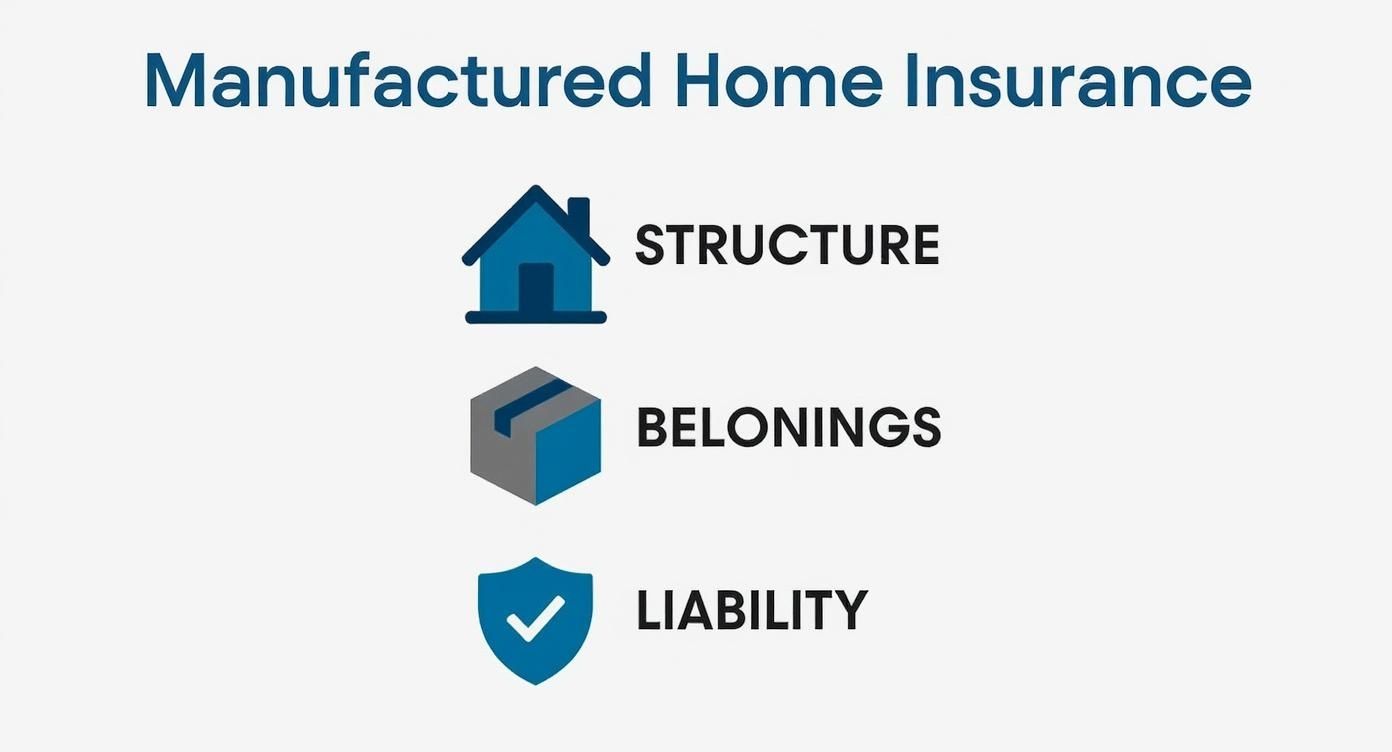
As you can see, the policy is structured to protect the physical home itself, everything you own inside it, and you from legal and financial responsibility if someone gets hurt on your property. It’s a comprehensive approach to securing your biggest assets.
Why This Coverage Is Growing in California
It’s no secret that affordable housing is a huge deal in California, which is why manufactured homes have become such a popular choice. This boom is also driving growth in the insurance market. The mobile home insurance sector is expected to grow between 5.8% and 7% annually, jumping from a $5.5 billion market in 2023 to potentially $12.5 billion by 2033.
While our focus here is on manufactured homes, it’s useful to see how this coverage compares to other types of property insurance. The basic ideas of covering a structure and liability are similar to what you'd find in standard home insurance in California or even renters insurance, but the details in an HO-7 policy are what make it the right tool for the job.
For California residents, standard coverage is just the beginning. The state’s unique environmental risks, such as devastating wildfires and earthquakes, often require additional, specialized endorsements that a basic policy may not include.
We’ll dive deeper into these California-specific challenges—and the optional coverages you’ll need to be truly protected—later in this guide. This way, you can build a policy that covers not just the everyday risks but also the unique threats that come with living in the Golden State.
Understanding Your Standard Policy Coverage

Think of your manufactured home insurance policy less like a document and more like a Swiss Army knife. A standard HO-7 policy—the common policy type for manufactured homes in California—is built around four main components that work together to protect your home, your stuff, and your savings.
Let's unpack these core coverages. Getting a handle on them will help you see your policy for what it really is: a critical safety net, not just another monthly bill.
Dwelling Coverage for Your Home Structure
This is the core of your policy. Dwelling coverage protects the physical structure of your home. If a fire, windstorm, or other covered disaster damages your home, this is the part of the policy that pays to repair or rebuild it.
It doesn’t just stop at the four walls, either. Dwelling coverage typically extends to attached structures like your deck, carport, or porch. Say a nasty winter storm in the Sierra foothills sends a tree branch crashing down on your roof and attached awning. Your dwelling coverage is what steps in to handle the repair costs, after you've paid your deductible. This is the bedrock of your protection.
Personal Property Coverage for Your Belongings
If dwelling coverage protects the "box," then personal property coverage protects everything inside it. This is what helps you replace your belongings if they’re stolen or destroyed in a covered event. We're talking about everything from your couch and TV to your clothes and kitchen gadgets. This concept is very similar to the coverage found in renters insurance policies.
Picture this: a pipe bursts in your home in a Riverside-area community, flooding the living room and ruining your furniture and electronics. That’s when your personal property coverage kicks in, providing the funds to replace those items. It’s what helps turn a house back into a home after a disaster.
A key detail to watch for is Actual Cash Value (ACV) vs. Replacement Cost Value (RCV). Standard policies often use ACV, which pays you what your five-year-old TV is worth today (not much). I almost always recommend upgrading to RCV, which pays for a brand new TV of similar quality. It's a small difference in premium for a massive difference in your ability to recover.
Personal Liability Coverage for Accidents
This might be the most important—and most overlooked—part of your entire policy. Personal liability coverage is your financial shield if someone gets hurt on your property and you're held responsible. It's designed to cover their medical bills, potential lost wages, and your own legal defense costs if they decide to sue. This is a fundamental component of all property policies, including standard home insurance and renters insurance.
Imagine a guest visits your home in a San Diego mobile home park, trips on a loose step, and breaks an ankle. Without this coverage, you could be on the hook for their medical bills and a potential lawsuit, putting your personal assets at risk.
It’s not just for injuries, either. If your kid accidentally sends a baseball flying through your neighbor's picture window, your liability coverage can handle that, too. It’s peace of mind for life’s unexpected—and sometimes expensive—accidents.
Additional Living Expenses for Displacement
What happens when you can't live in your home because of a covered disaster? For instance, a wildfire near Sacramento forces an evacuation, or a fire makes your home uninhabitable for a few months. This is exactly where Additional Living Expenses (ALE) coverage saves the day.
ALE helps cover the extra costs you rack up while you're displaced—things like hotel bills, restaurant meals, and laundry services. It's designed to help you maintain your normal standard of living while your home is being put back together. For anyone in California living with risks like wildfires, ALE isn't a luxury; it’s an absolute lifeline.
Protecting Your Home from California Wildfires and Earthquakes
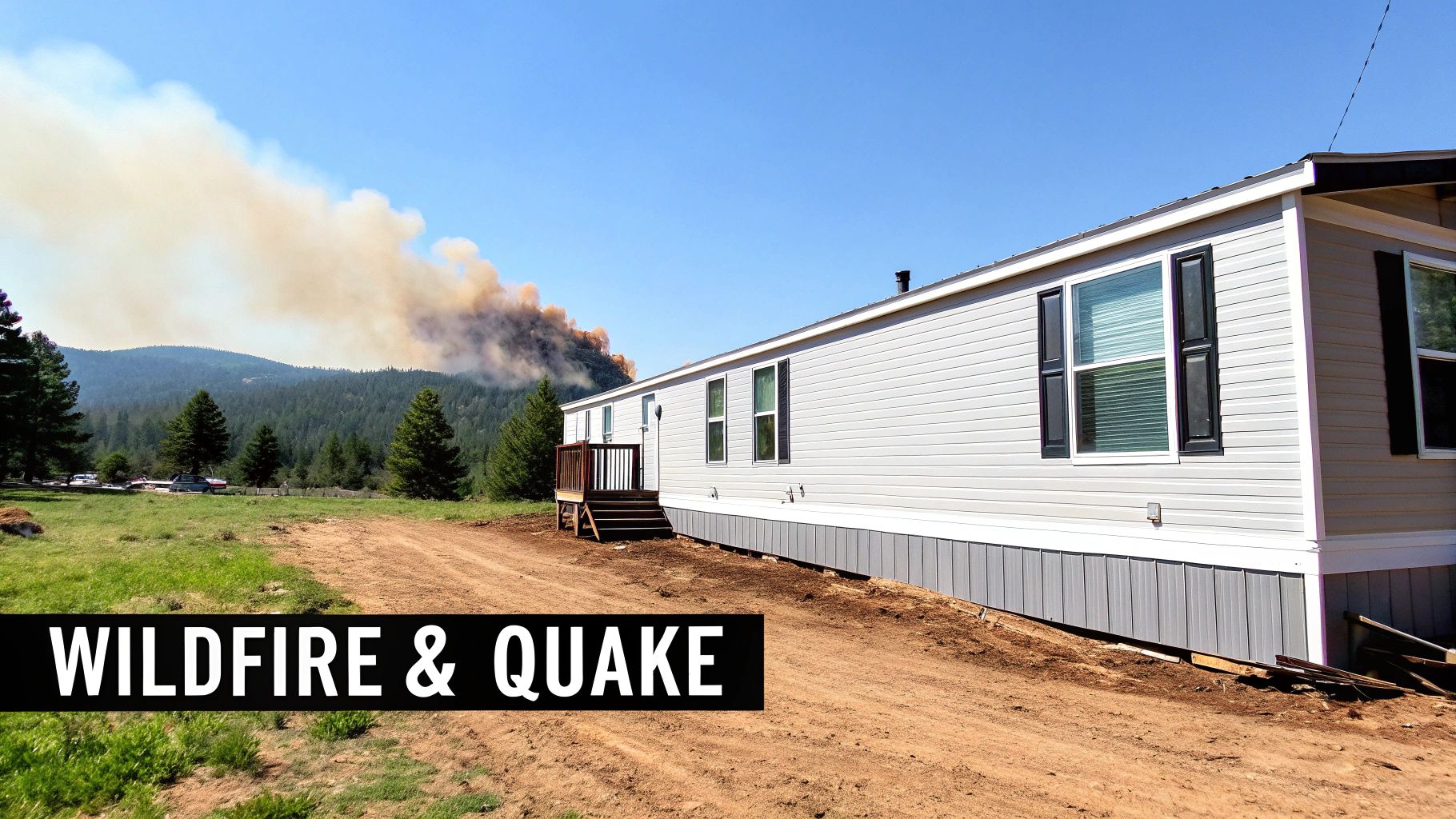
Living in California means living with serious natural risks. Your standard manufactured home policy is great for covering the basics like theft or a kitchen fire, but it almost always falls short when it comes to the state's two biggest threats: wildfires and earthquakes.
Think of your main policy as a family doctor. But for something as specialized and potentially devastating as a major quake or a fast-moving wildfire, you need a specialist. These events are often specifically limited or excluded entirely from a base policy. To close that gap, you must understand your home's unique risks and add the right endorsements. This proactive approach is crucial for all types of California insurance, not just home insurance.
Confronting the Earthquake Exclusion
Let's get straight to the point: standard home insurance policies do not cover earthquake damage. This isn't fine print; it's a huge exclusion that every Californian homeowner needs to understand. Without a separate earthquake policy or endorsement, you're on your own for repairs after a tremor.
This is why specialized earthquake insurance was created. It's designed to step in and cover:
- Dwelling Repairs: The cost to repair or rebuild your home's structure.
- Personal Property: Money to replace your furniture and belongings.
- Additional Living Expenses (ALE): Funds to pay for a hotel or rental if your home is unlivable.
For manufactured homes, this coverage is especially critical, as they can shift or fall off their foundations during a quake. While the California Earthquake Authority (CEA) is a major provider, many private insurers also offer this crucial protection.
Navigating High-Risk Wildfire Zones
While a standard policy typically covers fire, the rules change dramatically if your home is located in a high-risk wildfire zone. Insurers are getting more cautious about covering homes in these areas, which can make finding a policy difficult and expensive.
If you find yourself denied coverage by traditional insurance companies, your next move should be the California FAIR Plan.
The FAIR Plan isn't a typical insurance company. It's a "last resort" option created to provide basic fire insurance when no one else will. It’s a vital safety net ensuring homeowners in high-threat districts can still get essential protection against fire, lightning, and internal explosions.
Keep in mind, a FAIR Plan policy is a bare-bones solution. It only covers fire damage, not things like liability or theft. To get comprehensive protection, you'll need a separate "Difference in Conditions" (DIC) policy to fill in those other critical coverage gaps. For more on handling complex insurance situations, check out our other helpful guides on California insurance.
The Growing Need for Specialized Coverage
As more people discover the affordability of manufactured homes, the need for proper insurance is growing. After a slight dip in 2023, the manufactured housing market is bouncing back, with shipments rising by about 15.9% in 2024 and projected to reach 106,000 units by mid-2025. This surge is pushing the demand for mobile home insurance, a U.S. market already valued at USD 3.8 billion.
Ultimately, protecting your manufactured home in California isn't a one-size-fits-all task. It requires you to look at your location, read the exclusions in your policy, and proactively add the specific earthquake and fire coverages you need. A tailored strategy is the only way to make sure your investment is truly protected.
Key Factors That Determine Your Insurance Premium
Ever wonder how insurance companies come up with your quote? Calculating your premium is a bit like pricing car insurance—a new sports car on a busy city street will cost more to insure than an old sedan in a quiet suburb. It’s all about risk.
The same logic applies to your manufactured home. Insurers look at a host of factors related to your property, its location, and the coverage choices you make. Getting a handle on these elements is the first step to finding the best value.
Let's break down exactly what they're looking at.
Your Home's Unique Characteristics
The most immediate influence on your premium is the home itself. An insurer's primary question is, "What would it cost to fix or replace this home?" To answer that, they dive into the details.
Here's what they focus on:
- Age and Condition: A newer home built to current safety codes will be cheaper to insure than an older model.
- Foundation Type: A permanent foundation, like a concrete slab, is seen as more stable and less risky than one sitting on piers or blocks, which can lead to a lower premium.
- Value and Size: A larger, more valuable home requires more coverage to replace it, which leads to a higher premium.
Location and Environmental Risks
In California, where you live matters—a lot. Your home's proximity to specific environmental hazards is a huge factor for every insurance carrier.
Your zip code tells an insurer a story based on:
- Wildfire Risk: If your property is in a designated high-risk fire zone, you can expect significantly higher premiums.
- Earthquake Fault Lines: Being close to active fault lines also bumps up the perceived risk and the price of your policy.
- Local Crime Rates: Insurers also look at local data on theft and vandalism, which can nudge your premium.
Remember, insurance is all about assessing risk. A home located far from fire-prone brush and known earthquake faults presents a much lower risk to an insurer, and your premium will reflect that.
Your Choices and Personal History
The final pieces of the puzzle come down to you. The decisions you make about your coverage levels and your own insurance track record have a direct impact on your final rate.
This includes things like:
- Coverage Limits: The more protection you select, the higher your premium will be.
- Deductible Amount: If you choose a higher deductible, you're agreeing to pay more out-of-pocket on a claim, which in turn lowers your premium.
- Claims History: If you've filed multiple claims in the past, insurers may see you as a higher risk and charge a bit more.
This kind of detailed, risk-based insurance is becoming more common. The global mobile home insurance market was valued at about USD 15 billion in 2023 and is on track to hit USD 25 billion by 2032. This growth is fueled by the rising popularity of manufactured housing, and you can discover more about the market's expansion and why states are investing heavily in this housing sector.
How Different Factors Impact Your Insurance Premium
To make it even clearer, let's look at how these different elements can push your premium up or down. Think of it as a set of levers that insurers adjust to set your final price.
| Factor | Potential Impact on Premium | Reason |
|---|---|---|
| Newer Home (Post-1976) | Decrease | Built to stricter HUD safety codes, making it more resilient. |
| Older Home (Pre-1976) | Increase | May have outdated wiring, plumbing, and structural elements. |
| Permanent Foundation | Decrease | Considered more stable and less susceptible to shifting or wind damage. |
| High-Risk Wildfire Zone | Significant Increase | The probability of a total loss from fire is statistically much higher. |
| Proximity to Fire Station | Decrease | Faster emergency response can limit the extent of damage in a fire. |
| High Coverage Limits | Increase | The insurer is taking on a larger potential payout. |
| High Deductible ($2,500+) | Decrease | You are agreeing to cover a larger portion of any loss yourself. |
| Low Deductible ($500) | Increase | The insurer is responsible for a larger share of smaller claims. |
| Multiple Prior Claims | Increase | Past claims can indicate a higher likelihood of future claims. |
| Bundling with Auto Insurance | Decrease | Most carriers offer a multi-policy discount as an incentive. |
Ultimately, your premium is a unique reflection of your specific home and situation. By understanding what drives the cost, you're in a much better position to find the right balance of coverage and affordability.
How to Secure the Right Insurance Policy
Finding the right manufactured home insurance doesn't have to be a huge chore. It’s a three-step process: get your info together, figure out what you need, and then compare your options the smart way.
Let's break down how to get it done right.
Step 1: Gather Your Home's Information
Before you call for quotes, you need to pull together the specifics of your home. Insurance companies need these details to give you an accurate price.
Here’s the key information you’ll want to have on hand:
- Vehicle Identification Number (VIN): Your manufactured home has a unique VIN.
- Year, Make, and Model: This tells the insurer about the construction standards.
- Square Footage: The total living space inside your home.
- Foundation Details: Is your home on a permanent slab, piers, or something else?
Step 2: Assess Your Coverage Needs
With your home's stats ready, it's time to think about what you actually need to protect. This isn't just about the structure; it's about your belongings and your financial safety.
Start by doing a quick mental walk-through of your home. What would it cost to replace your furniture, electronics, and other valuables? It’s always better to aim a little high than to find out you’re underinsured.
For liability, a good rule of thumb is to carry at least $300,000 to $500,000 in coverage. That might sound like a lot, but it’s the buffer that protects your assets if someone is seriously injured on your property. This is a key consideration whether you are buying home insurance, renters insurance, or manufactured home coverage.
Don't just settle for the minimum coverage your lender or mobile home park requires. Your policy's first job is to protect you and your financial future, not just check a box.
Step 3: Compare Quotes the Smart Way
Okay, you've got your info and you know what you need. Now it's time to shop. Working with an independent insurance agency is the most efficient route. An agent can take your information and shop it with multiple carriers at once, saving you a massive amount of time.
This approach gives you a bird's-eye view of the market, instantly showing you who has the best rates for your specific situation. An independent agent who understands the tricky California insurance market can find a policy that truly fits. Ready to see what’s out there? You can easily compare manufactured home insurance rates and find the perfect match for your home.
Common Questions About Manufactured Home Insurance
Even after you've got the basics down, it's normal to have more questions. When it comes to protecting your home, the details matter. This is where we’ll dig into the specific questions we hear most often from California homeowners.
We'll cover everything from legal fine print to how claim payouts actually work, making sure you have all the information you need.
Is Manufactured Home Insurance Required by Law in California?
This is probably the most common question we get. While California doesn't have a state law that forces you to buy manufactured home insurance, it’s a practical must-have for almost every owner.
Why? Because other people require it.
If you have a mortgage, your lender will absolutely insist on it. They need to protect their financial stake in your home.
Likewise, if your home is in a mobile home park, the management will require you to carry liability insurance as part of your lease. This protects them—and you—if someone gets hurt on your lot. So, while the state government doesn't mandate it, your lender and community almost certainly do.
What Is the Difference Between Actual Cash Value and Replacement Cost?
Getting this one right is critical. It directly affects how much money you’ll get from the insurance company after a claim.
Here’s the breakdown:
- Actual Cash Value (ACV): This pays you for what your home or belongings were worth the moment before they were damaged. It subtracts depreciation for age and wear-and-tear.
- Replacement Cost Coverage (RCV): This is what you really want. It pays the full cost to replace your home with a new one of similar quality, with no deduction for depreciation. The same goes for your personal belongings.
A Replacement Cost policy costs a little more upfront, but the peace of mind it provides is invaluable. It’s the difference between getting a check for what your 10-year-old home was worth and getting the funds you actually need to build a new life.
Does My Policy Cover My Home While It Is Being Moved?
That's an excellent question, and the answer is almost always no. A standard manufactured home policy is designed to protect your home when it's stationary at a specific address. It doesn't cover the unique risks involved in transit.
To cover potential damage during a move, you need a special, separate policy often called a trip collision policy.
This coverage is typically provided by the professional moving company you hire. Before you sign anything with a mover, you absolutely must confirm they have this insurance and ask to see proof. Never assume your regular homeowners policy will protect you on the road—it won't.
How Can I Lower My Manufactured Home Insurance Premium?
Everyone wants great coverage without overpaying. You don't have to sacrifice protection to find savings.
Here are a few of the most effective ways to lower your rate:
- Increase Your Deductible: Raising your deductible from $1,000 to $2,500 tells the insurer you're willing to handle smaller claims yourself. In return, they'll lower your yearly premium.
- Install Safety Devices: Things like smoke detectors, deadbolts, fire extinguishers, and a monitored security system can earn you some very nice discounts.
- Bundle Your Policies: This is one of the easiest savers. Insuring your home and your car insurance with the same company almost always unlocks a significant multi-policy discount on both.
- Keep an Eye on Your Credit: In California, insurers can use a credit-based insurance score to help set your rates. A solid history of paying bills on time can translate into a lower premium.
- Review Your Coverage Annually: Don't just "set it and forget it." A quick chat with your agent once a year ensures your policy is still the right fit and that you’re getting every discount you deserve.
For a deeper dive into other insurance topics, from auto insurance to life insurance, feel free to explore our comprehensive insurance FAQ page. Working with an independent agent is a great strategy here, as they can quickly spot discount opportunities across several different insurance carriers to find you the absolute best deal.
Choosing the right insurance is a big decision. At Mai & Associates, our job is to give you clear answers and expert guidance. We’ll help you compare policies side-by-side, uncover every possible discount, and build a plan that truly protects your home and your family.
Protect your home and your peace of mind by visiting https://cahomeauto.com to get a free, no-obligation quote today.