California Low Mileage Auto Insurance Discounts: Save Big!
Your car may be sitting in the driveway a lot more than it used to. Maybe you work from home now. Maybe your commute shrank from five days a week to two. Maybe wildfire smoke, school schedules, or rising gas costs changed how often you drive. Yet many California drivers still carry auto insurance priced around old mileage habits.
That mismatch matters more in California than in most states. If your annual driving has dropped, you may be leaving real savings on the table, especially if your insurer still rates you like a daily commuter. The same review that can trim your car insurance bill can also help you rethink broader California insurance choices, including home insurance, renters insurance, and life insurance if you're trying to tighten your household budget without cutting protection.
Why California Drivers Overpay for Car Insurance
A lot of drivers assume insurance companies automatically adjust when life changes. They usually don't. If you haven't updated your annual mileage since before your job changed, before your child started driving a different car, or before your household began combining errands into fewer trips, your premium may still reflect driving you no longer do.
California is one of the few places where that oversight can be expensive. A Consumer Federation of America analysis of 275 quotes across five major insurers found that California drivers save $81 per year, or 8.7% on average, for every 5,000 fewer miles driven annually, compared with $30, or 1.6%, outside California. That's a major gap, and it's why low mileage auto insurance discounts deserve more attention here than they get in generic national advice.
Outdated mileage is the hidden pricing problem
Most overpayment starts with a stale estimate. A policy renews. The insured doesn't call. The carrier keeps using the prior driving pattern or a standard assumption. Nothing looks obviously wrong, but the price doesn't match real road exposure anymore.
That's especially common in California because driving patterns aren't stable. Urban drivers may stop commuting daily. Suburban households may shift one vehicle into occasional-use status. Families in wildfire-prone areas sometimes drive less for stretches because air quality, road closures, or remote work change the routine.
Practical rule: If your weekly driving has changed for more than a season, your policy should be reviewed.
Some drivers look only at the premium and assume the best move is shopping rate first. That's not always wrong, but it misses a simpler fix. Start with mileage classification. Then compare options. If you're also reviewing other ways to lower car insurance, mileage is one of the most concrete items to verify because it directly affects how many carriers rate the policy.
Why this hits California households harder
California's insurance market has its own rules, carrier appetites, and pricing behavior. Low mileage doesn't translate the same way here as it does elsewhere. That's why a California-specific review matters more than generic online advice.
If you want a broader look at how coverage is structured locally, it's worth reviewing California auto insurance options alongside your mileage status. A low-mileage discount can help, but it works best when the rest of the policy is built correctly too.
For practical purposes, the takeaway is simple. If you drive less now than you did when the policy was first written, don't assume the insurer noticed. Check it. In California, the financial upside is often meaningful enough to justify the call.
Are You a Low-Mileage Driver Defining the Tiers
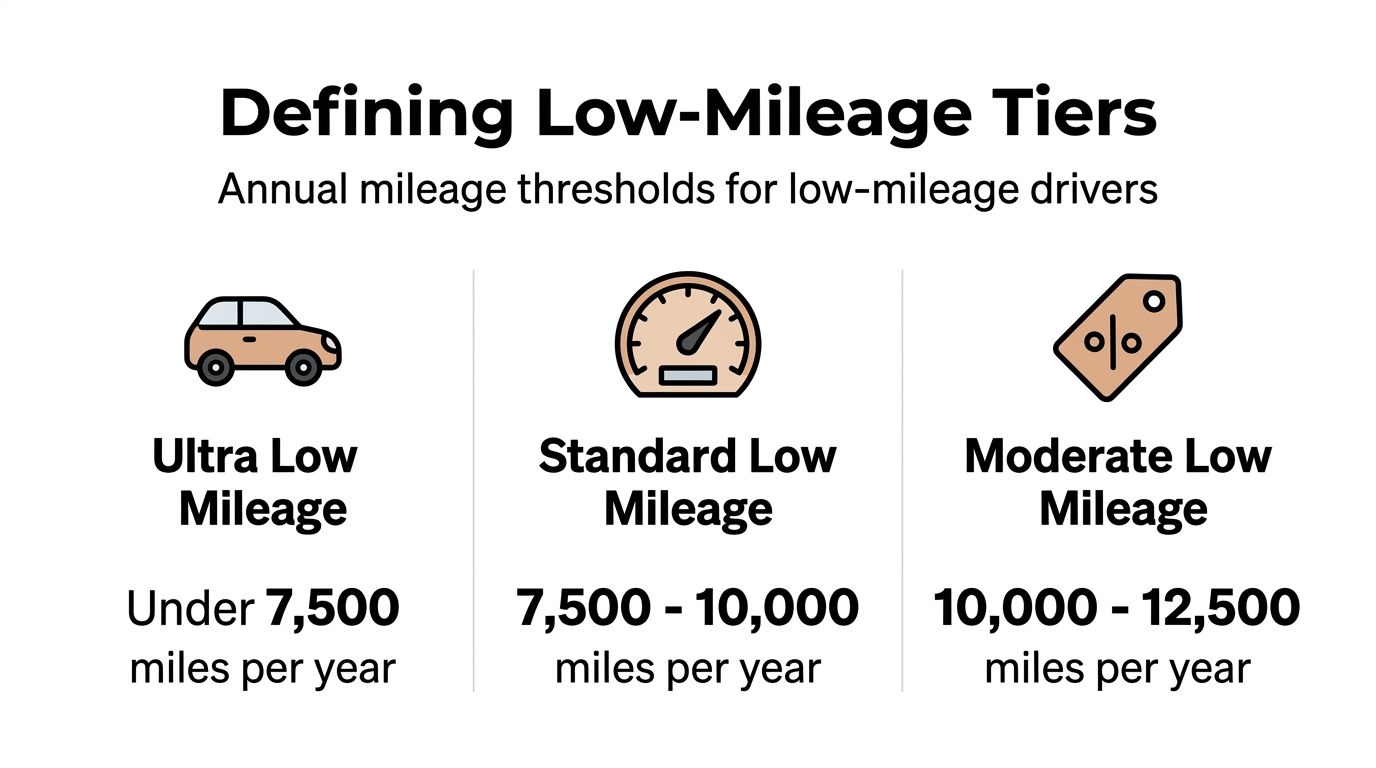
Insurers don't all use the exact same cutoff, but the broad pattern is consistent. Most insurers set the low-mileage threshold between 7,500 and 10,000 miles annually, and drivers under 5,000 miles per year may qualify for discounts as high as 15% to 30%, according to Acceptance's summary of major insurer practices.
That means the question isn't just "Do I drive less than average?" It's "Which mileage bucket do I fall into?"
The practical tiers most drivers fit into
Here's a clearer way to frame it:
Very low mileage
This is usually the driver under 5,000 miles a year. Think remote worker, retiree, or household with a second car used mostly for errands.Low mileage
This is often the driver between 7,500 and 10,000 miles a year. A student with a short campus commute or a hybrid worker often lands here.Borderline low mileage
Some drivers are just above the best tier but still below what many carriers consider standard use. These drivers need a closer look because one insurer may treat them better than another.
Quick self-check by lifestyle
A mileage estimate gets easier when you stop thinking in annual terms and start with weekly patterns.
| Driver type | Likely mileage pattern | Why it matters |
|---|---|---|
| Remote professional | Mostly local errands and occasional meetings | Often qualifies for the strongest low-mileage treatment |
| College student living near campus | Short recurring trips | May fit low-mileage tiers even with weekend driving |
| Two-car family with one spare vehicle | One car sits parked much of the week | That second vehicle may deserve separate rating treatment |
A car that's rarely used shouldn't be priced like the one that handles the entire household commute.
If you're not sure where you stand, gather a few months of odometer history, recent service records, and your rough weekly routine. Then compare your estimate against the tier your current carrier is using. Many people discover they qualify for better treatment than they thought.
For more California-focused insurance explainers beyond car insurance, this coverage guide library is a useful place to compare how auto, home insurance, renters insurance, and life insurance decisions fit together.
Pay-Per-Mile vs Traditional Low-Mileage Discounts
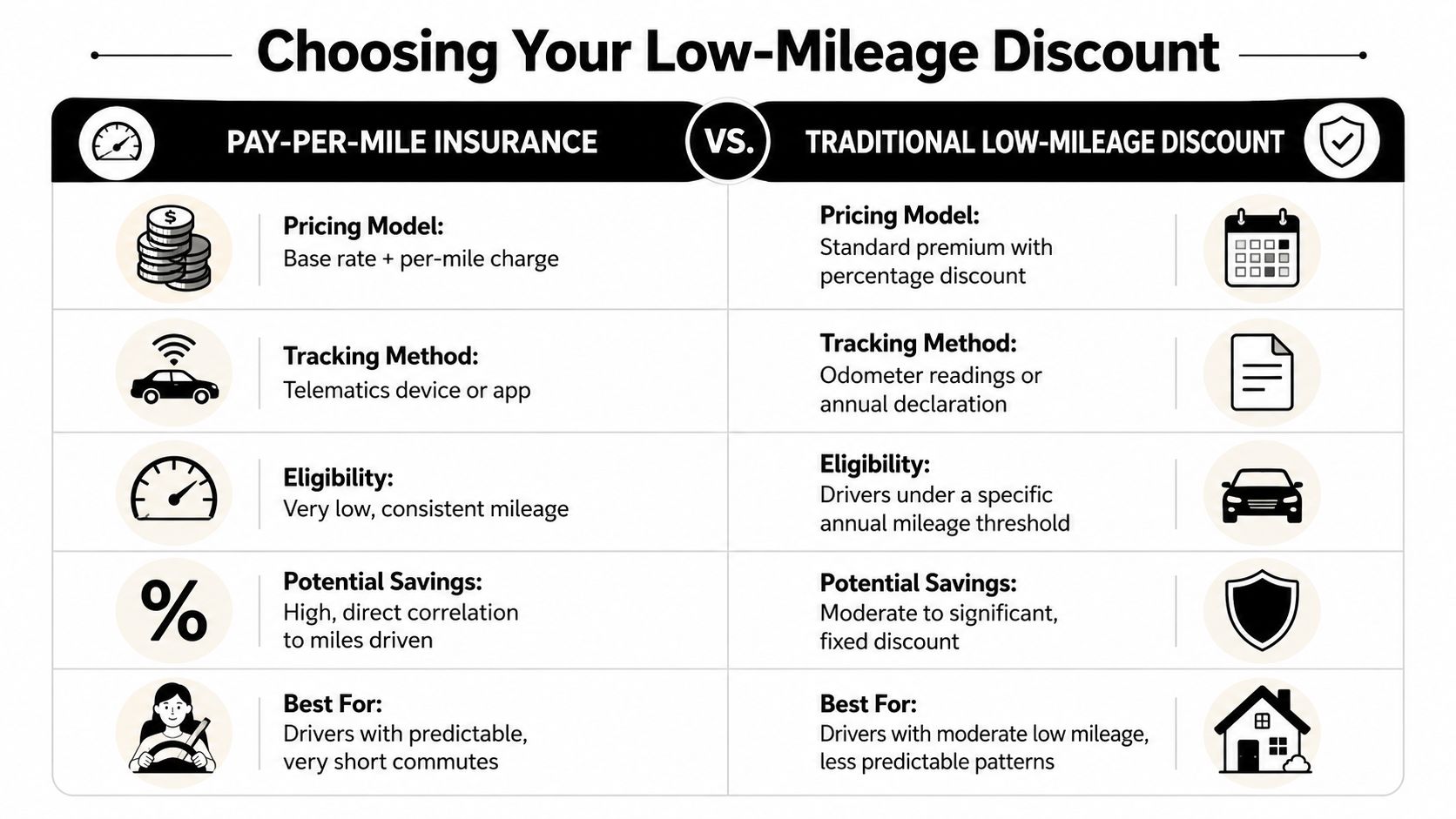
Once you know you're driving less, the next question is how you want that savings applied. There are two common paths. One is a traditional low-mileage discount added to a standard auto policy. The other is a pay-per-mile or usage-based setup, where pricing depends more directly on actual driving.
They're not interchangeable. The cheaper option on paper can become the wrong option if your driving pattern is inconsistent or if you hate tracking requirements.
How the two models work
A traditional low-mileage discount usually means you tell the insurer your expected annual mileage, and the carrier applies a lower rate if you fall within its qualifying tier. Verification may happen at new business, renewal, or during an audit.
A pay-per-mile structure is more active. The Wall Street Journal Buyside overview of low-mileage insurance describes this as a base rate plus a mileage rate, with an example of $0.10 per mile, and notes that drivers logging 3,000 miles per year may see about 8% savings, roughly $177 annually. That same overview also points out a practical issue many drivers miss. Seasonal shifts and occasional longer trips can throw off the expected benefit if you don't plan for them.
Best fit depends on your habits
A side-by-side view usually makes the choice easier:
| Decision point | Pay-per-mile | Traditional low-mileage discount |
|---|---|---|
| Monthly bill | Variable | More predictable |
| Mileage tracking | Usually telematics or app-based | Often odometer-based or self-reported |
| Privacy comfort | Lower for some drivers | Better for drivers who don't want continuous tracking |
| Best use case | Very consistent low-mileage use | Moderate low mileage with occasional fluctuations |
If your car is parked most days and your monthly driving is steady, pay-per-mile can make sense.
If you want a simpler renewal process and don't want your driving monitored trip by trip, a traditional discount usually fits better.
What works and what doesn't
What works is matching the policy style to the pattern, not chasing the most aggressive marketing language.
Works well for pay-per-mile
A driver with a predictable routine, limited use, and no issue with telematics or app tracking.Works well for traditional discounts
A household that drives less overall but still takes occasional weekend trips, holiday drives, or wildfire-related detours.Usually doesn't work
Choosing pay-per-mile because it sounds modern, then forgetting you have irregular travel. That can make budgeting harder.Also doesn't work
Understating mileage on a standard policy and hoping it never gets reviewed. That creates problems at renewal and can create claim headaches.
California drivers need to think about disruptions too. Wildfire season, road closures, remote work, and family schedule changes can all produce uneven mileage. For many people, that makes a fixed low-mileage discount more comfortable than a tightly tracked variable plan. For others, especially with a parked vehicle, usage-based pricing lines up better with reality.
Your Action Plan to Claim a Low-Mileage Discount
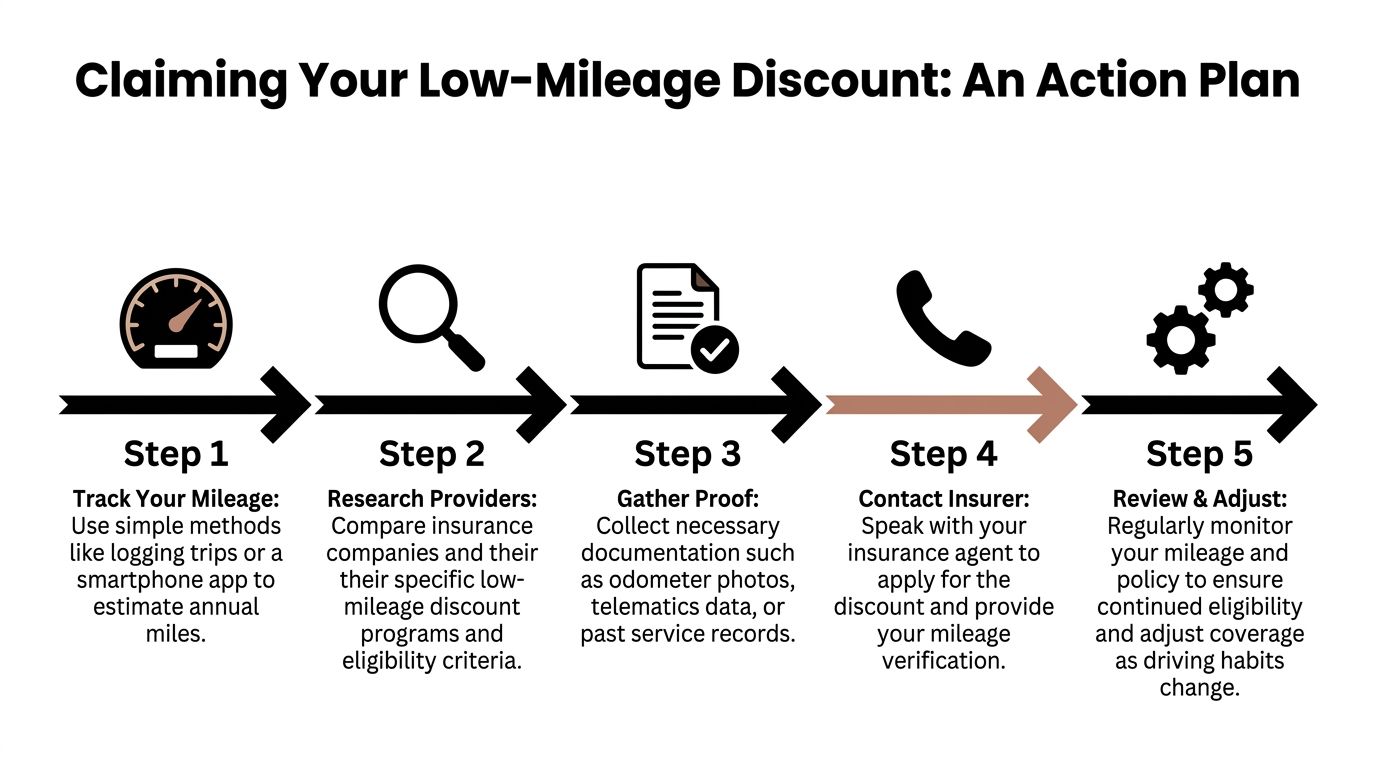
The hardest part isn't understanding the discount. It's documenting your mileage cleanly enough that the insurer treats it seriously. Good preparation saves time and gives your agent something concrete to work with.
Start with proof, not assumptions
Don't guess your mileage if you can avoid it. Build a file instead.
Odometer photos
Take a clear photo now, then again later. A simple time-spaced record is better than a verbal estimate.Service and maintenance records
Oil changes, tire rotations, and inspection paperwork often show mileage and help support your pattern.Calendar reality check
Note commute days, school runs, and seasonal changes. If you barely drove for a stretch because of remote work or wildfire smoke, that context matters.
The easiest discount to win is the one you can document without debate.
Ask the right questions when you call
When you speak with an insurer or broker, skip vague wording like "I think I drive less now." Ask direct questions:
- Can you review the annual mileage currently listed on my auto policy?
- What mileage threshold do you use for low-mileage rating in California?
- What proof do you accept if you need verification?
- Do you offer a traditional mileage discount, a telematics option, or both?
- Can this discount be combined with bundling?
That last question matters. According to Insurify's California discount overview, verified mileage discounts in California can offer up to 21% savings, and they can often stack with multi-policy discounts of up to 20% when bundling auto with home or renters insurance. For households already reviewing California insurance costs, that combination can be more powerful than chasing a single discount by itself.
Think in terms of total household insurance cost
A low-mileage discount shouldn't be reviewed in isolation if you also carry home insurance or renters insurance. Sometimes the better move isn't the cheapest auto policy on its own. It's the best combined outcome once you factor in bundling and cleaner policy alignment across the household.
A quick quote comparison helps. If you're reviewing auto insurance and also want to see how it pairs with renters insurance, home insurance, or even life insurance planning, you can start with a California insurance quote comparison and evaluate the full picture.
Common mistakes that cost drivers money
Some problems show up over and over:
| Mistake | Why it hurts |
|---|---|
| Leaving old commute mileage on file | You keep paying for use you no longer have |
| Giving an unrealistically low estimate | Verification problems can follow |
| Ignoring a second vehicle's low use | One underused car may deserve its own review |
| Shopping price without checking discount structure | A cheaper quote may still be rated on the wrong mileage basis |
The process doesn't need to be complicated. Track accurately. Ask direct questions. Compare structures, not just premiums. Then look for stacking opportunities across auto, renters, and home insurance.
Navigating California's Unique Insurance Landscape
California drivers don't all fit one pattern. A Los Angeles commuter, a Central Valley family with multiple cars, and a coastal retiree may all qualify for low-mileage treatment for different reasons. That's why generic national advice often falls short here.
Local conditions change how people use their cars. Hybrid work cut daily commuting for many households. Wildfire season can reduce driving for weeks in some areas because schools shift schedules, air quality worsens, or people consolidate trips. In dense areas, cars may move only for errands. In spread-out regions, one household vehicle may do most of the driving while another barely leaves the garage.
California savings can be dramatic when mileage drops
This isn't a minor rating issue. In California, the discount can be substantial when the mileage change is real. AIS Insurance's California mileage analysis states that drivers who reduce annual mileage from over 20,000 miles to 5,000 miles see an average discount of 29.4% on their auto premiums.
That kind of difference changes how you review a policy. It can justify revisiting not only car insurance, but how your broader California insurance portfolio is arranged, especially if you're also carrying home insurance in a wildfire-exposed area or renters insurance in a city where every monthly expense matters.

What Californians should watch closely
A California review should account for more than the odometer.
Commute reality
If your office schedule changed, update the policy. Carriers don't infer that from your ZIP code.Seasonal driving swings
Smoke events, road closures, and weather concerns can produce long low-use periods. Keep records if your annual pattern changed materially.Vehicle role in the household
A backup car, student car, or weekend-only vehicle may deserve a separate mileage conversation.Coverage pairing
Auto insurance should still fit with your home insurance, renters insurance, and life insurance decisions. Low mileage lowers road exposure, but it doesn't replace the need for solid coverage design.
For drivers in Southern California, local market differences also matter by area and carrier appetite. If you're comparing region-specific policy options, reviewing Los Angeles auto insurance considerations can help frame what local quoting looks like.
California rewards accurate mileage reporting more than many drivers realize. But the discount only helps if the carrier is using the right facts.
Frequently Asked Questions About Mileage Discounts
What documents actually prove mileage
An odometer photo helps, but it may not be enough by itself. According to this overview of mileage discount verification, insurers often default to 12,000 miles annually if a driver doesn't specify mileage, and some may require physical proof such as an odometer inspection report. In practice, accepted proof can also include maintenance receipts, service logs, or telematics program records if the carrier uses that method.
The safe approach is to keep more than one form of evidence. A current odometer image plus service paperwork is stronger than either one alone.
What if I start driving more after I get the discount
Report the change. Don't wait for renewal if the change is significant and likely to continue. A new job, longer commute, or family schedule change can move you out of the low-mileage tier, and it's better to correct the policy than let the insurer discover the mismatch later.
If the increase is temporary, ask how your carrier handles short-term spikes. Some plans are more forgiving than others.
Can a low-mileage discount apply to only one car on a multi-car policy
Often, yes. That's common in households where one vehicle is used for work and another is mostly parked. The key is making sure each vehicle is rated according to its actual use and primary driver pattern.
That review can also expose other opportunities. If one car is low-mileage and the household also carries renters insurance or home insurance, it may make sense to revisit the entire policy structure instead of treating the vehicle in isolation.
Mai & Associates helps California drivers compare auto insurance options built around real mileage, not outdated assumptions. If you're also reviewing home insurance, renters insurance, or life insurance, the agency can help you compare coverage across multiple carriers and identify practical bundling opportunities for your household. Start with a no-obligation review at Mai & Associates.