Your Guide to Low Cost Renters Insurance in California
Renting in California is a trade-off, isn't it? You get the sunshine and lifestyle, but it comes at a premium. The good news is, protecting your stuff doesn't have to be another high cost on the list. In fact, getting low cost renters insurance is shockingly affordable—we're often talking less than your monthly Netflix subscription. As experts in California insurance, we see it as a personal financial shield, stopping a small accident from snowballing into a full-blown crisis, whether you need renters insurance, auto insurance, or home insurance.
What Is Renters Insurance and Why Is It Essential in California
It’s easy to get this one wrong. Many people assume their landlord’s insurance has them covered, but that’s a dangerous misconception. The landlord's policy only protects the building itself—the walls, the roof, the pipes. It does absolutely nothing for your personal belongings or your financial liability.
So, if a fire breaks out, a pipe bursts and floods your living room, or someone trips and gets hurt in your apartment, you’re completely on your own without a renters policy. That’s where this simple, affordable insurance steps in. It's a crucial piece of the California insurance puzzle, designed to handle those "what if" moments that could otherwise drain your savings or push you into debt.
The Three Pillars of Protection
At its heart, even the most basic renters insurance policy stands on three powerful pillars of coverage. Once you understand them, you'll see just how much value is packed into such a small price tag.
- Personal Property Coverage: This is the part that covers your "stuff." It’s designed to help you repair or replace your belongings—electronics, clothes, furniture, you name it—if they’re stolen or damaged by a covered event like a fire or break-in.
- Personal Liability Coverage: Think of this as your "oops" fund. If you accidentally cause an injury to someone or damage their property (whether it happens in your apartment or not), this coverage protects your finances. It helps pay for legal fees and medical bills up to your policy limit.
- Additional Living Expenses (ALE): This is your lifeline if you're forced out of your home. If a disaster like a fire or major water leak makes your rental unlivable, ALE kicks in to cover necessary costs like a hotel, meals, and other essentials until you can move back in.
Here's the thing: most renters don't realize how quickly the value of their belongings adds up. You might think you don't own much, but when you start tallying up your laptop, phone, TV, furniture, and entire wardrobe, the total replacement cost can easily hit $20,000 to $30,000. A good renters policy protects that entire amount.
And it’s more affordable than ever. Across the country, the average annual premium is just $188, which shows just how accessible this critical protection has become.
What Your Renters Insurance Dollar Buys You
So, let's break down exactly what that small monthly payment gets you. For the cost of a few coffees, you’re buying real peace of mind. Our guide to renters insurance in California dives deeper, but the table below gives you a fantastic snapshot.
| Coverage Type | What It Protects | Example Scenario |
|---|---|---|
| Personal Property | Your belongings (furniture, electronics, clothes) | A thief breaks into your apartment and steals your laptop and television. |
| Personal Liability | Your assets from lawsuits if you're at fault | A guest slips on a wet floor in your kitchen, breaks their arm, and sues you. |
| Additional Living Expenses | Costs if your rental becomes unlivable | A kitchen fire forces you to live in a hotel for two weeks while repairs are made. |
As you can see, each piece of coverage is designed to handle a common, real-world risk that renters face every day. It’s a small investment for a massive amount of financial security.
Deconstructing Your Renters Insurance Policy
At first glance, a renters insurance policy can look like a wall of legal text. It’s easy to feel overwhelmed, but the truth is, it’s much simpler than you might think. A standard policy really boils down to three core protections, each one designed to be a financial safety net for different "what if" scenarios.
I like to explain it as a three-legged stool—if one leg is wobbly or missing, the whole thing loses its stability. To be truly protected, your policy needs all three components. Let's pull them apart so you can see exactly what your low cost renters insurance is doing for you.
Personal Property Coverage: Your "Stuff" Insurance
This is probably the part of the policy you’re most familiar with. Personal Property Coverage is all about protecting your belongings—your couch, TV, clothes, laptop, kitchen gadgets, you name it. If your things are stolen, or get damaged or destroyed in a covered event like a fire or a burst pipe, this coverage is what helps you pay to replace them.
Here's a classic California example: A thief breaks into the shared garage of your Los Angeles apartment complex and makes off with your high-end bicycle and some tools. Without insurance, that loss comes straight out of your pocket. With a renters policy, you just file a claim, pay your deductible, and your insurance helps cover the rest, right up to your coverage limit.
Your landlord’s insurance policy does not cover any of your personal belongings. It only protects the physical building itself. This is a critical distinction and the number one reason why having your own Personal Property Coverage is so essential.
Personal Liability Coverage: Your "Oops" Insurance
Accidents happen. This is the coverage that protects you and your finances when you’re found legally responsible for accidentally injuring someone else or damaging their property. Think of it as your "oops insurance," and it follows you, whether the incident happens inside your rental or out and about.
Let’s say you’re having friends over to your San Diego apartment, and someone slips on a spilled drink, breaking their wrist. It's an honest mistake, but they now have medical bills and decide to sue you to cover the costs.
This is where your Personal Liability Coverage is a lifesaver. It steps in to help pay for:
- Their medical bills.
- The legal fees to defend you in court.
- Any settlement or judgment made against you, up to your policy limit.
One simple accident could otherwise spark a lawsuit that threatens your savings and future income. This kind of protection is a non-negotiable part of any solid California insurance plan, from auto insurance to home insurance. If you come across terms in your policy that aren't clear, you can always check out our handy insurance glossary.
Additional Living Expenses: Your Relocation Fund
The final pillar of your policy is the lifeline you need if a disaster makes your rental uninhabitable. Additional Living Expenses (ALE) coverage helps pay for the necessary, above-and-beyond costs you rack up while your apartment is being repaired. It’s what allows you to maintain your normal standard of living without financial panic.
Imagine a wildfire forces a mandatory evacuation in your Northern California town. Even if your apartment building is untouched, you might not be allowed back for days or even a week.
ALE would reimburse you for reasonable costs during that time, such as:
- A hotel room or a short-term rental.
- Restaurant meals since you don't have a kitchen.
- Coin laundry, storage fees, and other essentials.
This coverage turns a major displacement into a manageable inconvenience, preventing a temporary setback from becoming a full-blown financial crisis. Together, these three protections form a powerful safety net, making even a basic low cost renters insurance policy one of the smartest investments a California renter can make.
How Much Does Low-Cost Renters Insurance Actually Cost in California?
Let's clear the air on one of the biggest misconceptions about renters insurance: the cost. When we talk about "low-cost" policies, we really mean it. Many California renters think it's another big monthly bill, but the reality is that a great policy is one of the most affordable financial safety nets you can get.
For the vast majority of renters in the Golden State, a solid policy will only set you back between $15 and $30 per month. Think about that—it’s probably less than you spend on a couple of streaming services or a single meal delivery. For the price of a few coffees, you're protecting yourself from financial hits that could otherwise run into the tens of thousands.
This small monthly payment buys you a surprising amount of protection, covering your personal belongings, liability, and even temporary housing if you're forced to move out.
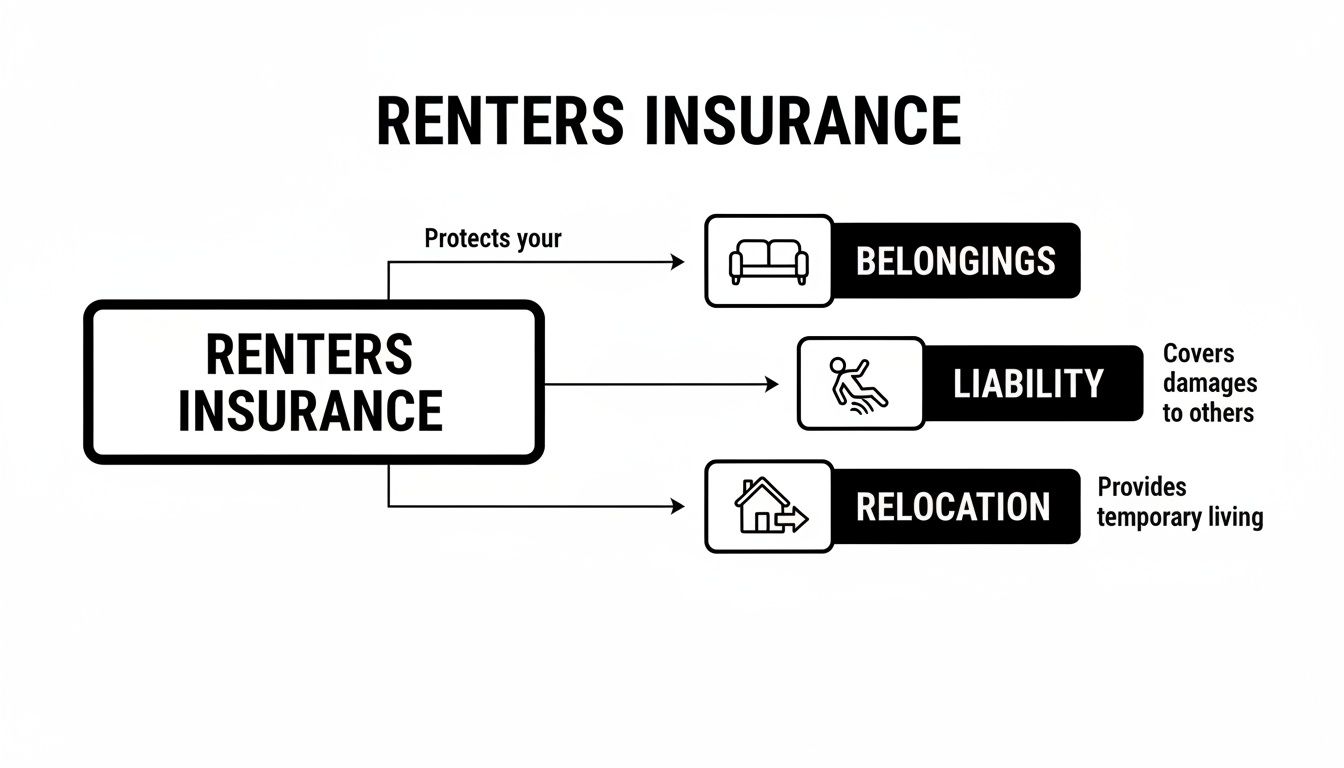
As you can see, one affordable policy acts as a shield against a whole range of common rental mishaps. So, what actually determines whether you pay closer to $15 or $30? Let's dive into the factors that shape your final price for California insurance.
What Goes Into Your Renters Insurance Rate?
Your premium isn't just a number pulled out of a hat. It's a personalized price calculated based on your specific situation, much like it is for auto insurance or home insurance. When you understand what drives the cost, you can make smarter decisions to find a lower rate.
An insurer’s main job is to assess risk. The factors they look at all point back to one question: what is the likelihood that you’ll need to file a claim? The table below breaks down the key variables that influence your premium.
| Factor | Impact on Premium | Example |
|---|---|---|
| Coverage Amount | High | The more stuff you own, the more it costs to insure. Covering $50,000 in property will cost more than covering $15,000. |
| Location | Variable | Renting in a high-crime neighborhood or a severe wildfire zone will likely raise your rate compared to a low-risk area. |
| Your Deductible | High | A higher deductible (e.g., $1,000) means you pay more out-of-pocket on a claim, which lowers your monthly premium. |
| Claims History | Moderate | A history of frequent claims can signal higher risk to an insurer, potentially increasing your rate. A clean record helps keep it low. |
| Safety Features | Moderate | Having a security alarm, smoke detectors, or sprinklers in your rental can often earn you a discount. |
| Credit-Based Score | Moderate | In California, a strong financial history often correlates with fewer claims, which can lead to a lower premium on your renters insurance policy. |
As you can see, your final price tag is a blend of your choices (like coverage limits and deductibles) and circumstances (like where you live).
A Deeper Look at What Influences Your Rate
Beyond that table, it helps to think about how these factors connect. Insurers are always trying to predict the future, and your personal details give them clues.
For example, your location isn't just about crime statistics. It also includes exposure to natural disasters like wildfires or floods, which are major concerns in California. Similarly, the amount of coverage you select is the biggest lever you can pull to adjust your cost. Before you get a quote, it's a great idea to do a quick home inventory to get a realistic estimate of what your belongings are worth. Most people are surprised to find their stuff is worth more than they thought.
The deductible is another key dial you control. Think of it as your share of the cost when something goes wrong. If you choose a $1,000 deductible instead of $500, you’re telling the insurance company you’re willing to handle smaller losses yourself. In return, they give you a lower premium.
Finally, things like your claims history and credit-based insurance score paint a picture of reliability. A track record of responsibility—both financially and with past insurance policies—suggests you're a lower risk. This often translates directly into savings, not just for renters coverage but also for things like your car insurance policy. Understanding these pieces of the puzzle empowers you to find the most affordable, high-quality coverage for your needs.
Proven Strategies to Lower Your Renters Insurance Premium
Knowing the average cost of renters insurance is just the starting point. The real magic happens when you learn how to actively drive that price down. Getting an affordable policy isn't about cutting corners or settling for flimsy coverage; it's about being a smart shopper who knows where to find the best value for all your California insurance needs.
Think of it like a treasure hunt. The discounts are out there, but you have to know where to look and what to ask for. With a few proven strategies, you can trim your monthly premium while keeping your financial safety net fully intact.
Bundle Your Insurance Policies for Big Savings
This is the first tip I give everyone for a reason—it’s the easiest and most effective way to get a significant discount. Bundling simply means you buy your renters insurance and your auto insurance from the same company. Insurers reward that loyalty with some of their best pricing.
It's a lot like buying in bulk at a warehouse store. You get a better price per item when you buy the whole case, and insurance works the same way. When you commit to more than one policy, the carrier gives you a better rate on each one. This strategy is a cornerstone for saving on California insurance, whether you are bundling car insurance and renters insurance or home insurance and auto insurance.
This is where working with an independent agency like Mai & Associates really pays off. We aren't stuck with just one company's bundle. We can mix and match policies from several top-rated carriers to find the absolute best value on a car insurance and renters combo for you, opening up far more savings opportunities.
Adjust Your Deductible Thoughtfully
Your deductible is the amount you agree to pay out of your own pocket for a claim before your insurance kicks in. This creates a classic trade-off: a higher deductible will lower your monthly premium, while a lower deductible will cost you more each month.
So, which one is right for you? It comes down to a quick check of your finances.
- Check the savings: Ask your agent for quotes with different deductibles, like $500 versus $1,000. See exactly how much you'd save on your premium over the entire year.
- Check your emergency fund: Be honest with yourself. Could you comfortably write a check for the higher deductible amount tomorrow if something happened?
- Make your move: If the annual savings are worth it and you have the cash set aside to cover that higher deductible, it's often a great way to lower your monthly bill.
For example, if raising your deductible from $500 to $1,000 saves you $60 a year, you’re effectively getting a 12% return on that extra $500 of risk you're taking on. For most people, that's a smart financial exchange. You'll find more practical tips like this in our other guides to California insurance.
Ask About Every Available Discount
On top of bundling, insurers have a whole menu of other discounts that can chip away at your premium. The key is that you usually have to ask for them. Don't be shy—run through this checklist with your agent to make sure you're not leaving money on the table.
- Safety and Security Devices: Do you have deadbolt locks, a smoke detector, a fire extinguisher, or a burglar alarm? Each of these can often get you a small discount because they lower your risk.
- Claims-Free History: If you haven't filed a claim in the last three to five years, you should qualify for a discount. It’s the carrier’s way of rewarding you for being a safe customer.
- Professional & Alumni Groups: Many companies offer special rates for members of certain alumni associations, professional organizations, or credit unions.
- Autopay & Paperless Billing: This is an easy one. Signing up for automatic payments or getting your documents electronically almost always knocks a few more dollars off your bill.
Every dollar adds up. Taking a few minutes to explore these discounts ensures you get the most competitive rate possible, whether you’re insuring your apartment, your first home with home insurance, or your future with life insurance.
Avoiding Critical Coverage Gaps in California
Everyone wants a good deal, but chasing the absolute lowest price on insurance can be a trap. The cheapest policy is often the weakest one, and when you’re hunting for low cost renters insurance, it's easy to end up with dangerous gaps in your coverage. A policy that’s too lean can leave you financially shattered after an accident, turning a minor mishap into a major crisis.
Here in California, with our unique risks, being underinsured is a gamble you just can't afford to take. The real goal is to find that sweet spot: a policy that’s both affordable and strong enough to actually protect you. It starts with knowing where the common pitfalls are in any California insurance product, from renters insurance to life insurance.
Is Your Liability Coverage Enough for California?
One of the most common and dangerous gaps in a bare-bones renters policy is skimping on liability coverage. Many basic policies default to a limit of $100,000. That might sound like a big number, but in a state as litigious as California, it can disappear in the blink of an eye.
Think about it: what if your dog nips a visitor, or a friend trips and gets seriously hurt in your apartment? Medical bills and legal fees can rocket past $100,000 faster than you can imagine.
If a claim against you goes over your liability limit, you’re on the hook for the rest. That could mean having your wages garnished or your savings wiped out. For real peace of mind, most Californians should be looking at a liability limit of at least $300,000, if not $500,000.
Right-Sizing Your Personal Property Limits
Another mistake I see all the time is people drastically underestimating the value of their belongings. It's easy to think, "I don't own that much," but once you start adding it all up, the real number is often a shock. Your furniture, laptop, clothes, kitchen gadgets, and bike can easily total $20,000, $30,000, or more.
Choosing a policy with just $10,000 in personal property coverage to save a few bucks a month could be a disaster after a fire or burglary. You’d be left trying to replace $30,000 worth of your life's essentials with only a third of the money you need. The only way to know for sure is to do a thorough home inventory.
The Elephant in the Room: Earthquake and Flood Coverage
This is probably the single most critical coverage gap for any California renter to understand. Your standard renters insurance policy does not cover damage from earthquakes or floods. This isn't some tricky fine print; it's a fundamental exclusion built into nearly every standard policy, including home insurance.
Given California's shaky ground and regional flood risks, ignoring these perils is a massive financial gamble. To get protection, you have to add it on with separate policies or endorsements:
- Earthquake Insurance: This is almost always a separate policy you must buy. It comes with its own deductible, which is typically a percentage of your coverage limit—usually between 5% and 25%.
- Flood Insurance: This is another separate policy, often available through the National Flood Insurance Program (NFIP) or a private insurer.
It's also crucial to know what your landlord's policy covers. A common misconception is that their insurance protects you, but it only protects the building itself—not your belongings or your liability. You can learn more by checking out a landlord insurance comparison guide for California rentals to see how their coverage leaves you responsible for these exact risks.
Navigating these nuances is where having an expert on your side, like the team at Mai & Associates, makes all the difference. We can help you pinpoint these critical gaps and secure the right add-on policies for your specific location, ensuring you’re fully protected without overspending.
Your Step-By-Step Guide to Getting the Best Quote

Alright, you know what goes into a policy and the common traps to sidestep. Now for the most important part: getting a quote that actually makes sense for you.
This isn't just about chasing the lowest number. It's about finding the sweet spot where great coverage meets a price you can feel good about. Following a few simple steps takes all the guesswork out of the equation and puts you in control.
Step 1: Take a Quick Home Inventory
Before you even think about getting a quote, you need a realistic idea of what you’re insuring. The single biggest mistake renters make is underestimating the value of their stuff. A quick inventory is the perfect fix.
Don’t worry, you don’t need a complicated spreadsheet. Just grab your smartphone and do a walkthrough.
- Take photos or a quick video of each room. Get wide shots and then zoom in on the important things.
- Jot down a list of your big-ticket items—think your laptop, TV, bike, sofa, and any jewelry or collections.
- Do a quick search online to estimate what it would cost to replace them today, not what you paid for them.
You’d be surprised how quickly it all adds up. Most renters find their belongings are worth somewhere between $20,000 and $40,000. Walking into the quoting process with an actual number ensures you don’t end up underinsured.
Step 2: Gather Your Basic Information
Next, pull together a few key details about your rental. Insurance companies need this to figure out their risk, which directly impacts your price. Having this handy will make everything go much smoother.
Be ready with:
- Your complete rental address.
- The type of building you live in (e.g., a large apartment complex, a duplex, a rented house).
- Any safety features you have, like smoke detectors, a fire extinguisher, or a burglar alarm. These can often get you discounts!
Step 3: Let an Independent Agent Do the Shopping
Here’s the real pro-tip for finding genuine low cost renters insurance. Instead of spending your weekend calling a dozen different companies and repeating yourself over and over, let an independent agent do the legwork for you.
This is, hands down, the smartest way to save time and compare the market. An agency like Mai & Associates works for you, not for a single insurance company.
We shop rates from numerous top-tier insurance carriers at once. This gives you a clear, side-by-side comparison without the hassle, ensuring you find the perfect blend of comprehensive coverage and affordability for your renters insurance, home insurance, or car insurance needs.
With our deep roots in the California market and multilingual support, our team handles all the heavy lifting. We know the local landscape and can find a policy that truly protects your life here. Ready to see what’s possible?
You can easily request a free insurance quote from our team to get started.
Answering Your Top Questions About Low Cost Renters Insurance
When you're looking for renters insurance, a few questions always pop up. It's totally normal. Here are the answers to the ones we hear most often from California renters just like you.
My Landlord Has Insurance. Why Do I Need My Own?
This is easily the most common question, and the answer is simple: your landlord's policy protects their property, not yours.
Think of it this way: if a pipe burst and flooded your apartment, their insurance would pay to fix the walls and floors. But what about your ruined sofa, TV, and laptop? That’s where your own low cost renters insurance policy steps in to cover the cost of replacing your personal belongings. It's a fundamental concept in California insurance that separates landlord and tenant responsibility.
How Much Coverage Do I Really Need for My Stuff?
It's almost always more than you think. The quickest way to get a solid number is to do a quick walk-through of your place.
Jot down your big-ticket items—furniture, electronics, clothes, kitchen gear—and make a rough estimate of what it would cost to buy them all again today. For most people, that number lands somewhere between $20,000 and $30,000. That's a great starting point for your personal property coverage.
This principle of knowing what you need to protect is universal. It’s the foundation for any good California insurance plan, whether it’s home insurance for a house you own or even life insurance to protect your family’s future.
What’s the Deal with Roommates? Can We Share a Policy?
While some insurance companies let you share a policy, we usually advise against it. It can get messy, fast.
If you share a policy, you also share your coverage limits. Even worse, if your roommate files a claim, it goes on your insurance record, too. It’s much cleaner and safer for each person to have their own policy. This way, everyone's property and liability are covered separately.
If Someone Breaks Into My Car, Is That Covered?
This is a great question that shows how different policies work together. Your auto insurance or car insurance covers damage to the car itself, like a broken window.
But your renters insurance is what protects your stuff, no matter where it is. So if a thief smashes your car window and steals the laptop you left on the seat, your renters policy would cover the cost of a new laptop (after you pay your deductible, of course). This is a perfect example of how car insurance and renters insurance complement each other to provide full protection.
Finding that sweet spot between great coverage and a low price is exactly what we specialize in. The team here at Mai & Associates is ready to walk you through your options and find a policy that fits your life and your budget.