Low Cost Auto Insurance: Save Big on California Car Insurance
Finding affordable low cost auto insurance in California can feel like trying to solve a tough puzzle. But here’s the secret: the real win isn't just snagging the lowest price, but building a car insurance policy that truly protects you without making your wallet cry.
Finding Affordable Car Insurance in California
When people hear "low cost," they often picture a flimsy, bare-minimum policy that just checks a legal box. And while meeting the state's requirements is a must, true value in California insurance comes from striking the right balance between cost and coverage.
Think of it this way: you wouldn't build a house with the cheapest, weakest materials just to save a buck, because you know it wouldn’t hold up in a storm. Your auto insurance is that same kind of financial shelter, and you want it to be there for you when you need it most.
This guide is your roadmap to finding that sweet spot. We’ll pull back the curtain on how insurance rates are calculated and show you how a few smart, simple moves can lead to serious savings. Once you understand how the system works, you're no longer just accepting a price—you're making an informed choice.
What You Will Learn
We’ve designed this article to give you practical, real-world advice. We’ll walk through the essentials so you can confidently find protection that fits your budget.
Here’s what we’ll cover:
- Understanding State Minimums: We'll look at what California legally requires for car insurance and, more importantly, why that might not be enough to protect you.
- Key Premium Factors: Discover the exact details insurers look at when they decide how much you’ll pay.
- Actionable Savings Strategies: Get proven tips, from bundling your auto insurance with home insurance or renters insurance to finding every last discount you qualify for.
- Quote Comparison Techniques: Learn how to line up quotes side-by-side to make a true apples-to-apples comparison.
Your goal should be to build a policy that fits both your life and your budget. By exploring all your options for auto insurance in California, you can save money now while making sure you’re properly protected for whatever happens down the road.
At the end of the day, getting genuinely low-cost car insurance comes down to making smart, informed decisions. Every choice, from adjusting your deductible to bundling policies, plays a part in your final premium.
Working with an independent agency like Mai & Associates gives you a huge advantage. We act as your guide, navigating California's crowded insurance market to find you the best fit. We do the heavy lifting by comparing rates from multiple carriers, finding that ideal policy that gives you peace of mind without breaking the bank.
Understanding California's Minimum Insurance Laws

When you start shopping for low cost auto insurance, the first thing you need to get a handle on is what California legally requires. The state has a mandatory liability coverage law, often boiled down to a simple set of numbers: 15/30/5. But what does that really mean for you?
Think of it as the absolute floor—the bare minimum you need to drive without breaking the law. This coverage is designed to pay for the damage you cause to other people and their property, not for repairs to your own car.
Deconstructing The 15/30/5 Rule
Let's pull apart what those numbers in the 15/30/5 rule actually stand for. It’s less complicated than it seems and clearly outlines what your policy will pay out if you're at fault in an accident.
- $15,000 for injury or death to a single person.
- $30,000 for injury or death to more than one person in one accident.
- $5,000 for damage to someone else's property (like their vehicle).
This is the legal starting line. The problem is, with today's sky-high costs for medical care and car repairs, these limits can be used up in a heartbeat after a serious crash. Once the insurance money runs out, you're on the hook for the rest.
Moving Beyond The Bare Minimum
While sticking to the state minimum keeps you legal, it often falls short of protecting your financial future. Let's be realistic: imagine you cause an accident that totals a brand-new SUV and injures the driver. That $5,000 property damage limit won't even make a dent in replacing a modern car, and $15,000 for injuries might barely cover the ambulance ride and initial ER visit.
This is exactly why we talk about optional coverages. They're what turn a basic policy into a real safety net. The two most common and crucial additions are Collision and Comprehensive.
Collision coverage is for your car. It helps pay for repairs if you hit another vehicle or an object, no matter who's at fault. Comprehensive coverage handles the unexpected stuff—theft, vandalism, fire, or hitting a deer. It covers damage from things other than a crash.
Another incredibly important piece of the puzzle is Uninsured/Underinsured Motorist (UM/UIM) coverage. This steps in to protect you if you're hit by a driver who has no insurance at all or not enough to cover your medical expenses.
The global motor insurance market is always evolving, with new tech making policies more accurate and affordable. You can see some of the trends shaping the global insurance market on mexc.com. But at the end of the day, finding the right balance between what's legally required and what gives you true peace of mind is what smart California insurance planning is all about.
What Really Drives Your Car Insurance Rate?
Ever get a car insurance quote and wonder where that number actually comes from? It’s not just pulled out of thin air. Think of it as a custom price tag based on a handful of key details about you, your car, and where you live. Getting a handle on these factors is the first step to finding genuinely low cost auto insurance in California.
Insurance carriers are essentially trying to predict how likely you are to file a claim. Some of the ingredients in their calculation are things you can change, while others are fixed. Once you understand what they’re looking at, you can start making smart moves to lower your premium.
Your Driving Record and Habits
This one’s the biggie. Your driving history is the single most important factor you can control. A clean record—no recent accidents, no tickets—is like gold to an insurance company. It tells them you’re a safe bet, and they’ll reward you with their best rates.
On the flip side, a history of speeding tickets, at-fault accidents, or especially a DUI will send your premiums soaring. These are red flags that signal a higher risk of future claims. The good news? Your record isn't a life sentence. A few years of safe, focused driving can make a huge difference and bring your costs back down to earth.
Where You Park Your Car
It might seem strange, but your home address plays a surprisingly big role in what you pay for car insurance. Insurers use your ZIP code to assess the risks specific to your neighborhood.
For instance, someone living in a dense part of Los Angeles will almost always pay more than a driver in a quiet, rural town. Why? It comes down to statistics. Cities tend to have higher rates of:
- Theft and Vandalism: More cars packed together means more opportunities for crime.
- Accidents: Simply put, more traffic leads to more fender-benders.
- Litigation Costs: In some areas, the cost to settle claims and handle lawsuits is just higher.
The Car You Drive
The make, model, and year of your vehicle are also major pieces of the puzzle. A flashy new sports car is going to cost a lot more to insure than a practical, used sedan. It’s simple economics.
Insurers look at a car's sticker price, how much it typically costs to repair, its safety ratings, and how often it gets stolen. If you're considering a new vehicle, it's also smart to understand the full costs and payback of an electric car, as these details feed into the overall insurance calculation.
Key Takeaway: You can't change your age or move to a new city just to save on insurance. But you do have direct control over your driving habits and the car you choose. These are the two most powerful levers you can pull to find more affordable coverage.
Actionable Strategies to Lower Your Insurance Costs
Alright, now that you know what goes into your premium, let's get to the good part: how to actually lower it. Getting genuinely low cost auto insurance in California isn't about finding some magic trick; it's about being strategic and proactive. Think of it like a checklist—each item you tick off can chip away at what you pay every month.
These aren't just theories; they're proven, practical steps you can take today. From making a few simple phone calls to adjusting your policy with a bit of know-how, you have more control over your California insurance costs than you might think.
Unlock Every Available Discount
Here’s a little insider secret: insurance companies have a long list of discounts, but they don't always hand them out automatically. You often have to ask. If you don't, you could be leaving money on the table. Be your own best advocate and make sure you're getting every penny of savings you deserve.
Some of the heaviest hitters when it comes to discounts include:
- Good Driver Discount: This is a big one in California. If you've kept your record clean of accidents and tickets for a few years (usually three to five), you're in line for a serious price break.
- Good Student Discount: Got a student on your policy hitting the books? If they maintain a "B" average or higher, most insurers will reward that responsibility with a nice discount.
- Multi-Policy Discount: Bundling is almost always a winner. When you combine your auto insurance with your home insurance, renters insurance, or even a life insurance policy from the same company, the savings can be substantial.
These are just the start. It’s always worth asking an agent to do a full discount review.
Common Auto Insurance Discounts in California
To help you get started, here's a quick checklist of common discounts available in California. Run through this list and see which ones might apply to you—then, make sure to ask your agent about them specifically.
| Discount Type | Who Is Eligible? | Potential Savings |
|---|---|---|
| Multi-Policy (Bundling) | Customers with multiple policies (auto, home insurance, renters insurance) from the same insurer. | 10% - 25% |
| Good Driver | Drivers with a clean record for 3-5 years (no at-fault accidents or major violations). | 15% - 20% |
| Good Student | Full-time students (usually under 25) with a "B" average or better. | 5% - 15% |
| Defensive Driving Course | Drivers (often seniors or young drivers) who complete an approved course. | 5% - 10% |
| Anti-Theft Device | Vehicle owners with factory-installed or aftermarket alarms, immobilizers, or tracking systems. | 5% - 20% |
| New Car Discount | Owners of vehicles that are less than three years old. | Up to 10% |
| Paid-in-Full | Policyholders who pay their entire premium upfront instead of in monthly installments. | 5% - 10% |
| Paperless Billing | Customers who opt for electronic statements and communication. | A few dollars per month |
Remember, availability and savings vary by company, so a direct conversation is the best way to confirm what you qualify for.
Adjust Your Policy with Confidence
Discounts are great, but you can also find savings by making smart tweaks to your actual policy. The two most powerful levers you can pull are your deductible and your coverage levels.
Your deductible is simply the amount you agree to pay out-of-pocket for a claim before the insurance company starts paying.
Think of it this way: if you have a $1,000 deductible and get into an accident that causes $4,000 in damage, you cover the first $1,000. The insurer handles the remaining $3,000. By raising your deductible from, say, $500 to $1,000, you’re telling the insurer you're willing to share more of the risk. They'll almost always reward that with a lower premium.
Embrace Modern Insurance Options
The insurance world is finally catching up with technology, and that can mean more savings for you. Telematics, or usage-based insurance, is the perfect example. These programs use a small device you plug into your car or a smartphone app to monitor your actual driving habits—things like how many miles you drive, how hard you brake, and how quickly you accelerate.
If you’re a careful driver who doesn't rack up a ton of miles, this data is your proof. It can unlock personalized discounts that truly reflect how safe you are on the road, making it a fantastic way to get low cost auto insurance. While national trends show rates are beginning to stabilize, with full coverage averaging $178 per month in January 2026, how you drive is what matters most to your bottom line. You can read more about recent auto insurance rate trends on cbtnews.com. By taking advantage of these modern tools, you can make sure you’re paying a price that’s fair for you.
How to Effectively Compare Car Insurance Quotes
Shopping for low cost auto insurance in California often feels like you're lost in a maze. You see dozens of different prices and policies, but how can you be sure you’re actually getting a good deal? The real secret lies in making a true "apples-to-apples" comparison, where every quote is for the exact same level of protection.
Getting quotes is easy. But just grabbing the lowest number is one of the biggest mistakes you can make.
Picture this: you have two quotes in hand. One is for $120 a month, and the other is $150. The cheaper one seems like a no-brainer, right? But look closer. It might only have a flimsy $5,000 property damage limit and a massive $2,000 deductible. You'd be dangerously exposed. That more expensive quote, on the other hand, could offer the kind of solid protection that saves you thousands if you ever get into a serious accident.
To avoid that trap, you have to insist that every single quote has identical details. This is where working with an independent agency like Mai & Associates really makes a difference. We do all the heavy lifting for you, gathering quotes from our network of carriers that all match the specific coverage levels, limits, and deductibles you actually need for your auto insurance. We can even do the same for bundled home insurance or renters insurance policies.
Look Beyond The Price Tag
Once you have a stack of comparable quotes, the final step is to look at more than just the cost. A cheap policy from an insurance company with a horrible reputation for paying claims isn't a bargain—it's just a future headache waiting to happen.
This infographic breaks down the core strategies for finding affordable coverage that you can actually count on.
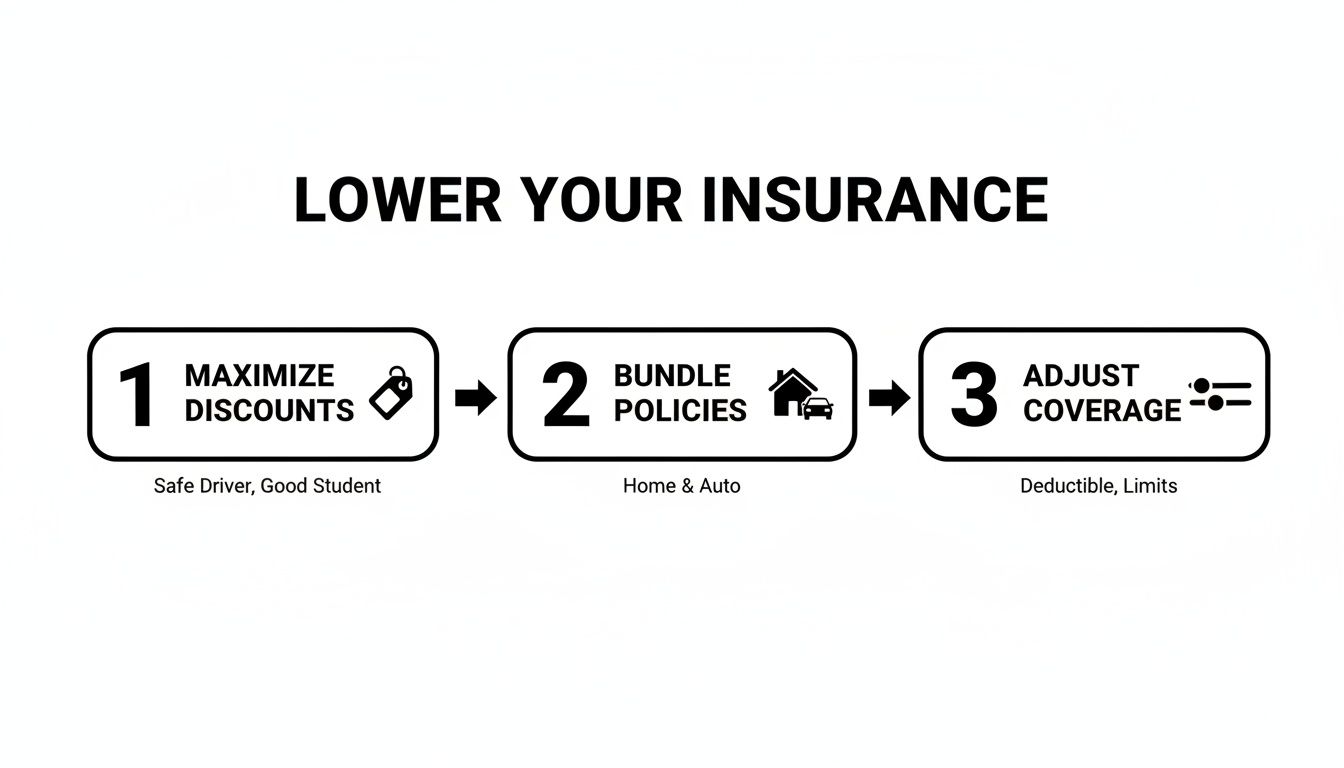
As the visual shows, the most powerful path to savings comes from a combination of three things: asking for every discount you qualify for, bundling your policies, and making smart adjustments to your coverage.
It also helps to know where the market is heading. The average cost for full coverage auto insurance is around $208 per month, or about $2,496 annually. This shows a slight increase from last year, making smart shopping even more critical.
Key Takeaway: The best California insurance policy is a perfect blend of three things: a price you can afford, protection that actually protects you, and a company that has your back when you need them most.
By following this approach, you can confidently pick a policy that gives you genuine value and, more importantly, peace of mind. To see how it works, you can request a no-obligation insurance quote from Mai & Associates, and we'll help you compare your best options side-by-side.
Why a Local California Agency Is Your Best Ally

Sure, online quote tools are quick and easy. But when it comes to something as important as your insurance, nothing beats having a real person on your side—especially in a place like California.
Finding low cost auto insurance here isn’t just about the price tag. It’s about understanding the unique risks we face, from bumper-to-bumper traffic on the 405 to the constant threat of wildfires. That’s where a local, independent agency really shines. We’re your personal guide through it all.
Think about it: instead of spending hours calling a dozen different carriers and repeating your story over and over, you just make one call to us. At Mai & Associates, we do the legwork for you. We compare policies from multiple top-rated companies to find the best fit for your auto insurance, home insurance, or even life insurance. It saves you a massive amount of time and guarantees you’re seeing the whole picture.
We Speak Your Language
California’s diversity is one of its greatest strengths, and we believe clear communication is everything. We bridge the language gap by offering support in English, Spanish, Armenian, Russian, and Vietnamese. You should feel completely confident you understand every detail of your policy.
Our local touch goes deeper than language. We have firsthand experience with the specific challenges California homeowners and drivers face—the kind of stuff a big national call center just doesn't get.
- Wildfire Protection Strategies: We can walk you through creating defensible space and help you find home insurance policies that won't leave you underinsured in a high-risk zone.
- California Fair Plan Reviews: If you're on a FAIR Plan policy, we'll review it for any critical gaps and find companion policies to make sure you have solid, comprehensive coverage.
Navigating California’s insurance landscape requires a partner who understands its specific challenges. A local agency offers personalized advice that goes beyond a simple quote, ensuring you get protection that is both affordable and truly effective for where you live.
This dedicated, on-the-ground support is what makes all the difference. With multiple offices and the ability to provide same-day quotes, we blend modern speed with the kind of personal service you can only get from a neighborhood expert.
To see how this local knowledge can help, take a look at our guide on finding the right auto insurance in Los Angeles—a place where having an expert in your corner is non-negotiable.
Common Questions About California Auto Insurance
When you're looking for low cost auto insurance, a few key questions always seem to pop up. Getting straight answers is the first step to feeling confident about the policy you choose. Let's tackle some of the most common ones we hear from drivers all across California.
How Often Should I Really Be Shopping for New Rates?
This is a great question. A good rule of thumb is to take a look at your car insurance rates at least once a year, right around the time your policy is set to renew.
Life changes are also a huge trigger for a rate review. If you've moved to a new zip code, bought a different car, or are now in a position to bundle your home insurance or renters insurance, your premium could change dramatically. A quick annual check-up ensures you're never leaving money on the table.
Will One Fender Bender Wreck My Insurance Rate?
Not necessarily. A single, minor accident where you were at fault will probably cause your rate to go up at your next renewal, but it's unlikely to be catastrophic.
Some insurance companies even offer "accident forgiveness" for your first mishap. The real trouble comes from a pattern of claims, which signals to insurers that you're a higher risk. This is also where details matter; a common concern is, "do I pay my deductible if not at fault in California?" Knowing the answer can save you a major headache.
Is It Possible to Get Low Cost Insurance with a Bad Driving Record?
Yes, it is, but you'll have to be more strategic. A history of tickets or accidents will definitely push your premium up, but affordable car insurance isn't out of reach.
Your best bet is to focus on what you can control. Completing a defensive driving course can help, and every day you drive safely rebuilds your record. This is where an independent agent shines—they can shop your policy with non-standard carriers who specialize in insuring drivers who need a second chance.
Have more questions? We’ve got more answers. Check out our comprehensive FAQ section for more insights.
Key Insight: California's state minimum liability coverage (15/30/5) is rarely enough. In a serious accident, those limits can be exhausted in a heartbeat, leaving you on the hook for tens of thousands of dollars in medical bills and damages. Protecting your savings and your future often means investing in better coverage.
Ready to stop wondering and start saving? The licensed agents at Mai & Associates are experts at finding Californians the perfect balance of coverage and cost. We compare rates from multiple top carriers for your auto, home, renters, and life insurance needs to deliver a policy that protects what matters most.