Limits of Liability: A Guide for California Drivers &
You just got the renewal notice, or maybe the estimate from a claim you didn't cause, and the number on the declarations page suddenly feels small. That's usually when people in California stop treating limits of liability like paperwork and start treating them like the financial line between a bad week and a long lawsuit.
When the Policy Cap Is Not Enough
A Glendale commuter gets hit by an underinsured driver on the 134, the hospital bills start landing fast, and the at-fault policy runs out before the treatment is even finished. A homeowner near a wildfire corridor watches a fast-moving fire damage the structure, then learns the policy limit won't cover the full rebuild. Those aren't edge cases, they're the moments when a limit stops being a number and becomes a hard ceiling.
The ceiling is the point
In insurance, limits of liability are the maximum amounts an insurer will pay for a covered loss. A classic actuarial study found that about two-thirds of automobile insureds bought increased limits coverage, while in some general liability sublines such as professional malpractice almost all insureds carried increased limits coverage, which tells you plenty of buyers already know minimums can be thin protection. The same study also showed how sharply pricing can change by line, with auto bodily injury liability at 41% of the basic limits charge for $100,000 per person / $300,000 per accident, while comparable general liability charges could reach 159% of basic limits premium CAS actuarial study.
That spread matters because a limit isn't just a legal cap, it's also a pricing lever. In plain English, insurers charge differently based on how likely they think losses will blow past the smaller number and hit the bigger one. California drivers and homeowners feel that difference most when a real claim lands and the policy pays up to the cap, then stops.
Practical rule: If a loss could touch medical care, reconstruction, or legal defense, treat the policy limit as a starting point, not a finish line.
What Limits of Liability Mean
A limit of liability is the most an insurer will pay for a covered claim. The policy has a fixed-capacity tank, and once that tank is empty, the insurer stops paying. That simple structure matters more than most policy summaries admit.
Per occurrence and aggregate are not the same thing
A per-occurrence limit is the most the policy pays for one covered event. An aggregate limit is the total the policy will pay across multiple claims during the policy term. One serious accident can drain the first cap quickly, while a series of smaller claims can use up the second and leave later losses uncovered.
If you want a plain-English refresher on how insurers and claims teams talk about liability coverage, SnapClaim's guide to liability insurance is a useful companion. The terminology is simple enough, but the consequences are not.
Defense costs can eat the cap
This is the trap people miss. In some professional liability policies, defense costs are inside the limit, which means every dollar spent on lawyers is a dollar that no longer sits there for settlement or judgment. Other policies put defense costs outside the limit, which leaves the full cap intact for the claim itself Victor Insurance's explanation of defense costs outside the limit.
Tollbooth analogy: if defense costs are inside the limit, every trip through the tollbooth takes money out of the same lane that should have been paying the claim.
For a quick glossary-style reference while you review your own declarations page, use the California home and auto glossary. It helps strip out the jargon and makes side-by-side comparisons easier.
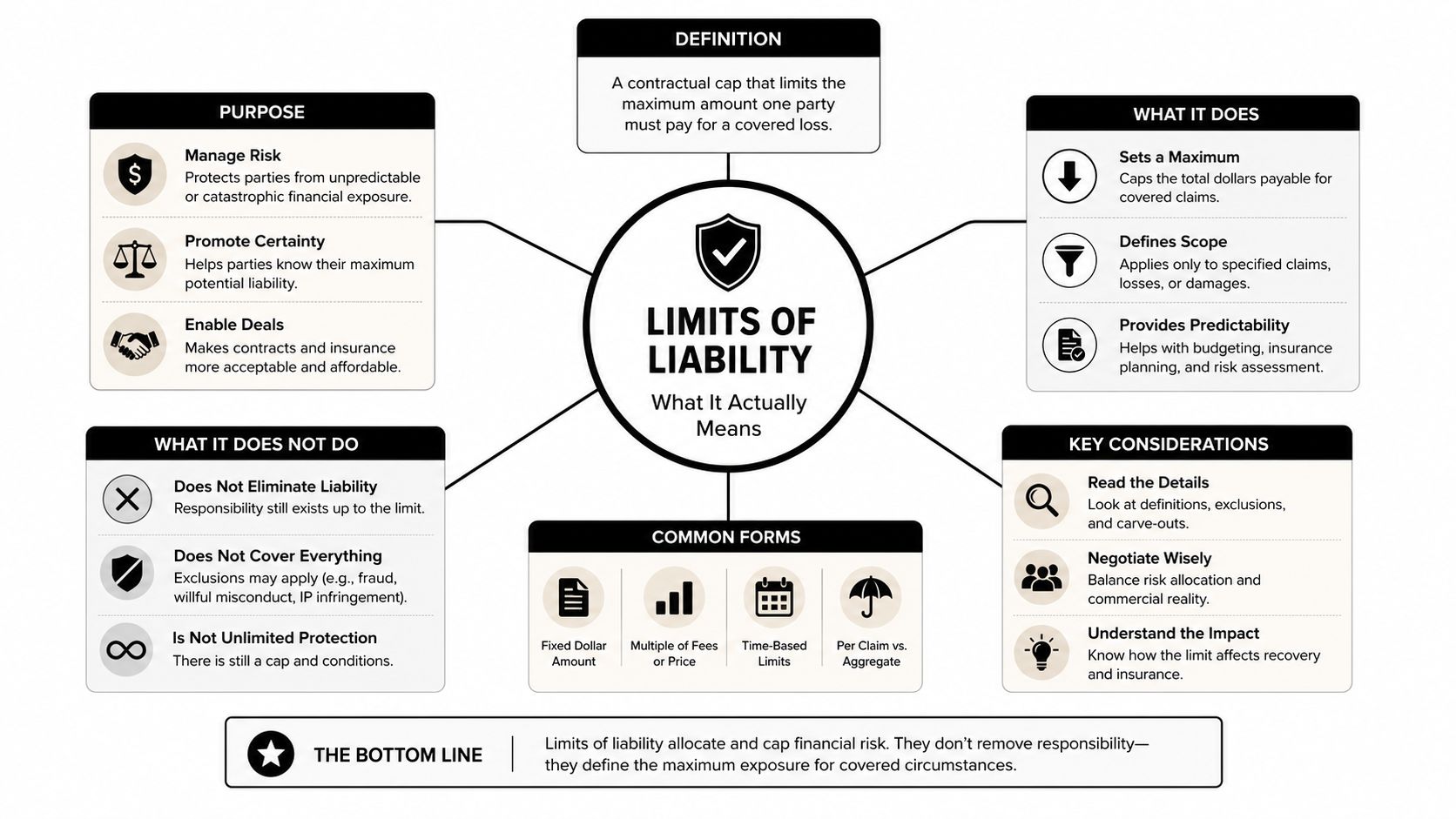
The cleanest way to read a policy is this. First, identify the cap. Second, confirm whether it is per occurrence, aggregate, or both. Third, find out whether defense costs are shrinking the bucket or sitting outside it.
California Minimums and Regulatory Notes by Policy Type
California minimums are legal floors, not comfort levels. They exist to put some money on the table for other people's losses, and that is exactly why they often leave the policyholder exposed.
The state floor is the wrong place to stop
For auto insurance, California's liability rules sit inside the state's insurance framework and Department of Insurance oversight, but the practical point is simple. Minimum liability gets eaten fast when a multi-car injury claim, a totaled vehicle, or a lawsuit lands on it. If you're comparing your current numbers against a better benchmark, use the internal guide on California auto insurance coverage.
For homeowners insurance, the California Fair Plan matters in wildfire-exposed areas where standard coverage is hard to get. The Fair Plan is a backstop, not a comfort policy, so people who rely on it usually need to think hard about wraparound coverage and replacement cost gaps.
For renters insurance, liability usually starts as a modest layer that protects the tenant if someone is injured or property is damaged in the unit. In a high-cost city, that modest layer can disappear quickly once a claim involves medical care, legal defense, or damaged landlord property.
| Policy Type | California Minimum / Typical Floor | Commonly Recommended Range | Key Regulatory Note |
|---|---|---|---|
| Auto | State minimum liability is the floor, not a target | Higher personal auto limits or umbrella layering | State auto rules set the baseline, but serious injury claims move past it fast |
| Homeowners | Dwelling and liability should reflect replacement needs, not market price | Full replacement cost, plus higher liability and umbrella | The Fair Plan may cover access to insurance, not a complete risk-transfer solution |
| Renters | Liability usually starts low | Higher liability than the default, often paired with umbrella | Cheap coverage is useful only if it can absorb a real claim |
For a broader auto-focused comparison, this California auto insurance overview helps frame why the legal minimum is usually just the opening bid.
Three Claim Math Examples That Make Limits Real
Numbers land better than labels. A driver can read “minimum coverage” all day and still not feel it until a claim turns into invoices, repair estimates, and attorney letters.
A freeway crash that burns through the cap
A Los Angeles driver rear-ends two cars on the 101. The injured parties have $90,000 in combined medical bills, $35,000 in lost wages, and $25,000 in vehicle damage. That's $150,000 before anyone starts negotiating pain, suffering, or legal costs. If the driver only carries a basic auto liability limit that runs out before the bills do, the unpaid balance becomes the driver's personal exposure.
A wildfire loss that outgrows the dwelling limit
A homeowner in a wildland-urban-interface area has a house that costs far more to rebuild than the policy was written to cover. The fire leaves the structure in a state where the rebuild estimate comes in above the dwelling limit, and code-upgrade work adds more pressure. If the policy limit is $800,000 and the rebuild plus required upgrades come to $1,050,000, the shortfall is $250,000 before any deductible or uncovered items are counted.
A teenage driver creates a second claim
A family policy has enough liability for one serious injury claim, then the household teen causes another collision later in the same policy period. The first claim uses up the available limit, and the second claimant is left with no coverage left to tap. If the policy limit is exhausted by the first loss, the second loss is the family's responsibility, not the insurer's.
In real life, the question isn't whether the policy was valid. The question is whether it still had money left when the second bill arrived.
For a deeper walkthrough of coverage scenarios, the California insurance guides library is a practical place to compare policy language against actual claim pressure.

The takeaway is blunt. If the claim can easily outrun the cap, the policy is underbuilt, and the remaining bill becomes personal debt.
How Limits Move Premiums and Out-of-Pocket Risk
Higher limits usually cost less than people fear because insurers are pricing a low-frequency, high-severity event. That's the part most drivers and homeowners get backward. They focus on the annual premium and ignore the much larger number sitting on the other side of a lawsuit.
More protection usually means a smarter trade
A California driver moving from state minimums to 100/300 is buying more breathing room for a serious injury claim, and the jump from there to 250/500 or a combined single limit is about protecting against the kind of loss that won't be fixed by a polite exchange of letters. The premium rises, but the added out-of-pocket protection is usually much more valuable than the increase feels when you look at the invoice.
Homeowners and umbrella layers work the same way. Each step above the floor is there to absorb the kind of damage that turns a normal claim into a financial problem. If a judgment exceeds the limit, the policyholder can be left exposed to collection efforts, including wage garnishment or a lien against future assets.
Stop judging coverage by the monthly payment
A cheap policy can be the most expensive one you own if it fails on the day you need it. That's especially true when defense costs are inside the limit, because the legal spend shortens the money available for the claim itself. A policy that looks generous on paper may feel a lot smaller after the defense bills start coming in.
If doubling your limits costs less than a nice dinner out per month, you're probably underinsured.
That's the line I use with clients because it cuts through the noise. You're not buying bragging rights. You're buying distance between your assets and the next bad claim.
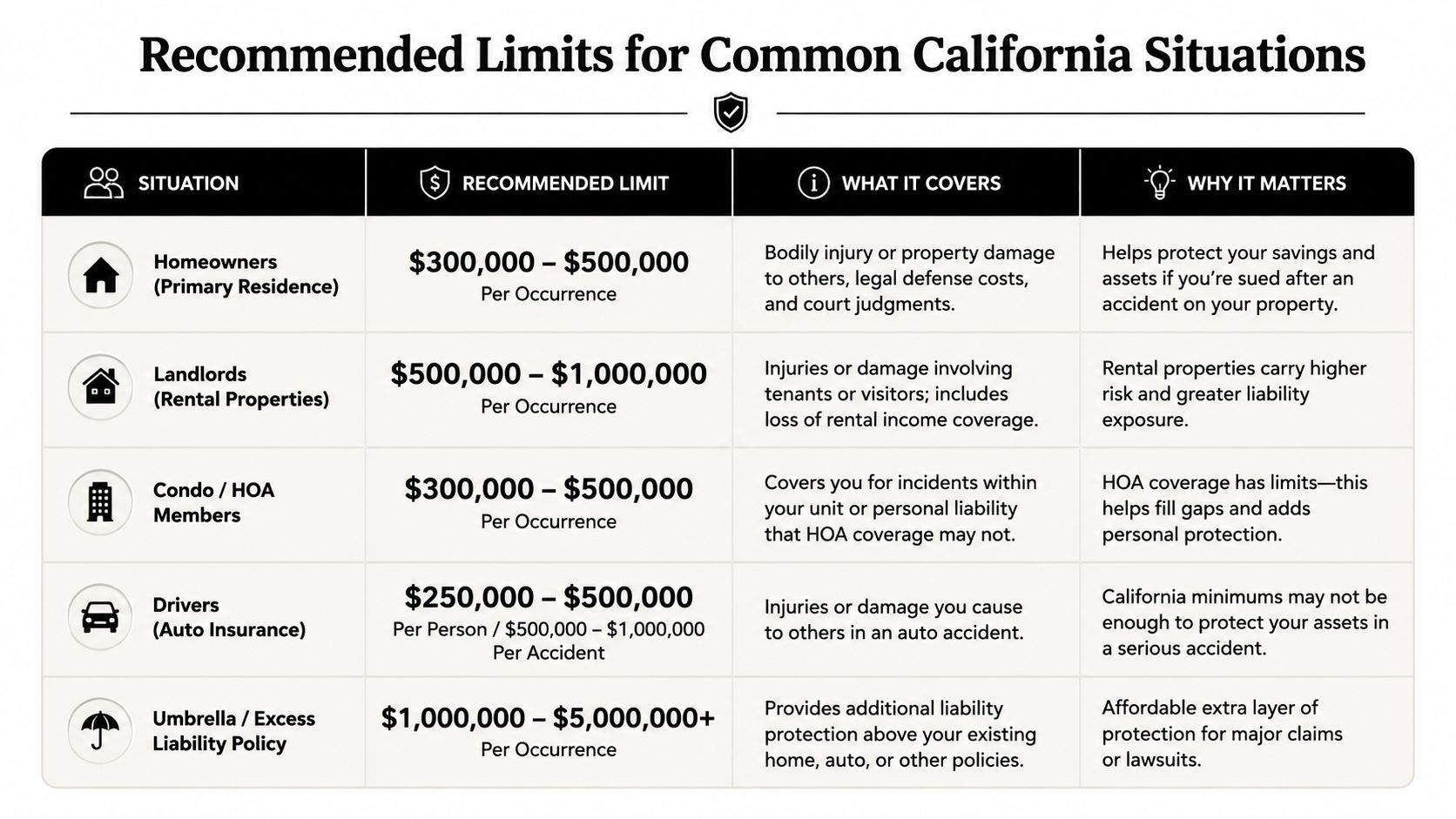
Recommended Limits for Common California Situations
The right limit depends on how much loss you could plausibly hand to someone else on a bad day. Californians who drive a lot, live in wildfire country, rent in expensive cities, or have teens in the household should think in layers, not minimums.
Match the limit to the risk, not the sticker price
A daily commuter in Los Angeles or the Bay Area should be looking at 250/500 or a $500,000 combined single limit on auto, then adding a $1 million umbrella. That combination makes sense because commuter mileage creates more exposure than a low-use car, and one serious injury case can exhaust a skimpy auto policy fast.
A homeowner in a Tier 2 or Tier 3 wildfire zone should focus on full replacement cost for the dwelling, extended replacement coverage, a code-upgrade endorsement, and an umbrella on top. Market value doesn't rebuild a house, replacement cost does, and code work is exactly where underinsurance shows up after a total loss.
A family with a teen driver needs higher auto limits and a $1 million to $2 million umbrella. Teens don't need to be reckless for a claim to stack up, one serious crash can touch multiple claimants and multiple categories of loss.
A renter in a high-cost California city should carry renters liability at $300,000 or higher, then consider a small umbrella if the price is right. That's cheap insurance against a lawsuit that starts with a guest injury or a water-loss dispute and ends with a demand letter.
A Fair Plan policyholder should review the wraparound Difference in Conditions policy, because the Fair Plan alone often leaves a gap between basic access to coverage and actual recovery.
The cleanest rule is simple. Buy enough liability to survive the claim you can't imagine today, not the one you hope to avoid forever.
Common Pitfalls That Erode Your Protection
The most expensive policy mistake is paying for coverage that falls apart when a claim hits. I see the same three problems again and again. The cap is too small, defense costs eat into it, or an exclusion wipes out the loss the buyer thought was covered.
The policy can fail in ways the premium never warned you about
Defense inside the limit is the first trap. Legal fees come out of the same pot as the settlement or judgment, so every dollar spent defending the claim leaves less available for the actual payout. A policy that looked fine on paper can turn thin fast once the lawyers get involved.
Aggregate exhaustion is the second trap. Several smaller claims can drain the total available coverage even when none of them looks disastrous by itself. By the time the larger claim shows up, the insurer may have little room left.
Exclusions and carve-outs are the third trap. Fraud, intentional acts, personal injury, and business activity run from the home can all create gaps if the policyholder assumes every loss is covered. The actual policy wording decides the result, not the buyer's expectation.
Wildfire and rebuild gaps are where homeowners get hurt
A homeowner can also confuse market value with replacement cost, then find out the rebuild bill is nowhere near the sale price. That mistake gets worse in wildfire country because reconstruction and code-upgrade costs are often the first things people forget to insure. The carrier may have paid exactly what the contract promised and still leave the owner short.
Read the declarations page, then read the exclusions. That's where the actual policy lives.
Umbrella coverage has its own blind spot. If the limit is too low for your assets and future earnings, it will not protect the part of a judgment that hurts most over time. Treating a household as if it has no exposure beyond the current year is how people end up paying a claim out of pocket for years.
A One-Hour Review With Mai & Associates
The fastest way to fix bad coverage is to audit the policies you already own. Pull every declarations page in the house, write each liability limit in one column, and mark whether defense costs are inside or outside the limit.
Work the list in this order
- Auto first: compare your liability numbers against the recommended California ranges above, then flag anything that still looks like minimum coverage.
- Home next: confirm whether the dwelling limit reflects replacement cost, not market value, and check for code-upgrade support.
- Renters last: verify the liability limit and see whether a small umbrella would be cheap enough to make sense.
- Umbrella layer: make sure it sits above the auto and home limits, not beside them.
- Household exposure: list every named insured, teen driver, roommate, and at-home business use that could change the risk picture.
If you want a faster path from question to quote, use the California insurance quote request page and have the policy pages ready before you call. You'll get a cleaner comparison and a better answer.

If Fair Plan, earthquake, or wildfire questions are part of the review, bring those up right away so the gap analysis is honest. The best time to adjust limits is before a claim, not after.
Mai & Associates helps Californians review auto, home, renters, and life coverage with a focus on the limits that protect you when claims get ugly. If you want a straight answer on whether your policy is built for a real loss, visit Mai & Associates and get your coverage checked before the next claim tests it.