Lightning Protection for Homes: A California Insurance Guide
When you think about protecting your home, a lightning protection system probably isn't the first thing that comes to mind. But it should be. It’s a complete network—air terminals (those are the rods you see on the roof), heavy-duty conductors, and deep-earth grounding rods—all working together to capture a lightning strike and channel its raw, destructive power safely into the ground.
This system is your home's first line of defense against structural fires and fried electronics. For homeowners in California, particularly in areas prone to thunderstorms, it’s not a luxury; it’s a fundamental upgrade for your home's safety, your peace of mind, and a smart complement to your home insurance.
Why You Can't Afford to Ignore Lightning in California
In California, we're conditioned to think about earthquakes and wildfires. Lightning often feels like a secondary threat, but it's a mistake to underestimate it. A single bolt carries an unbelievable amount of energy—enough to blow apart a chimney, ignite a fire that consumes your home, or wipe out every electronic device you own in a flash.
The risk has only grown as our homes have become smarter. Think about everything plugged in right now: your smart TV, your home office computer, the high-end kitchen appliances, and even your security system. A nearby strike can send a massive power surge through the grid, and without protection, it will toast the sensitive circuits inside all of it. This is precisely why a professionally installed lightning protection for homes system, supported by robust California insurance, is so important.
California's Unique Vulnerabilities
The Golden State's diverse landscape creates a patchwork of risk zones. If your home is perched on a hilltop, sits in an open field, or is surrounded by tall trees, you’re naturally a more attractive target for a lightning strike.
There’s also a powerful, and dangerous, link between lightning and our state's ever-present wildfire threat. All it takes is one strike on a tinder-dry hillside to ignite a blaze that could threaten an entire neighborhood. From this perspective, a lightning protection system becomes an integral part of your overall fire prevention strategy, a key factor for any home insurance provider in California.
Your insurance carrier is thinking about this, too. Your home insurance California policy is your financial backstop, but insurers are getting much more scrupulous about risk. A home without proper protective measures is a bigger gamble for them, which could translate into higher premiums or even difficulty getting coverage. Installing a certified system is a tangible way to show your insurer you’re serious about protecting your property.
For a California homeowner, adding a lightning protection system isn't just about preventing damage—it's about being a responsible property owner. It sends a clear message to your insurance company that you're actively managing risk, which can positively impact your entire insurance relationship, from home insurance to auto insurance.
How Lightning Protection Fits Into Your Overall Insurance Picture
While this guide zeroes in on home insurance, a lightning strike can create a domino effect that touches all your other policies. A power surge, for example, could easily fry the expensive charging system for your electric vehicle, suddenly making it an auto insurance (or car insurance) issue. If you're a renter, a fire sparked by lightning could destroy everything you own, highlighting the absolute necessity of renters insurance.
At the end of the day, protecting your home is about securing your family’s financial stability—the same core mission of life insurance. By investing in a lightning protection system, you're not just reinforcing the physical structure you live in; you're fortifying your entire financial safety net. It’s a foundational piece that works hand-in-glove with your California insurance portfolio to build a stronger defense against life's unpredictability.
What Goes Into a Home Lightning Protection System?
When people think of lightning protection for homes, they often picture a single, old-fashioned rod on a roof. The reality is far more sophisticated. A modern system is a complete, engineered network designed to give lightning a safe and direct path to the ground, guiding its massive energy away from your structure, your wiring, and your family.
Think of it as creating a controlled highway for electricity. Without it, a strike is a chaotic, destructive force looking for the quickest way to the earth—which could be through your roof, your wiring, or your plumbing.
The Core Components and How They Work Together
Let's break down the physical parts of the system you'd see on your house. Each component has a specific job, but they all have to work in perfect concert to be effective.
- Air Terminals: These are the discreet, modern versions of lightning rods. Placed at the highest points of your roof, their job isn't to attract lightning but to intercept a strike that's already coming toward your home, giving it a safe place to land.
- Main Conductors: From the air terminals, you'll have heavy-gauge cables (usually copper or aluminum) running along the ridges and eaves of your roof and down the sides of the house. These are the express lanes on our electrical highway, built to handle the immense current of a lightning strike.
- Grounding System: This is where the journey ends. The conductors connect to long rods driven deep into the earth, at least 10 feet down. This is the crucial "off-ramp" that safely disperses all that dangerous energy into the ground, far from your foundation.
The infographic below shows just how a system like this protects you from the primary threats of a direct strike, like fire, and the secondary threats that can fry your electronics.
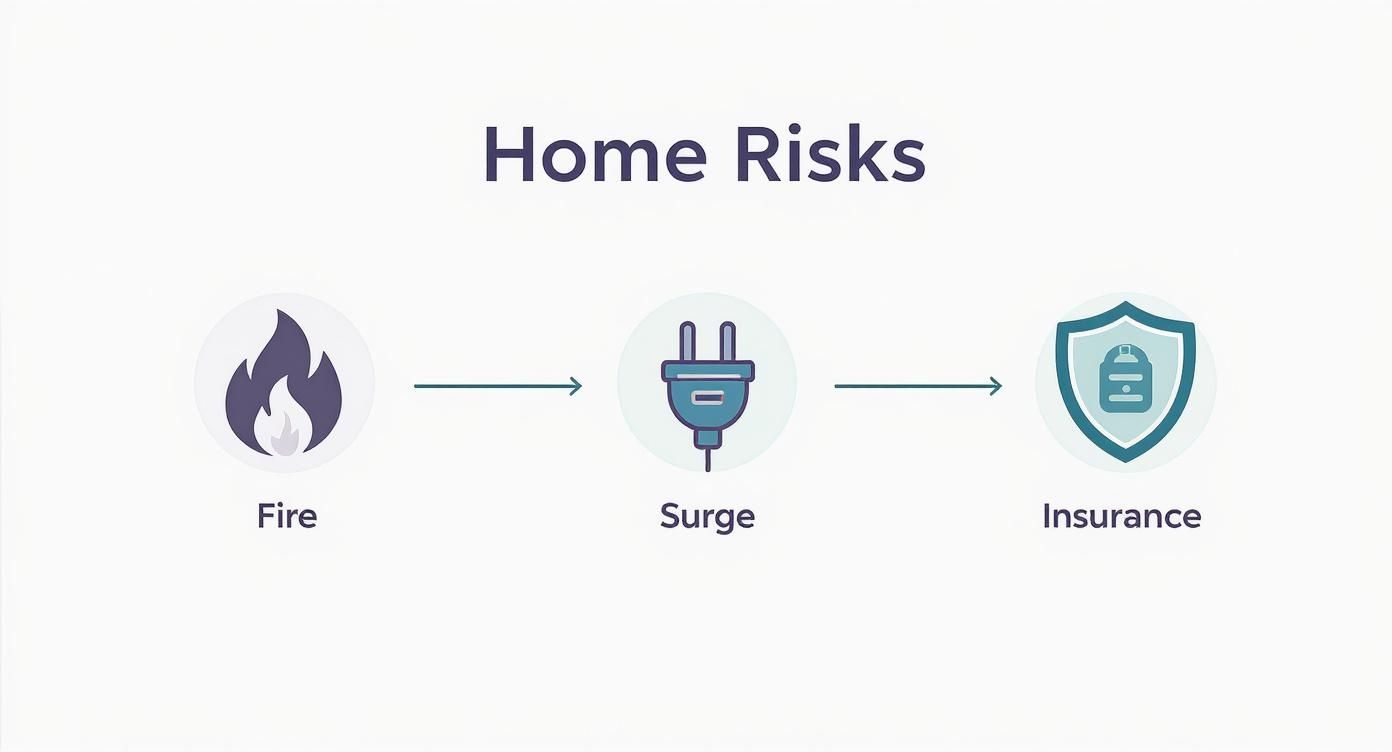
As you can see, a comprehensive system is about more than just the structure itself; it’s about creating a total shield that complements your home insurance coverage.
The table below summarizes these essential components and their roles.
Core Components of a Home Lightning Protection System
| Component | Primary Function | What It Protects |
|---|---|---|
| Air Terminals | Safely intercept a lightning strike at the highest point of a structure. | The roof, chimney, and other high points from a direct hit. |
| Down Conductors | Provide a low-resistance path for lightning current to travel from the terminals to the ground. | Siding, walls, and the structural frame from electrical damage and fire. |
| Grounding System | Disperse the electrical charge harmlessly into the earth. | The foundation, internal wiring, and plumbing from surges. |
| Surge Protector | Block or divert power surges coming through utility lines (electrical, cable, phone). | Appliances, computers, smart home devices, and all sensitive electronics. |
| Bonding | Connect all metallic systems (pipes, ductwork) to the main system to equalize potential. | Prevents side-flashes and protects against internal arcing and fires. |
Together, these parts form a protective shell around your entire home, managing both the external strike and the internal surge.
Don't Forget the Unseen Guardian: Whole-House Surge Protection
The external system is brilliant at handling a direct hit. But what about a strike that hits a utility pole a mile down the road? That can send a massive power surge racing through the grid and right into your electrical, cable, and phone lines.
This is where whole-house surge protection is absolutely vital.
Installed right at your main electrical panel, this device is like a security guard for your home’s power supply. It constantly monitors the incoming voltage. The second it detects a dangerous spike, it diverts the excess energy safely to the ground before it can obliterate every sensitive electronic device you own. For a modern California home packed with expensive tech, this isn't a luxury—it's a necessity that works in tandem with your California insurance to prevent loss.
A strike doesn't have to hit your house to cause thousands of dollars in damage. A whole-house surge protector is the only thing standing between a distant storm and the destruction of every device plugged into an outlet.
It's no surprise that as homes get smarter, the demand for this protection is soaring. The global residential lightning protection market was estimated at USD 4.205 billion in 2025 and is on track to hit USD 6.738 billion by 2033. You can explore more data about this growing market to see how homeowners are responding to these risks.
Bonding: Tying It All Together
The final, and often overlooked, piece of the puzzle is bonding. This is the process of physically connecting all the other major metallic systems in your house—gas lines, water pipes, HVAC ducts—to the main lightning conductor.
Why is this so critical? It equalizes the electrical potential across everything conductive during a strike. Without it, lightning could jump from a down conductor to a nearby metal pipe, causing a dangerous side-flash that could lead to a fire or even an explosion. Bonding ensures there are no alternate paths for the electricity to take, forcing it to follow the safe route to the ground. It’s the step that truly makes the system a single, cohesive shield.
How to Assess Your Property's Lightning Risk
So, is your home a sitting duck for a lightning strike, or is your risk fairly low? Before you even think about buying a protection system, you need to get a real handle on your property's specific vulnerability. This isn't about guesswork; it's a straightforward look at the factors that genuinely increase your chances of getting hit.
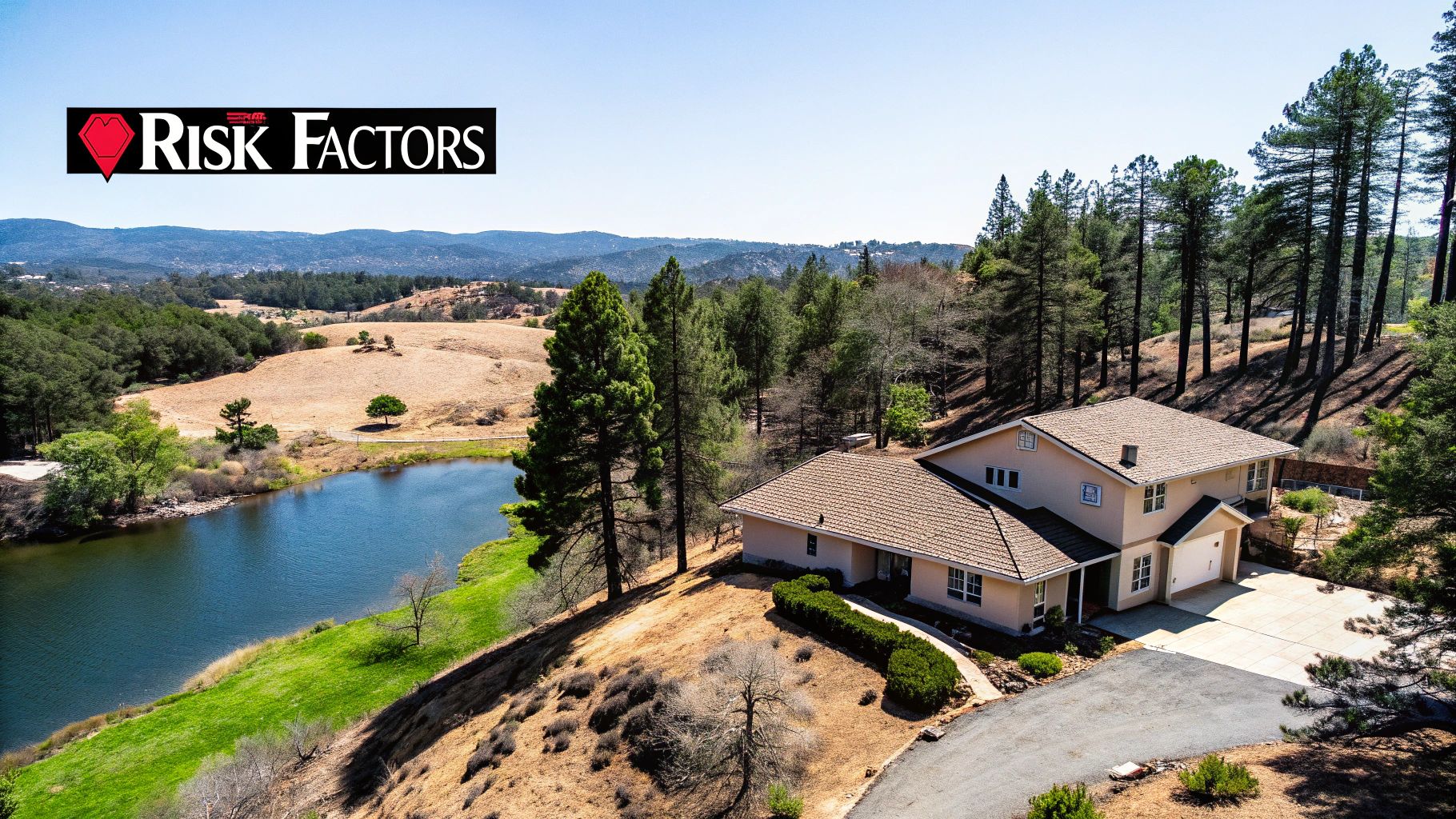
Walking through this assessment will help you make a clear-headed decision on whether lightning protection for homes is a worthwhile investment. It also gives you solid information to bring to the table when you discuss your risk profile with your agent for home insurance California.
Geographic and Environmental Factors
Where your house is located and what’s around it are the biggest pieces of the puzzle. Lightning is lazy—it's always looking for the easiest path to the ground, and certain features on your property can roll out the welcome mat.
Take a look around. Are you in a flat, sprawling suburb, or are you perched on a ridge with a great view? That elevation makes a huge difference.
- Homes on Hills or Elevated Terrain: If your house is the tallest thing in the immediate area, you're statistically more likely to get struck. Simple as that.
- Proximity to Tall Objects: A home tucked between towering pine trees is at higher risk. Trees are natural lightning magnets, and a strike on a nearby tree can easily jump sideways—right onto your house.
- Location Near Water: Living near a lake, river, or the coast can also bump up your risk a bit. The moist ground is more conductive, making it an attractive target.
You also have to consider your specific spot in California. We all know Florida is the nation's lightning capital, but areas like the Sierra Nevada and some inland deserts get some seriously intense thunderstorms. A home in the mountains has a completely different risk profile than one in a dense city like San Francisco.
A common myth is that lightning rods attract strikes. That's not how they work. They simply intercept a strike that was going to happen anyway, giving it a safe, controlled path to the ground instead of letting it blast through your roof.
Architectural and Structural Considerations
The design of your house itself plays a big role. A home with a complex roofline—lots of peaks, dormers, and a prominent chimney—offers up more potential strike points than a simple, low-slung roof. If you have the only two-story home in a neighborhood of single-story bungalows, you're naturally a more prominent target.
The materials used in construction matter, too. A metal roof doesn't attract lightning, but if it gets hit, the energy behaves differently than it would on asphalt shingles. The key takeaway here is that any conductive element, from your roof to your gutters, needs to be properly bonded and grounded as part of a complete system.
The Rising Stakes of a Connected Home
Your risk isn't just about a direct hit setting your roof on fire. These days, the financial stakes are so much higher because of all the sensitive electronics we pack into our homes. A powerful surge from a nearby strike—one that doesn't even hit your property—can be just as destructive as a direct hit, making renters insurance and home insurance even more critical.
Think for a second about the value of the electronics in your house right now:
- Home Office: Computers, monitors, printers, routers.
- Entertainment Systems: Smart TVs, high-end sound systems, gaming consoles.
- Smart Home Tech: Thermostats, security cameras, smart appliances.
- Major Appliances: Even modern refrigerators and ovens have circuit boards that are easily fried.
A single surge could instantly wipe out tens of thousands of dollars in equipment. This financial vulnerability is what really changes the game, turning lightning protection for homes from a simple structural safeguard into a critical defense for your most valuable possessions.
Thinking through these risks is a huge part of managing your overall financial health, a topic we explore often on the Mai & Associates insurance blog at https://cahomeauto.com/blog. When your home insurance policy has specific limits on electronics coverage, preventing the loss from ever happening becomes the smartest move you can make.
Is a Lightning Protection System Worth the Money?
It's easy to look at the price tag for a professionally installed lightning protection system and hesitate. But thinking of it only as an upfront cost is missing the bigger picture. The real financial question isn't about the initial investment—it's about shielding yourself from the astronomical and often hidden expenses a lightning strike leaves in its wake.
So, what are we talking about for installation? The cost really depends on your house. The size, roof complexity, and materials chosen all play a part. For a standard single-family home in California, you might be looking at a few thousand dollars, though that figure can climb for larger, more intricate properties.
While that number might make you pause, it's a drop in the bucket compared to the financial chaos a single lightning strike can cause.
The Real Cost of a Lightning Strike Isn't What You See
When you picture lightning damage, you probably imagine a burnt spot on the roof. But that's just the beginning. The true financial hit comes from a domino effect of expenses that can spiral out of control, leaving you with a stressful and expensive recovery that can drag on for months.
Let's get real. A direct hit can easily spark a fire, leading to repair bills in the tens or even hundreds of thousands of dollars. Even without a fire, the explosive force can blow out chunks of your wall, shatter a brick chimney, and weaken the very structure of your home. These aren't simple patch jobs; we're talking major reconstruction.
And that's just the visible part. The electrical surge from a strike races through your home's wiring, frying it from the inside. This often means your entire house needs to be rewired to be safe again—a massive, costly undertaking.
Adding Up the Damage
The financial pain doesn't stop there. That secondary electrical surge is what often hits families the hardest. Think about what it would cost to replace every single electronic item plugged into an outlet.
- Major Appliances: Your fridge, oven, washer, dryer, and dishwasher have sensitive electronics that a surge will destroy in an instant.
- Work and Fun: Laptops, desktop PCs, monitors, smart TVs, sound systems, and gaming consoles are all prime targets.
- Connected Home Tech: Your Wi-Fi router, security cameras, smart thermostat, and even the garage door opener are likely to be toast.
The bill to replace all of that can easily top $15,000, $20,000, or more. That's a sudden, devastating out-of-pocket expense that most people simply aren't ready for. When you pile that on top of the structural repair costs, the total is truly staggering.
It’s not a matter of whether you can afford a lightning protection system. The real question is: can you afford not to have one? A single storm can inflict more financial damage than the cost of a system many times over.
This isn't just a hypothetical risk. The financial fallout from lightning is getting worse. In the United States, the total value of lightning-related homeowners insurance claims jumped by over 30% in 2023 alone, hitting an incredible $1.27 billion. The average cost per claim also shot up, reaching $17,513 in 2023. You can review the full report on these escalating claim costs to see the trend for yourself.
This is where having the right home insurance is absolutely crucial. A good policy is your backstop, but navigating a major claim is never a walk in the park. Preventing the damage from happening in the first place is always the smarter move. Plus, a massive claim can affect your future premiums and even your ability to get insured, especially in a tough market like California.
Protecting your home is a two-part strategy: physical safeguards on the outside and solid California insurance coverage on the inside. It's a conversation worth having with your insurance advisor. To see where you stand, you can get a personalized insurance quote and make sure your policy truly covers your home's value and risks.
Finding a Certified Installer in California
A professional lightning protection system is only as good as the person installing it. You can buy top-of-the-line components, but without a precise, expert installation, they can easily fail when that storm rolls in. That’s why finding a properly certified installer in California isn't just a good idea—it's absolutely critical for your safety and for making sure your home insurance company recognizes the upgrade.
One of the biggest mistakes I see homeowners make is hiring a general contractor or their roofer for this job. It seems logical, but it's a costly error. Installing lightning protection for homes is a highly specialized trade that demands a deep understanding of electrical grounding and strict adherence to national safety codes. A botched job isn't just ineffective; it can actually increase the risk of damage to your home.
Why Certification Is Non-Negotiable
When you start looking for an installer, your first and most important question should always be, "Are you certified?" In the U.S., there are two main organizations that set the bar for quality and safety in this industry.
- Lightning Protection Institute (LPI): This is the gold standard. An LPI-certified installer has gone through rigorous training and testing on system design and installation, ensuring they meet the highest safety protocols.
- Underwriters Laboratories (UL): A UL-listed company is one that has been audited and approved to install systems that meet very specific safety and performance benchmarks. They can provide a UL Certificate of Inspection, which is powerful proof for your California insurance carrier.
Choosing an installer with these credentials guarantees the work will follow NFPA 780, which is the national safety standard for lightning protection. This is the very code that inspectors, engineers, and insurance companies use to verify a system is built to last and function correctly.
An uncertified installation is a huge gamble. Your insurer might refuse to acknowledge the system, or worse, deny a claim because the work wasn't done by a qualified professional following established national standards.
Vetting Your California Contractor
Once you've got a short list of certified pros, it's time to dig a little deeper. This isn't just about comparing prices; it's about finding a true partner who you can trust with your biggest asset.
Ask them specific questions about their experience with homes similar to yours in your part of California. Someone familiar with the local building codes and permitting process in your city or county will make the whole process much smoother. Don't forget to verify their California contractor's license and ask for proof of both liability insurance and workers' compensation.
The demand for these skilled installers is only growing. The North American market for lightning protection products is projected to account for over 40% of global revenue by 2035, a shift largely driven by strict safety regulations like NFPA 780. Discover more insights about these market trends to understand how safety standards are influencing homeowners' choices.
From Quote to Final Inspection
A reputable installer will always give you a detailed, written proposal. It should break down every single component, from the air terminals on your roof down to the grounding rods and the whole-house surge protector. The quote should also explicitly state that the installation will conform to LPI, UL, and NFPA 780 standards.
After the work is done, make sure you get a certificate of completion from either the LPI or UL. This piece of paper is your official proof that the system was installed correctly and meets all safety requirements. File it away with your home insurance policy—it could be invaluable if you ever need to make a claim.
Taking these steps ensures you're making a wise investment in your home's long-term safety. For more practical advice on everything from insurance to protecting your property, check out our helpful guides at Mai & Associates.
How Protection Systems Affect Your Home Insurance
Installing a certified lightning protection system is one of the smartest upgrades you can make for your home. It sends a clear message to your insurance provider that you’re serious about managing risk. For California homeowners, taking this proactive step can really pay off, especially now when carriers are being more selective about the properties they're willing to cover.

At its core, insurance is all about risk. When you install a system that drastically reduces the chances of a catastrophic fire or massive electrical damage, you're fundamentally lowering your home's risk profile. Many California insurance companies see this and are willing to reward that effort, often with discounts or credits on your premium for home insurance, and sometimes even influencing rates on bundled auto insurance.
Unlocking Potential Policy Discounts
While a discount isn't guaranteed and will always vary by the insurance company, a professionally certified system from UL or LPI is a major home improvement that gets their attention. Insurers who offer these credits do so because the numbers don't lie: protected homes are far less likely to file expensive lightning-related claims. Plain and simple, it makes your property a much more attractive and less risky client for them.
This is a big deal in California, where the connection between lightning strikes and wildfires is a huge concern for insurance carriers. By installing lightning protection for homes, you aren’t just guarding against a direct hit to your roof; you're also adding a powerful layer of fire prevention that insurers truly value.
Streamlining the Claims Process
Beyond just saving some money on your premium, having a certified system can make a world of difference if you ever do need to file a claim. A lightning strike can cause all sorts of complex and hidden damage, but a professionally installed system makes the situation much clearer. It proves you took every reasonable precaution to protect your property.
That kind of clear-cut risk management can lead to a smoother, faster, and less frustrating claims experience. Instead of arguing about what caused a fire or electrical surge, the conversation can move straight to getting you back on your feet.
Properly documenting your lightning protection system with your insurance agent isn't just about chasing a discount. It's about making sure your insurer has a complete and accurate picture of your home's resilience, which can be invaluable when you need them most.
Documenting Your System for Your Insurer
To get the full benefit of your investment, you have to let your insurance company know about it the right way. Once the installation is finished, pull together the following documents and send them straight to your agent:
- The UL or LPI Certificate of Completion: This is the golden ticket. It's the official proof that your system was installed correctly and meets national safety standards.
- Installer’s Information: Make sure to include the name and license number of the certified company that did the work.
- A Detailed Invoice: This should break down the components installed, specifically mentioning things like the whole-house surge protector.
With this paperwork in hand, you can have a meaningful conversation with us at Mai & Associates. We can pull up your current home insurance California policy, check for any available credits you're entitled to, and make sure your coverage properly reflects the new, lower-risk profile of your home. It’s a simple step that helps you maximize the return on your smart investment.
Sorting Fact from Fiction: Common Lightning Protection Questions
When it comes to protecting your home from lightning, there's a lot of old folklore and misinformation floating around. Let's clear the air on some of the most common questions California homeowners ask.
Do Lightning Rods Actually Attract Lightning?
This is probably the biggest myth we hear, and the answer is a hard no. A professionally designed lightning protection system isn't a magnet for lightning strikes. It doesn't draw a bolt out of the sky that wasn't already headed your way.
Think of it more like a designated, safe highway for electricity. Its job is to intercept a strike that was already going to hit your house or the area right around it. The system then gives that incredible surge of energy a controlled, low-resistance path straight into the ground, preventing it from tearing through your home's structure and electrical system.
Does Having a Metal Roof Make My Home a Target?
Here's another common worry we can put to rest. The material of your roof, whether it's asphalt shingles, tile, or metal, doesn't make your home more or less likely to be struck by lightning. A storm doesn't "see" your roof and decide where to strike.
Where a metal roof really changes the game is in what happens after a strike. Because metal is so conductive, a properly bonded system can use the entire roof surface to safely spread out and channel the electrical energy down to the ground. In many ways, it can be even safer than a strike on a flammable material like wood shakes, where the risk of fire is much higher.
Isn't Lightning Damage Already Covered by My Homeowners Insurance?
Yes, most standard home insurance policies do cover lightning as a listed peril. But here's the thing: relying on your insurance is a reactive strategy, not a proactive one. It means you've already suffered the damage.
Filing a claim involves paying your deductible, navigating the often-stressful claims process, and potentially seeing your premiums go up afterward. Installing a certified protection system is about preventing that catastrophic event from ever happening. It’s always smarter—and less disruptive—to stop the damage before it starts. Plus, many California insurance carriers will offer a premium discount for homes with certified systems.
Ready to make sure your coverage is as robust as your home's protection? The team at Mai & Associates can walk you through your policy, explore potential discounts, and ensure you're not left vulnerable. Let's talk about a strategy that combines physical safety with the right insurance.