Life Insurance Tax Rules Every Californian Should Know

If you're juggling an auto policy, a homeowners renewal, maybe renters coverage for a kid in an apartment, and now you're wondering whether life insurance belongs in the same budget conversation, you're not alone. A Glendale family with a new mortgage, an Escondido homeowner who keeps an eye on wildfire risk, or a Costa Mesa renter just starting out all run into the same question sooner or later, what part of life insurance tax rules is real, and what part is just shorthand people repeat without explaining it?
The clean answer starts with four questions. Is the death benefit taxed, is cash value growth taxed, does employer coverage create income tax, and can the payout end up inside a taxable estate? Once you separate those buckets, the rules get much easier to read, especially for California households that already think in layers, one policy for the car, one for the roof, one for the lease, and one for family protection.
Why Life Insurance Tax Matters for California Families
A lot of California families buy life coverage while they're already comparing auto, home, or renters insurance. That timing matters because the policy often gets folded into a broader household protection plan, not treated as some standalone legal puzzle. A family in a wildfire-prone area may be reviewing a California Fair Plan option at the same time, and that same year they may also be asking whether their life policy behaves like a bank account, a retirement plan, or a pure protection contract.
The confusion usually starts with the phrase “tax-free.” In everyday conversation, people use it to mean everything about life insurance is protected from tax. That's too broad, because the tax answer changes depending on whether you're talking about the payout after death, the cash value while the insured is alive, workplace group coverage, or estate inclusion.
The four questions that settle most of the confusion
If you only remember one framework, make it this one.
- Death benefit: Most beneficiaries receive it free of ordinary income tax under the federal rule for life insurance proceeds.
- Cash value: Accessing money inside a permanent policy can create taxable income if the distribution goes beyond what you've already put in.
- Employer coverage: Group coverage through work has its own threshold rule and can show up on a paycheck.
- Estate treatment: A policy can still create estate tax issues depending on ownership, beneficiary designations, and the size of the estate.
California readers need that map because real life rarely stays in one lane. A household might be managing property values, community property questions, a spouse's workplace benefits, and a policy that was bought years before any of those moving parts changed. If you want a plain-English glossary for the other insurance terms that often show up in the same conversation, the California insurance glossary is a useful place to keep nearby.
Practical rule: start with the question, “Which tax bucket am I actually dealing with?” Most mistakes happen when people treat all life insurance transactions as if they're the same.
How Death Benefits and Cash Value Growth Stay Tax Free
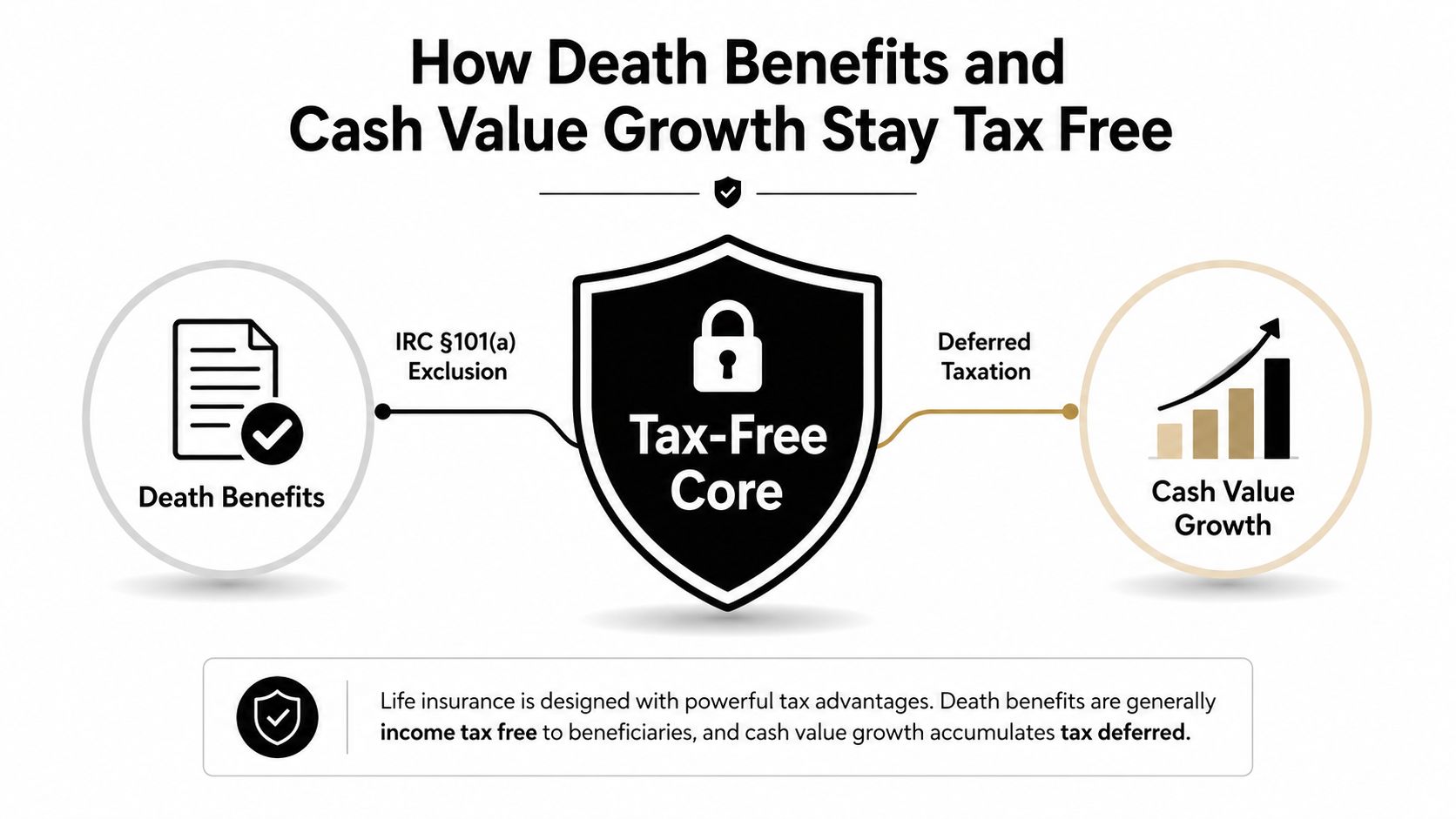
A family in California can own a life insurance policy for years and still never owe ordinary income tax on the core death benefit. That is the basic federal rule under IRC §101(a). Permanent policies also have a protected growth track under Section 7702, which kept the historic tax treatment of inside buildup in place. In plain English, the policy can work like a tax-favored locker, with value building inside it without the same yearly tax reporting you would see in a brokerage account.
The tax-favored locker versus the taxable account
A permanent policy works like a locked compartment. Money can build inside it, and as long as the policy stays within the federal guardrails Congress created, that growth is not taxed the same way yearly investment gains are taxed in a normal account. That is why people describe cash value as tax-deferred. The buildup is not erased, it is taxed under a different set of rules until money comes out.
The fine print still matters. A beneficiary usually receives the basic death benefit without ordinary income tax, but interest paid after death is taxable as ordinary interest income. Transferred-for-value policies can also lose the full exclusion, except to the extent of consideration paid plus later premiums and certain amounts, as the IRS explains in its guidance on life insurance proceeds. So “tax-free” applies to the core death proceeds, not to every dollar that may arrive later. For a California family sorting through ownership and beneficiary questions, a practical probate discussion such as life insurance proceeds in Texas probate shows why the paperwork still matters even when the underlying payout is generally income-tax-favored.
A California beneficiary should expect the payout mechanics to be orderly, not mysterious. The main benefit itself is generally not treated like wages or investment income, which is why the tax treatment feels so different from a paycheck or a bank account. If the insurer pays the claim in stages or adds interest because the money was not distributed immediately, that extra interest is the part that changes the tax answer. That distinction matters in real households, including wildfire-area and Fair Plan households that often have to compare life coverage with the rest of their protection stack. A plain-language California insurance glossary can help keep the terms straight when the conversation starts mixing policy types.
Practical rule: the basic death benefit is the easy part. The moment you see delayed-payment interest, you are in a different tax lane.
When Cash Value Becomes Taxable in Real Life
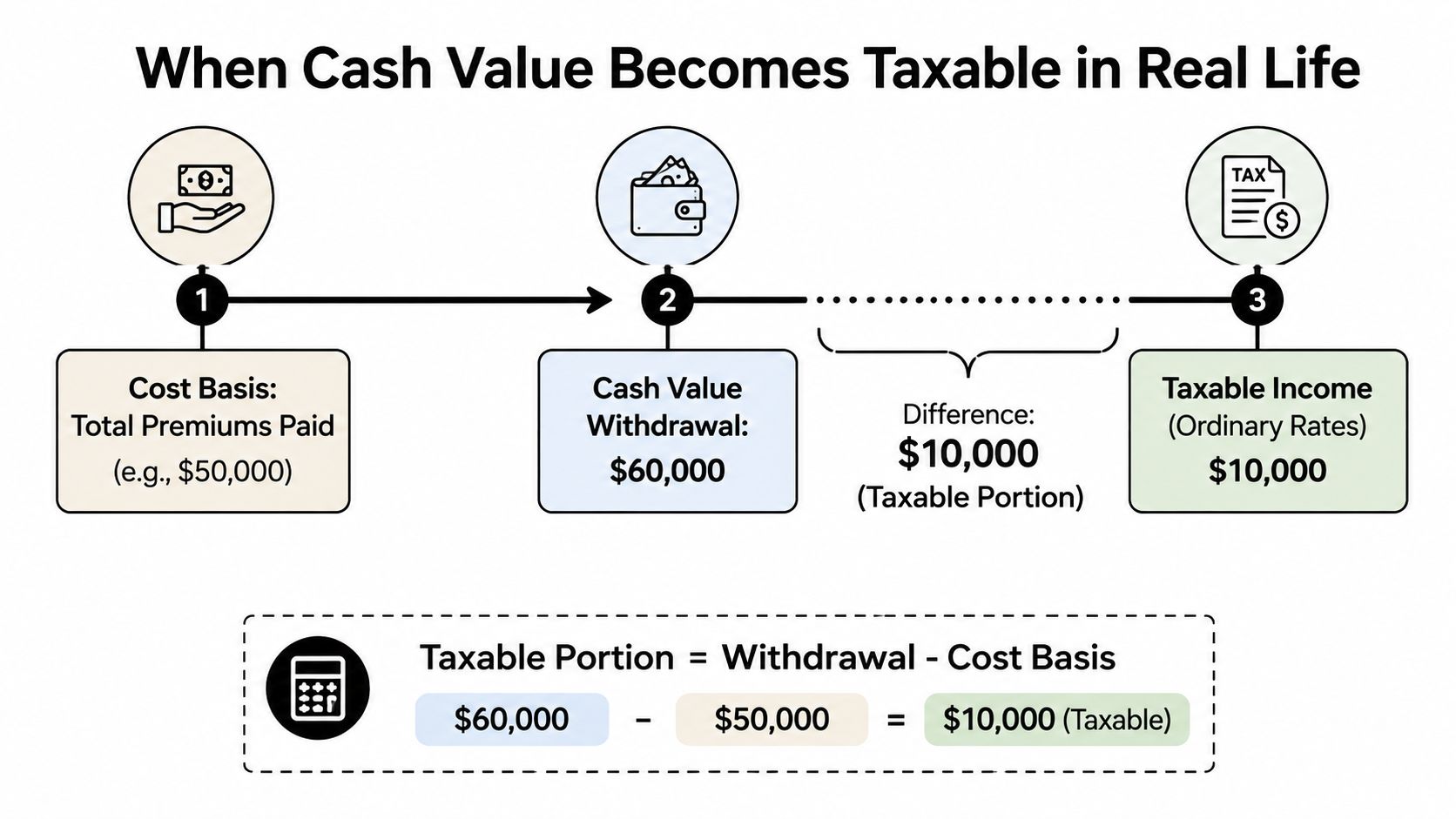
Cash value gets taxed when you take more out than you've put in, and that's the cleanest way to think about it. The policy's cost basis is usually the sum of premiums paid, since premiums are generally personal expenses and not deductible. Under the standard mechanic explained by MassMutual, distributions from permanent life insurance are treated as a return of basis first, and only the amount above basis is subject to income tax.
Withdrawals, loans, and surrender are not the same thing
A withdrawal up to basis usually isn't taxed, because you're pulling out your own after-tax money first. A full surrender is different, because the policy ends and the taxable amount can be the cash surrender value above adjusted cost basis. Policy loans are their own category, and they're easy to misunderstand because a loan can look harmless until the policy collapses or lapses and the debt is effectively settled from the policy value.
That's the mechanic people miss. A loan isn't automatically a permanent shield from tax consequences, because if the policy later terminates with a loan outstanding, the unpaid amount can become part of the taxable result. That's the “phantom income” problem, money you never held in your hand can still be treated as received for tax purposes.
A quick example makes the threshold clearer. If someone withdraws $20,000 from a policy with $15,000 of basis, the first $15,000 is treated like a return of basis, and the remaining $5,000 is taxable income. The policy didn't become taxable just because it exists, it became taxable because the distribution crossed the basis line.
The other label readers need to know is modified endowment contract, or MEC. Congress added Section 7702A in 1988 to define that category and limit some tax advantages for policies that are overfunded beyond the intended guardrails. In plain English, if a policy is pushed too hard with premium funding early on, the tax treatment becomes less forgiving, especially for withdrawals and loans.
If you're reading a policy illustration, look for the current basis, current cash value, and whether the contract is described as a MEC. Those three items tell you much more than the marketing language on the front page. For a quick comparison of policy types and how they're commonly discussed, how group term life works for SMBs is useful context, even though employer coverage follows a different tax rule than permanent cash value.
Practical rule: know your basis before you touch the policy. Once withdrawals or surrender values move past that number, the tax picture changes fast.
Employer Provided Life Insurance and the Section 79 Threshold
A lot of employees assume workplace life coverage stays out of the tax picture. It often does for the first part of the benefit, but Section 79 sets a limit that matters once the coverage gets larger. The cost of the first $50,000 of employer-paid group-term life insurance is excluded from taxable income, and coverage above that can create imputed income, which may show up on the employee's W-2.
Why the paycheck can look odd
The rule makes more sense if you separate the insurance value from the payroll value. The employer pays for group coverage, the first chunk gets a special tax break, and anything above that can be treated like a taxable fringe benefit. That is why an employee may study a pay stub and wonder why the taxable wage base does not line up neatly with salary.
The threshold matters most for workers with richer benefits packages. That includes many California public sector employees, tech workers, and anyone whose company offers life coverage well above the federal baseline. If the policy is generous, the tax reporting can get a little messy even though the coverage itself still serves a real protection purpose.
| Section 79 Imputed Income Above the $50,000 Threshold | |||
|---|---|---|---|
| Employee Age Bracket | Monthly Cost per $1,000 Above $50K | Example Coverage | Estimated Monthly Imputed Income |
| 45-year-old employee | about $0.42 | $250,000 of group coverage, with $200,000 above the exclusion | about $8.40 |
That example explains why a W-2 can feel inconsistent. The employee is not being taxed on the death benefit itself in the ordinary sense, but on the value of employer-paid coverage above the excluded amount. So if Box 1 and Box 5 on a W-2 do not quite match your intuition, group life coverage is one of the first places to check.
For small business owners and employees comparing benefit packages, a plain explanation like how group term life works for SMBs can help separate coverage design from payroll reporting. If you are trying to keep the full household insurance picture organized, the California insurance guides page is also a useful place to start alongside auto, home, and renters coverage.
Practical rule: if your employer gives you more than $50,000 of group-term life, check the payroll reporting. The tax cost may be small, but it is still real.
Estate Tax Gift Tax and the Three Year Rule
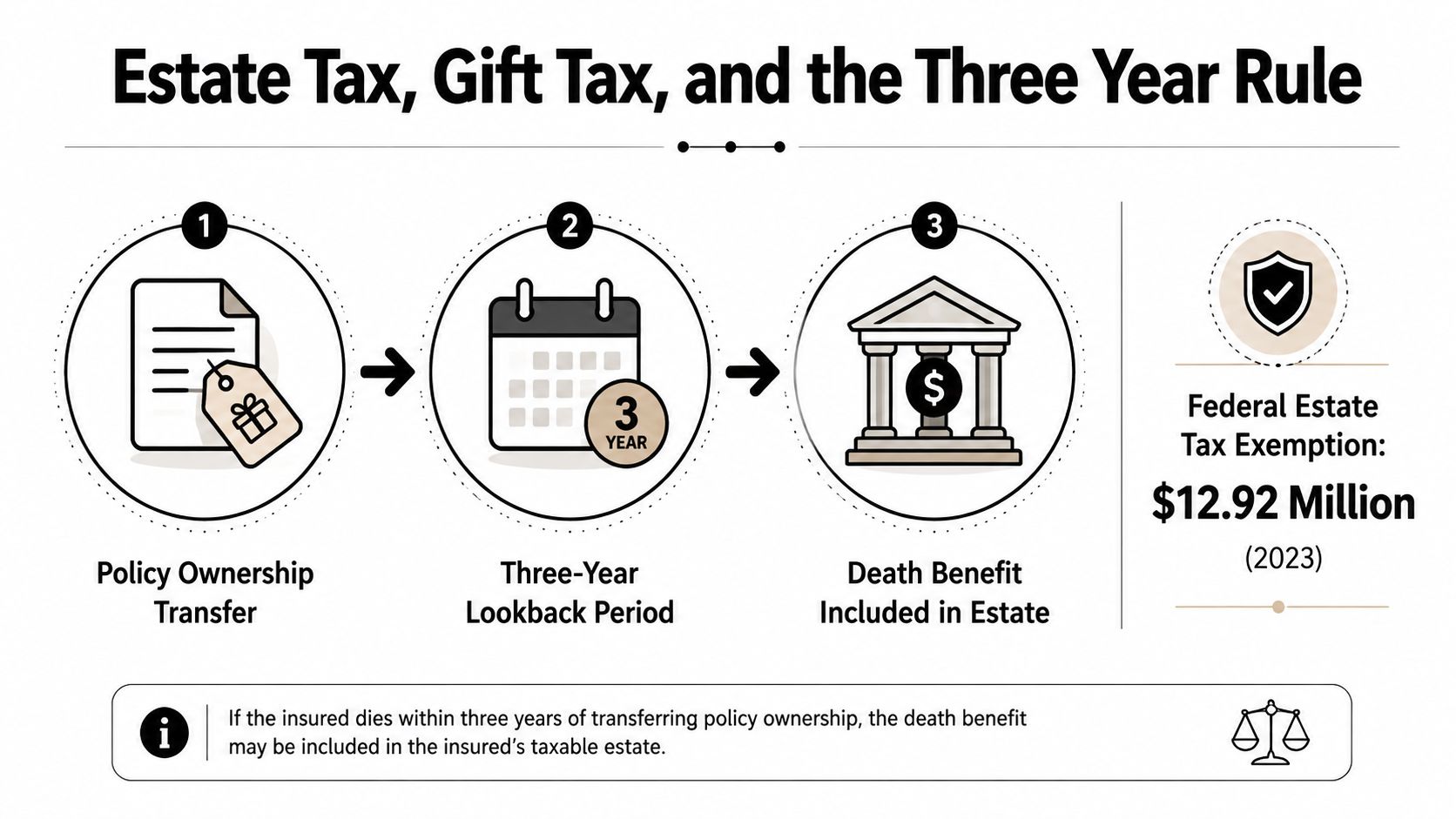
A life insurance death benefit can be income-tax-free and still raise estate tax questions. The two rules do different jobs. One rule looks at income tax treatment, while the other asks whether the policy value belongs inside the insured person's taxable estate. In the material provided here, the federal estate tax threshold is cited as $12.92 million for 2023, and ownership, beneficiary designation, and estate inclusion rules all affect whether life insurance is counted in that calculation.
Ownership decides more than the policy does
If a policy is payable to the estate, or if the proceeds are otherwise pulled into the taxable estate, the death benefit can become part of the estate tax picture. If the payout goes directly to a named beneficiary outside the estate, the result is usually cleaner. That is why beneficiary forms matter so much, because they often do more estate planning work than people realize. For a broader planning overview, trusts gifting and charitable planning often sit in the same conversation as life insurance.
The three-year rule is another point that surprises families. If someone transfers ownership of an existing policy and dies within three years, IRC §2035 can pull the proceeds back into the estate for tax purposes. In plain terms, the law does not let a last-minute ownership change erase estate inclusion so easily.
That rule matters in family transfers. A parent may think moving a policy to a child, a trust, or another relative automatically fixes the issue. It does not always do that, because the transfer timing, the ownership chain, and the estate structure all matter. A policy owned by the estate can also be a poor fit if the goal is to keep the proceeds outside the taxable estate.
California families often need to sort this out before a health scare, not after it. Community property questions, home values, and blended households can all affect who should own the policy and who should receive the benefit. If you want a plain-English reminder of how these pieces fit into a household's coverage picture, the California insurance blog can help you keep the discussion grounded in everyday decisions.
A simple test helps. Ask two questions. Who owns the policy today, and where would the money go if that owner died this year? Those two answers usually show whether the policy is a clean family protection tool or a possible estate-tax asset. For broader California coverage context, the life insurance California guide is a useful reference point when you are reviewing the rest of your insurance stack.
Practical rule: beneficiary choice and policy ownership often matter more than the policy face amount. Estate tax is a design problem, not just a size problem.
Common Misconceptions That Lead to Surprise Tax Bills
The biggest mistake is assuming every life insurance transaction gets the same tax result. It doesn't. A policy can be completely fine in one situation and taxable in another, especially once you change ownership, borrow against cash value, or let the policy lapse with debt still attached.
Five myths that cause the most trouble
- “Life insurance is always tax-free.” The death benefit is generally income-tax-favored, but cash value access, estate inclusion, and post-death interest are separate issues.
- “Naming the estate as beneficiary is harmless.” That can move the payout into the estate tax conversation and defeat the point of keeping the policy outside the estate.
- “All policy loans are tax-free.” Loans can be fine while the policy stays in force, but the outcome can change if the contract ends with debt outstanding.
- “Group coverage over $50,000 costs nothing extra.” The first $50,000 is excluded under Section 79, but coverage above that can create taxable imputed income.
- “I can transfer a policy to family and nothing changes.” The transfer-for-value rule under IRC §101(a)(2) can strip the income-tax exclusion when a policy is sold or transferred for valuable consideration, subject to narrow exceptions for transfers to a partner, a corporation, or an insured partner.
A short family example shows why this matters. A spouse keeps coverage after divorce and assumes the paperwork is just a formality. If the ownership or value exchange is handled carelessly, the tax result may not match the family's expectation. The same is true for a family LLC that receives a policy without anyone checking the transfer rules first.
The safest habit is simple. Any life event that changes ownership, beneficiary designations, or how a policy is funded should trigger a quick review with a licensed agent and, if needed, a tax professional. That small check is often enough to catch the mistake before it becomes a surprise bill.
California Specific Planning Strategies and Next Steps
A California household often reviews life insurance at the same time it checks home, auto, renters, and wildfire-related coverage. That matters because the policy is part of the same family protection picture, especially for homeowners who rely on the California Fair Plan or who are already sorting through broader insurance changes after a wildfire scare.
Start with ownership, then check the numbers
California is a community property state, so spouses sometimes share premiums, titles, or account records in ways that can affect policy ownership, basis questions, and later divorce or death planning. That does not mean every policy turns into a community property dispute, but it does mean the paperwork should be read carefully instead of guessed at. If one spouse paid the premiums and the other is the insured, the file still needs to tell a clear and consistent story.
A simple rule helps here. First check who owns the policy, then check whether the tax treatment still matches the family's plan.
The practical checklist is straightforward:
- Request an in-force illustration: Ask for current basis, cash value, and any MEC status in writing.
- Confirm beneficiaries: Make sure the form matches the estate plan, not last year's family situation.
- Review W-2 reporting: Look for any imputed income tied to employer-provided coverage.
- Coordinate with your broader insurance review: Life insurance should be considered alongside auto, home, renters, and California Fair Plan decisions.
That last point matters because many California families review several policies at once. A homeowner comparing wildfire protection options or a renter changing carriers is already looking at the household balance sheet, so life insurance belongs in the same conversation. The policy may still offer favorable tax treatment, but it only works well when the design fits the family's real needs and records.
A yearly review also helps catch language and paperwork problems before they spread. If the policyholder, spouse, or adult child prefers another language, the review should be understandable before anyone signs a change form. Clear ownership records and beneficiary designations make it less likely that a tax issue will show up later.
If you want a place to organize the questions before meeting with a licensed professional, Mai & Associates life insurance California guidance can help you frame the review. Keeping life insurance in the same annual conversation as home, auto, or renters coverage is one of the easiest ways to avoid surprises later.