Life Insurance Rates By Age a California Guide

It's the simplest truth in the insurance world: when it comes to life insurance, the younger you are, the less you'll pay. In California, this principle holds true across all types of coverage, from life and auto insurance to home insurance.
Insurance carriers love younger applicants because they see them as a lower risk, and they reward that lower risk with the best possible rates. It's a bit like booking a flight—the earlier you lock in your price, the more you save down the road.
Why Age Is the Biggest Factor in Life Insurance Rates
When an insurance company in California sits down to calculate your premium, they're really making an educated guess about your life expectancy. And the most powerful tool they have for that prediction? Your age.
Younger people are, statistically speaking, healthier and have more years ahead of them. This means it's far less likely the insurer will have to pay out a death benefit anytime soon.
Here’s a simple way to think about it: insuring a 25-year-old is like placing a bet that a brand-new car will run without any major issues. But insuring a 65-year-old? That’s more like betting on a classic car with a lot of miles on it. The risk is just plain higher, and so is the cost to cover it. This is the core principle of risk, and it’s why grabbing a policy early is the best move you can make for a lower rate.
How Age Impacts Different Policy Types
The way your age bumps up your premiums really depends on the kind of policy you're looking at. Getting this distinction right is crucial for making a smart choice for your family's future.
- Term Life Insurance: Think of this as temporary coverage, almost like renting an apartment. It protects you for a set period, usually 20 or 30 years. Because it has an expiration date, the rates for young, healthy applicants are shockingly low. But watch out—those rates climb steeply with every birthday you pass.
- Whole Life Insurance: This is permanent coverage that you own for your entire life. It costs more upfront because the payout is guaranteed, and it builds cash value over time. While the initial sticker price is higher, your premium is locked in for good, so you're shielded from those age-related price jumps later in life.
No matter which route you're considering, one thing is certain: every year you wait, the cost of getting coverage goes up. At Mai & Associates, we specialize in helping Californians navigate these decisions—from auto and home insurance to life policies—so you can find the right protection at the right price.
How Term Life Insurance Rates Change as You Age
Term life insurance is the go-to choice for most people, and for good reason. It’s simple, affordable protection that covers you for a specific period of time—say, 20 or 30 years. You can think of it like renting an apartment versus buying a house; you get all the protection you need for the years it matters most, without the higher, lifelong commitment of a permanent policy.
This is perfect for covering temporary, but significant, financial responsibilities like a mortgage or raising children. Because the coverage has a set end date, insurers can offer surprisingly low rates, especially when you're young and healthy. The trick is to lock in that low "rent" early, because the price goes up every single year you wait.
The Power of Acting Early
When it comes to buying life insurance, time is quite literally money. Securing a term policy in your 20s or 30s can save you thousands of dollars over the policy's lifespan. Why? Because the rate you lock in today stays the same for the entire term, whether it's 10, 20, or 30 years.
The core principle is simple: the younger and healthier you are, the lower the risk you represent to an insurance company. Every birthday you have means a slight increase in your statistical risk, which translates directly into a higher premium.
This isn't just a sales tactic; it's the fundamental math of the insurance industry. Your age is the single biggest factor you can't change, and it’s your most powerful tool for getting an affordable rate.
A Look at the Numbers: Term Life Premiums in California
Let's put this into perspective with some real-world numbers for a standard policy in California. The data paints a very clear picture: waiting costs you.
This chart shows just how steeply the cost can climb once you move past your 30s.
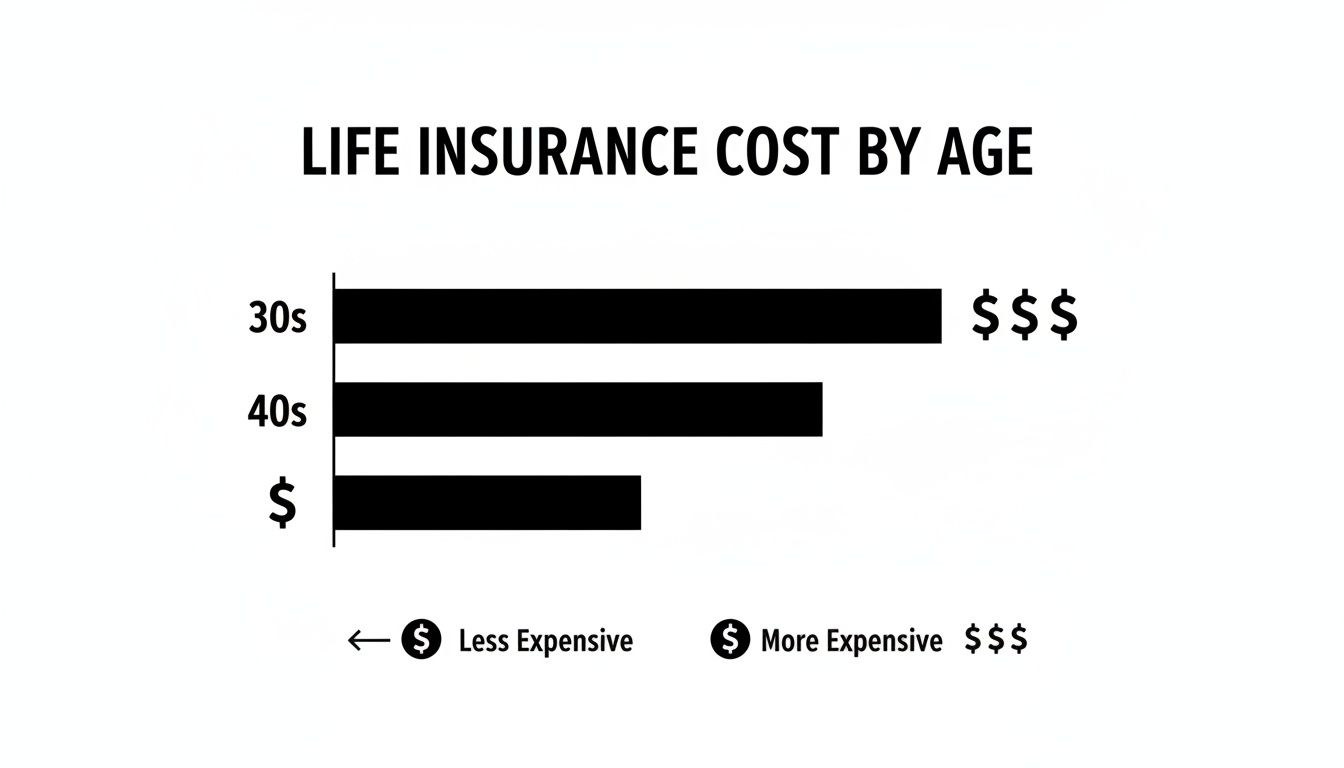
As you can see, the jump from one decade to the next isn't a small step—it's a leap.
To break it down even further, here are some sample annual premiums for a common policy.
Sample Annual Premiums for a $500,000 20-Year Term Policy
| Applicant Age | Average Annual Premium (Male) | Average Annual Premium (Female) |
|---|---|---|
| 20 | $213 | $146 |
| 30 | $231 | $187 |
| 40 | $406 | $343 |
| 50 | $1,180 | $918 |
| 60 | $3,682 | $2,610 |
These are estimates for healthy, non-smoking individuals in California. The difference is staggering. A 20-year-old man might pay just $213 a year for a $500,000 20-year term policy, while a woman of the same age could pay $146. Fast forward to age 60, and that exact same policy could cost $3,682 for a man and $2,610 for a woman. That's more than a 17-fold increase for the same coverage, simply based on age. You can dive deeper into these trends by exploring more life insurance statistics on Openkoda.com.
These figures highlight why it's so important to shop around. Just like with auto insurance or home insurance, comparing quotes is the key to finding the best value. At Mai & Associates, we specialize in helping Californians—from Glendale to Escondido—navigate the market and compare top-rated carriers to find protection that fits their budget.
Understanding Whole Life Insurance and Its Costs
If term life insurance is like renting protection, think of whole life insurance as owning it for good. It's a completely different tool, built for long-term financial goals that demand permanence and stability—something a temporary term policy just can't offer.

This kind of policy is built around two powerful promises. First, the death benefit is guaranteed for your entire life, as long as you pay the premiums. It never expires. Second, it includes a cash value component that grows over time, almost like a separate savings or investment account you can borrow against or withdraw from down the road.
Because of these features, Californians often turn to whole life for specific purposes like estate planning, creating a financial legacy for their kids, or even supplementing their retirement income. That permanence, however, comes at a significantly higher initial cost than you'd see with term insurance.
Why Premiums Are Higher and Predictable
The higher premium for a whole life policy makes sense when you think about it: the insurance company knows it will have to pay out a death benefit eventually. A portion of every payment you make goes toward funding that future payout, while another part gets funneled into your growing cash value.
The real beauty of whole life insurance is its predictability. Yes, the initial payments are larger, but your premium is locked in for life. It will never increase, no matter how old you get or if your health changes.
This fixed cost makes it an incredibly reliable tool for long-term financial planning. You’re not just buying a safety net; you're methodically building a stable financial asset. This is a huge contrast to term policies, which need to be renewed at much higher rates as you get older.
Comparing Whole Life Insurance Rates by Age
The old saying "the early bird gets the worm" absolutely applies to whole life insurance. Locking in your rate in your 20s or 30s can save you a staggering amount of money over your lifetime, as the premiums climb steeply with each passing decade.
For a $250,000 whole life policy, a 20-year-old man might pay around $169 per month, while a woman of the same age could pay $146. Fast forward to age 40, and those rates jump to $355 for men and $296 for women. At age 50, they climb again to $543 for men and $462 for women, reflecting the higher risks that come with aging. Men almost always pay more due to shorter average life expectancies—a statistical reality insurers build right into their pricing. To dig into these figures, you can get the full details about whole life insurance costs on Aflac.com.
Just like with your car insurance or renters insurance, your age and gender are fundamental pricing factors. The table below gives you a clear snapshot of how these rates change across different life stages.
Sample Monthly Premiums for a $250,000 Whole Life Policy
| Applicant Age | Average Monthly Premium (Male) | Average Monthly Premium (Female) |
|---|---|---|
| 20 | $169 | $146 |
| 30 | $252 | $215 |
| 40 | $355 | $296 |
| 50 | $543 | $462 |
These numbers really drive home the financial benefit of securing a policy sooner rather than later. At Mai & Associates, we help Californians compare options for all their insurance needs—from life insurance to home insurance—to find the right fit for their life and budget.
What Else Insurers Look at Besides Your Age
While your age gives insurers a starting point for your life insurance rates, it’s just the first piece of the puzzle. To really understand your personal risk, underwriters in California dig much deeper. Your birthday tells them about the average person your age, but it’s your health and habits that tell them about you.
Think of it this way: age sets the baseline. Everything else is what fine-tunes your final premium, moving it up or down. Knowing what they look for puts you in a much better position to control your costs.
Your Health and Medical History
After age, your health is hands-down the most important factor. Insurers will want a complete picture of your current health status, any past medical problems, and even your family's health history.
Here’s what they zero in on:
- Pre-existing Conditions: A history of things like heart disease, diabetes, or cancer will almost always mean higher rates. The good news? If you're actively managing the condition with medication and regular check-ups, some companies will see that as a positive sign and may offer a better rate.
- Height and Weight: Insurers use your Body Mass Index (BMI) as a quick way to gauge potential health issues. Being significantly overweight can bump you into a higher-risk class.
- Blood Pressure and Cholesterol: These numbers are direct indicators of your cardiovascular health. If your levels are well-controlled, you're on the right track to qualifying for the best rates available.
Your family’s medical history matters, too. If your parents or siblings developed serious conditions like heart disease or cancer before hitting 60, it can suggest a higher genetic risk for you.
At the end of the day, an insurer’s job is to predict risk. A clean bill of health and a proactive approach to managing any existing conditions are your best tools for getting a lower premium.
Lifestyle Choices and Occupation
What you do for a living and how you spend your weekends can have a surprisingly big impact on your life insurance costs. Insurers are always on the lookout for anything that elevates your risk of an early death beyond the norm.
Here are the big lifestyle factors:
- Tobacco and Nicotine Use: This is a huge one. Because of the well-documented health risks, smokers can easily expect to pay two to three times more for coverage than non-smokers.
- Driving Record: A history of DUIs, at-fault accidents, or a stack of speeding tickets tells an insurer you might be a risk-taker. This will cost you more on both your life insurance and car insurance.
- High-Risk Hobbies: Love skydiving, deep-sea scuba diving, or rock climbing? Your adventurous spirit will likely come with higher premiums due to the increased risk of a fatal accident.
- Occupation: A software developer sitting at a desk all day is a much lower risk than a commercial fisherman, pilot, or police officer.
Finally, your gender and the policy details themselves will be factored in. Women generally pay less than men simply because they have a longer average life expectancy. And of course, a $1 million policy will always cost more than a $250,000 one. You can dive deeper into how all these factors come into play by checking out our other California insurance guides.
How to Find the Best Life-Insurance-Rates in California
Once you understand how life insurance companies calculate their rates, you're in a much better position to find a great deal. A few smart strategies can turn that knowledge into real, tangible savings. For Californians looking to lock in the lowest possible premiums, it’s all about being proactive and knowing where to find the best value.

This process doesn't start when you fill out an application—it starts long before. Simple, deliberate improvements to your health and lifestyle can make a huge difference in your final quote.
Create Your Savings Playbook
The secret to lower life insurance rates is to present yourself as the lowest possible risk to an insurer. By taking control of the factors you can actually influence, you can secure a much more affordable policy for your family.
Here’s a practical checklist of proven tactics to get you started:
- Manage Your Health: If you're dealing with high blood pressure or cholesterol, work with your doctor to get it under control before you apply. Insurers look much more favorably on a condition that is well-managed with a documented treatment plan.
- Quit Smoking: This is, without a doubt, the single biggest health-related change you can make. Non-smokers can pay two to three times less for the exact same coverage. Even quitting for a full year before applying can move you into a significantly cheaper rate class.
- Choose the Right Policy: It’s easy to overbuy insurance. A 20-year term policy is often the perfect, low-cost solution for a family with a mortgage and young kids, giving you robust protection when your financial obligations are at their peak.
The most effective strategy, however, is also the simplest: you must compare quotes. Each insurance carrier evaluates risk differently, meaning the company that’s best for your neighbor might not be the best for you.
Partner with an Independent Agency
Shopping for insurance on your own can be an overwhelming chore. You could spend hours plugging your information into multiple websites, only to be left wondering if you're truly getting the best deal available. This is where partnering with an independent agency like Mai & Associates becomes your greatest asset.
Instead of representing just one company, we work with a wide network of top-rated carriers all across California. We take your unique profile—your health, your lifestyle, your financial goals—and shop the entire market on your behalf. Our licensed agents have the inside track on which companies tend to offer the most favorable rates for specific health conditions, occupations, or even hobbies.
This approach saves you a ton of time and, more importantly, money. We do the heavy lifting to find the carrier that views you in the best possible light, ensuring you don't overpay for the coverage you need. Whether you're looking for life insurance, auto insurance, or home insurance, our goal is simple: find you comprehensive protection at a competitive price.
To learn more, check out our guide to getting the right life insurance in California. Let a trusted partner find you the perfect fit.
Get Expert Guidance on Your California Insurance Needs
Figuring out the world of insurance can feel like a maze, especially when you're trying to protect the things that matter most—your family, your home, and your car. As we've seen, when it comes to life insurance rates by age, your biggest advantage is simply starting early. The other major takeaway? Getting a little expert advice is the smartest way to find real value.
This is where having a dedicated professional in your corner can change everything. At Mai & Associates, we’re not just brokers. We see ourselves as long-term partners for California residents, helping with everything from auto insurance to finding the perfect life policy.
Putting Your Whole Financial Picture Together
We take the time to look at your entire financial situation to build a protection plan that actually makes sense for you. It’s shocking how many people miss out on coverage because of simple misunderstandings. Research shows there's a huge "needs gap"—54 million young adults know they need life insurance but think it's wildly expensive.
Many people guess a $250,000 term life policy will run them $250+ a month, but the reality is often closer to just $20-$30. It's a misconception that costs families dearly. You can dig into more of these life insurance trends over at Nerdwallet.com.
By truly understanding your needs, we can help you lock in the right coverage at the right price. We specialize in:
- Life Insurance: To make sure your family's future is secure.
- Auto Insurance: Finding you the best possible rate for driving in California.
- Home & Renters Insurance: To protect your home and everything in it.
Don't leave something this important to guesswork. Let our team show you how simple this can be. Connect with us today to get a personalized insurance quote and see how we can help you build a more secure future with confidence.
Frequently Asked Questions About Life Insurance Rates
It's natural to have questions when you're exploring life insurance—after all, it’s a big decision. Let’s clear up some of the most common things California residents ask when figuring out how premiums and coverage work.
At What Age Do Life Insurance Premiums Increase the Most?
Rates do creep up a little bit every year, but the really noticeable price hikes tend to kick in after you hit 50, and then again after 60.
Why? From an insurer's perspective, this is when health risks start to climb more steeply. As a result, the cost for a new policy can easily be double what you might have paid if you'd locked in a rate back in your 40s.
Can I Get Life Insurance with a Pre-Existing Health Condition?
Absolutely. It's a common misconception that having a pre-existing condition automatically disqualifies you. In reality, getting life insurance in California is often still very much possible.
Insurers will want to look at the big picture: your specific condition, how you're managing it, and your overall health. You might see a higher premium, but coverage is definitely not off the table.
This is where having an independent agent in your corner makes a huge difference. They have the inside track on which carriers are more understanding about certain conditions, boosting your odds of getting approved at a better rate—whether it's for life insurance or even auto insurance.
How Much Life Insurance Coverage Do I Actually Need?
You've probably heard the old rule of thumb: get 10-12 times your annual income. It's not a bad starting point, but it's far from a complete picture.
A better way to calculate your needs is to add up your specific financial obligations. Think about your mortgage, any car loans, future college tuition for your kids, and even final expenses. A good insurance professional can walk you through a detailed analysis to land on a number that truly protects your family.
Have more questions? We've got answers. Check out our detailed California insurance FAQ page for more information. Getting clear on the facts is the best first step you can take.
Finding the right answers—and the right policy—can feel overwhelming, whether you're looking for life, home, or auto insurance. The licensed agents at Mai & Associates are here to cut through the noise. We'll give you expert guidance, compare quotes from top carriers, and help you find the protection that fits your life. Visit us at https://cahomeauto.com for a no-obligation quote today.