Life Insurance Policy for Seniors: A California Guide
Retirement changes the questions people ask about insurance. Earlier in life, the focus is usually income replacement. Later on, the concern is different. You want to know whether your spouse will be left with bills, whether your children will need to cover final expenses, and whether your home, car, savings, and legacy are protected as one complete plan.
That's where a life insurance policy for seniors becomes practical, not theoretical. In California, I often talk with families who already carry home insurance, auto insurance, renters insurance, or car insurance, but haven't reviewed life insurance in years. That leaves a gap. A strong household protection plan should look at the full picture, not just one policy at a time.
Planning for Peace of Mind in Your Later Years
A lot of seniors in California are in a familiar spot. The mortgage may be smaller now, the kids may be grown, and the day-to-day pressure isn't what it used to be. But one question keeps coming back. If something happens, who pays for the loose ends?
In Glendale, Costa Mesa, Westlake Village, and Escondido, I hear the same quiet concern in different words. Some people want to make sure their spouse can stay in the home without stress. Others want to leave a small gift to children or grandchildren. Some don't want their family scrambling to cover funeral bills, credit card balances, or other final costs.

A life insurance policy for seniors should be treated like a financial tool. It's not always about replacing a paycheck. It can help cover end-of-life expenses, support estate planning, protect a surviving spouse, or pay off a remaining loan tied to the household.
A 2023 estimate found that 42% of Americans age 65+ held a life insurance policy, which means a large share of older adults still have no coverage in place for these needs, according to this senior life insurance market analysis. That gap matters.
Think in terms of total household protection
If you own a home, drive regularly, or rent in California, life insurance shouldn't sit in a separate box. It belongs in the same conversation as your home insurance, renters insurance, and auto insurance.
Practical rule: If your family would feel financial pressure after your death, you should at least price life insurance before deciding you don't need it.
For many households, the smarter move is to review all protection in one sitting. That means checking whether your property coverage still fits California risks, whether your car insurance limits are adequate, and whether life insurance fills the final gap. If you want a broader insurance review first, these California insurance guides are a useful place to start.
Decoding Your Senior Life Insurance Options
Most seniors don't need more jargon. They need plain English. Here's the cleanest way to think about it.
Term life insurance is like renting. You pay for coverage during a set period. If the term ends, the coverage ends.
Whole life insurance is like buying. It's designed to stay in force for life if premiums are paid, and it builds cash value.
That basic distinction drives most senior decisions.
A projected 2026 market analysis estimated that senior demand breaks down as 53% term life, 32% whole life, and 15% guaranteed issue, according to this age-based life insurance rate and market breakdown. That mix makes sense. Seniors often want either lower-cost temporary coverage or simpler permanent coverage with fewer surprises.
The main policy types
Term life works best when you have a temporary job for the policy to do. Think mortgage protection, a few remaining years of debt, or a limited period where a spouse still depends on your income or pension structure.
Whole life works better when the goal is permanent coverage. It's commonly used for final expenses, legacy planning, and situations where the policy needs to stay in place regardless of when death occurs.
Final expense insurance is usually a smaller permanent policy designed around burial costs and related bills. It's often the most understandable option for seniors who want one focused outcome.
Guaranteed issue life insurance is the fallback choice when health gets in the way. Approval is easier, but that convenience comes at a cost. Coverage is usually smaller and more expensive for the amount of protection you get.
Senior Life Insurance Policy Comparison
| Policy Type | Primary Purpose | Coverage Length | Builds Cash Value? | Medical Exam Required? |
|---|---|---|---|---|
| Term Life | Temporary needs such as mortgage or short-term debt | Fixed term | No | Sometimes |
| Whole Life | Lifelong protection, final expenses, legacy goals | Lifetime if premiums are paid | Yes | Sometimes |
| Final Expense | Burial costs and end-of-life bills | Lifetime if premiums are paid | Usually yes, depending on policy design | Often no exam, but health questions may apply |
| Guaranteed Issue | Coverage for applicants with serious health barriers | Lifetime if premiums are paid | Typically limited | No |
My blunt recommendation
If you're a senior and you still have a specific financial obligation that will likely disappear in a few years, start with term life. Don't overpay for permanence you may not need.
If your main concern is burial costs, leaving a small benefit, or making sure family members get cash no matter when you pass away, look at whole life or final expense.
If your health is poor and traditional approval is unlikely, use guaranteed issue carefully. It solves an access problem, but it is rarely the first option I'd choose if simplified or underwritten coverage is still available.
Don't shop by premium alone. Shop by purpose. The cheapest policy is a bad deal if it expires before the problem does.
One estate planning angle seniors often miss
If your life insurance is part of a larger legacy plan, policy ownership and beneficiary structure matter. That's especially true for higher-net-worth families thinking beyond simple burial coverage. If that's your situation, it's worth understanding ILITs for your estate before you finalize a policy.
And if you run into unfamiliar terms while comparing quotes, a plain-language insurance glossary for California consumers can save you from signing something you don't fully understand.
How Age and Health Impact Your Policy and Premiums
Policy type matters. Your age and health matter just as much.
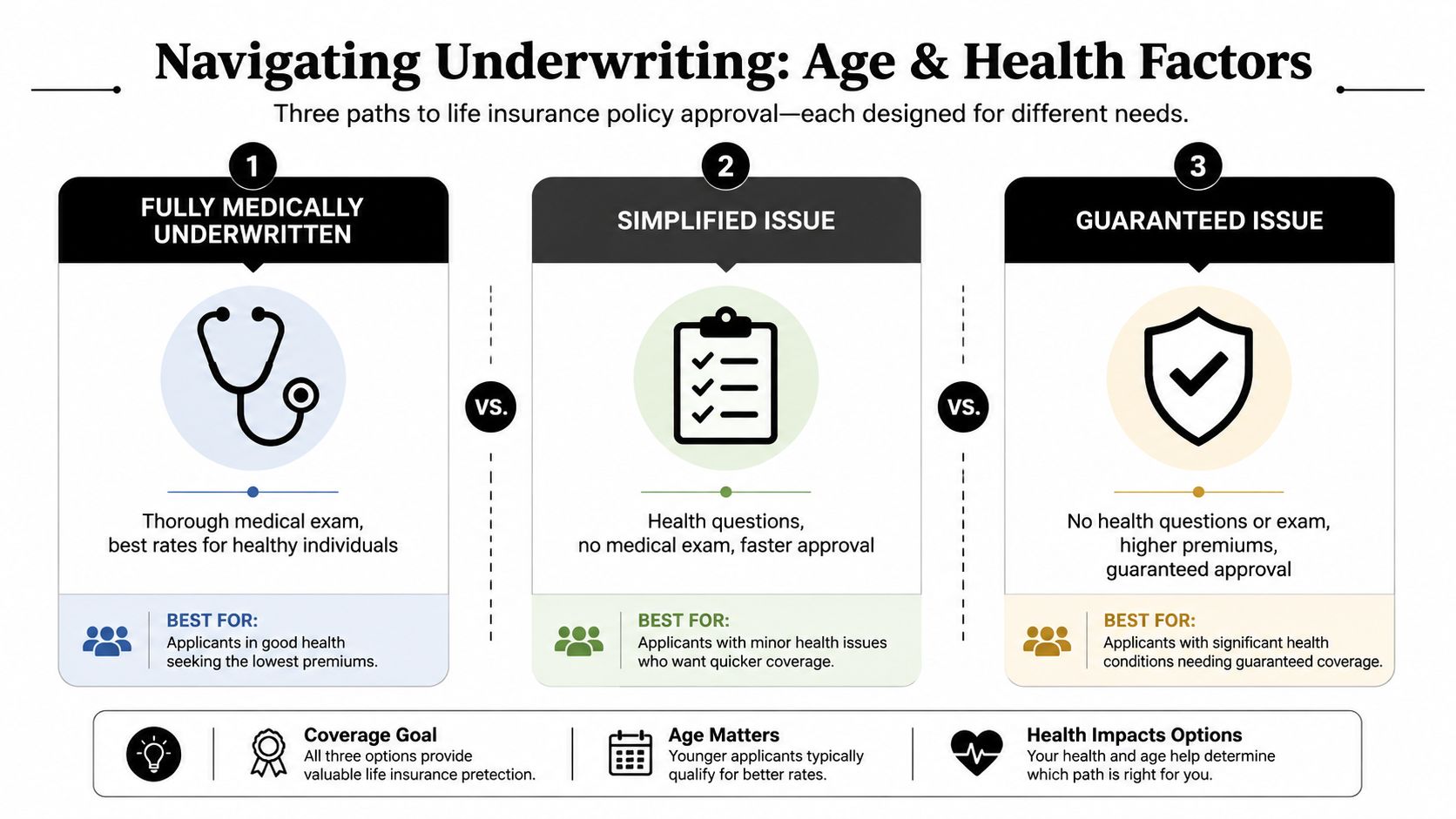
Insurance companies generally put seniors into one of three paths. The more health information you provide, the better your chance of getting stronger pricing and more coverage. The less information the carrier gets, the more cautious it becomes.
The three underwriting paths
Fully medically underwritten
This route may involve a medical exam and a deeper review of your health history. It's more work, but healthy applicants usually get the best value here.Simplified issue
This usually skips the medical exam but still asks health questions. It's faster and more convenient, but the tradeoff is often higher premiums or tighter coverage limits.Guaranteed issue
No medical exam. Usually no health questions. That sounds attractive, but you pay for that convenience through higher cost and smaller benefit amounts.
The tradeoff is real
A lot of seniors ask for “no medical exam” coverage as if it's automatically better. It isn't. It's easier, yes. Better, no.
For older applicants, simplified-issue and guaranteed-issue policies generally avoid exams, but they also tend to come with higher premiums and lower coverage caps, as explained in this guide on senior life insurance options after age 80. That's the trade. Less underwriting usually means less favorable economics.
The same pattern shows up in pricing. A healthy 65-year-old man is estimated to pay about $110 per month for a 10-year, $250,000 term policy, while whole life with the same death benefit can cost about $1,122.84 per month, according to this senior life insurance pricing comparison. That isn't a small gap. It changes the entire decision.
What I tell clients
- If you're reasonably healthy: don't assume an exam is your enemy. It may be the reason you qualify for a much better rate.
- If you have manageable conditions: simplified issue can be a good middle ground.
- If health issues are serious: guaranteed issue may still make sense, but only after you compare it against every other available path.
The question isn't “Can I avoid the exam?” The better question is “What does avoiding the exam cost me?”
Be honest on the application. Senior life insurance underwriting is built around health disclosure. If you leave things out, you create problems for your family later. Clean paperwork matters as much as the premium.
Matching the Right Policy to Your Life Story
The right policy depends on what problem you're trying to solve. Seniors make better decisions when they stop asking, “What policy is best?” and start asking, “What exactly needs to be paid for if I die?”
The grandparent planner
This person is usually less worried about debt and more interested in leaving a clean, intentional gift. Maybe it's money for grandchildren, help for adult children, or a modest benefit that passes quickly without forcing the family to liquidate savings.
For that situation, I usually lean toward whole life if the budget can support it. Permanent coverage fits a legacy goal better than temporary coverage. If the budget is tighter, a smaller permanent policy may still do the job better than stretching for a large face amount that becomes hard to keep.
The fixed-income retiree
This is one of the most common California situations. The concern is simple. “I don't want my family paying for my funeral.”
For seniors on a fixed income, a final expense policy with a $10,000 benefit can cost around $61 per month for women and $81 per month for men, according to this senior final expense pricing overview. That makes final expense coverage one of the clearest practical options for families that need focused protection without a large monthly commitment.
If this is you, don't overcomplicate it. A small policy that stays in force is often better than chasing a larger plan that strains the budget.
The active senior with a remaining mortgage
Some seniors still carry a mortgage, especially in California where housing costs stay high and refinancing decisions over the years can extend repayment. If your spouse would struggle with that payment alone, term life deserves a serious look.
A 10-year term policy is often the clean answer when the need is temporary and tied to a specific debt. You're not trying to build cash value. You're trying to protect the house during the years when the debt still matters.
The shopper in their late 70s or 80s
Realism matters. Options tighten with age. Some term products stop at older ages, and no-exam products often center on smaller benefit amounts with stricter limits.
If you're in this age range, compare these factors in order:
- Acceptance rules: Some policies are available in theory but not to applicants with your health history.
- Benefit size: Small caps may still be enough if your goal is only final expenses.
- Monthly cost: The wrong policy can eat into retirement income quickly.
- Waiting periods and policy details: Families need to know exactly how the coverage works.
A life insurance policy for seniors should fit your story, not a generic sales script. A grandparent, a widow, a renter, and a homeowner with wildfire concerns do not need the same recommendation.
Navigating Insurance as a California Senior
California seniors should look at life insurance as one part of a larger protection strategy. That matters more here than in many other states because property risk, driving exposure, and housing costs can all affect the financial burden left behind.
If you own a home in a wildfire-prone area, life insurance can protect your spouse or heirs from being left with mortgage debt at the worst possible time. If you rent, a smaller policy can still protect loved ones from immediate expenses while your renters insurance handles your belongings. If you drive often, your auto insurance and car insurance limits should also be reviewed alongside life coverage, because one weak point in the household plan can create problems for the whole family.
Buy insurance or self-insure
This is the question too many agents skip.
An independent guide on affordable coverage for seniors notes that one of the most important decisions is whether to buy insurance or self-insure with savings, and that the answer depends on your assets, health, and the cost-benefit of available options, as discussed in this review of affordable life insurance decisions for seniors. That's exactly right.
If you have substantial liquid savings, no major debt, and family members who won't be financially harmed by your death, you may not need much coverage at all. If your savings are limited, your spouse depends on shared income, or your home and auto obligations would continue after your death, life insurance is still doing real work.
Why a full policy review makes sense in California
A senior household shouldn't review life insurance in isolation. Review it together with:
- Home insurance: especially if rebuilding risk or lender requirements have changed
- Auto insurance: especially if vehicles, drivers, or liability needs have shifted
- Renters insurance: if you've downsized and still want affordable property and liability protection
For Californians comparing life options specifically, this California life insurance page is a straightforward starting point. Keep the goal simple. Build a protection plan protecting the person, the property, and the people left behind.
Your Next Steps to Securing Coverage in California
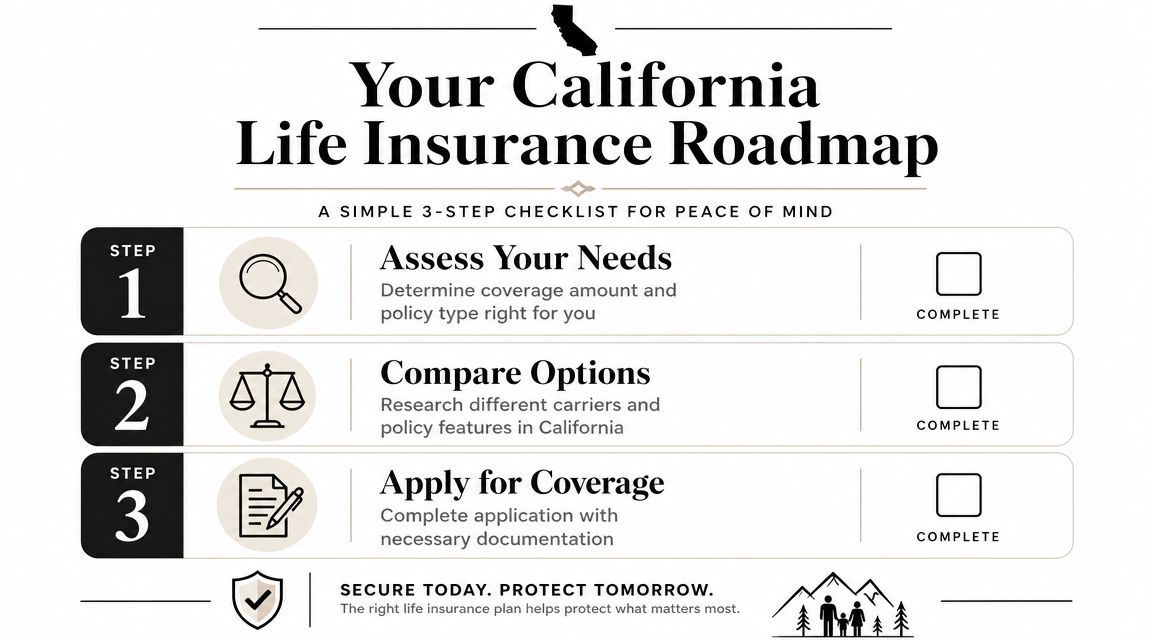
You don't need to solve everything in one afternoon. You do need to take the next step while you're still insurable and while your options are still open.
Start with your why
Decide what the policy needs to accomplish. That's the first filter.
Maybe you want to cover burial costs. Maybe you want to protect a spouse from mortgage payments. Maybe you want to leave a tax-free benefit to children. If you can't define the job, you can't choose the right policy.
Gather the facts before you quote
Have these ready:
- Health history: medications, diagnoses, tobacco use, and recent procedures
- Budget range: what monthly premium feels sustainable
- Existing policies: older life insurance, employer coverage, home insurance, auto insurance, and renters insurance
- Debt picture: mortgage, personal loans, or final expense concerns
This is also the point where a local agency can compare carriers for you. Mai & Associates provides California quotes for life, auto, home, and renters insurance, which makes it easier to review coverage gaps across the household instead of shopping each policy separately.
Apply with clean information
Don't guess on the application. Don't round things in your favor. Don't hide medical history.
A good application is accurate, complete, and realistic about your goals. If your health supports underwritten coverage, explore it. If not, move to simplified issue. If health barriers are significant, evaluate guaranteed issue with clear eyes.
Good insurance planning isn't about buying the biggest policy. It's about buying the right policy and keeping it in force.
If you're ready to compare options, use this California insurance quote request form to start with your actual situation, not a generic online estimate.
If you want help sorting through a life insurance policy for seniors, talk with Mai & Associates. A licensed California agent can help you compare life insurance with your home, auto, renters, and car insurance so the whole household plan makes sense. The agency offers no-obligation quotes, same-day quote support, and multilingual assistance in English, Spanish, Armenian, Russian, and Vietnamese for California families who want clear answers without pressure.