A Life Insurance Policy for Parents: California Guide

A lot of California families start thinking about a life insurance policy for parents at the same moment. A parent gets older, the mortgage is still there, the family home may be in a wildfire area, and nobody is fully sure what would happen financially if that parent died first.
Sometimes the concern is immediate. An adult child is helping with bills. A surviving spouse would struggle to keep the house. A parent has coverage through work, but nobody knows if it's enough or whether it disappears at retirement. In other households, the issue is quieter. There's no crisis today, but there is a clear risk if the wrong event happens at the wrong time.
In California, this decision also connects to more than life insurance alone. A parent's death can affect the family's home insurance, property obligations, renters insurance needs during relocation, and even car insurance if vehicles are jointly owned or financed. That's why the best planning looks at the full picture, not just one policy.
Why Consider Life Insurance for Your Parents
The most common real-world scenario is simple. Your parents have built a life around a house payment, day-to-day expenses, and family obligations, but the paperwork is fragmented. One policy may exist. Another may have lapsed. A surviving spouse may assume things are covered when they aren't.
That concern is valid. According to the 2023 Insurance Barometer Study, 59% of parents with minor children own life insurance, but 47% of this group say they do not have enough coverage, which shows a real protection gap even among insured families, as summarized by the Insurance Information Institute.
The reasons are usually practical, not abstract
Most families aren't buying coverage because they enjoy talking about mortality. They're trying to solve specific financial problems:
- Funeral and immediate costs: The first expenses arrive fast, often before a family has time to reorganize finances.
- Mortgage or housing pressure: If one parent dies, the surviving spouse may need help keeping the home.
- Co-signed debts or shared obligations: Car loans, personal loans, and housing-related debt don't disappear just because a borrower dies.
- Support for a surviving parent: Even if children are grown, the surviving spouse may still rely on the deceased parent's income or pension pattern.
Practical rule: If a parent's death would force the family to sell a house, take on debt, or interrupt care for a surviving spouse, there's a strong reason to review coverage now.
What adult children often miss
Adult children often focus only on burial expenses. That's too narrow. In practice, the bigger strain is often the financial disruption left behind. The surviving spouse may need time, liquidity, and options. If the family owns property, that pressure gets heavier.
That's also why broad planning resources can help before anyone shops for quotes. A useful starting point is this guide with essential tips for parents' insurance, especially if your family is still sorting out whether the goal is income protection, debt coverage, or final expenses.
For California households, this review fits naturally beside other protection questions. If the same family is reviewing life insurance, it's often the right time to revisit home insurance limits, renters insurance for a parent who downsized, and auto insurance on jointly titled vehicles. Families rarely have just one exposure. They have a chain of them.
Assessing Your Parents Real Coverage Needs in California
The right amount of life insurance isn't a generic formula. It depends on what financial problem the policy needs to solve, for how long, and who would feel the impact first.
Start with a worksheet mindset. You're not trying to guess the perfect number on the first pass. You're identifying obligations that would still exist if your parent died tomorrow.

Build the need from the ground up
List the costs in layers:
Immediate expenses
- Funeral and memorial costs
- Final medical bills
- Travel and family logistics
- Legal or estate administration expenses
Outstanding debts
- Mortgage balance
- Home equity obligations
- Car loans
- Credit lines or personal loans
- Any debt an adult child co-signed
Ongoing support needs
- Income support for a surviving spouse
- Household bills that continue after death
- Caregiving or transportation costs
- Support for dependents still relying on that parent
If you want a separate resource to organize this review, California families often start with a life insurance planning page for California before comparing policy types.
California changes the math
A standard life insurance calculator usually misses California property risk. That's where many families underinsure.
For California families in high-risk areas, life insurance for parents should account for potential post-disaster liabilities, such as mortgage shortfalls after a wildfire loss or outstanding property taxes on an inherited home, which are often underestimated in standard needs analyses, as discussed in this guidance on insuring parents.
That matters in a few very specific situations:
- A parent owns a home in a wildfire-prone county: If the property is damaged or difficult to keep, heirs may face carrying costs, tax bills, or loan pressure.
- An adult child expects to inherit or co-manage the home: Life insurance can provide liquidity when the property itself isn't easy to sell or occupy quickly.
- The family may need temporary relocation: A death tied to a disruptive event can create housing needs beyond funeral costs.
Don't treat life insurance in isolation. In California, a parent's death can trigger home insurance questions, temporary renters insurance needs, and vehicle ownership changes that affect car insurance and auto insurance records.
A practical way to think about the target
Use three buckets instead of one number in your head:
| Need bucket | What it covers | Why it matters |
|---|---|---|
| Immediate liquidity | Final expenses and urgent bills | Cash needs come first |
| Debt protection | Mortgage, loans, tax obligations | Keeps the family from forced sales |
| Stability buffer | Time for the surviving household to adjust | Prevents rushed financial decisions |
That broader view usually leads to better decisions than shopping for the cheapest face amount. A life insurance policy for parents should match the actual risks surrounding the family, especially when a house, vehicles, and California property exposure are part of the picture.
Choosing the Right Policy Term vs Whole vs Final Expense
Once you know what the policy needs to do, the next question is product fit. At this stage, many families either overbuy a complicated permanent policy or underbuy a tiny final expense policy that won't solve the problem.
The core trade-off is straightforward. Life insurance policies for parents involve distinct trade-offs: term life offers higher coverage for lower premiums over a set period, while permanent policies like whole life provide lifelong coverage at a higher cost and typically require more rigorous medical underwriting, as outlined in Aflac's overview of life insurance policy options for parents.
Comparison of Life Insurance Policies for Parents
| Feature | Term Life Insurance | Whole Life Insurance | Final Expense Insurance |
|---|---|---|---|
| Coverage duration | Fixed period | Lifelong coverage | Usually designed for lifelong or later-life burial-focused protection |
| Typical cost pattern | Lower premium for higher coverage | Higher premium | Often used when broader coverage is hard to qualify for |
| Underwriting | Can be thorough | Often more rigorous | Often a practical option for older or less healthy applicants |
| Cash value | No | Yes | Not usually the main reason people buy it |
| Best use case | Mortgage payoff, income protection, temporary family obligations | Long-term estate or lifetime support planning | Funeral costs and limited end-of-life obligations |
When term life makes sense
Term life usually fits best when the problem has an end date. If a parent still has a mortgage, still supports a spouse, or wants coverage during a remaining working period, term often does the cleanest job.
It's usually the most efficient option when you need meaningful protection without paying for lifelong features you may not need.
When whole life earns its place
Whole life can make sense when the family wants permanence. That may include a parent who wants coverage that won't expire, a family planning around estate administration, or situations where liquidity will likely be needed regardless of when death occurs.
Whole life is also the policy type families sometimes pair with trust planning. If your household is also considering how assets pass to children or how proceeds should be controlled, this overview of expert guidance on irrevocable trusts can help frame the legal side.
The wrong way to choose a policy is to start with the product. Start with the job the policy must do, then choose the least complicated product that does that job well.
Where final expense fits
Final expense insurance is often a practical answer for older parents who can't qualify easily for larger traditional coverage. It won't replace a major income stream or solve every estate issue, but it can still remove immediate strain from the family.
That makes it useful when:
- Health has narrowed options: The parent may not qualify comfortably for standard term or whole life.
- The goal is limited but important: The family mainly wants funds for burial, small debts, or short-term bills.
- The application needs to be manageable: Simpler underwriting can be easier for older applicants.
What usually doesn't work
A few patterns create problems:
- Buying too little because the monthly premium looks attractive
- Buying whole life only because it sounds permanent, without confirming the budget
- Ignoring the parent's age and health until options shrink
- Assuming work coverage is enough without checking portability or end dates
A good life insurance policy for parents should fit the family's timeline, property exposure, and budget. If the parent's main risk is a remaining house payment, term may be ideal. If the issue is lifetime certainty, whole life may be worth the higher cost. If health has already limited choices, final expense may be the practical path.
Understanding Underwriting and What Affects Costs
The price of life insurance comes from underwriting. That's the insurer's process for deciding how risky it is to insure a person and on what terms.
Families often think of this as a medical exam issue only. It's broader than that. Insurers review health, medications, age, medical history, lifestyle, and the details of the policy being requested.
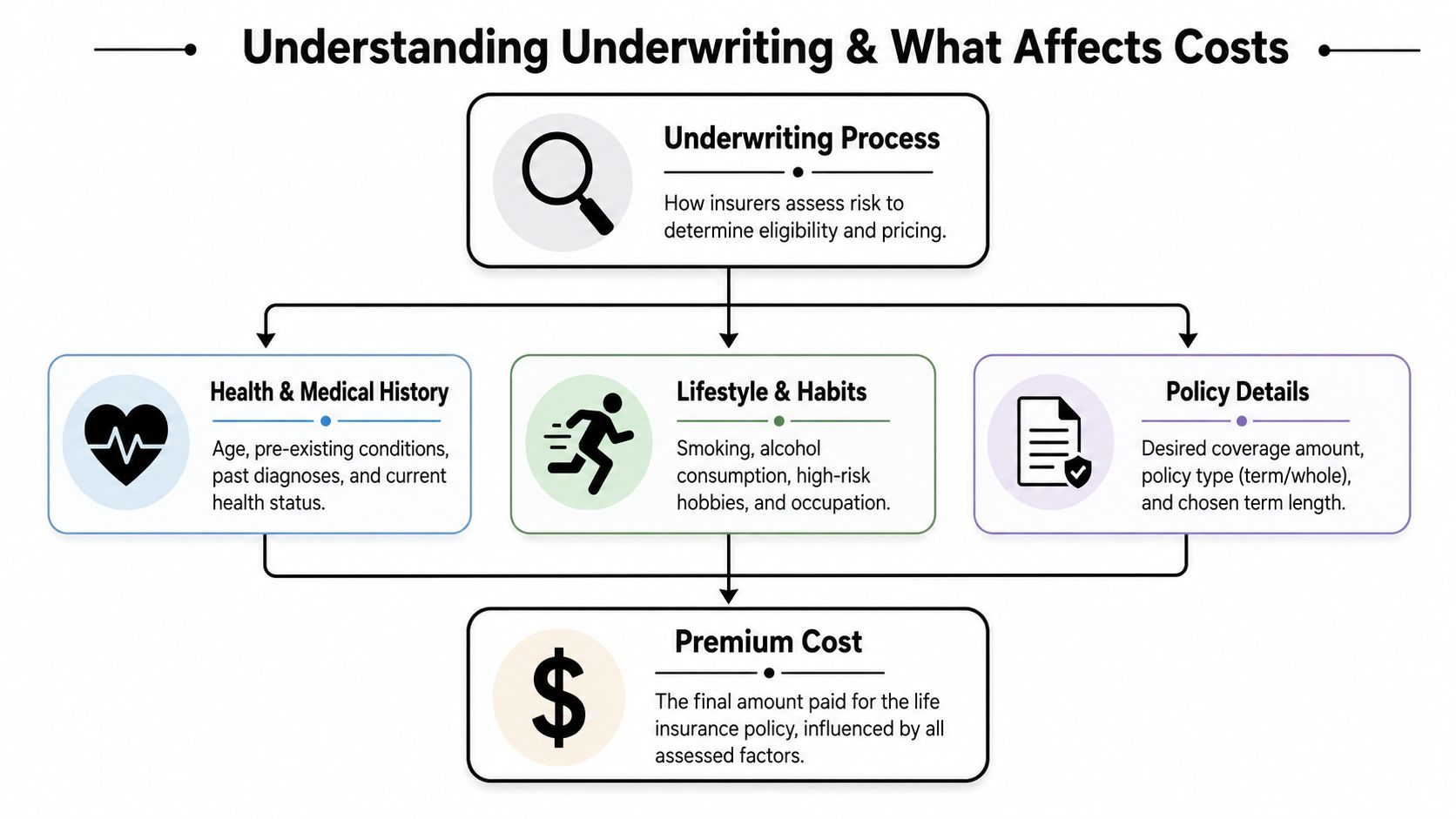
The main inputs insurers review
Health and current conditions
Current diagnoses matter. So do prior procedures, prescriptions, height and weight patterns, and whether the parent is managing conditions consistently. For older applicants, even a manageable chronic issue can change which carriers are realistic.
Lifestyle and habits
Smoking remains a major pricing factor. Alcohol misuse, risky hobbies, and some occupations can also affect eligibility or premium class. Even when a parent feels healthy, underwriting still looks at the complete risk picture.
Policy design
Coverage amount, policy type, and term length influence how an insurer evaluates the application. A modest final expense policy and a larger whole life application don't get evaluated the same way.
Family history matters more than people expect
This part surprises many families. Insurers increasingly use predictive models that analyze family medical history; inaccuracies in reporting conditions like early-onset cancer or heart disease in first-degree relatives can lead to incorrect pricing, as up to 30% of non-disclosed conditions are often found during medical record checks, according to this analysis of predictive modeling in underwriting.
That has two practical consequences:
- Be complete, not selective: If an application asks about family history, answer carefully.
- Gather records early: It's easier to explain a condition accurately when medication lists, doctor names, and timelines are in front of you.
A clean application doesn't mean a vague application. Accurate detail is what protects both pricing and future claims handling.
What families can do before applying
A few steps improve the process:
- Collect documents first: Medication lists, physician details, prior diagnoses, and any existing policy information.
- Review old applications if they exist: Inconsistencies between applications can create delays.
- Discuss the goal of the policy before applying: A parent may qualify differently depending on the amount and product type.
- Use a question list: Families often miss obvious items unless they write them down. A general insurance FAQ resource can help organize what to ask before submitting an application.
Underwriting doesn't reward guesswork. It rewards clarity, consistency, and realistic expectations. For parents, especially older ones, that can mean the difference between a smooth approval and a long series of avoidable delays.
How to Buy a Life Insurance Policy for Parents in California
The buying process is usually less complicated than people expect, but there is one rule that isn't flexible. You cannot legally buy a life insurance policy for a parent without their knowledge and signature on the application; insurers also require the applicant to prove insurable interest, meaning they would suffer a financial hardship upon the parent's death, as explained in Western & Southern's guide to life insurance for your parents.
That means secret coverage is not an option. The parent must participate.

Step one is the family conversation
Start with the reason for the policy, not the product. If the parent hears only, “I want to insure you,” the discussion can feel cold or transactional. If they hear, “I want to make sure Mom can stay in the house,” the conversation is usually much easier.
Good conversations focus on:
- Who depends on the parent financially
- Which debts would remain
- Whether there's existing coverage already
- Who should own the policy and who should be beneficiary
The application checklist
Most families should gather these items before asking for quotes:
- Basic identification: Full legal name, birth date, address
- Health background: Doctors, diagnoses, medications, recent care
- Financial purpose: Mortgage details, support obligations, or estate concerns
- Existing coverage: Employer life insurance, older private policies, or association benefits
Direct carrier vs independent agency
Buying direct from one insurer can work if the parent is straightforward medically and you already know which product fits. The downside is simple. You only see that carrier's answer.
An independent agency approach works better when there are health concerns, multiple product options, or California property issues in the background. Families comparing life insurance often also need help reviewing related home insurance, renters insurance, auto insurance, or car insurance exposures at the same time. If you're ready to start that process, a California insurance quote request is the practical next step.
Buy after you confirm ownership, beneficiary designations, and the purpose of the policy. Those decisions matter as much as the premium.
California-specific details to keep in mind
If your parent owns property in a wildfire area, ask how death of the insured would affect household finances if the surviving family member keeps, rents, or sells the home. If vehicles are shared, confirm title and loan obligations. If a surviving spouse may need temporary housing, review whether the broader insurance plan is coordinated.
A life insurance policy for parents works best when it's part of the household's full protection plan, not a standalone purchase made in a rush.
Lowering Costs and Avoiding Common Mistakes
Families usually save the most money by making better decisions early, not by chasing the absolute lowest premium at the end.
What helps lower costs
- Apply sooner: Age and health don't usually get easier for underwriting.
- Match the product to the need: Term is often more efficient for temporary obligations than permanent coverage.
- Keep the application accurate: Corrections and inconsistencies can lead to delays or less favorable offers.
- Review existing policies first: A parent may already have coverage that can be kept, supplemented, or replaced thoughtfully.
Mistakes that create expensive problems
- Focusing only on burial costs: That overlooks mortgage, tax, and household stability needs.
- Ignoring California property risk: Families in wildfire areas often underestimate inherited housing exposure.
- Choosing based only on price: The cheapest policy can be the wrong policy if duration or amount is off.
- Forgetting related coverage: A death in the family can affect home insurance, renters insurance, and auto insurance decisions at the same time.
The strongest approach
A solid plan usually looks like this:
- Confirm what financial loss the family is trying to cover.
- Review any current life insurance already in force.
- Choose the simplest policy structure that solves the problem.
- Coordinate the decision with the household's broader protection plan.
For families who want a wider review of protection issues beyond life insurance alone, these California insurance guides can help you think through home, renters, car insurance, and related planning questions in one place.
The best life insurance policy for parents is rarely the flashiest product. It's the one that pays at the right time, for the right purpose, without leaving the family exposed somewhere else.
If you want help comparing life insurance with your broader California insurance needs, Mai & Associates can help you review coverage across life, home, renters, auto, and car insurance so your protection works together instead of leaving gaps.