A Californian's Guide to a Life Insurance Policy Beneficiary

You might be dealing with several insurance decisions at once right now. Maybe you just bought a home in California and had to think about wildfire exposure. Maybe you updated your car insurance because a teen driver was added to the household. Maybe you're renting in a city where replacing your belongings after a loss would be harder than it looks.
Then life insurance comes up, and the beneficiary form feels like the easy part.
It isn't.
Your life insurance policy beneficiary is the person, people, trust, or entity named to receive the policy's death benefit. That choice decides who gets the money and how smoothly things unfold after your death. If your form is outdated, incomplete, or poorly set up, your family can run into confusion at the worst possible time.
For Californians, this deserves extra attention. Family structures are often more complex than a single spouse and two kids. There may be remarriages, unmarried partners, adult children from prior relationships, aging parents, or a mortgage tied to a home in a high-risk area. In that setting, beneficiary choices aren't paperwork. They're instructions.
Why Your Beneficiary Choice Matters More Than Ever
A California family can do a lot of insurance planning and still leave one of the biggest instructions unfinished. They buy auto coverage because they have to drive. They set up homeowners or renters insurance because a lender or landlord expects it. Then they add life insurance and assume the hardest part was choosing the coverage amount.
Often, the harder question is who should receive the money.
Your policy is only half the plan
Life insurance creates the money. The beneficiary designation tells the insurance company exactly where that money should go.
A simple comparison helps here. Home insurance pays to repair or rebuild property after a covered loss. Auto insurance pays for vehicle damage, injuries, or liability after a covered accident. Life insurance is meant to replace income and provide stability after a death. The beneficiary works like the delivery instructions. If those instructions are outdated or unclear, the money may take longer to reach the right hands.
California families reviewing their household protection should look at the full picture, including life insurance options in California. Coverage amount matters. The beneficiary setup matters just as much.
Why this choice carries so much weight
A beneficiary designation is a direct instruction inside the insurance contract. This designation determines whether money goes to the intended person quickly or ends up delayed, disputed, or paid to an estate instead.
That matters because life insurance usually passes by contract, not by the terms of a will. Many people assume, "I already handled that in my estate plan." Then they discover the policy still names an ex-spouse, a parent, or nobody at all.
This detail often surprises people. They spend time updating a will, refinancing a home, or changing titles on bank accounts, but the beneficiary form sits untouched for years.
In California, that can create real problems for families already dealing with high housing costs, shared debts, and complicated family structures. A bad beneficiary choice can leave a surviving spouse short on mortgage money, create conflict between children from different relationships, or force proceeds into the estate where the transfer can take longer and involve more expense.
Practical rule: If you want life insurance money to go to a specific person or trust, confirm that the beneficiary form says exactly that. Do not assume your will fixes an old designation.
Common California moments when this becomes urgent
Some life events should trigger a beneficiary review right away, especially in California where community property questions and blended families are common.
- A home purchase: A new mortgage often means your income is supporting a much larger monthly obligation.
- Marriage or remarriage: An old form may still name a parent, sibling, or former partner.
- Children arriving: Minor children usually should not receive proceeds outright without planning for who manages the money.
- Divorce: Delays in updating forms can lead to conflict and, in some cases, court fights.
- A broader insurance review: If you are already updating home, renters, or auto policies, review your life insurance beneficiaries at the same time.
The main point is simple. Buying life insurance is only step one. Naming the right beneficiary is what turns that policy into clear instructions your family can use.
Understanding Your Financial First Responders
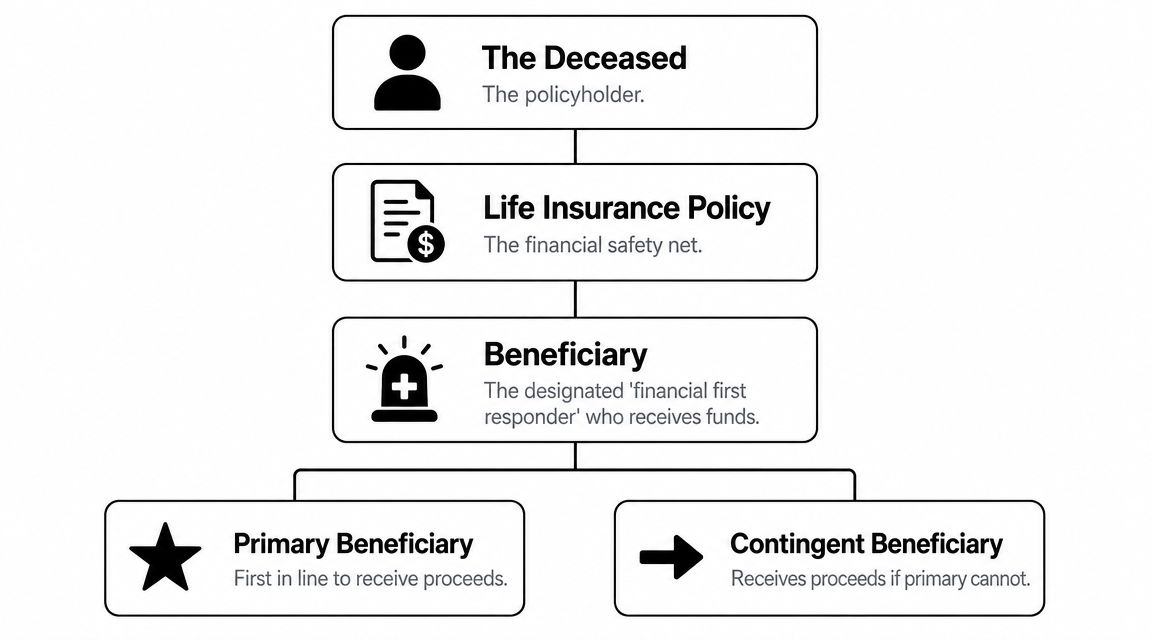
A beneficiary is often described in technical terms. A simpler way to think about it is this: your beneficiary is your financial first responder.
When you die, this is the person or entity positioned to receive the death benefit and put that money to work. They may use it to cover mortgage payments, groceries, childcare, funeral costs, rent, or create breathing room while the family adjusts.
Primary and contingent mean first choice and backup
Most policies use a basic structure with primary and contingent beneficiaries.
In the U.S., 52% of American adults had life insurance in 2024, and the structure is typically “primary” and “contingent”: the primary beneficiary is first in line, and contingent beneficiaries receive the benefit only if the primary has died or cannot be found, as noted in Policygenius life insurance statistics.
In plain English, this means:
- Primary beneficiary: The first person or entity meant to receive the payout.
- Contingent beneficiary: The backup if the primary beneficiary can't receive it.
If you only name a primary beneficiary and that person dies before you, you've created a hole in the plan. A contingent beneficiary fills that hole.
A simple family example
Suppose Elena in Pasadena has a life insurance policy. She names her husband as the primary beneficiary. She names her sister as the contingent beneficiary.
If Elena dies and her husband is living, he receives the benefit. If he died earlier, or can't be located, her sister becomes next in line. That backup can keep the proceeds from falling into a more complicated process.
This is one of those insurance details that sounds small but does a lot of heavy lifting.
The naming details matter
Insurers commonly need identifying information to validate the claimant and avoid paying the wrong person. That usually means using a full legal name and other identifying details.
A vague label like “my kids” or “my partner” can create confusion. A clear designation gives the insurance company less room for doubt and gives your family fewer hurdles.
If you're sorting through insurance terms and want a plain-English reference point, a good place to start is this insurance glossary for California consumers.
The strongest beneficiary setup is boring on paper. Full names, clear roles, exact shares, and a backup plan.
Why this structure works
Primary and contingent designations do two jobs at once:
- They reflect your wishes.
- They reduce the chance of delay if life changes before you die.
That second part matters more than people expect. Families change. Relationships change. People move. Someone listed on a form years ago may no longer be the right fit, or may no longer be alive.
A life insurance policy beneficiary isn't just a recipient. It's part of the policy's delivery system.
Exploring Your Beneficiary Options
Picking a beneficiary is a little like deciding who should get the keys and instructions to an important house. The wrong choice can leave your family stuck outside, even if your intentions were clear.
In California, that choice also needs to fit the rest of your planning. A life insurance policy does not sit in isolation. It often interacts with your home, your family budget, and the property rules that affect married couples here.
The main beneficiary choices
A beneficiary can be one person, several people, a trust, or your estate. Many insurers also let you split the benefit by percentage, as long as the total equals 100%.
Here's a quick comparison:
| Beneficiary Type | Best For | Key Consideration |
|---|---|---|
| Individual person | A spouse, adult child, partner, sibling, or other specific person | Keep legal name and details current |
| Multiple individuals | Families who want to divide proceeds among several people | Percentages should total 100% |
| Trust | Minor children, dependents needing managed funds, more controlled distribution | Requires planning and correct trust setup |
| Estate | Rare situations where no better option fits | Can expose proceeds to probate and creditor issues |
Individual people
Naming one adult is usually the cleanest setup. The insurer can identify the person, verify the claim, and pay the benefit without added layers.
Naming more than one person also works well if you want to divide the money on purpose instead of leaving relatives to sort it out later. A California parent, for example, might leave 60% to a spouse and 20% to each of two adult children. Clear percentages act like labeled containers. Each person knows what share belongs to them.
This approach can be especially helpful in blended families, where assumptions often cause conflict.
Trusts and estates are very different
A trust allows you to appoint someone to manage money for a child or another beneficiary. That can make far more sense than naming a minor directly and expecting the family to figure out the legal details later.
An estate works differently. Once life insurance proceeds are paid to your estate, the money may have to move through probate before heirs receive it. That can mean delay, added expense, and more opportunity for creditors to make claims. For California families who already own a home or are trying to keep property transfers simple, that concern often overlaps with bigger estate questions, including quitclaim deeds and probate in California.
A will does not solve that problem by itself. If your goal is fast access to money for loved ones, naming the estate is usually a last-resort option, not a default choice.
Revocable and irrevocable are not the same
This is the part many policyowners overlook.
A revocable beneficiary can usually be changed later by the policyowner. That gives you room to adjust after marriage, divorce, a new child, or other family changes.
An irrevocable beneficiary has stronger rights. If you make that designation, you usually cannot change it without that beneficiary's consent.
That difference matters in real life. A divorce settlement may require a parent to keep coverage in place for a child or former spouse. A business agreement may also call for an irrevocable beneficiary to protect a buy-sell plan. In those cases, the designation works less like a preference and more like a locked instruction.
For many households, revocable is the better fit because life changes. Irrevocable can be useful, but it deserves the same level of care you would give to a property title or a major contract.
Navigating Special California Beneficiary Rules
California adds a few wrinkles that generic life insurance articles often miss. Families here should pay close attention to spouse rights, divorce fallout, and planning for minors.
Community property can complicate a clean-looking form
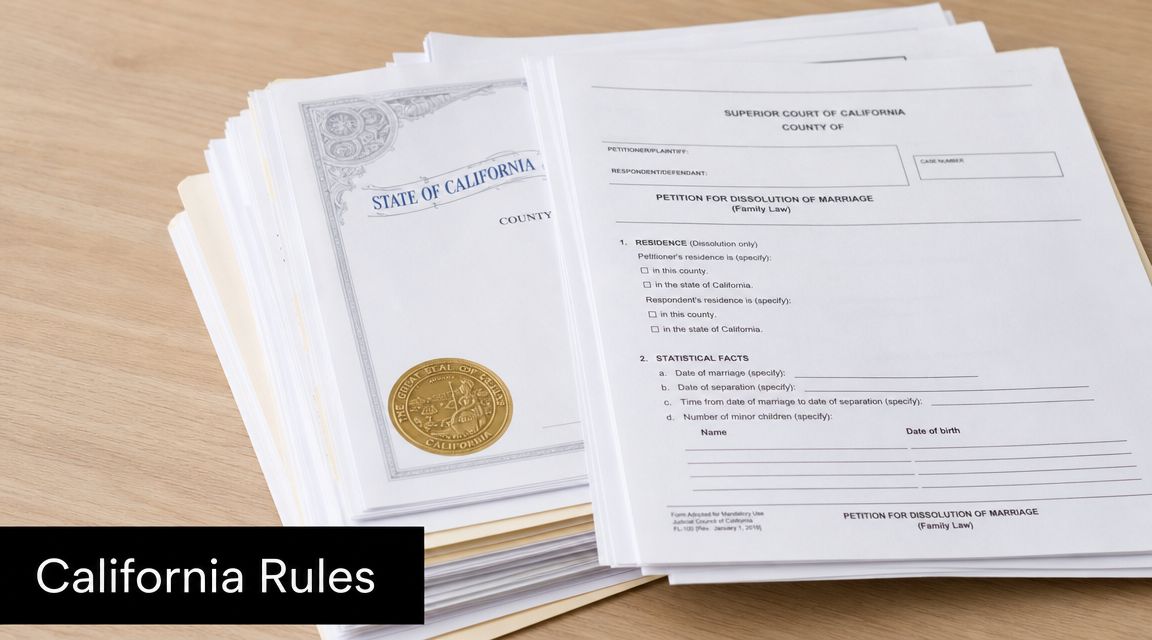
California is a community property state. In plain language, that can matter when a married person pays premiums with community funds.
A beneficiary form may look clear on its face, but a surviving spouse may still raise questions about rights tied to the policy. This is one reason married Californians shouldn't assume that naming someone else is automatically simple.
If you're married and want to name someone other than your spouse, get advice before relying on the form alone. That's especially true in second-marriage and blended-family situations.
Divorce doesn't fix old paperwork by itself
Divorce creates one of the most common beneficiary problems. People separate emotionally long before they update forms. Then the paperwork keeps pointing at an ex-spouse.
That risk isn't limited to life insurance. It often shows up alongside title issues, beneficiary disputes, and probate questions involving homes. If you're sorting out property transfers or inherited real estate, this overview of quitclaim deeds and probate in California is a helpful legal resource because it explains how ownership paperwork and probate consequences can intersect.
Short version: after divorce, review everything. Life insurance. Home title. Retirement accounts. Transfer-on-death designations. Auto ownership records if needed. Don't leave one form in the old chapter of your life.
Minors should not be named casually
Parents often make a mistake with good intentions.
Guidance on no-beneficiary and disputed cases notes that minors generally cannot directly receive payouts, and if no valid beneficiary exists the proceeds may pass to the estate and face probate delays and creditors, a problem highlighted by Western & Southern's discussion of policies with no beneficiaries.
That matters for California parents because “I'll just list my child” can create court involvement or force someone else to step in later.
Better approaches often include:
- Using a trust: This can let a trustee manage funds under instructions you set.
- Using a legal custodian arrangement where appropriate: This may be useful for smaller, more straightforward situations.
- Coordinating with your will and guardianship planning: Beneficiary designations and estate documents should work together.
A child can be the person you intend to benefit without being the person who directly receives and manages the money.
Blended families need extra precision
In California, blended families create the most avoidable disputes. A parent may want to protect a current spouse in the short term and children from a prior relationship in the long term. One policy can do part of that work, but only if the designations are current and specific.
General wording causes conflict. Precise wording prevents it.
How to Name or Update Your Beneficiaries
A California family buys a bigger home, adds a second car, welcomes a new child, and updates every policy except the life insurance beneficiary form. Years later, the coverage amount is still right, but the payout is pointed at the wrong person. That is how a small paperwork issue turns into a large family problem.
The basic steps
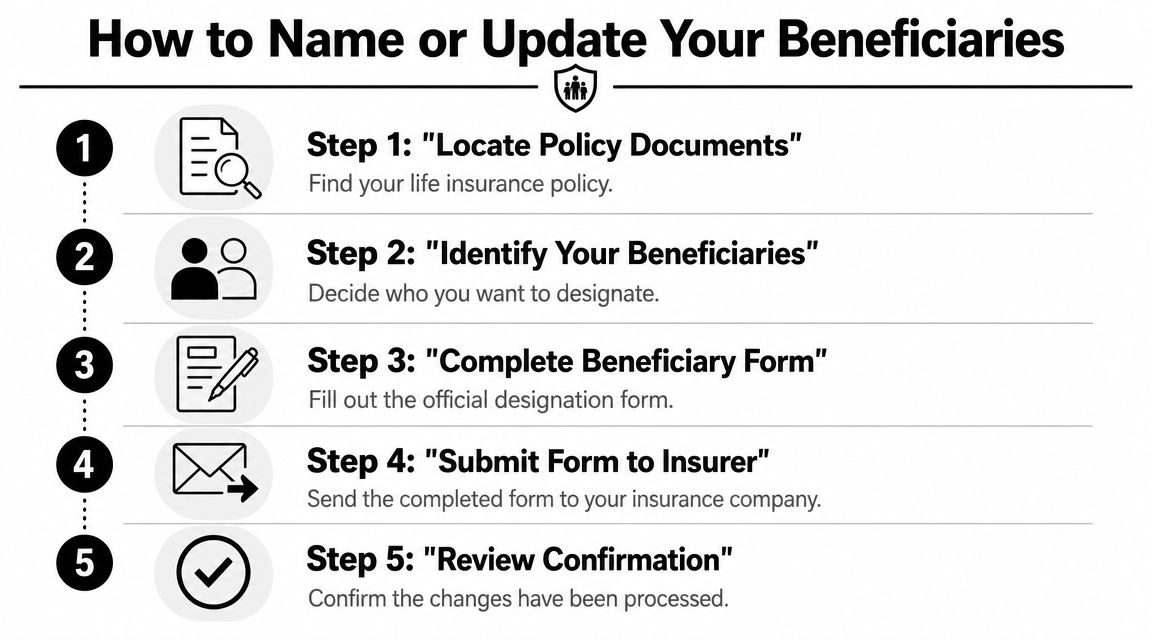
Naming or updating a beneficiary is usually straightforward. The part that takes thought is making sure the form matches your real life today, not your life five or ten years ago.
Use this process:
- Gather the policy details. Find the insurer name, policy number, and your current beneficiary record.
- Choose both primary and contingent beneficiaries. The primary beneficiary is first in line. The contingent beneficiary is the backup if the first person cannot receive the money.
- List full legal information. Insurers often ask for a full legal name, date of birth, relationship to you, and sometimes a tax ID or other identifying details.
- Complete the insurer's beneficiary form. A will does not usually override the carrier's beneficiary record. The insurer pays based on the valid designation on file.
- Submit the change and verify it was accepted. Keep a copy with your important documents.
A beneficiary form works like the address label on a package. If the label is outdated, the carrier follows the label first.
Check for limits before you make changes
Before you submit an update, confirm whether your current designation is revocable or irrevocable.
If it is revocable, you can usually change it as the policyowner by following the insurer's process. If it is irrevocable, the current beneficiary may need to consent before any change can be made. This comes up often after divorce settlements, business agreements, or estate planning arrangements.
That one word matters.
For California residents, this is also a good moment to pause and ask whether another person may have rights that affect the policy, especially if premiums were paid with marital income during marriage. Community property questions do not change every policy in the same way, but they can complicate a last-minute beneficiary update if you assume the form is the whole story.
Review after life changes that already affect your insurance
A simple habit helps. Review beneficiaries whenever you review the rest of your protection plan.
Use this checklist:
- Marriage or remarriage: A new spouse may need to be added, or your shares may need to be adjusted.
- Divorce or legal separation: Old designations often stay in place until someone actively changes them.
- Birth or adoption of a child: Your plan may need a trust, a custodian arrangement, or a different split.
- Death of a beneficiary: Your backup may now be missing.
- Home purchase, refinance, or a larger mortgage: Bigger household obligations often mean it is time to revisit who would receive the death benefit and how it would support the family.
- Annual insurance review: If you are already checking home, auto, or umbrella coverage, add life beneficiaries to the same conversation. A good starting point for common coverage questions is this California insurance FAQ page.
For many families, the easiest routine is this: if a life event would make you update your auto policy, homeowners policy, or emergency contacts, it should also trigger a beneficiary review.
Every major family change deserves a quick beneficiary check.
Filing a Claim A Guide for Beneficiaries
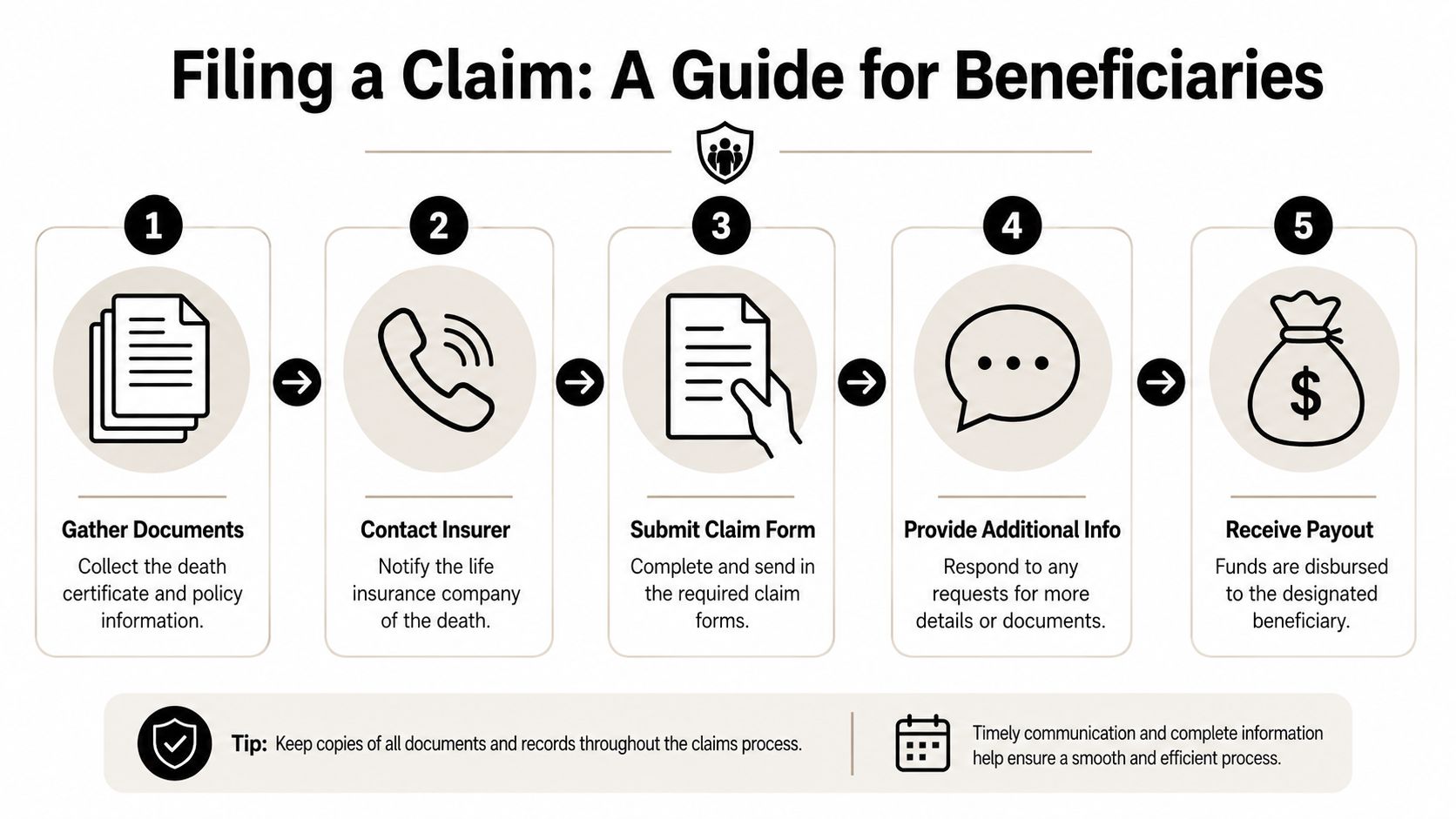
If you're the beneficiary, the process can feel intimidating because it starts during grief. It helps to know what usually happens before you make the first phone call.
Start with locating the policy
Let's say your father dies, and you remember him mentioning a life policy years ago. You don't need to know everything on day one. Start by finding the insurer name, policy paperwork, or any account statements that mention the policy.
The NAIC warns that tens of millions of dollars in death benefits go unclaimed each year, and advises policyholders to inform beneficiaries or trusted advisors about the policy and review beneficiary information annually, according to the NAIC consumer guidance on life insurance beneficiaries.
That warning is why good recordkeeping matters so much.
What you'll usually need
Insurers commonly ask for a few core items before they can pay a claim.
Bring together:
- A certified death certificate: This is usually the key document.
- The policy number if you have it: Helpful, but not always essential if you know the insurer.
- A completed claim form: The insurer will provide it.
- Your identification details: The carrier may need enough information to verify you're the right claimant.
Where delays usually happen
The claim itself isn't always the problem. Missing information is.
Common slowdown points include:
- An outdated beneficiary record: The insurer may need to sort through conflicting information.
- A mismatch in names: Nicknames, married names, and legal names can create extra steps.
- Incomplete forms: A blank field can trigger follow-up.
- Unclear policy location: Family members may not know which company issued the policy.
If you're naming beneficiaries on your own policy, tell at least one trusted person where the policy is kept. That small step can spare your family a long search.
If you're not sure a policy exists
You may need to search personal files, email records, old premium notices, or ask a financial professional or executor who worked with the deceased. Some beneficiaries also use policy locator tools when the insurer isn't known.
The smoother claim experiences usually start years earlier, when the policyholder leaves a clear trail.
Beneficiary FAQs and Your California Insurance Partner
A few practical questions tend to come up after families understand the basics.
Are life insurance proceeds taxable
That depends on the circumstances and how the payout is structured, so it's smart to confirm with a tax professional for your situation. What matters for beneficiary planning is that tax questions are separate from the naming question. Even a tax-efficient outcome can still become messy if the wrong beneficiary is listed.
Can creditors reach the death benefit
That can depend on who is named and how the proceeds are handled. One reason people try to keep life insurance out of the estate is to reduce the chance of the funds getting pulled into probate-related complications. If the estate receives the proceeds, that can create a different set of risks than naming a direct beneficiary or trust.
Can I name anyone I want
Often yes, but "can" and "should" aren't the same. Naming an unmarried partner, a friend, or one child instead of several may be legally possible, but it can also create disputes if the broader plan doesn't match your family reality. In trust-based planning situations, this guide to trust beneficiary rights in California can help you understand how beneficiary interests and trustee responsibilities may work.
Should my life insurance be reviewed with my home and auto coverage
Yes. Not because the products work the same way, but because families live one financial life, not five separate ones. A California household may need to balance a mortgage, wildfire-related home insurance issues, car insurance for multiple drivers, renters coverage for a young adult child, and life insurance that protects income.
When those policies are reviewed together, gaps are easier to spot. If you're ready to compare options across your protection plan, you can start with a California insurance quote request.
A good insurance review doesn't just ask, “Do you have coverage?” It asks, “If something serious happens, does the money go where you mean it to go?”
Mai & Associates helps Californians look at insurance as one connected plan, not a pile of separate policies. If you want a no-obligation review of your life, auto, home, or renters coverage, or you need help checking whether your beneficiary designations still match your family situation, visit Mai & Associates.