California Life Insurance for New Parents 2026

You're probably reading this with a baby monitor nearby, a half-finished cup of coffee on the counter, and a growing sense that your financial life just changed overnight. That feeling is correct. Once you have a child, life insurance stops being an abstract “someday” task and becomes part of the job of protecting your family.
For California parents, that responsibility carries extra weight. Housing is expensive. Childcare is expensive. Replacing a parent's income or day-to-day role is expensive. If you already shop carefully for car insurance, auto insurance, home insurance, or renters insurance, you already understand the point of coverage. You buy insurance because your family can't afford a major loss. Life insurance works the same way, except the stakes are far higher.
Welcome to Parenthood Your Family's Financial Shield
A lot of new parents have the same moment. The baby is finally asleep. The house is quiet. One parent looks at the other and says, “We need to get our paperwork in order.” That usually means updating health coverage, checking beneficiaries, revisiting the budget, and finally dealing with life insurance.
That instinct is right.

Life insurance for new parents isn't about fear. It's about control. If something happens to you or your partner, the policy gives your family money to keep the mortgage paid, the lights on, and your child's future intact. That's the practical side of love. It turns a worst-case event into a survivable financial situation.
In California, I'm especially direct about this. Families here often carry bigger housing costs, larger monthly obligations, and less room for error than they realize. A young family in Glendale, Costa Mesa, Escondido, or Westlake Village may look stable on paper, but if one income disappears, the financial pressure shows up fast.
What protection really means now
You don't need a perfect financial plan before you buy coverage. You need a workable one. Start with enough protection to keep your family in their home, replace lost income, and buy time for the surviving parent to make smart decisions instead of desperate ones.
Practical rule: Life insurance is not for you. It's for the people who would have to keep going without your income, labor, and stability.
For many parents, life insurance also belongs in the same conversation as wills, guardianship, and estate planning for asset protection. If you have a child now, those decisions shouldn't wait.
Your next steps should be simple
Most parents delay coverage because they think the process will be confusing or time-consuming. It doesn't have to be. You need three answers:
- How much coverage fits your family
- Which type of policy makes sense
- How to apply without making beneficiary mistakes
Get those right, and you've handled one of the most important financial jobs on your list.
How Much Life Insurance Do You Actually Need
A monthly premium is the wrong place to start. Start with the size of the hole your family would face if your income, childcare, or day-to-day support disappeared tomorrow.
That number is often bigger than new parents expect, especially in California. A mortgage in Glendale, Costa Mesa, Escondido, or Westlake Village can eat up a large share of one income. Add childcare, car payments, student loans, and basic living costs, and a small policy will not do the job.
Start with a fast estimate
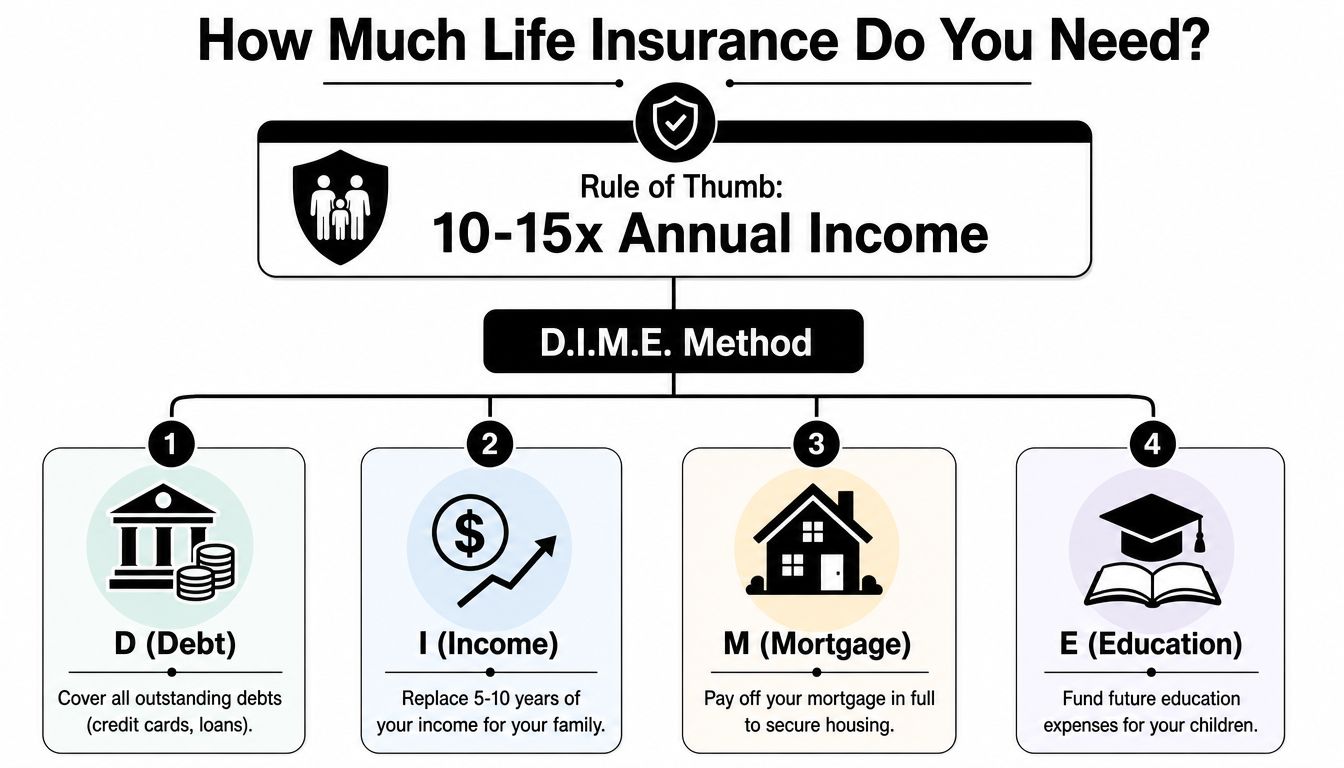
A practical starting point is this: many advisors use 10 to 15 times annual income, then add more if you want to help cover future education costs according to guidance on life insurance for new parents.
Use that rule to get in the right range. Then pressure-test it against your real life. If your family depends on your income and you live in a high-cost part of California, the low end of the range is often too low.
Use the DIME method to get closer
The DIME method stands for Debt, Income, Mortgage, Education. It gives you a better planning number because it ties coverage to the bills and goals your family would still carry.
The four parts are simple:
Debt
Credit cards, personal loans, car loans, and other balances that do not disappear with you.Income replacement
The amount your spouse, partner, or children would need to replace your earnings for a set number of years.Mortgage
Enough to pay off the home or reduce the balance so your family can stay put without panic.Education
Money set aside for future schooling, training, or college if that is part of your plan.
A common DIME example from Quility's explanation of the DIME method for life insurance shows how the total can climb quickly once you add a mortgage and long-term income replacement. That is normal. Parents tend to underestimate the cost of keeping the household stable.
Don't skip coverage for the stay-at-home parent
I strongly recommend coverage for both parents.
The replacement value of a stay-at-home parent is substantial. Western & Southern's discussion of life insurance for new parents highlights that mainstream advice often overlooks the actual cost, noting that stay-at-home parent replacement can exceed $100,000 annually, with immediate childcare replacement costs often falling in the $50,000 to $150,000 range.
If a stay-at-home parent dies, the surviving parent may need paid childcare, transportation help, after-school coverage, cleaning help, meal support, and more flexibility at work. In California, those services add up fast. One income does not mean one parent needs no insurance.
What California parents should count
Local math matters. California families should base coverage on the life they already built, not a national average that ignores local costs.
Look closely at:
Housing
If your family needs to stay in the home, count the mortgage realistically.Childcare and household help
Even part-time care in California can be expensive.Debt and transportation
Car loans, student loans, and revolving debt reduce your spouse's margin for error.How long your children depend on you
A newborn creates a much longer protection need than a teenager.
If you want a clearer benchmark before you shop, our California insurance guides for families can help you organize the numbers.
At Mai & Associates, we tell new parents the same thing every day. Buy enough life insurance to keep your family in control of their choices. If your coverage would only cover funeral costs and a few months of bills, it is not enough.
Choosing Your Policy Term vs Permanent Life Insurance
You just had a baby in California. Your mortgage is high, childcare will not get cheaper, and one missed paycheck would hit your family hard. That is why I usually recommend term life insurance first.
For most new parents, term life insurance is the right purchase. Permanent life insurance has a place, but it is not where most young families should start.
Term covers the years when your family depends on your income the most. Permanent coverage is built to stay in force for life and includes features, such as cash value, that cost more. If you still need to shore up your emergency fund, protect your mortgage, or keep your monthly budget under control, paying extra for permanent coverage is usually the wrong priority.
Why term fits most young families
A 20 year or 30 year term policy usually lines up well with real family responsibilities. It protects the child-raising years, the mortgage years, and the period when replacing your income would be hardest on your spouse.
Term is also far more affordable for many parents. For example, the Insurance Information Institute's overview of term life insurance explains why term policies generally cost less than permanent coverage because they provide protection for a set period without a cash value feature. That price difference matters in California, where housing, daycare, and everyday living costs already strain family budgets.
Permanent life insurance can be a good fit if you know you need lifelong coverage, want to build cash value inside the policy, or have estate planning goals that go beyond basic income replacement. But that is a narrower use case. If you are a new parent trying to protect your family today, term is usually the cleaner and smarter decision.
Term vs Permanent Life Insurance at a Glance
| Feature | Term Life Insurance | Permanent Life Insurance |
|---|---|---|
| Coverage length | Set period, often chosen to match child-raising years | Lifelong coverage if premiums are maintained |
| Cost | Usually lower for new parents | Usually higher cost |
| Cash value | No cash value | Includes cash value component |
| Best fit | Income protection, mortgage protection, family support during dependent years | Long-term estate, legacy, or lifelong planning needs |
| Buying mindset | Cover a specific risk period | Keep coverage for life |
Match the policy to your family timeline
Choose the term based on your youngest child, your mortgage, and how long your family would need income support. A newborn often points to a longer term. Parents with older children may need a shorter window.
Keep it simple. Buy coverage for the problem you have.
For many California families, that means getting solid term coverage in place, then making sure the rest of the household protection is in order too. If you want to compare how life insurance fits with your other priorities, our California family insurance guides cover life, home, renters, and auto insurance in one place.
At Mai & Associates, we take that broader view every day. New parents do better when their life insurance decision fits the rest of their California household plan, not just a quote on a screen.
The Application Process What to Expect
It is 10:30 p.m. The baby is finally asleep, you are tired, and one parent says, “We need to finish the life insurance application this week.” That is the typical application process for new parents in California. It usually happens between feedings, work emails, and pure exhaustion.
The good news is that applying is not hard. It is detailed. If you come prepared and answer carefully, you can get this done without dragging it out for months.

Get your numbers and names ready before you start
Do this first. Pull together your household income, mortgage balance, other debts, current insurance coverage, employer benefits, and the full legal names of the people you may name as beneficiaries. If you own in California, have your monthly housing cost in front of you too. Between mortgage payments, property taxes, and everyday living costs, missing one number can lead to a bad coverage decision.
Apply for both parents if you can. In most families, that is the right move. The working parent needs income protection. The parent handling more childcare at home needs coverage too, because replacing that work in California is expensive.
Tell the truth on every question
The application will ask about your health history, medications, tobacco or nicotine use, driving record, and past medical treatment. Slow down and answer every question fully. A rushed application creates problems you do not need.
Insurers pay the large majority of valid life insurance claims, but disputes often start with inaccurate or incomplete information on the original application. The Insurance Information Institute's overview of life insurance basics is a good reminder that the contract depends on the details you provide. If something is unclear, ask before you submit.
Waiting also costs money. Premiums usually rise as you get older, and a new diagnosis can change your rate class fast. For new parents, the best time to apply is now, while you are already updating the rest of your household protections.
Be careful with beneficiary choices
New parents make this mistake all the time. They want the money to go straight to the baby.
That is not how this should be set up.
A minor should not be named as the direct beneficiary without a proper legal structure in place. The Farm Bureau Financial Services guide for new parents explains why a trust or a custodian arrangement is often the better choice. If the beneficiary setup is sloppy, the payout can be delayed by court involvement, and your family needs that money available quickly.
Keep these beneficiary rules in mind:
- Name an adult who can legally receive and manage the funds.
- Coordinate the beneficiary form with your will or trust.
- Review percentages and backup beneficiaries after the baby arrives.
- Update the form again if you buy a home, refinance, or add another child.
Your beneficiary form controls where the money goes. Treat it with the same care as the policy itself.
Underwriting usually comes next
After you submit the application, the insurance company reviews your file. Some parents qualify for accelerated underwriting. Others will need a medical exam, a phone interview, or records from their doctors. None of that is unusual.
Once you are approved, read the policy summary before you pay the first premium. Confirm the term length, death benefit, riders, and beneficiary details. Then save the policy where your spouse can find it. I also recommend keeping a simple one-page insurance summary with your life policy, home policy, and auto policy in one place. That is one reason California families like working with agencies such as Mai & Associates. You can ask life insurance questions while keeping the rest of your household coverage organized too.
If you want straightforward answers before you apply, the California insurance FAQ for families at Mai & Associates covers many of the questions new parents ask during the buying process.
California-Specific Strategies for Smart Savings
California changes the math. A family in this state often needs more protection because the cost of replacing income, securing housing, and keeping the household running is higher.
That doesn't mean you should buy blindly. It means you should build coverage around California realities, then look for smart ways to reduce total insurance costs across your household.

Higher costs often mean higher coverage
In Orange County, guidance for new parents points to 10 to 15 times household income as the standard recommendation, with 30-year level-premium term life often fitting local families well. The same guidance also says stay-at-home parents should carry a minimum of $500,000 in coverage because local childcare replacement costs can run from $75,000 to $110,000 annually, according to Orange County term life guidance for new parents.
That's a useful California example because it reflects what many families already know. Local living costs can turn a modest coverage amount into an inadequate one very quickly.
Separate Orange County guidance also notes that, where mortgages often exceed $1 million, many young families require a death benefit of $1 million or more per working spouse when the DIME method is used, according to this California-focused life insurance discussion.
Use your full insurance picture
Life insurance shouldn't sit in isolation. New parents should review the whole household protection plan at the same time:
- Auto insurance and car insurance: If you've added a car seat, changed commuting patterns, or bought a larger vehicle, review limits and household drivers.
- Home insurance: If you own a home in California, your mortgage, wildfire exposure, and rebuilding concerns all deserve a fresh look.
- Renters insurance: If you rent, don't ignore this. A child means more possessions, more liability exposure, and more reason to protect the household.
- Life insurance: This is the income and family continuity piece.
Working with one California agency that handles auto insurance, home insurance, renters insurance, and life insurance can simplify billing, reduce coverage gaps, and make it easier to review your full risk picture in one conversation.
California tax treatment helps your family
One piece of good news is straightforward. California residents benefit from favorable tax laws. Life insurance death benefits are generally federal income-tax-free to beneficiaries, and California imposes no additional state tax on these payouts, based on California life insurance tax guidance.
That means the benefit is designed to reach your family intact, which is exactly what you want from protection planning.
Local service matters more than people admit
California is diverse, expensive, and insurance-heavy. Families often need help across multiple policies, not just one. They may also need support in their preferred language or want a local agent who understands regional issues like wildfire exposure, Fair Plan questions, and the way housing costs shape life insurance needs.
That local context matters. A generic national script often misses what California families are dealing with.
Secure Your Family's Future Today
You don't need to solve every financial issue this week. You do need to handle the ones that would hurt your family most if left undone. For new parents, life insurance belongs near the top of that list.
The right approach is simple. Calculate your real need. Pick the policy type that matches your family's stage of life. Complete the application carefully. Set up beneficiaries the right way. Then keep your policy details where your spouse or trusted family member can find them.
The best time is now
Waiting rarely helps. Coverage is usually easier to secure when you're younger and healthier, and delay creates risk you don't need. If your baby is already here, your responsibility is already here too.
This is also a good time to think beyond the policy itself. If you're organizing guardianship plans, documents, and long-term priorities, these strategies for family legacy are a useful companion to the insurance side of the conversation.
You bought the car seat before you needed it in a crash. Life insurance works the same way. You put it in place before the emergency, not after.
If you're ready to act, start with a straightforward California insurance quote request. Keep it simple. Get the numbers. Compare options. Then put the protection in force and move on with your life knowing your family has a real financial shield in place.
If you want help sorting through life insurance, auto insurance, car insurance, home insurance, or renters insurance in California, Mai & Associates offers no-obligation quotes and guidance from licensed agents who can compare options from multiple carriers and help you protect your family without overcomplicating the process.