Life Insurance for Mortgage Payoff: California Guide 2026
Buying a first home in California often feels like two emotions at once. You get the keys, take the photos, and start imagining birthdays, school pickups, and ordinary nights in a place that's finally yours. At the same time, you look at the mortgage payment, the property tax bill, the homeowners insurance premium, and every other housing cost that now lands on your shoulders.
That's why so many first-time buyers start asking about life insurance for mortgage payoff. It's not really about the loan alone. It's about protecting the people who live inside the home if one income disappears too soon. For California families already balancing home insurance, auto insurance, renters insurance history from past moves, and the daily cost of living, that question matters more than is commonly understood.
Protecting Your California Dream Home
A lot of homeowners run into the same moment right after closing. They've updated the address on their car insurance, reviewed their California home insurance, and maybe even cleaned up an old renters insurance policy from their apartment days. Then a lender offer or mailer arrives talking about mortgage protection. It sounds simple, which is why many people assume it must be the right fit.

But the issue is bigger than one product. Life insurance for mortgage payoff is a strategy. You're deciding how your family would keep the home if you died before the mortgage was paid off.
The confusion that costs families flexibility
The biggest misunderstanding is who gets the money.
According to Coventry Direct's explanation of life insurance to pay off a mortgage, Mortgage Protection Insurance (MPI) pays the lender directly, leaving beneficiaries with no liquidity for other expenses like taxes or maintenance, whereas standard life insurance pays the beneficiary, who can then choose to pay the mortgage or cover other needs. That distinction matters in California, where housing costs don't stop at the loan itself.
Practical rule: If the policy pays the bank first, it protects the debt. If the policy pays your family first, it protects the household.
That's why this topic belongs next to your other coverage decisions. A strong protection plan can include California home insurance options, smart car insurance choices, and enough life coverage to keep the roof over your family's head.
What families usually want
Individuals aren't looking for a complicated financial product. They want simple answers to practical questions:
- Can my spouse stay in the home?
- Will the kids have to move?
- Could one policy help with the mortgage and other bills?
- What happens if there's still a house payment after I'm gone?
If you've wondered about the legal and financial side after a death, this guide on what happens to a mortgage gives useful background.
For most first-time buyers, the smart starting point is this: don't assume every policy called “mortgage protection” protects your family the same way.
Choosing Your Shield MPI vs Term vs Whole Life
Three options come up most often when homeowners talk about protecting a mortgage: Mortgage Protection Insurance, term life insurance, and whole life insurance. They all involve life insurance, but they do very different jobs.
A simple way to think about them is this. One shield mainly covers the lender. One shield usually gives your family the broadest protection for the cost. One shield can last for life, but typically costs more.

Mortgage Protection Insurance
MPI is usually tied closely to the mortgage itself. The lender is typically the beneficiary, and the payout goes straight to the loan balance.
Northwestern Mutual explains that mortgage life insurance differs from traditional life insurance because MPI typically designates the mortgage lender as the beneficiary, while traditional life insurance designates the policyholder's chosen heirs. The payout from MPI decreases in lockstep with the remaining mortgage balance, but a standard term life policy provides a fixed death benefit that remains constant, allowing beneficiaries to use the full amount as they see fit.
That “decreasing” feature is where many buyers get tripped up. As your loan balance falls, the insurance benefit falls too. Your premium may stay fixed, but the amount available at claim time gets smaller.
Term life insurance
Term life is usually the clearest fit for mortgage protection. You buy coverage for a set number of years, often chosen to line up with the mortgage term or the years your family depends most on your income.
The key advantage is flexibility. Your beneficiary gets the death benefit, not the lender. That means the money can go toward the mortgage, but it can also cover property taxes, groceries, childcare, a car payment, or other immediate needs. For many households trying to manage California life insurance, home insurance, and auto insurance costs in one realistic budget, that flexibility is hard to beat.
A good place to compare policy types and pricing options is California life insurance guidance.
Whole life insurance
Whole life is permanent coverage. It doesn't expire after a set term as long as the policy stays in force. It can also build cash value over time.
For mortgage payoff alone, whole life is often more coverage structure than a first-time buyer needs. Some families still choose it because they want lifelong protection, estate planning tools, or a policy that serves several financial goals at once. The tradeoff is usually cost. If your main job is to protect the mortgage during your earning years, term life often matches that need more directly.
Side by side comparison
| Policy type | Who gets paid | Benefit pattern | Typical fit |
|---|---|---|---|
| MPI | Lender | Decreases with mortgage balance | Buyers who want a mortgage-tied policy and prioritize easy qualification |
| Term life | Your chosen beneficiary | Stays level during the term | Families focused on mortgage protection plus flexibility |
| Whole life | Your chosen beneficiary | Designed as permanent coverage | Buyers who want lifelong coverage and broader planning features |
Where many homeowners go wrong
People often hear “mortgage protection” and assume it means “family protection.” Those aren't automatically the same thing.
The best policy for a mortgage isn't always the one branded for mortgages. It's the one that leaves your household with choices.
MPI can make sense for some people, especially if simplified underwriting matters most. But if your actual goal is keeping your family financially stable, term life usually deserves the closest look first.
How Much Coverage Do You Really Need
A lot of people start with one question: “Should I just match the mortgage balance?” Sometimes that works as a rough floor. But it's often not enough.
If your family loses your income, the mortgage isn't the only bill that keeps showing up. California homeowners still have property taxes, insurance, upkeep, utilities, and everyday living costs. If you own two vehicles, there's also auto insurance or car insurance to keep current. If you're moving from an apartment into a house, the mindset must shift beyond what renters insurance used to cover.

A practical way to estimate coverage
Use the mortgage as the starting point, not the finish line. Build your estimate around these categories:
Mortgage payoff amount
What would it take to clear the home loan?Other debts
Think about car loans, credit cards, or student debt.Ongoing household costs
Include housing costs that remain even after a mortgage disappears.Income support
Ask how long your family would need help replacing your paycheck.Future goals
College funding, childcare, and transition costs can matter just as much as the house.
Matching the term to the need
If your main goal is mortgage protection, many buyers choose a term that roughly lines up with the years they want the home protected. Others choose shorter or layered terms based on when kids will be older, debts will shrink, or savings should be larger.
For mortgage math and payoff scenarios, tools can help you pressure-test your plan. The New American Funding home loan tools are useful for looking at how extra payments or different timelines affect the loan.
Why timing matters
Rocket Mortgage notes in its mortgage protection insurance guide that MPI premiums can range from less than $10 per month for a healthy 30-year-old with a $100,000 mortgage to more than $500 per month for a 75-year-old with a $400,000 loan, and that a standard level-term life policy is often more cost-effective over the full term.
The exact policy you qualify for depends on your age, health, and insurer underwriting. But the practical lesson is simple: waiting usually doesn't give you more options.
Buy coverage when you're insurable and the need is clear, not after a health change narrows your choices.
Common Pitfalls and Smart Strategies
The biggest mistake homeowners make is treating the first offer as the best offer. That happens a lot with MPI because it often shows up right when the mortgage closes and you're already signing a pile of paperwork.
What not to do
- Don't assume the lender's mailer is the best fit. It may be convenient, but convenience and value aren't the same thing.
- Don't insure only the debt if your family depends on your income. Paying off the house is helpful, but it won't buy groceries or cover school costs.
- Don't assume health concerns end the conversation. Some buyers still have options even if one path is harder than another.
What to do instead
Bankrate explains in its comparison of mortgage protection insurance and life insurance that if a homeowner already has sufficient life insurance coverage, mortgage protection insurance is likely unnecessary, because the death benefit can be used to pay off the mortgage. It also gives an example that a $250,000, 20-year term policy can provide a fixed payout that covers a mortgage even if the loan balance is significantly lower, leaving the family with surplus cash.
That gets to the heart of a smarter strategy. A level benefit can solve the mortgage problem and still leave room for the rest of life.
Smarter planning moves
- Review what you already own. An existing life policy from work or an earlier purchase may cover part of the need.
- Consider layering coverage. One policy can cover the mortgage years, while another addresses shorter-term family obligations.
- Revisit coverage after major changes. Refinance, marriage, divorce, children, income jumps, and home upgrades can all change the right amount.
Some people focus so heavily on the mortgage that they forget the goal. The goal isn't just to erase a loan. It's to give your family options at the worst possible time.
Your Step by Step Guide to Buying a Policy in California
Buying life insurance feels easier when you break it into a checklist. In California, that matters because families are already juggling home insurance, car insurance, wildfire concerns in some areas, and rising living costs.
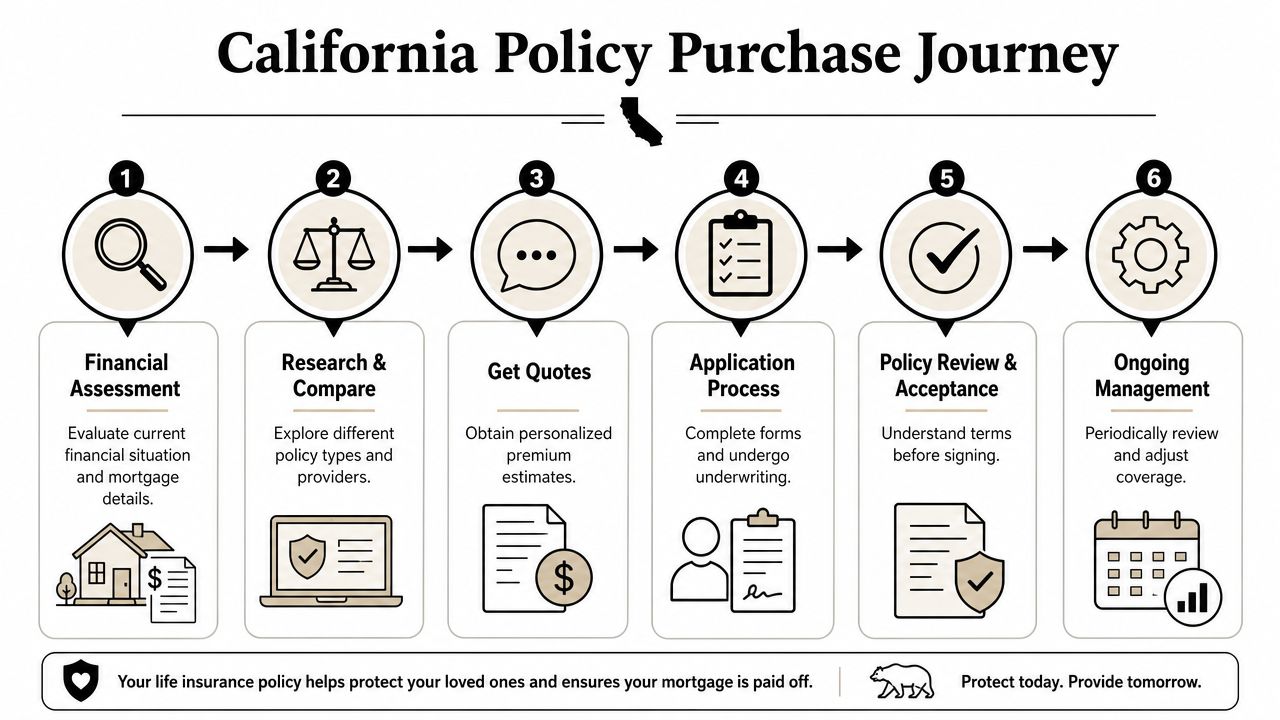
Step 1 and Step 2
First, figure out what you're trying to protect. Is the goal just the mortgage balance, or the broader household budget if one income disappears?
Then compare policy types. California's Department of Insurance recognizes life insurance as a valid tool for specific needs such as mortgage payoff. The state notes in its life insurance consumer guide that life insurance can help families avoid foreclosure or a forced sale without the lender being the automatic beneficiary.
Step 3 and Step 4
Get quotes based on your actual situation, not generic assumptions. Age, health, policy length, and coverage amount all affect the result.
Then complete the application. Depending on the product, that may involve more underwriting or a simpler process. The goal isn't just approval. It's understanding what you're buying, who receives the benefit, and how long the protection lasts.
A good next move is to request a California insurance quote so you can compare options side by side.
Step 5 and Step 6
Before accepting a policy, read the beneficiary section carefully. In this section, many homeowners discover whether they bought family protection or lender protection.
After the policy is active, don't file it away and forget it. Review it when life changes.
- Refinance: Your mortgage timeline may change.
- New child: Your protection need may increase.
- Bigger income: A larger household budget may need more replacement.
- Home upgrades: Higher carrying costs can change the picture.
A policy works best when it still matches the life you're living now, not the one you had when you signed the application.
Real World Scenarios for California Homeowners
Real decisions get clearer when you can see how they play out in daily life.
First-time buyers in Costa Mesa
Elena and Victor buy their first home and take on a long mortgage. They're also updating their home insurance, moving their cars onto a new car insurance setup, and trying to keep monthly costs predictable.
Their main concern isn't building cash value. It's making sure the surviving spouse could keep the home without rushing to sell. For a household like this, term life often fits the problem cleanly because the coverage can be designed around the years the mortgage and income need are highest.
A family in a wildfire-sensitive area near Glendale
A couple with children own a home in an area where insurance planning feels more layered. They're already thinking about homeowners coverage, wildfire exposure, and whether their auto insurance and life coverage should all be reviewed together.
For them, mortgage payoff is only one part of the risk picture. If one parent dies, the other may need money for the home, temporary living adjustments, school logistics, and day-to-day bills. A lender-paid policy may solve the loan, but it may leave the surviving spouse short on cash right when flexibility matters most.
A buyer with health concerns
Marcus recently bought a condo and worries he won't qualify for traditional coverage because of his health history. He sees a mortgage protection offer and likes the simplicity.
In his case, the decision isn't just “MPI is bad” or “term is always best.” It's about comparing what's available. If he qualifies for term at a reasonable level, that may give his beneficiary more control. If he doesn't, a mortgage-focused product may still be better than leaving the family unprotected. The point is to compare before choosing.
A homeowner who already has coverage
Priya bought life insurance years ago, before she purchased her current home. Now she wonders whether she needs a separate mortgage policy.
Sometimes the answer is no. If the existing death benefit already supports the mortgage and the family's wider budget, she may only need an update to beneficiaries or coverage review, not a second policy aimed solely at the home.
Frequently Asked Questions
What happens if I refinance my mortgage
Your life insurance policy doesn't automatically refinance with the loan. Review the coverage amount, term length, and beneficiary setup after refinancing to make sure the policy still matches the need.
Can I use an existing life insurance policy for a new home
Often, yes. If the death benefit is large enough and the policy term still fits your goals, an existing policy may already provide life insurance for mortgage payoff. The key is checking whether the total household protection is still adequate.
Is the death benefit taxable income in California
In many situations, beneficiaries receive life insurance proceeds without treating them as income for tax purposes, but tax treatment depends on the details of the payout and ownership structure. For personal guidance, ask a qualified tax professional or estate planning attorney.
Do I need a separate mortgage policy if I already have term life
Not always. If your current term policy is sufficient for the mortgage and the rest of your family's financial needs, a separate MPI policy may add cost without adding much value.
Where can I get answers on other California insurance questions
If you're comparing life insurance with home insurance, auto insurance, renters insurance, or broader California policy questions, the insurance FAQ resource can help you sort through common situations.
If you want help comparing life insurance for mortgage payoff with your broader California coverage needs, Mai & Associates can help you review options for life insurance, home insurance, auto insurance, car insurance, and renters insurance so your protection fits your real budget and your family's priorities.