Life Insurance for Couples: A California Guide (2026)

Buying a home in California, combining finances, or welcoming a child often changes how a couple thinks about risk. Auto insurance protects your car. Home insurance or renters insurance protects where you live. Life insurance protects the income and stability behind all of it. That’s why it matters so much for couples who share bills, plans, and responsibilities.
For many couples, life insurance feels harder to approach than car insurance or homeowners coverage because the choices seem abstract. The easiest way to think about it is this. You can buy two separate policies, like ordering two meals suited for two different appetites. Or you can buy one joint policy, more like a shared platter, where both people are covered under one structure. There are two versions of that shared platter. One pays when the first partner dies. The other pays only after both partners have passed away.
That structure matters because marriage and long-term partnership usually create deeper financial interdependence. Married people own life insurance at higher rates than single people, and a common planning rule is to carry 10 to 15 times annual household income in death benefit coverage. For a household earning $100,000, that points to roughly $1 million to $1.5 million in coverage, according to Choice Mutual’s life insurance statistics research.
California couples often need to think even more carefully because the cost of living can make one income harder to replace. Mortgage payments, rent, childcare, car payments, and everyday living costs don’t pause when a family loses a breadwinner. In a state where many households also juggle wildfire concerns, earthquake planning, high home values, and heavy driving, life insurance works best as part of a broader protection plan rather than as a stand-alone purchase.
Securing Your Future Together An Introduction for California Couples
A couple in Glendale buys their first condo. Another couple in Costa Mesa signs up for a bigger apartment because a baby is on the way. A domestic partnership in Los Angeles finally combines bank accounts and realizes one person’s income now supports most of the rent. Different stories, same issue. If one person dies too soon, the surviving partner may be left carrying a mortgage, rent, debt, childcare costs, and daily expenses alone.
That’s the primary purpose of life insurance for couples. It isn’t about dwelling on worst-case scenarios. It’s about making sure the surviving partner has time, options, and financial breathing room.
Why couples usually need a different conversation
When you’re single, life insurance can feel optional unless someone depends on your income. When you’re in a committed relationship, the math changes. Shared housing, shared debt, and shared long-term plans make your finances more connected.
Common California pressure points include:
- Housing costs: A surviving partner may struggle to keep up with mortgage or rent payments on one income.
- Children and dependents: Childcare and education costs don’t disappear after a loss.
- Joint debts: Car loans, credit cards, and personal loans often stay with the surviving household.
- Uneven incomes: If one partner earns more, the financial shock can be severe.
Practical rule: Think of life insurance as income protection for the household, not just for the person insured.
The three basic policy structures
Couples usually choose from three paths:
Two separate individual policies
Each person owns coverage on their own life. This gives the most control and usually the most flexibility.A joint first-to-die policy
One policy covers both people and pays once, after the first death.A joint second-to-die policy
One policy covers both people but pays only after both insured people have died.
If you already carry California car insurance, homeowners insurance, or renters insurance, you’ve already accepted a basic planning truth. Protecting assets is only part of the job. You also have to protect the cash flow that keeps those assets affordable.
Understanding Your Three Core Life Insurance Options
Most confusion starts because couples compare prices before they understand structure. Start with how each option works. Then compare cost, flexibility, and long-term fit.

Joint policies often attract attention because they can cost less than buying two separate policies, and 44% of Americans view life insurance primarily as family income replacement, according to Western & Southern’s overview of life insurance for married couples. If you want a broader overview of policy types available in this state, California life insurance options for individuals and families can help frame the bigger picture.
Two separate individual policies
This is the clearest option. Each partner has a policy on their own life, with their own beneficiary choices, coverage amount, and term length.
That matters when one person earns more, one stays home with children, or one partner needs a different amount of protection. A couple might decide one person needs more income replacement, while the other mainly needs debt and childcare coverage.
Best fit: couples who want customization, flexibility, and coverage that stays in place independently.
Joint first-to-die coverage
A joint first-to-die policy covers both partners under one contract and pays a death benefit when the first insured person dies. After that payout, the policy ends.
This can work when the main goal is helping the survivor stay in the home, pay down debt, or replace income during the early shock after a death. It’s simple in concept. One policy. One premium. One payout.
Best fit: couples focused on immediate survivor protection and straightforward management.
Joint second-to-die coverage
A joint second-to-die policy, sometimes called survivorship coverage, doesn’t pay at the first death. It pays after both insured people have died.
That structure usually fits estate planning, legacy planning, or funding needs that arise only after both partners are gone. For everyday income replacement, it usually doesn’t solve the survivor’s immediate cash-flow problem because the first surviving spouse receives no payout at the first death.
Best fit: couples with estate planning goals rather than short-term household income replacement.
A simple comparison
| Option | When it pays | Who it tends to help most | Main trade-off |
|---|---|---|---|
| Separate policies | Each policy pays when that insured person dies | Couples with different needs or changing plans | Usually more to manage |
| Joint first-to-die | Pays at the first death | Couples focused on immediate survivor support | Coverage ends after one claim |
| Joint second-to-die | Pays after both deaths | Couples using life insurance in estate planning | No payout at the first death |
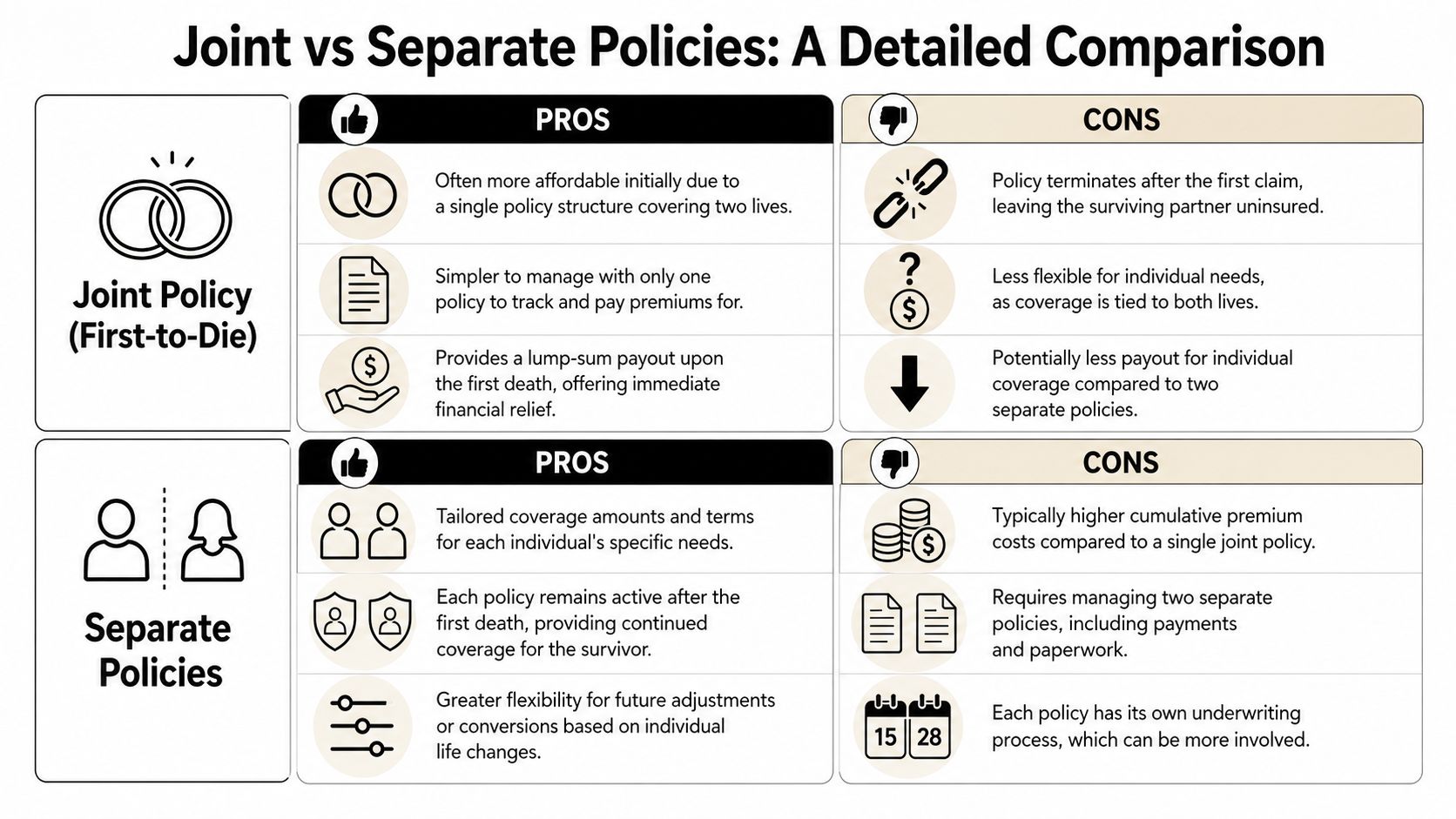
Joint vs Separate Policies A Detailed Comparison
The biggest mistake couples make is assuming the cheaper option is automatically the smarter option. With life insurance, the question isn’t only “What costs less today?” It’s “What still works after a death, a job change, a health change, or a relationship change?”
Cost now versus protection later
A joint first-to-die policy can look appealing because there’s only one policy to buy and maintain. But lower initial cost doesn’t always mean better long-term protection.
A major drawback is what happens after the first claim. The survivor is left without that joint policy in force. If they then need new insurance later in life, the new price may be far higher. New York Life’s discussion of term life for couples notes that a survivor from a joint first-to-die policy may face premiums that rise 200% to 500% when trying to buy new coverage later, and that over 70% of couples ultimately choose separate policies because of their flexibility.
A policy that saves money upfront can create a tougher insurance problem later, especially for the surviving partner.
Flexibility matters more than most couples expect
Separate policies let each person choose coverage that reflects their role in the household. That matters in real life because couples are rarely financial mirror images of each other.
One spouse may be the primary earner. The other may earn less but handle childcare, transportation, or elder care. One may want a longer term because of a younger child. The other may need a shorter term tied to a mortgage payoff plan.
For plain-language insurance definitions that help when you’re sorting through terms like beneficiary, rider, or underwriting, this California insurance glossary is useful.
A side-by-side decision table
| Decision factor | Joint first-to-die | Separate policies |
|---|---|---|
| Initial premium | Often lower | Often higher combined |
| Number of policies | One | Two |
| Payout structure | One payout at first death | Each policy stands on its own |
| Survivor coverage | Ends after claim | Survivor keeps their own policy |
| Customization | Limited | Strong |
| Handling different needs | Harder | Easier |
| Divorce or separation | Can be complicated | Cleaner to unwind |
Use a planning formula before you compare quotes
Before choosing structure, estimate how much coverage the household needs. A practical method is the DIME formula, which stands for:
- Debt: Credit cards, personal loans, and other obligations
- Income replacement: What the household needs if one income disappears
- Mortgage: What it would take to pay off or support the home loan
- Education: Future school costs for children
Here’s a simple example using figures already established in the verified guidance. If a couple earns $100,000 per year and wants about 10 years of income support, that points to $1 million in need. If they have $200,000 in liquid assets available, they might target around $800,000 of coverage. That framework appears in the verified couple-planning guidance and gives you a starting point, not a final answer.
When joint makes sense and when separate wins
Joint first-to-die often makes the most sense when a couple wants simple administration and immediate funds for the survivor, and both partners’ needs are very similar.
Separate policies often make the most sense when:
- Coverage needs differ: One partner needs much more income replacement.
- Health profiles differ: One partner may qualify for better rates independently.
- You want lasting survivor protection: The surviving spouse keeps their own policy.
- Your life may change: Divorce, remarriage, new children, or a business change can make shared coverage awkward.
If you remember one thing, remember this. Joint is often simpler. Separate is often sturdier.
How to Calculate Your Ideal Coverage Amount in California
The hardest part for many couples isn’t choosing between joint and separate. It’s deciding how much life insurance to buy without guessing.

California households benefit from a written calculation because living costs can make “ballpark” planning misleading. A number that feels large on paper may not stretch as far once you account for housing, childcare, transportation, and debt.
Start with your household obligations
A useful worksheet starts with four buckets:
- Immediate debt such as personal loans, credit cards, and final expenses
- Income replacement for the surviving partner or children
- Housing needs including rent support or mortgage payoff
- Future family costs such as childcare or education
Write down what would still need to be paid if one person died next month. Don’t just list balances. List monthly realities.
Build a simple California example
Say a couple has these goals:
- Keep the household stable for several years
- Give the surviving partner room to grieve without rushing into major financial decisions
- Protect the home or rental situation
- Cover child-related costs
One practical rule from the verified research is to target 10 to 15 times annual household income. For a couple earning $100,000, that suggests about $1 million to $1.5 million in total coverage. If they already have $200,000 in savings that could support the household, a rough adjusted target could be $800,000 on the lower end of that planning example.
Don’t treat online calculators as an answer. Treat them as a draft.
A worksheet you can do at the kitchen table
Use this order:
- List debts that would remain
- Estimate how many years of income support the family would want
- Decide whether the goal is mortgage payoff or payment support
- Add child-related or dependent-related costs
- Subtract liquid assets you would use
- Compare that total against what each policy structure can deliver
Where couples often undercount
Many couples remember the mortgage and forget the small recurring costs that add up fast:
- Transportation costs: Car payments, fuel, insurance, maintenance
- Childcare changes: The surviving parent may need more paid help
- Household labor: A stay-at-home parent provides economic value even without a salary
- Emergency reserves: Cash helps a family avoid making rushed decisions
In California, this matters across the full insurance picture. A family may be able to keep the home only if the survivor can also keep up with car insurance, home insurance, or renters insurance. That’s why life insurance should support the entire household budget, not just a funeral expense or a single debt.
Key Factors That Influence Your Policy's Cost and Approval
Two couples can apply for the same amount of coverage and receive very different quotes. That isn’t random. Insurers look at how likely it is they’ll need to pay a claim during the policy period, and they price the policy around that risk.

The usual pricing factors
Most life insurance applications look closely at these items:
- Age: Younger applicants usually have more options.
- Health history: Ongoing conditions, past diagnoses, and medications can affect approval and price.
- Tobacco use: Smoking and nicotine use often change pricing significantly.
- Lifestyle: Risky hobbies or hazardous work can matter.
- Coverage amount and policy type: More coverage and permanent policy designs often cost more than a smaller term policy.
- Policy length: A longer term can cost more than a shorter one.
Those basics apply whether you’re buying life insurance for couples, an individual term policy, or a permanent policy for estate planning.
The health mismatch problem couples often miss
Now consider a common California situation. One partner is younger, healthy, and likely to qualify for strong individual rates. The other has a chronic condition, a recent diagnosis, or a more complicated health history.
A joint policy may help the less healthy partner get coverage more easily. But there’s a trade-off. The healthier partner may effectively subsidize the premium. Northwestern Mutual’s discussion of joint life insurance makes that point directly and advises couples to compare a joint policy against two separate policies, even if one separate policy comes with a higher rated premium.
If one partner is much healthier, don’t assume a joint policy is the bargain. Run both quote paths.
Three mini-scenarios
A married couple with similar health
If both partners are close in age, healthy, and want similar coverage, a joint first-to-die policy may be worth pricing for simplicity. They still need to weigh the survivor coverage issue carefully.
A domestic partnership with one difficult medical history
If one partner may have trouble qualifying alone, a joint option might open a door that feels closed. But they should compare that against a structure where the healthier partner buys a stronger individual policy and the other partner uses a smaller or alternative form of coverage.
A blended family with different responsibilities
If each partner has children from prior relationships, separate policies often make beneficiary planning cleaner. Each person can set coverage and beneficiary designations to match their own obligations.
Approval is also about documentation
Insurers don’t only ask about health. They also need a clear application, consistent information, and in some cases proof of the financial relationship between the insured people. That becomes especially important for unmarried couples and domestic partners, which leads directly into the California buying process.
A Guide to Buying Life Insurance in California
Buying life insurance is easier when you treat it like a checklist instead of a mystery. The process is usually straightforward, but California couples should prepare for a few state-relevant details, especially if they aren’t legally married.
Step one is define the need
Start with the household calculation you built earlier. Decide what the policy needs to accomplish.
It might need to replace income, keep a mortgage current, protect children, or preserve flexibility for a domestic partner. If you own a home in a wildfire-prone area, rent in a high-cost city, or drive long distances every day, think about life insurance as one part of a broader California protection plan alongside home insurance, renters insurance, and auto insurance.
Step two is gather documents early
Applications move more smoothly when you have core documents ready. Unmarried couples and domestic partners may need extra proof of financial interdependence because some insurers want evidence of insurable interest.
According to Progressive’s guidance on life insurance for couples, proof such as a joint mortgage, shared business ownership, or a will can strengthen the application for unmarried couples and domestic partners, though requirements vary by insurer.
Helpful documents can include:
- Identity documents: Basic personal information for each applicant
- Financial records: Income and debt details that support the coverage request
- Relationship proof: Joint mortgage statements, shared ownership documents, or estate planning documents if needed
- Health details: Physician information, medications, and past treatment history
Step three is compare carriers and policy structures
Don’t compare only one quote type. Compare separate policies and joint policies if both are on the table.
For California shoppers who want help comparing multiple carriers for life, home, renters, or car insurance, requesting an insurance quote through a California agency can streamline that review. Mai & Associates states that it offers same-day quotes, multilingual support, and access to multiple carriers, which can be useful when a couple’s needs are more complex than average.
Step four is complete underwriting carefully
Some policies require a medical exam. Others may use health questionnaires, records, or alternative underwriting methods. Accuracy matters. If the application is inconsistent, approval can slow down or create problems later.
Step five is review the final policy before it goes live
Check these items before accepting coverage:
- Beneficiaries are correct
- Coverage amount matches your plan
- Term length fits your timeline
- Ownership is set up properly
- Premium fits your budget long-term
A good policy isn’t just affordable today. It should still make sense years from now.
Your Next Steps and Frequently Asked Questions
The right life insurance choice for a couple usually comes down to one core trade-off. Joint policies can be simpler and may cost less upfront. Separate policies usually provide more control and stronger long-term flexibility. California couples should make that decision with the full household picture in mind, including housing costs, children, debt, and how life insurance fits with auto insurance, homeowners coverage, or renters insurance.
Questions couples often ask
What happens to a joint policy if we divorce?
It depends on the contract and ownership structure. This is one reason separate policies are often easier to manage over time. When a relationship changes, individual ownership is usually cleaner than trying to untangle a shared contract.
Can a joint term policy be converted later?
Possibly, but conversion rights depend on the specific policy language and carrier rules. Check the contract before buying, not after a health change.
Can we name children as beneficiaries?
You can often name children, but many families prefer a more structured plan depending on the children’s ages and the family’s estate planning goals. If your questions move beyond insurance and into trust planning, Bryan Fagan's guide to ILITs offers a helpful overview of how life insurance trusts can fit into a broader estate strategy.
Can domestic partners buy life insurance together in California?
Yes, often they can, but the insurer may ask for proof of insurable interest and shared financial obligations.
Should both partners have the same coverage amount?
Not always. Equal coverage and appropriate coverage are not the same thing. If one partner earns more, has children from a prior relationship, or handles most childcare, the best amounts may differ.
Review your life insurance whenever your household changes. A move, new child, new mortgage, or major income shift can change the right answer.
Where can we get help with common insurance questions?
A practical place to start is this California insurance FAQ page, especially if you’re trying to coordinate life insurance with car, home, or renters coverage.
Life insurance for couples doesn’t need to be complicated. It needs to be clear enough that both partners understand what they’re buying, why they’re buying it, and how it protects the life they’re building together.
If you want a personalized next step, Mai & Associates can help you compare life insurance options for couples in California and see how that coverage fits alongside your auto insurance, home insurance, or renters insurance needs.