Life Insurance for Children: A 2026 California Guide
You're probably here because you saw an ad, talked with a relative, or heard a financial professional mention life insurance for children and thought, “Wait, is that smart, or is that just a sales pitch?”
That's a fair question.
For most parents in California, money decisions don't happen in a vacuum. You're balancing car insurance, home insurance or renters insurance, rising household costs, emergency savings, and maybe college planning too. A child life insurance policy might fit into that picture, but it shouldn't be treated like an automatic must-have.
The useful way to look at it is simple. Child life insurance is not mainly about replacing income, because children usually don't earn income or support dependents. Its value is usually tied to future insurability, a modest final-expense cushion, and in some cases a small long-term cash-value component. Whether that matters enough for your family depends on what problem you're trying to solve.
Is Life Insurance for Your Child a Good Idea
A lot of parents reach this question the same way. They've already handled the visible risks first. They bought car insurance because they drive every day. They bought home insurance or renters insurance because they need to protect where they live. Then they start thinking about the less obvious risks, especially ones tied to their child's future.
A common example is a parent who says, “I don't think my child needs life insurance, but I do worry about what happens if they develop a health condition later.” That concern is real. It's not really about today. It's about preserving options for adulthood.
The best child insurance decisions start with one question: What job do you want the policy to do?
If your goal is to create a large savings pool for college, a child policy may not be the strongest first choice. If your goal is to lock in future coverage access while your child is healthy, the conversation changes.
For California families, that distinction matters even more. In a high-cost state, every premium competes with something else. Sometimes the right answer is yes. Sometimes it's no. Sometimes it's “only after we've tightened up the rest of our protection plan.”
Understanding Child Life Insurance Basics
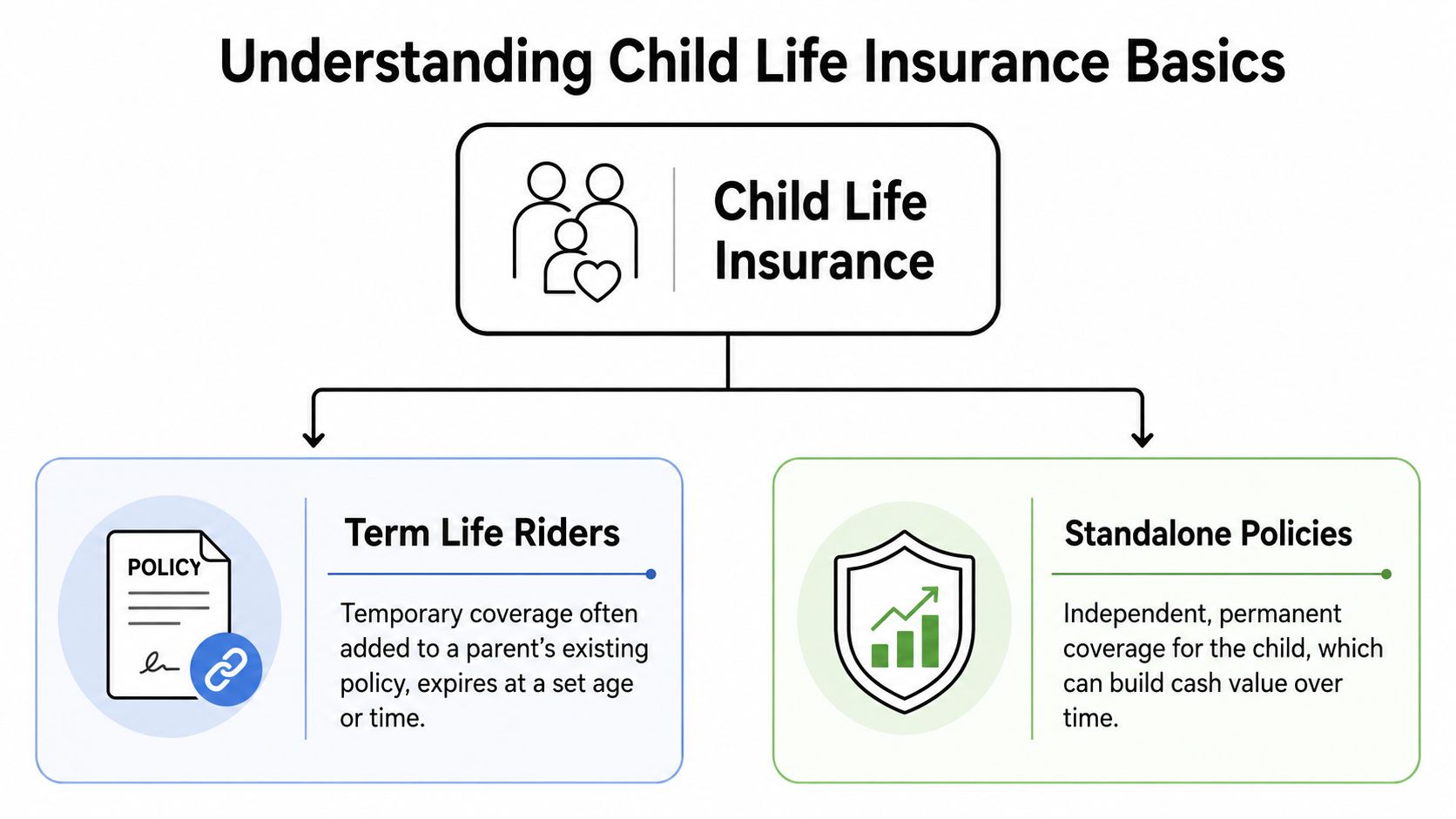
Child life insurance usually comes in two forms. One is a term rider attached to an adult's policy. The other is a standalone whole life policy, sometimes called juvenile life insurance.
That sounds technical, but the easiest way to picture it is this. A rider is like adding a car seat to the family vehicle. It's part of something you already own and serves a limited purpose. A standalone whole life policy is more like buying a small starter vehicle for the child's future. It's separate, it can stay around longer, and it may build value over time.
Term riders versus standalone policies
A term child rider is typically added to a parent's life insurance policy. It usually provides temporary coverage for children in the household. It's often chosen for convenience and lower cost, especially by families who want some protection without opening a separate policy.
A standalone whole life policy is an independent contract on the child. An adult owns the policy while the child is a minor. These policies are permanent in design and may include cash value.
What the key terms really mean
Two terms confuse people most.
- Death benefit means the amount paid if the insured child dies while the policy is active.
- Cash value means a portion of a whole life policy that may build over time inside the contract.
For children, the coverage amount is usually modest. Guardian Life explains that children's death benefits generally range from $5,000 to $50,000, and premiums for a baby's whole life policy can be as low as $3 to $27 per month. The same page also notes an average annual premium of $166 for a $25,000 policy on a newborn. That gives you a sense of what this product is designed for. It's usually a small policy, not a major wealth-building engine.
What child life insurance is and isn't
Child life insurance is a niche planning tool. It can provide a modest death benefit and, in the case of whole life, a long-term contract the child may keep later.
It isn't a substitute for making sure the adults in the household are properly insured first. In most families, the bigger life insurance risk is still the parent or caregiver whose income supports the household. If you want a broader look at that protection question, a guide to California life insurance options can help frame where child coverage fits.
The Main Arguments for Buying a Child Policy
The strongest case for life insurance for children isn't emotional. It's practical. A child policy can solve a few specific problems, and if one of those problems matters a lot to your family, the policy can make sense.

Guaranteed future insurability
This is the biggest argument by far.
That matters because future health is unknown. A child who is healthy today could develop a medical condition later that makes adult coverage harder to buy or more restrictive. A policy purchased early can act like reserving a place in line while the door is open.
A small financial cushion for a terrible scenario
No parent wants to think about funeral expenses for a child. Still, some families value having a policy because it can provide funds for final expenses and create space to step away from work and grieve without immediate financial pressure.
This is not the same logic as adult life insurance. With an adult, the question is often income replacement. With a child, the financial need is usually narrower and more immediate.
Practical rule: If your main reason is final-expense protection, compare a low-cost rider against a standalone policy before paying for more than you need.
A structured long-term savings habit
Whole life policies for children can also appeal to families who like forced consistency. The cash value feature can create a small, disciplined savings component inside the policy.
That doesn't mean it's automatically the best savings tool. It means some parents appreciate the structure. They like that the policy is separate from the checking account and may remain in place for the child's adult years.
Families who already think in terms of a broader protection plan often evaluate this alongside their other insurance decisions. That might include reviewing home, renters, auto, and life coverage together, not one policy at a time. If you like reading practical insurance planning ideas, the Mai & Associates blog is one place to keep learning.
Weighing the Drawbacks and Opportunity Costs
The hardest truth about life insurance for children is also the most important one. Most children don't have a traditional life insurance need.
That doesn't mean a policy is useless. It means you should be careful not to buy a niche product to solve a problem you don't really have. If your budget is tight, every monthly premium needs to earn its place.
The policy may not be your highest priority
For many California families, the first priorities are more immediate. An emergency fund often comes first. So does adequate life insurance for the adults in the household. In many homes, better auto insurance limits, stronger home insurance, renters insurance, earthquake planning, or wildfire-related coverage reviews may deserve attention before a child policy does.
That's especially true when household finances already feel stretched. A small premium can still matter if it pulls money away from more urgent protections.
Opportunity cost is the real debate
That's the right question to ask.
If you pay into a child whole life policy for years, what are you giving up? Maybe it's college savings. Maybe it's paying down debt. Maybe it's keeping more cash available for repairs, rent increases, or deductibles. A child policy can't be judged in isolation. It has to compete with those other uses of money.
Cash value can be misunderstood
Cash value often sounds more powerful than it is. People hear “it builds cash value” and assume it works like a flexible investment account. It doesn't.
Cash value is part of the insurance contract. It may grow over time, but it typically isn't as simple or as liquid as money kept in savings. If your primary goal is access, flexibility, or education funding, you may prefer a tool built directly for that purpose.
Buying a child policy makes more sense when you specifically value insurability. It makes less sense when you're mainly looking for maximum flexibility.
Comparing Alternatives for Your Child's Future
Most families aren't choosing between “care” and “no care.” They're choosing between financial tools. That's a healthier way to think about this.
A child whole life policy does one thing uniquely well. It can preserve future insurability. Other tools do other jobs better. A 529 plan is built for education. A savings reserve is built for access. A basic brokerage account offers flexibility, though it comes with market movement and planning discipline.
Child Financial Tools Compared
| Financial Tool | Primary Goal | Growth Potential | Best For |
|---|---|---|---|
| Child whole life insurance | Preserve insurability and provide modest permanent coverage | Typically slower, tied to policy structure rather than open-ended investing | Families who strongly value guaranteed future coverage access |
| 529 plan | Save for education | Built for long-term education savings | Parents focused mainly on school funding |
| Emergency fund or savings account | Keep money available for surprises | Lower growth potential, higher liquidity | Families who need fast access and flexibility |
Matching the tool to the goal
If your goal is college funding, a 529 usually fits that mission more directly than life insurance.
If your goal is liquidity, an emergency fund wins because you can access the money without working through the structure of an insurance contract.
If your goal is future insurability, child whole life has a real argument that the others can't fully replace.
This is why broad financial planning matters. Parents often benefit from understanding the key differences in financial planning across different tools before they decide where each dollar should go.
Where California families often land
California households often have overlapping risks. A family may be paying for car insurance, dealing with housing costs, trying to maintain enough home insurance or renters insurance, and setting aside cash for deductibles or disruptions. In that environment, the order of operations matters.
A practical way to prioritize is:
- Cover income first: Make sure the adults who support the household are properly insured.
- Protect cash flow next: Build reserves for urgent expenses and uncovered surprises.
- Fund major goals intentionally: Use education or savings tools for education goals.
- Add child life insurance selectively: Consider it when future insurability is a top concern, not as a reflex purchase.
If you like reviewing insurance and planning topics in one place, California insurance guides can help you compare how different policies fit into the same household plan.
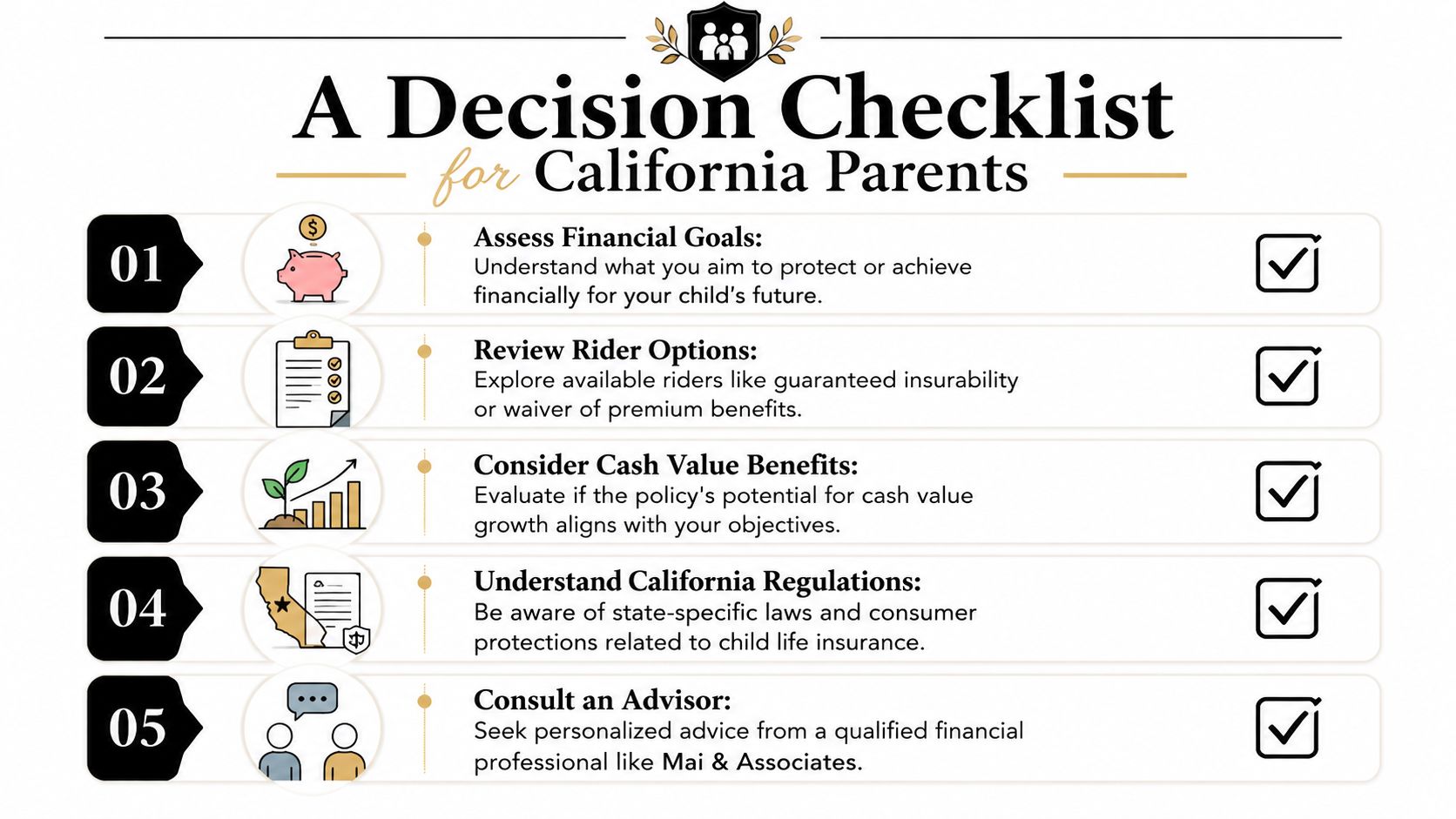
A Decision Checklist for California Parents
Good decisions usually get easier when you stop asking, “Is this product good?” and start asking, “Is this product right for my specific household?”
That's the right frame for life insurance for children. In California, where many families juggle high living costs and property-related risks, context matters as much as product design.
Start with your actual goal
Before you compare policies, pin down the job you want the policy to do.
- Future insurability: You want to protect your child's ability to keep or obtain coverage later, even if health changes.
- Final-expense protection: You want a modest cushion for a low-probability but devastating event.
- Long-term savings structure: You like the discipline of a policy-based approach and aren't expecting it to function like a high-flexibility account.
If you can't clearly name the goal, pause there. Unclear goals lead to mismatched products.
Check the rest of the household plan
A child policy shouldn't subtly outrank the bigger vulnerabilities in your home.
Ask yourself:
- Are the adults in the household properly covered with life insurance?
- Do we have emergency savings for disruptions and deductibles?
- Are our car insurance limits still appropriate?
- If we rent, is renters insurance up to date?
- If we own, are our home insurance choices aligned with wildfire, earthquake, or other California-specific concerns?
For many families, the answer will be that child coverage belongs later in the sequence, not first.
Some of the best insurance choices are the ones you postpone until the foundation is stronger.
Decide whether bundling is enough
That's an important clue. Sometimes a rider is the better fit because it handles the narrow need without committing you to a separate permanent policy. Other times, a standalone policy makes more sense because the insurability feature is the whole point.
Use a short self-test
If most of these statements sound true, a child policy may deserve a closer look:
- You specifically care about future insurability.
- You've already handled the larger insurance gaps for the adults.
- You have enough monthly room in your budget to keep the policy long term.
- You understand that cash value is secondary, not magic.
- You're choosing the policy for a clear reason, not just because it was offered.
If most of those don't sound true, it may be better to strengthen your broader California family protection plan first.
How to Get Child Life Insurance in California
If you decide to explore life insurance for children, the process is usually fairly straightforward. In many cases, the first step is choosing whether you want to price a child rider or a standalone policy.

A practical way to shop
Keep the process simple.
- Gather your basics: Child's age, your coverage goal, and whether you want to compare a rider against a standalone policy.
- Review the household plan too: Since this is California, it's smart to look at auto insurance, home insurance, renters insurance, and life insurance together.
- Compare multiple carriers: Product details vary, especially around policy ownership, continuation into adulthood, and rider design.
- Ask plain-language questions: Who owns the policy, when can ownership transfer, what happens at adulthood, and what options exist later?
Why a full review can help
A child policy is a small part of a larger risk picture. Sometimes the better financial move is not buying more insurance for a child right away. Sometimes it's improving liability limits on your car insurance, correcting a home insurance gap, or adding renters insurance if you've been putting it off.
If you want to compare options without committing, you can start with an insurance quote review for California coverage. That gives you a chance to look at life insurance along with the rest of your household protections in one conversation, which is usually how the smartest decisions get made.
Frequently Asked Questions
Can a grandparent buy life insurance for a child
Often, yes. Policy ownership depends on insurer rules and insurable-interest requirements, but grandparents are commonly allowed to own a policy on a grandchild if the carrier permits it and the application is properly structured.
What happens to the policy when the child becomes an adult
It depends on the policy terms. In many cases, the adult who bought the policy owns it while the child is a minor. Later, ownership may be transferred to the child, who can then continue the policy if premiums are paid.
Is a child rider the same thing as a standalone whole life policy
No. A rider is usually attached to a parent's policy and is more limited. A standalone whole life policy is its own contract and may continue long term with different features.
Are cash value access and policy changes always simple
Not always. Insurance policies have rules, timelines, and possible tradeoffs. Before buying, ask how access works, what happens if premiums stop, and what choices the child will have later as an adult.
If you want help thinking through whether child life insurance belongs in your broader California protection plan, Mai & Associates can help you compare options without the pressure. Their team can review life insurance along with auto, home, and renters coverage so you can make one coordinated decision for your family, not a series of disconnected ones.