Life Insurance Dividend Options: Optimize Your Policy

You open the mail, or more likely your insurer's email, and see a line about a life insurance dividend. If you own participating whole life insurance, that notice can feel oddly vague. Is it a bonus, a refund, taxable income, or just insurance language nobody explains well?
For many California families, the confusion is understandable. You may already be juggling rising costs, reviewing car insurance, comparing home insurance because of wildfire exposure, or updating renters insurance after a move. Life insurance often sits in a different mental bucket, even though it's part of the same job: protecting your household when something expensive or unexpected happens.
A dividend notice isn't just paperwork. It's a decision point. What you choose can affect cash access today, premiums next year, and how much value your policy builds over time.
Your First Life Insurance Dividend Notice
A common situation goes like this. A parent in Glendale or Costa Mesa opens a policy statement and sees a dividend has been credited to their whole life policy. Then comes the next question: “Do I take the cash, lower my premium, or leave it alone?”
That uncertainty makes sense because life insurance dividend options sound more technical than they are. In plain language, your insurer is giving you choices for how to use a policy benefit. The right choice depends on what your family needs now and what you want this policy to do later.
Some people want immediate flexibility. Their auto insurance just renewed higher, or they're dealing with home hardening work because their property sits in a wildfire-sensitive area. Others want long-term growth inside the policy because they're thinking about legacy planning, college funding flexibility, or building assets that don't move with the stock market.
Practical rule: Don't assume the default dividend election is still the best one for your life today.
That matters because life insurance doesn't exist in isolation. A California household usually needs several layers of protection working together. Car insurance protects income from liability claims. Home insurance and earthquake planning protect property. Renters insurance protects belongings and liability for tenants. Life insurance protects the people who depend on your income and long-term financial stability.
A dividend notice is your chance to tune one part of that protection plan. If your policy is participating whole life, the dividend can become a small but meaningful lever. Used well, it can support liquidity, reduce costs, or strengthen the policy itself.
What Are Life Insurance Dividends Anyway
A life insurance dividend is easiest to understand if you think of a member-owned co-op refund. You paid into a participating policy. The insurer had a favorable year. It returns part of that surplus to eligible policyholders.
That's why dividends are different from guaranteed policy values. They're not guaranteed, and they're not the same as the built-in guarantees of whole life insurance. They depend on company results. The main drivers are company cash flow, investment returns, mortality experience, and operating expenses, as explained in Northwestern Mutual's overview of life insurance dividends.

Why policyholders pay attention to them
These aren't tiny side notes at some carriers. Northwestern Mutual expects to pay $9.2 billion in total dividends in 2026, according to its published dividend explanation, and New York Life has paid dividends for 166 consecutive years since 1854 in the same source's summary of industry consistency. Those facts help explain why many policyholders treat dividends as an important feature, not a footnote.
If you're comparing policy structures, it helps to compare top whole life plans and see how participating policies differ from simpler guaranteed-only designs.
For readers wanting a broader overview of permanent coverage, this guide to life insurance in California is a useful starting point.
What usually confuses people
People often hear the word “dividend” and think of stocks. That comparison causes problems. A life insurance dividend is better understood as a return of surplus from a participating policy.
Here's the simple version:
- If claims were lower than expected, the insurer may have more surplus.
- If investments performed well, that can support the dividend.
- If expenses were controlled, that can also help.
A dividend tells you something about how a mutual insurer performed. It does not change the fact that the policy's guarantees and the dividend are separate things.
That distinction matters. The guaranteed part of your whole life policy keeps doing its job whether a dividend is large, small, or absent in a given year. The dividend is an extra decision layer, and that's where life insurance dividend options come in.
Exploring Your Six Dividend Options
Your dividend notice arrives, and the line that looks simple turns into six separate choices. For a California family, that decision can feel a lot like choosing how to use an unexpected tax refund. You could take the money now, lower a bill, pay down debt, or put it back to work for future protection.

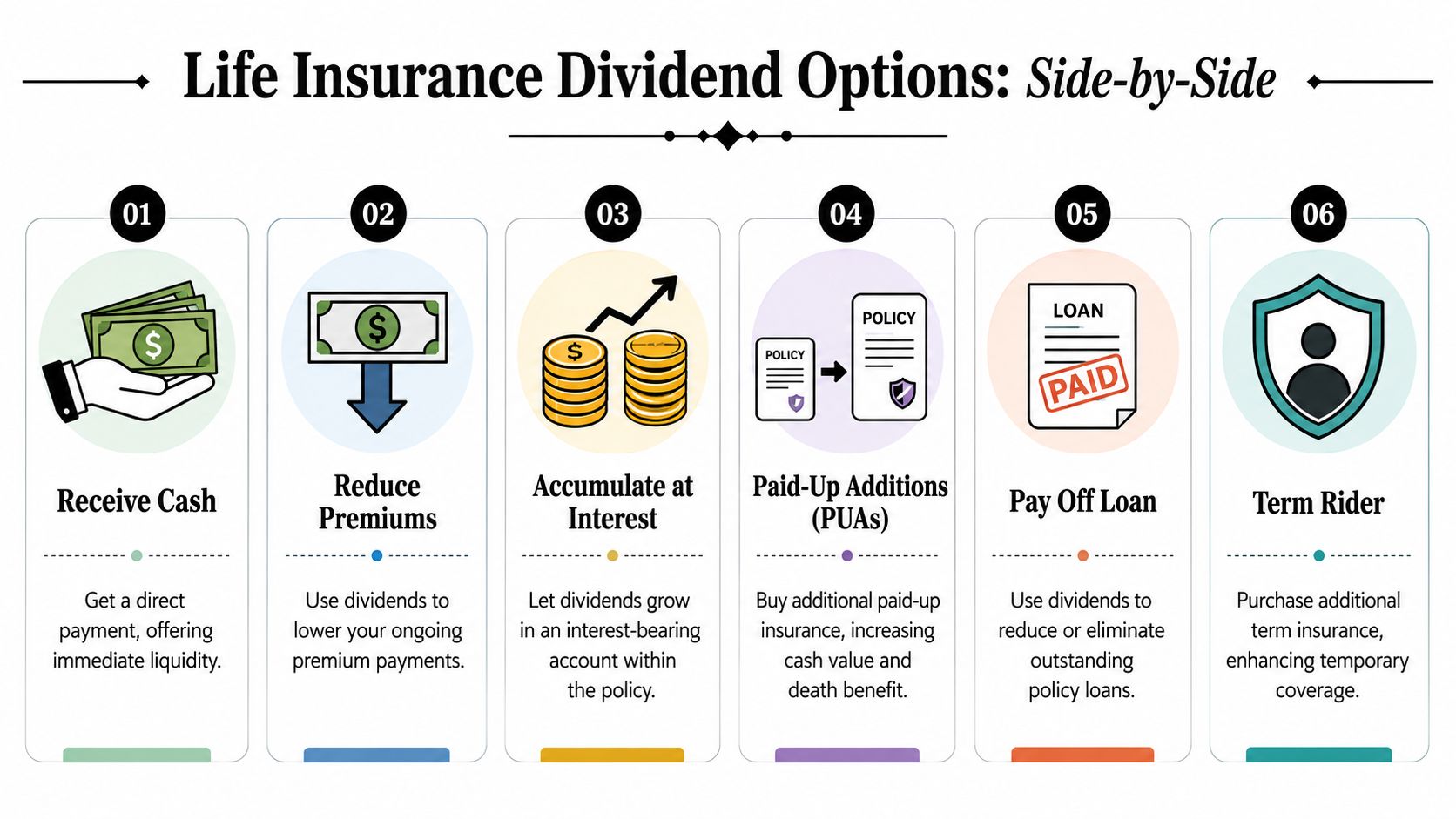
Participating whole life policies usually offer six dividend options: cash, reduced premium, loan repayment, paid-up additions, one-year term insurance, and accumulation at interest. The names sound technical, but the choices become easier once you sort them by purpose. Some options help with today's cash flow. Others build future policy value.
Options that solve an immediate need
These choices are the easiest to understand because the benefit shows up quickly.
Take cash
The insurer sends the dividend to you directly. This can help if you want flexibility for current expenses, such as rebuilding savings, covering a seasonal property cost, or setting aside money for emergency planning. In California, policy dividends are often treated as a return of premium up to your basis, but your tax treatment depends on your policy and total distributions.Reduce your premium
The dividend is applied to your premium bill. Families often choose this during tighter budget years, especially if they are also balancing rising home, auto, or disaster-preparedness costs.Reduce a policy loan
If you borrowed against the policy, the dividend can go toward that loan. This option does not put cash in your pocket, but it can lower interest pressure and help keep the policy healthier over time.
Options that keep the dividend working
These choices are more about future value than present relief.
Purchase paid-up additions, often called PUAs
The dividend buys small amounts of fully paid whole life insurance. Each addition can increase cash value and death benefit. For households in Glendale, Costa Mesa, or anywhere else in California, this often appeals to people who want the policy to keep growing while they focus on other risks, like making sure the home is properly protected for wildfire or earthquake exposures.Accumulate at interest
The insurer holds the dividend in an interest-bearing account connected to the policy. This can offer more access than PUAs, but the interest credited may be taxable, which matters for California families trying to avoid surprises at tax time.Buy one-year term insurance
The dividend purchases temporary extra death benefit for one year. This can fit a short-term need, such as covering a larger mortgage balance, a temporary income gap, or a period when family obligations are unusually high.
A practical way to sort the six choices
A simple question helps narrow the list. Do you want the dividend to help your household now, or do you want it to strengthen the policy for later?
| Dividend option | Best fit for |
|---|---|
| Cash | Immediate access to funds |
| Reduce premium | Lower out-of-pocket premium cost |
| Reduce loan | Paying down existing policy debt |
| PUAs | Long-term growth in cash value and death benefit |
| Accumulate at interest | Holding dividends separately with interest crediting |
| One-year term | Temporary extra protection |
Many policyholders hesitate because none of these choices is automatically right or wrong. A family building reserves after a wildfire season may prefer cash or reduced premium. A family focused on long-term estate planning may prefer PUAs. The better choice depends on what your policy needs to do for your life in California right now.
Comparing Dividend Options Side by Side
Once you move past the names, the choice becomes clearer. Each option changes two big numbers in a participating whole life policy: Total Cash Value and Total Death Benefit.
What changes inside the policy
The trade-offs are easier to see in a simple comparison.
| Option | Cash value effect | Death benefit effect | Liquidity | Tax consideration |
|---|---|---|---|---|
| Cash | Little or no internal growth from that dividend | No added permanent growth from that dividend | High now | Depends on policy basis and tax treatment |
| Reduce premium | Less internal compounding from that dividend | Usually no added permanent growth | Helps current cash flow | Often used to avoid more out-of-pocket premium |
| Reduce loan | Supports policy debt management | Indirect policy support | Limited immediate cash in hand | Depends on overall policy tax status |
| Accumulate at interest | Grows outside core policy value structure | Typically limited impact on permanent death benefit | Moderate | Interest earned can be taxable |
| PUAs | Adds to policy cash value | Adds permanent death benefit | Lower now, stronger long term | Growth is typically tax-deferred |
| One-year term | Limited cash value effect | Adds temporary coverage | Low | Primarily a coverage choice |
The compounding trade-off
The big dividing line is this: options like cash and premium reduction help today, while options like PUAs aim to help later.
That isn't opinion alone. Thrivent's discussion of life insurance dividends states that electing premium reduction lowers out-of-pocket costs but gives up compounding growth. The same source says data modeling shows PUAs can result in a 6.2% IRR over 20 years, compared with 4.1% for taking cash.
If you need relief this year, premium reduction can make sense. If you want the policy to build on itself, cash usually gives up too much future value.
How families usually decide
A household with several current expenses may favor premium reduction or cash. That can be sensible. California families often balance mortgage costs, auto premiums, deductibles, and home resilience spending all at once.
But if the policy's mission is long-term protection, PUAs often stand out because they strengthen both major levers of a whole life policy. Accumulate-at-interest sits in the middle. It may feel conservative, but it doesn't usually deliver the same policy-building effect as PUAs.
One-year term is more specialized. It can fit a short-term coverage need, but it doesn't create the same permanent value.
The Power of Paid-Up Additions (PUAs)
A lot of California families first hear about PUAs after they open a dividend notice and wonder, “Are we taking cash, or are we reinvesting inside the policy?” That question matters because a paid-up addition changes the policy itself. It uses the dividend to buy a small piece of permanent whole life insurance that is fully paid for from day one.
You do not go through new underwriting. You do not send in a separate premium for that added slice of coverage. The dividend buys it for you.

Why PUAs get so much attention
New York Life's explanation of dividend options says PUAs are the most commonly elected dividend option. The company explains that dividends can buy additional paid-up coverage at net single premium rates, which can increase policy value over time through tax-deferred growth.
That is the practical appeal. Instead of pulling money out of the policy, you are feeding it back in so the contract has more cash value and more death benefit working for you.
For a California household, that can fit a very specific goal. Many families here are balancing long-term protection with other high-cost risks, such as wildfire hardening, earthquake retrofits, rising home insurance costs, and higher deductibles on auto and property policies. A PUA election will not solve those cash flow pressures today, but it can strengthen a policy that is meant to protect the family for decades.
A simple way to understand how PUAs work
A dividend used for PUAs works like planting another small tree in the same orchard. The new tree is separate in one sense because it is its own paid-up piece of insurance, but it still becomes part of the same property. Over time, the policy has more structure, more value, and often more capacity to produce future dividends.
Suppose your policy receives a $1,000 dividend. If you elect PUAs, that dividend buys as much additional paid-up whole life coverage as $1,000 can purchase based on your policy terms, age, and rating class. The result is not a dollar-for-dollar cash payout to you. The result is more permanent insurance inside the policy.
That distinction trips people up. The dividend is still your value, but under the PUA option it is being converted into added policy benefits instead of being sent out for current spending.
If you want a plain-English refresher on terms like cash value, death benefit, and policy loan, our insurance glossary of common policy terms is a good place to start.
What changes after you add PUAs
Paid-up additions usually affect the policy in three ways.
- Cash value can rise. Part of each addition shows up in the policy's value.
- Death benefit can rise. Your beneficiaries may receive a larger payout.
- Future growth potential can rise. Because the added insurance can itself participate in future dividends, the policy may build on a larger base over time.
“Paid-up” is the key phrase here. It means that added slice of insurance does not require an ongoing premium later.
Why this option often fits long-range planning
PUAs are often attractive to families who want the policy to do more than stay level. They want it to grow gradually, year after year, without needing fresh medical underwriting each time they add coverage through dividends.
That can be useful in estate planning, legacy planning, and special-needs planning. Families who are handling financial matters for Texas wards often run into related questions about ownership, control, and how life insurance fits into a broader protection plan. In California, similar planning conversations come up when parents want durable long-term support for children or dependents, even though the legal rules are different here.
There is also a tax point worth understanding. In general, using dividends for PUAs does not create the same annual taxable interest issue that can apply when dividends are left to accumulate at interest. For California residents, that distinction matters because state income tax can make small annual tax costs more noticeable over time.
PUAs are not the automatic best choice. A family that needs cash for a roof upgrade, defensible space work, or an emergency fund may reasonably choose a different dividend option. But if the goal is to strengthen the policy itself for the long haul, PUAs are often the option that does that most directly.
Choosing the Right Option for Your California Life
The best dividend election depends less on theory and more on what your household is trying to solve.
A California family in a wildfire-prone area may be spending heavily on roofing, defensible space, or insurance changes tied to the home. Another family may be focused on estate planning, or on creating a larger asset base that can support future flexibility. The same dividend can serve very different jobs.
When each choice can fit
Here are common real-life matches.
- Choose cash if you need liquidity now. That might help with a deductible, temporary income interruption, or an urgent household expense.
- Choose premium reduction if you want breathing room in the monthly budget.
- Choose loan reduction if your policy loan balance is the main issue you want to address.
- Choose PUAs if your priority is long-term growth in cash value and death benefit.
- Choose one-year term if you need extra temporary protection for a specific period.
- Choose accumulate at interest if you want the dividend held with interest rather than applied to permanent additions.
The California tax angle
Tax treatment matters more in California than many people realize. According to McFie Insurance's discussion of dividend options, the accumulate at interest option creates annual taxable income on the interest earned, and that interest is subject to California state tax. The same source says PUAs allow tax-deferred growth within the policy and may save 20% to 30% in after-tax returns compared with other options in high-tax states.
That doesn't mean every Californian should automatically choose PUAs. It does mean you should look closely at after-tax results, not just convenience.
A dividend option that looks simple on paper can become less attractive once you factor in California taxes.
Connecting life insurance to broader protection
Insurance planning gains practical application. If your household already reviews auto insurance, home insurance, renters insurance, and earthquake exposure as one coordinated protection plan, life insurance should be handled the same way.
For example:
- Homeowners in wildfire zones may value policy liquidity differently than homeowners in lower-risk areas.
- Renters building savings may want to keep costs lower now and revisit the dividend election later.
- Parents with growing estates may care more about expanding permanent death benefit.
If your family is also navigating legal responsibility for someone else's finances, state-specific guidance matters there too. For a useful example outside California, this article on handling financial matters for Texas wards shows how policy decisions can change when another person manages the insured's affairs.
If you're comparing coverage choices across your household, getting a California insurance quote can help you view life, home, renters, and car insurance decisions in one place.
Questions to Ask Your Mai & Associates Agent
A good life insurance review should feel like a planning conversation, not a product pitch. Bring your current policy statement and ask direct questions that force a side-by-side comparison.
Questions worth asking
Can you show me an illustration comparing PUAs versus taking cash?
Ask for a long-range view so you can see how each choice changes cash value and death benefit over time.What is my current dividend election, and when can I change it?
Many policyholders don't remember what they selected years ago.How does my choice affect my premium obligation and policy flexibility?
This matters if your budget has changed.If I have a policy loan, should the dividend go to the loan or still go toward growth?
The right answer depends on the policy details and your larger financial picture.How should I think about taxes as a California resident?
This is especially important if you're considering accumulate at interest.
Questions that connect life insurance to the rest of your coverage
- Does this life policy still match my family's protection needs today?
- How does this fit with my home, auto, or renters insurance strategy?
- If I live in an earthquake or wildfire-sensitive area, should I keep more liquidity outside the policy or build more value inside it?
A strong agent should be comfortable discussing both the policy mechanics and the bigger household risk picture.
Frequently Asked Questions about Dividend Options
Can I change my dividend option later
Often, yes. Many policies let you change your election, subject to company rules and timing. Check before your next dividend period so you know when the change takes effect.
What if the insurer doesn't pay a dividend in a given year
Dividends are not guaranteed. If no dividend is paid, your policy's guaranteed features remain separate from that dividend decision. Your core whole life policy doesn't stop being whole life just because the dividend changes.
Are life insurance dividends taxable
They can be, depending on how they're used. The biggest practical issue discussed earlier is that interest earned under an accumulate-at-interest option can create taxable income. Cash treatment can also depend on whether amounts exceed your policy basis. This is one place where personal tax advice matters.
Which option usually builds the most long-term value
Among common life insurance dividend options, PUAs are often favored when the goal is long-term growth because they add to both cash value and death benefit. But “best” still depends on whether your priority is growth, cash flow, loan management, or temporary coverage.
Where can I get more general insurance answers
If you want broader guidance on common policy questions, the insurance FAQ page is a helpful place to start.
If you want help reviewing life insurance dividend options alongside your California auto insurance, home insurance, renters insurance, or broader family protection plan, Mai & Associates can help you compare coverage and make sense of the trade-offs in plain language.