Life Insurance California: A Practical Guide for 2026

A lot of California families wait too long to buy life insurance because the need doesn't feel urgent until something big happens. Then the math turns brutal fast. One income disappears, the mortgage is still due, car insurance and home insurance bills keep coming, and nobody at the kitchen table cares that the family meant to “get around to it.”
That's why I treat Life Insurance California as part of the same protection conversation as California insurance for your house, car, apartment, and income. If you're comparing auto insurance, renters insurance, home insurance, or life insurance, you're not shopping for paperwork. You're deciding which financial disasters your family can survive.
Why California Households Need a Life Insurance Game Plan
A California household can look stable on paper and still be exposed.
Take a common setup. Two working parents. A mortgage. Two cars. Maybe one child in day care and another headed toward college. The checking account looks fine because both paychecks are landing. Then one person dies, and the surviving spouse has to cover every fixed bill with less income, less time, and more stress.
California costs don't forgive slow decisions
In California, most families aren't buying life insurance because they love insurance. They're buying it because the state is expensive. Mortgage payments are high. Child care is expensive. Replacing income takes more than a workplace benefit brochure and good intentions.
Employer coverage is where many people get lazy. I'll say it directly. Group life through work usually isn't enough. It may help with immediate expenses, but it rarely solves the long-term problem of lost income, debt payoff, and future education costs.
Here's the practical lens I use with clients:
- Income replacement matters first. Your family needs time to adjust without panic-selling the house.
- Debt cleanup matters second. Mortgage balances, private student debt, and other obligations don't disappear when you do.
- Children change the equation. If you have kids, life insurance isn't optional. It's part of the household budget.
- Housing status matters less than people think. Renters need coverage too, especially if one person's income supports most of the household. If you're renting, pair this with a look at California renters insurance options.
Practical rule: If your death would force your family to move, borrow, or rely on relatives, you need life insurance.
This is a financial backstop, not a luxury product
California is the largest life insurance market in the United States. The American Council of Life Insurers reports that Californians had about $4.6 trillion in life insurance in force in 2022, bought about $350 billion in new life insurance coverage that year, and generated about $21 billion in total direct premium receipts. The same fact sheet says insurers paid California families about $22.2 billion in life insurance and annuity benefits in 2022, or roughly $60.7 million per day, and that 10.3 million individual life insurance policies were in force, averaging about $282,000 in death-benefit protection per policy (ACLI California life insurance fact sheet).
That scale tells you something important. Californians use life insurance because they need it. The only smart question is how much coverage fits your household and which type solves the problem.
The Three Policy Types Every California Buyer Should Understand
Don't need a seminar on policy design. You need a plain-English answer to one question. What should I buy?
For most families, the answer starts with term life. Not always. But usually.
Term life is the workhorse
Term life insurance is like renting a coverage apartment for a set number of years. You lock in the premium for a defined period, often around major family obligations such as a mortgage term or the years your kids depend on you.
This is the right fit for a younger California household that needs maximum protection for the lowest upfront cost. If you're in your thirties, raising kids, and carrying a mortgage, term usually does the heavy lifting.
Whole life is permanent and expensive
Whole life insurance is closer to owning the building. It's permanent coverage with a cash value component that grows slowly over time, and the premium is generally fixed.
I recommend whole life selectively. It can make sense for a high-net-worth parent who wants a guaranteed death benefit, long-term planning, or a permanent asset that doesn't expire. I don't recommend it as the default answer for a young family that mainly needs income replacement.
Buy whole life because you need permanence, not because someone waved around a shiny illustration.
Universal life sits in the middle
Universal life insurance is a more flexible hybrid. It's permanent coverage, but the premium and death benefit can often be adjusted within policy limits. Cash value performance depends on the structure and can be tied to declared interest or an index formula.
That flexibility attracts business owners and older buyers who want options. It also creates room for mistakes if the policy is underfunded. If you don't understand how the funding works, don't buy it until someone explains it clearly.
Term vs. Whole vs. Universal Life Insurance at a Glance
| Feature | Term Life | Whole Life | Universal Life |
|---|---|---|---|
| Duration | Fixed period | Lifetime if kept in force | Lifetime if kept in force and funded properly |
| Cost | Lowest starting cost | Higher | Usually higher than term |
| Cash Value | No | Yes | Yes |
| Best Use Case | Income replacement, mortgage protection, child-raising years | Permanent protection, estate planning goals, guaranteed death benefit | Flexibility for changing income or business planning needs |
If you're getting hit with unfamiliar terms while shopping, use a plain-language insurance glossary before you sign anything.
My blunt recommendation
Here's where I land most often:
- Young families: Start with term.
- Affluent households with permanent planning needs: Consider whole life.
- Business owners or buyers with variable income and strong policy oversight: Look at universal life carefully.
If an agent leads with permanent insurance before understanding your debt, income, and family obligations, slow the conversation down. Product should follow need. Not the other way around.
What Really Drives Life Insurance Costs in California
Two applicants can live in the same neighborhood, ride the same BART line, and still get very different life insurance quotes. That doesn't mean the market is random. It means underwriting is personal.
The biggest pricing drivers are your age at application, health profile, tobacco use, policy size, term length, and the product you choose. Riders matter too. Add-ons such as waiver of premium or an accelerated death benefit can change the premium.
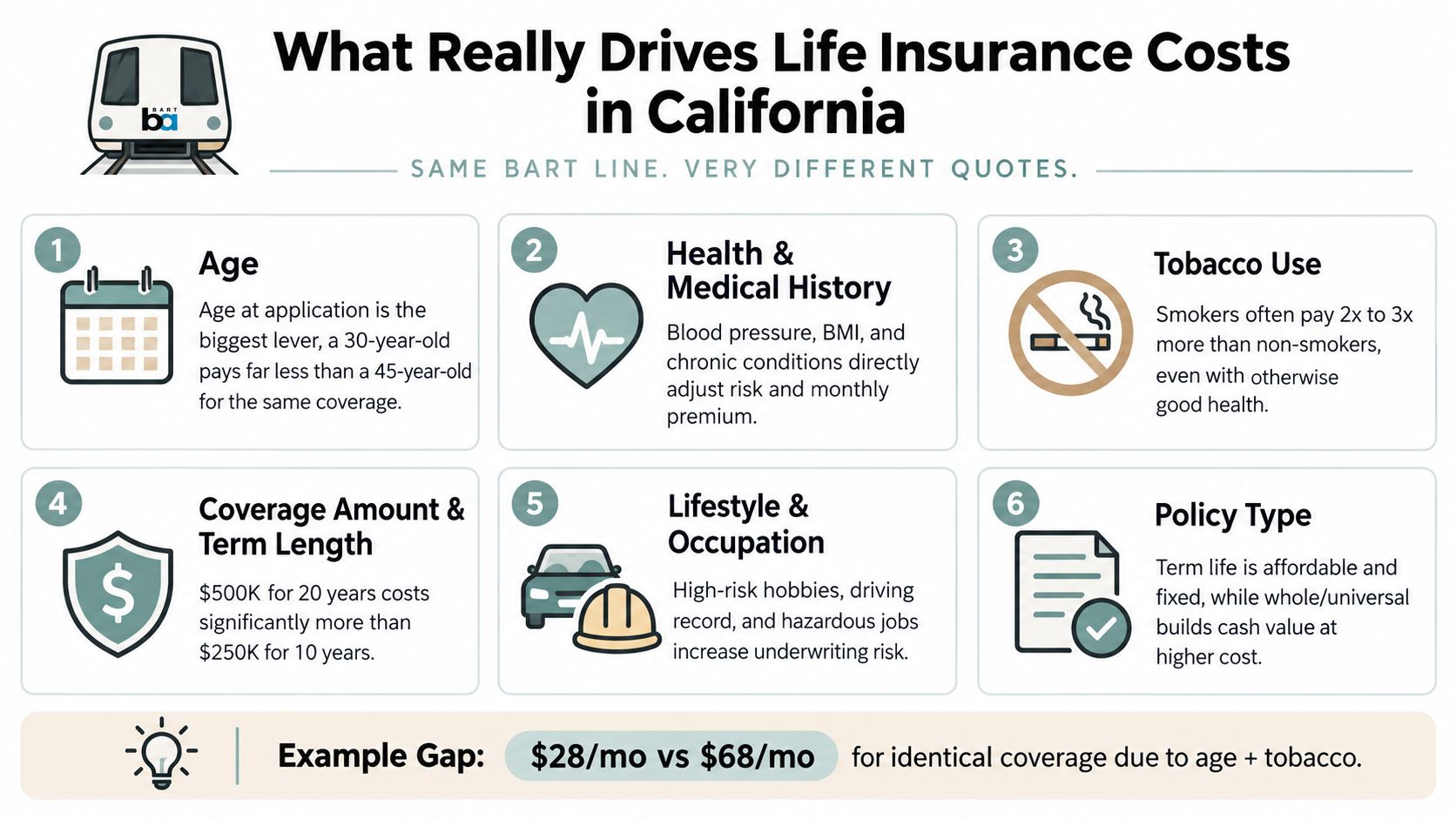
What moves the premium up or down
A healthy buyer who applies younger usually gets a better rate class. A buyer with high blood pressure, chronic conditions, recent tobacco use, or risky hobbies won't. That's why one quote comes in light and another lands much higher, even when the death benefit is identical.
California families also tend to buy larger face amounts because the obligations are larger. Bigger mortgages and higher living costs mean the coverage target often rises. That doesn't make the policy overpriced. It means the household's actual exposure is higher.
A few common cost levers:
- Age at application: Waiting usually costs more.
- Health class: Better underwriting results mean lower premiums.
- Tobacco status: This can materially change pricing.
- Coverage amount and term: More coverage and longer duration usually mean higher premiums.
- Gender: Insurers factor it into pricing.
- Riders: Useful riders add cost, so don't stack them mindlessly.
California buyers often overspend in one place and underspend in another
They overspend when they buy features they don't understand. They underspend when they settle for a death benefit that won't protect the family.
If your budget is tight, cut product complexity before you cut core coverage.
Young Los Angeles and Bay Area families often ask about child riders, living benefits, or premium waiver features. Some are worthwhile. Some are just noise. I'd rather see a clean term policy with enough death benefit than a fancy contract with too little protection.
I'm not going to invent a statewide rate chart, because pricing moves by carrier, underwriting class, and market conditions. For a healthy adult buying a 20-year, $500,000 policy, expect a quote range rather than one universal number, and expect that range to move over time as carriers adjust assumptions. The right way to shop is to compare real carrier offers on the same day, with the same application profile.
California Rules That Quietly Shape Your Policy
California doesn't treat life insurance like a casual retail purchase, and that's a good thing. The rules are stricter than many buyers realize, especially when an agent wants to replace an existing policy.
Replacement paperwork exists for a reason
California requires life insurers using an agent to make the application include a signed statement from the agent about whether replacement is or may be involved. The rules also require the agent to leave the applicant with the presentation materials used (California Department of Insurance life insurance guide).
That matters because replacement is where consumers get burned. If someone tells you to surrender, exchange, or swap a current policy, insist on a side-by-side comparison of cash values, surrender charges, premium patterns, and what you're giving up.
Solvency oversight is not background noise
California also requires annual actuarial certification for life insurers doing business in the state. A qualified actuary must opine on whether reserves and related actuarial items are computed appropriately, satisfy contractual provisions, stay consistent with prior reported amounts, comply with California law, and whether reserves plus supporting assets adequately provide for policy obligations (California actuarial certification requirement).
That's not abstract regulatory language. It means California puts real pressure on carriers to reserve properly and manage their books responsibly.
The paperwork can feel tedious. It's there because life insurance only works if the contract is clear and the company stays sound.
Other protections buyers should actually use
Some protections are only useful if you use them. Don't ignore them.
- Free-look review: When your policy arrives, read it during the free-look window and confirm it matches what was sold.
- Policy illustrations: If you're buying permanent coverage, don't rely on rosy projections. Ask what's guaranteed and what isn't.
- Producer verification: Confirm that the person selling you the policy is properly licensed in California.
- Out-of-state marketing skepticism: National ads and call centers may be fine, but California-regulated advice from a California-licensed professional is better when the case involves replacement, disclosures, or language access.
This is one place where local knowledge matters. Not because California is mysterious. Because the rules are specific, and mistakes can cost you years of premiums or the wrong policy altogether.
Wildfire Risk and Life Insurance, Separating Myth from Reality
A lot of Californians assume wildfire exposure affects life insurance the same way it affects home insurance. It doesn't.
Property insurance prices the building, the location, and the local hazard environment. Life insurance underwrites the person. Those are different systems with different questions.
Living in a wildfire area usually doesn't set your life rate
If you live in a high-risk fire area, that can absolutely complicate your home insurance options. It doesn't automatically mean your life insurance premium jumps because of your ZIP code. California's wildfire reform activity has focused on property coverage rules, mitigation recognition, and wildfire model transparency, which reinforces the need to separate property insurance from life underwriting (California wildfire insurance reforms).
If you're sorting out both sides of that issue, it helps to review California home insurance coverage separately from your life insurance decisions.
What actually matters
Underwriters care far more about your health, age, smoking status, occupation, and personal risk factors than they do about a residential address in a fire-prone area.
There are exceptions, but they're usually tied to the work you do or the environments you regularly enter. A career wildland firefighter presents a different risk profile than an office worker who happens to own a house in a foothill community. The same goes for certain utility field roles or travel-heavy jobs in hazardous regions.
Here's my advice. Don't delay a life insurance application because fire season is active. Apply when your health profile is favorable, keep your records current, and disclose respiratory issues if they exist.
Misrepresentation is a bigger threat to a future life insurance claim than wildfire season.
For day-to-day smoke management at home, some families also look for practical indoor air resources such as EcoQuest Purifiers wildfire protection. That's a household air-quality decision, not a life underwriting strategy, and it's worth keeping those categories separate.
How to Quote, Apply, and Buy with a Local California Agency
You sit down to buy life insurance in California, and within ten minutes you can tell whether the agency is doing its job. The right advisor asks about your family, your mortgage, your income, your beneficiaries, and whether you're replacing an older policy. The wrong one jumps straight to price and starts pitching product names.
Start with an independent California agency if you want real comparison shopping. That matters here because carrier rules, underwriting speed, multilingual service, and replacement paperwork are not the same from one insurer to the next. If you want to start the process online before talking with an agent, use a California life insurance quote request form that collects the basics without locking you into one carrier.
Quote first. Product second.
A useful quote conversation covers five things right away: who depends on your income, how long they would need support, what debts would survive you, who should be named as beneficiary, and whether you already own life insurance.
That last point matters more in California than buyers expect. If you are replacing an existing policy, your agent has to handle specific replacement disclosures and documentation under California rules. Good advisors slow down there on purpose. They should. Replacing a policy without reviewing surrender charges, contestability periods, cash value loss, and changed underwriting class is how families make expensive mistakes.
Language access matters too. California families often need these discussions in Spanish, Armenian, Russian, Vietnamese, Chinese, or Korean so beneficiary instructions and replacement forms are clear the first time. That is not a convenience issue. It is an accuracy issue.
What the application actually looks like
The application itself is usually straightforward. Most carriers use electronic forms and e-signatures. Some cases are approved without an exam. Others still require a paramedical exam, prescription history review, medical records, driving history, or follow-up questions about work and travel.
Expect questions in three categories:
- Household and coverage details: income, debts, dependents, existing coverage, and beneficiary choices
- Health history: medications, diagnoses, tobacco or nicotine use, height and weight, and doctor visits
- Risk details: occupation, hobbies, DUI history, foreign travel, and any other factors the carrier flags
Answer cleanly and completely.
In California, I tell clients to be extra careful on two items. First, disclose every existing life policy if you are considering a replacement. Second, slow down on beneficiary designations. A rushed beneficiary mistake causes more trouble later than a slow underwriting file.
Why a local California agency still earns its keep
The sale is only the start. Policies need service after issue, and California buyers often need more of it than they expect.
You may need to update beneficiaries after a marriage, divorce, birth, or trust change. You may want help reading annual statements on a permanent policy. Your family may need claim support later, in plain language, not a call center script. If there is a problem with a replacement, lapse, or policy record, local documentation matters.
A local agency should also know what California buyers ask that national sales desks often miss. Which carriers are easier to work with if English is not the client's first language. Which insurers are stricter on nicotine use. Which applications stall because the old policy information was incomplete. Which carriers ask more follow-up questions when someone works in field utility, fire response, or other higher-risk jobs.
One example of a California agency that handles multiple personal lines, including life insurance, is Mai & Associates. That can be useful if you want one office to review life coverage alongside your home, renters, auto, and umbrella planning, while keeping each recommendation separate and appropriate.
A good local advisor proves their value after the policy is issued, during changes, claims, and replacement reviews.
My recommendation is simple. Use a California agency that compares multiple carriers, explains replacement rules clearly, offers language support your household needs, and treats underwriting questions seriously from day one. Skip any shop that leads with a quick quote and acts annoyed when you ask how the policy would hold up for your family five or ten years from now.
Choosing the Right Coverage for Your Family in 2026
The right policy depends on who depends on you, how long they'll depend on you, and which obligations would survive you.
That's the decision frame I use. Not a canned multiple of income. Not a trendy product pitch.
Match the policy to the stage you're in
A young single earner in Los Angeles or Oakland often needs straightforward term coverage, especially if parents, siblings, or a partner would struggle with final expenses or shared debt. Parents with mortgages often need larger term coverage and may add a smaller permanent policy if they want funds set aside for final expenses. High-net-worth households may layer permanent coverage for estate liquidity or inheritance planning.
The point is simple. Buy for the problem in front of you.
Coverage Recommendations by California Life Stage
| Life Stage | Recommended Policy Type | Typical Coverage Range | California-Specific Note |
|---|---|---|---|
| Young single earner | Term life | Based on debts, support obligations, and future insurability goals | Good time to lock in coverage while health is strong |
| Married or partnered with no kids | Term life | Based on mortgage, shared bills, and income replacement need | Coordinate with home, auto, and emergency savings planning |
| Parents with young children | Term life, sometimes paired with a smaller permanent policy | Based on mortgage payoff, child care, education goals, and income replacement | Usually the highest need stage for pure protection |
| Older family with mostly grown children | Smaller term or permanent coverage, depending on goals | Based on final expenses, spouse income needs, and legacy goals | Review old workplace coverage before retirement |
| High-net-worth household | Whole life or universal life, often layered with term | Based on estate, business, and legacy planning needs | Product design matters more than marketing language |
What I'd tell most California families to do next
Start with your obligations, not your budget fantasy. Add up the mortgage balance, debt you'd want erased, and the income gap your family would face. Then choose the leanest product that solves that problem well.
A few filters matter in California:
- Check carrier quality: Ask about financial strength and don't settle for a weak insurer just to save a little premium.
- Confirm replacement compliance: If you're changing policies, demand full California disclosures in writing.
- Ask about language access: If English isn't the policyholder's strongest language, clarity matters more than speed.
- Review after major life changes: Marriage, divorce, a new baby, a new home, retirement planning, or a major property loss should trigger a review.
If you're buying Life Insurance California in 2026, keep it simple unless your planning needs are complex. Most families need enough term coverage, clean beneficiary designations, and a local professional who can explain the contract without hiding behind jargon.
Mai & Associates helps California families compare life insurance alongside auto, home, renters, and car insurance, which makes it easier to build one protection plan instead of five disconnected policies. If you want a California-licensed team to quote coverage, explain replacement rules, and review what fits your household, visit Mai & Associates.