Joint Life Insurance in California: A 2026 Guide

You’re in California, rent is high, home insurance is getting harder in some ZIP codes, car insurance keeps demanding attention, and now you’re talking with your partner about bigger things. Maybe it’s a condo in Glendale. Maybe it’s a starter home in Costa Mesa. Maybe it’s just the shared spreadsheet where both of your names now sit next to the same bills.
That’s usually when joint life insurance comes up.
It sounds simple. One policy, two people. But most couples get stuck on the same questions. Does it save money? Who gets paid, and when? Is it smart if you own a home together? What happens if one person has a health issue? And in California, where property rights and divorce rules can get complicated fast, is one joint policy safer than it looks?
Is Joint Life Insurance the Right Move for You?
A lot of couples don’t first ask about joint life insurance because they’re fascinated by insurance. They ask because life is starting to look shared in a real way. Shared rent. Shared mortgage plans. Shared car payments. Shared goals.

That makes this product more emotional than people expect. An InvestmentNews summary of a Nationwide survey found that 42% of surveyed U.S. renting couples saw a shared policy as the modern equivalent of marriage, and 35% said it felt more significant than saying “I love you” for the first time.
That tracks with what young couples often feel. Insurance isn’t romantic, but commitment is often practical before it’s poetic.
If you’ve been browsing options like digital joint life insurance for partners, the basic idea is this: a joint life insurance policy covers two people under one contract. Instead of each person buying a separate policy, the two of you share one policy structure.
What couples usually mean when they ask about it
Frequently, the inquiry boils down to one of these:
- “Can this protect our home?” If one of you dies, could the survivor keep paying the mortgage or rent?
- “Will it fit our budget?” You may already be balancing auto insurance, renters insurance, home insurance, and rising living costs.
- “Is this better than two separate policies?” Sometimes yes. Sometimes absolutely not.
- “How messy does this get in California?” That’s a smart question, especially if marriage, domestic partnership, or property ownership is involved.
If you’re also comparing broader coverage needs, it helps to look at joint life insurance alongside a full California life insurance overview, not as a standalone decision.
Joint life insurance works best when the two of you share a financial life, not just a mailing address.
The plain-English definition
Think of joint life insurance as one umbrella for two people. It can be built to pay when the first person dies or when the second person dies. That choice matters more than the phrase “joint policy.”
That’s where most confusion starts. So let’s make those two versions easy to remember.
First-to-Die vs Second-to-Die Policies
The cleanest way to understand these policies is to think about when the payout trigger gets pulled.

First-to-die means the first loss triggers the safety net
A first-to-die policy pays the death benefit after the first insured person dies. After that payout, the policy usually ends.
A simple analogy helps. Imagine a relay race where the baton drops the moment one runner falls. The policy responds right then, because the surviving partner may need money immediately.
That’s why first-to-die coverage often makes sense for couples who want protection tied to everyday life:
- mortgage payments
- rent and household bills
- child care or future education costs
- replacing one partner’s income
- paying off shared debts
If one partner dies unexpectedly, the surviving partner doesn’t need an estate planning tool first. They need cash flow, breathing room, and time.
Second-to-die means the finish line is both lives
A second-to-die policy, also called survivorship life insurance, pays only after both insured people have died.
This is less about replacing income for a surviving spouse and more about what happens to the family’s assets later. In California, that can matter when a family owns a house with significant value, a business interest, investment accounts, or property they want to pass on without forcing a sale.
For readers thinking about legacy planning, trusts, and liquidity for heirs, this broader discussion of comprehensive inheritance tax solutions can help frame why survivorship coverage exists in the first place.
Practical rule: If your main worry is “How does my partner manage financially if I die first?” you’re usually thinking about first-to-die. If your main worry is “How do our heirs handle what we leave behind after we’re both gone?” you’re usually thinking about second-to-die.
Where health can change the answer
One of the biggest practical advantages of joint life insurance is that it can help cover a partner who may struggle to get their own policy. Northwestern Mutual explains that a key advantage is the ability to insure a partner who has been denied individual coverage due to preexisting conditions.
That matters for real couples, not theoretical ones. One partner may be healthy and easy to insure. The other may have a medical history that makes individual coverage harder or more expensive.
Terms people mix up
If the jargon starts blurring together, use a quick glossary. A solid insurance glossary for common policy terms helps when you’re comparing ownership, beneficiaries, term length, and payout structure.
Here’s the easiest memory trick:
- First-to-die = protection for the survivor now
- Second-to-die = protection for heirs later
Once that clicks, the next decision gets sharper. Should you share one policy at all, or keep things separate?
Should You Get One Policy or Two?
This is the fork in the road. Plenty of couples like the simplicity of a joint policy. Plenty of others are better off with two separate policies from day one.
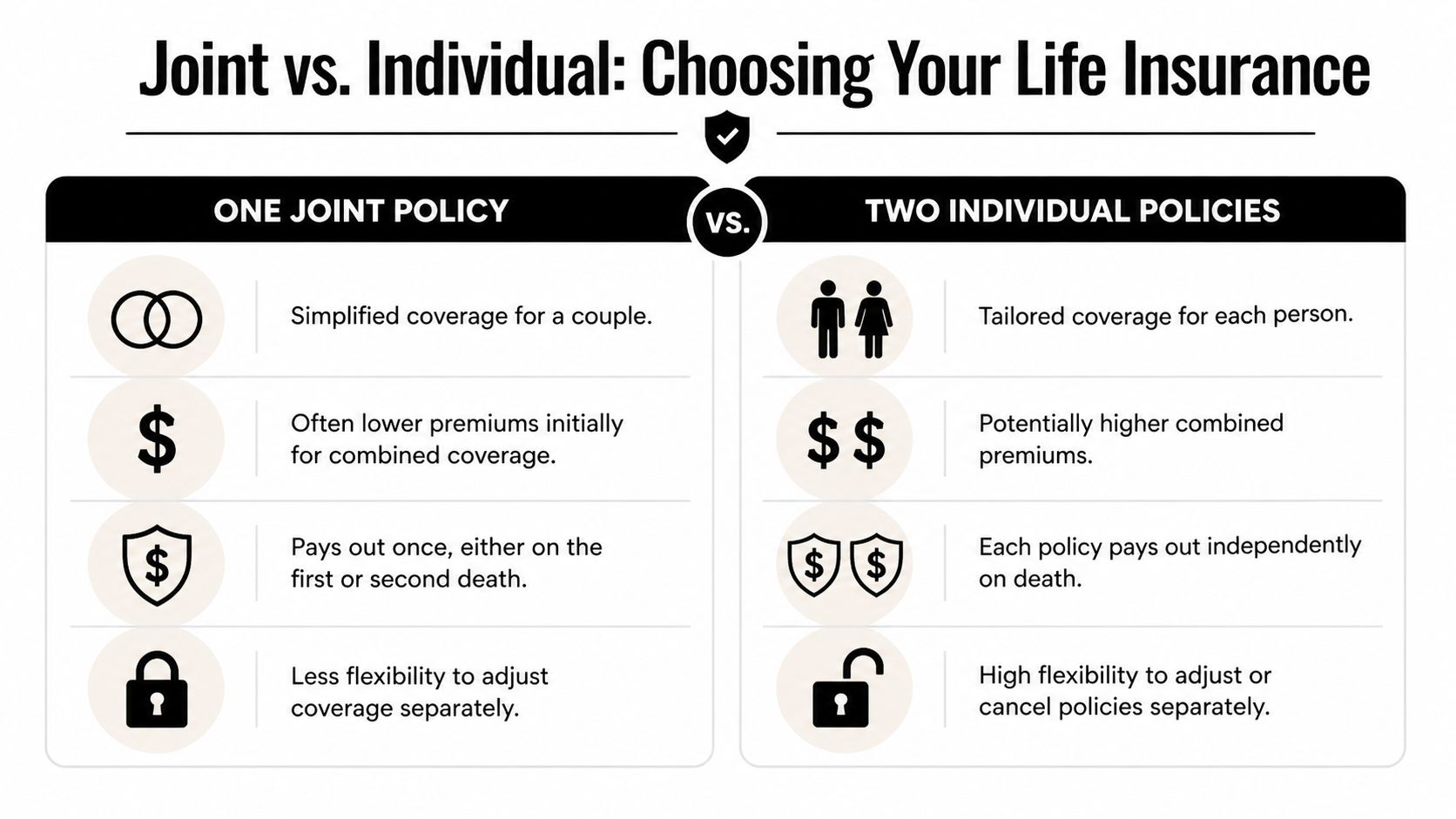
One policy feels simpler. Two policies usually give more control.
A joint policy can be easier to manage because there’s one contract, one structure, and one coordinated plan. For couples who want a straightforward solution for a shared debt or a shared estate goal, that can be appealing.
But simplicity isn’t the same as flexibility.
With two individual policies, each person has their own coverage, their own beneficiary setup, and their own ability to change or keep coverage if life changes. If one spouse dies, the other person’s policy stays in force. If the relationship changes, each person still controls their own contract.
That last point matters more than many couples realize.
Joint Life vs. Two Individual Policies at a Glance
| Feature | First-to-Die | Second-to-Die (Survivorship) | Two Individual Policies |
|---|---|---|---|
| Main purpose | Immediate support for surviving partner | Estate or inheritance planning | Independent protection for each person |
| When benefit pays | After the first death | After the second death | Each policy pays on that insured’s death |
| Best fit | Shared debts, kids, mortgage, income replacement | Legacy planning, heirs, asset transfer | Couples who want flexibility and separate control |
| Coverage after one death | Usually ends after payout | Continues until both have died | Survivor keeps their own policy |
| Ability to adjust separately | Limited | Limited | Strong |
The trade-off in plain language
Choose one joint policy when the priority is a shared objective and both of you are comfortable tying the coverage together.
Choose two individual policies when the priority is independence, long-term flexibility, or protection that survives major life changes.
A lot of California couples land here:
- They have a mortgage or plan to buy soon.
- They’re already juggling home insurance, renters insurance, and car insurance costs.
- They want to know whether a lower-cost combined option is worth giving up flexibility.
If you’re comparing options and still feel split, a good insurance FAQ page for California consumers can help clarify the practical differences before you request quotes.
A joint policy is a shared tool. Two individual policies are two separate tools in the same toolbox.
When two policies are often the cleaner choice
Two individual policies are usually easier to justify if:
- Your incomes are very different. One partner may need a larger death benefit.
- You want different term lengths. One person may need coverage to retirement, the other mainly until the kids are older.
- You want beneficiary control. That matters in blended families and second marriages.
- You’re worried about future insurability. If one person dies under a first-to-die plan, the survivor may need to apply for new coverage later.
- You want easier separation if life changes. Breakups, divorce, and property disputes can turn “simple” into complicated quickly.
That doesn’t mean joint life insurance is wrong. It means you should buy it for a specific reason, not just because it sounds efficient.
Weighing the Pros and Cons for Your Situation
A joint life policy isn’t good or bad on its own. It’s a fit issue.
Advantages that make sense for some couples
The strongest case for joint life insurance is usually one of these.
It can lower the hassle
One policy can feel cleaner than managing two. That matters for couples who want one coordinated solution attached to a shared obligation, such as a mortgage, family budget, or long-term estate objective.
It may help when one partner has health challenges
This is one of the most useful features in real life. If one person has had trouble qualifying for separate coverage, a joint structure may open a door that individual underwriting didn’t.
It can match a clearly shared goal
Sometimes the need is joint. A first-to-die design can support a surviving parent. A survivorship design can support heirs later. When the financial goal belongs to both people together, one policy can line up well.
Disadvantages couples often underestimate
The drawbacks are where most regrets come from.
Less flexibility
You can’t easily pull joint coverage apart without consequences. If one person wants to change beneficiaries, keep coverage longer, or cancel separately, the shared structure can become frustrating.
The surviving partner may need new coverage later
With a first-to-die policy, the policy typically ends after the first payout. If the surviving spouse still needs life insurance, they may have to apply again at an older age and possibly with worse health.
Divorce can get especially messy in California
National advice often gets too vague. California isn’t just any state. Property division rules matter. Duties between spouses matter. Ownership and disclosure matter.
NerdWallet’s joint life insurance overview notes a California-specific concern tied to community property and fiduciary duties between spouses, and cites a 2024 LIMRA study showing 68% of divorced Californians regretted joint policies due to post-split payout restrictions, compared with 41% nationally.
That gap is hard to ignore.
If you live in California and there’s any realistic chance the relationship structure could change, don’t treat a joint policy like a harmless shortcut.
A practical scorecard
Here’s a simple way to pressure-test the idea:
Good candidate for joint life insurance
- You share major financial responsibilities
- You both agree on the same payout purpose
- You’re comfortable with less individual control
- One partner may have trouble getting separate coverage
Good candidate for separate policies
- You want independent ownership and beneficiary choices
- You have different coverage amounts in mind
- You want survivor coverage to stay intact after the first death
- You want cleaner options if the relationship changes
For California couples, especially those with a home, separate assets, or growing net worth, this isn’t just an insurance choice. It’s also a legal and planning choice.
A Californian's Guide to Getting Covered
California changes the conversation because your insurance life is rarely just about one policy. You’re usually building a stack. Auto insurance, home insurance, renters insurance, and life insurance all compete for the same monthly dollars.

That’s why joint life insurance should be viewed through a California lens, not a generic national one.
Start with the pressure points you already feel
If you live in a wildfire-prone area, your home insurance bill may already be forcing trade-offs. Some families are paying more attention to cash flow because housing costs, replacement-cost concerns, and FAIR Plan issues are already stretching the budget.
That’s one reason joint term coverage deserves more attention than it usually gets. Western & Southern’s overview highlights that a healthy 40-year-old couple might save 37% with a joint term policy versus two individual ones, which can matter for families in higher-risk California areas balancing other property costs.
That doesn’t mean joint term is automatically better. It means there are situations where budget matters enough to put it on the table.
Where joint term can make practical sense
For many younger California couples, the biggest need isn’t permanent estate planning. It’s temporary protection during expensive years.
That can include:
- Mortgage protection: Enough coverage to help the survivor stay in the home.
- Income replacement: Protection while children are young or while one partner depends on the other’s paycheck.
- Debt support: A cushion for car loans, personal loans, or shared obligations.
- Budget coordination: A way to create life insurance room without crowding out home or auto coverage.
Think in layers, not silos
A strong California insurance plan usually works best when you ask how each policy supports the others.
For example:
- If your home insurance costs rise because of wildfire exposure, you may prefer term life over permanent life to preserve cash flow.
- If you’re renters now but plan to buy soon, a first-to-die policy may line up with your future mortgage discussion.
- If you and your partner both drive, your car insurance setup and household budget may already reveal whether shared or separate insurance decisions tend to work better for you as a couple.
In California, the best life insurance decision is often the one that still leaves room to properly insure the car, the home, and the people in it.
How to shop without getting overwhelmed
Don’t compare only by premium. Compare by fit.
Look at:
Policy type
Is this first-to-die, second-to-die, or separate individual coverage?Term versus permanent
Are you solving a temporary family-income problem or a long-range estate planning problem?Survivor outcome
If one person dies first, what coverage remains for the other?California exposure
Are high housing costs, wildfire risk, and asset ownership pushing you toward flexibility or lower upfront cost?
If you’re ready to price out options, start with a California insurance quote request that lets you compare the life side of your planning alongside broader household coverage.
Your Next Steps for a No-Obligation Quote
By this point, you don’t need more jargon. You need a short checklist.
Step 1: Decide what problem you’re solving
Don’t start with “joint or separate?” Start with the primary goal.
Maybe it’s replacing income if one of you dies. Maybe it’s protecting a home purchase. Maybe it’s making sure children are cared for. Maybe it’s estate planning tied to assets you want to pass on.
Write the goal in one sentence. If you can’t do that yet, you’re not ready to compare policies.
Step 2: Gather the basics before you shop
Have these ready:
- your ages
- general health history
- tobacco status
- rough income amounts
- major debts
- mortgage or rent amount
- who depends on your income
- whether you want temporary or long-term coverage
This doesn’t need to be perfect. It just needs to be honest enough to produce useful quotes.
Step 3: Talk through uncomfortable scenarios together
Couples often avoid the most important part. Ask each other:
- If one of us dies, what bills must be covered right away?
- Do we both need the same amount of coverage?
- Would we still want coverage for the survivor after a first payout?
- Are we comfortable sharing ownership and control?
Those answers often reveal whether joint life insurance fits, or whether two separate policies would age better.
Step 4: Compare structure before price
A cheap quote on the wrong structure is still the wrong policy.
Ask the agent to show:
- first-to-die options
- second-to-die options if estate planning is relevant
- two individual policies side by side
That comparison is where clarity usually happens.
Step 5: Review California-specific details
If you’re married, own property together, live in a wildfire-prone area, or expect your financial picture to change, ask specifically about ownership, beneficiaries, and how the policy fits with your broader insurance plan.
Common Questions About Joint Life Insurance
Can unmarried couples get joint life insurance?
Often, yes. Eligibility depends on the insurer and the reason for coverage. The key issue is usually whether there’s a real financial connection between the two people.
Is joint life insurance only for married people?
No. Some policies may work for domestic partners or other financially linked relationships. But the insurer’s underwriting rules matter, so don’t assume every carrier treats every relationship the same way.
Is the death benefit taxed in California?
Life insurance death benefits are often discussed as generally tax-advantaged, but tax treatment depends on ownership, estate structure, and the surrounding facts. If taxes are a major concern, especially for larger estates, get legal or tax advice before choosing survivorship coverage.
What happens to a joint policy in a divorce?
California couples should pay close attention. Ownership, beneficiary designations, and how the policy was funded can all matter. If divorce is on the table, don’t make assumptions based on general online advice. Review the policy and the broader property picture together with qualified professionals.
Is joint life insurance better than two separate policies?
Sometimes. It can be attractive when the goal is clearly shared and cost is a major factor. Separate policies are often stronger when flexibility, long-term control, or post-divorce simplicity matter more.
If you want help comparing joint life insurance with separate policies, plus how that choice fits alongside your California auto, home, renters, and life coverage, Mai & Associates can help you review options with a licensed agent. You can get a no-obligation quote, compare carriers, and talk through the California-specific issues that generic national guides usually skip.