Jet Ski Insurance in California: A Complete 2026 Guide

You're standing at the ramp, keys in hand, looking at your jet ski and realizing the seller, the marina clerk, or your buddy never gave you a straight answer on insurance. That's the moment most first-time owners hit, and it's exactly when bad coverage decisions get made.
Jet ski insurance in California is really personal watercraft coverage, and it should be treated like a real protection decision, not a box to tick because the price looked low. If you own a PWC, ride in busy California waters, store it near a marina, or share it with friends and family, you need to know what the policy pays for, what it leaves out, and whether it belongs on its own policy or inside a broader home and auto strategy.
What Jet Ski Insurance Actually Covers in California
A California rider usually doesn't worry about insurance until they're already at the launch ramp, trailer hooked up, and one question finally lands: if something goes wrong, what does this policy really do? The right answer is simple, jet ski insurance protects the watercraft, the people around it, and your finances when a claim spills beyond the ride itself.
Personal watercraft coverage, not a casual add-on
Jet ski insurance is usually sold as personal watercraft, or PWC, insurance. It is generally not federally required for recreational owners in the U.S., but people buy it to cover physical damage, theft, liability claims, and medical expenses. That matters because a jet ski can damage another boat, a dock, or a rider faster than a lot of new owners expect.
A useful way to think about it is this. Your homeowners policy usually isn't built for a motorized PWC, and your auto policy is meant for the truck towing it, not the hull sitting on the trailer. The PWC policy is the piece that follows the machine itself.
Practical rule: If the loss happened because the jet ski was on the water, near the dock, or sitting on the trailer, start by checking the PWC policy before you assume another line of insurance will respond.
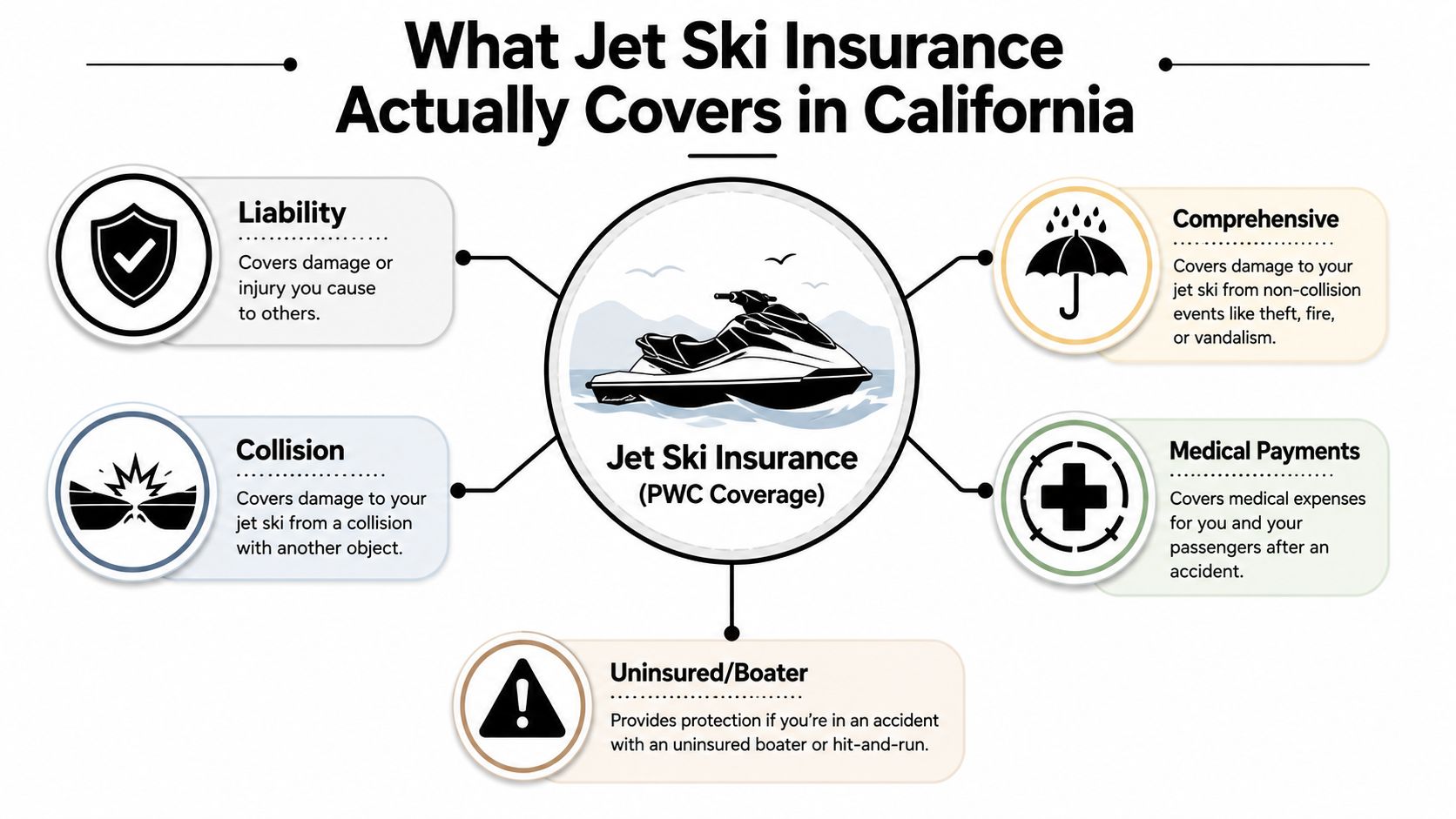
The coverage picture is easier to understand if you keep it scenario-based. If a rented craft clips a dock in Newport Beach, the liability part is the first place you look for third-party damage. If your own ski gets stolen off a trailer, the physical damage and theft protection matter more than liability. If someone gets hurt, the medical side of the policy is the line that can help with bills tied to the accident.
Why it stands apart from standard home and auto insurance
PWC insurance exists because the risk profile is different. A jet ski has its own value, its own launch and storage exposure, and its own liability pattern. That's why the policy is usually written as a separate marine-style product instead of being forced into a generic homeowners form.
California buyers should think in terms of asset-specific protection. If the craft is new, financed, or often kept where theft and dockside damage are real possibilities, a dedicated policy makes more sense than hoping a household policy will fill the gap. If you want a quick refresher on how these policies are commonly discussed alongside household coverage, the California home and auto FAQ is a useful place to compare the logic behind different insurance lines.
The Five Coverage Layers That Matter Most
A common mistake first-time buyers make is focusing only on the annual premium. The better question is which layer pays when the loss happens, because not all jet ski insurance responds to the same problem. A cheap policy that skips the wrong layer can cost far more after a claim than a richer policy ever would.
Liability and medical payments
Liability coverage is the part that pays for harm you cause to other people or their property. In California boating traffic, that can mean another rider, a dock, a buoy, or a moored vessel. Medical payments coverage helps with injuries to you or your passengers, regardless of fault, which is why it sits in a different bucket from liability.
If you ride in crowded water, liability deserves serious attention. Minimum limits may look fine on paper, but they can be thin once a collision turns into property damage and injury exposure. Medical payments is especially useful if you want a policy layer that works alongside health insurance instead of replacing it.
Collision, comprehensive, and uninsured boater protection
Collision coverage pays for damage to your own jet ski when you hit another object or craft. Full-coverage protection handles non-collision losses like theft, vandalism, fire, storm damage, and other physical damage events. Those are the two pieces that protect the machine itself, which is where the money usually sits.
Uninsured or underinsured boater coverage is the practical safety net when another operator causes injury or damage and doesn't have enough insurance to make it right. That can matter anywhere watercraft traffic is tight, because your loss doesn't care whether the other person made a smart insurance choice.
A policy with liability only can look affordable until the claim is about your own hull, your gear, or the other rider's lack of coverage.
How California incidents tend to map to coverage
A wake collision, a dock bump, or a trailer-related theft all point to different parts of the policy. That's why buyers should read the insuring agreement as a set of promises, not a single price tag. If you mainly want to avoid legal exposure, liability matters most. If you bought a newer ski or one with meaningful replacement value, collision and full-coverage are the pieces that keep the loss from landing on your bank account.
California Legal and Safety Requirements for Jet Skis
California doesn't require recreational owners to carry jet ski liability insurance statewide, but that doesn't mean the operating rules are loose. The state takes boating safety seriously, and local launch points can be stricter than people expect. If you ride in California, you need to separate state law, local marina rules, and insurance expectations in your head before you show up to launch.
What California expects from the operator
The operator side starts with age, education, and safety gear. California also treats sobriety on the water as a serious issue, so riding impaired is not a gray area. Life jackets are part of the basic operating standard, and the engine cut-off lanyard is a common safety expectation on PWCs because it helps stop the craft if the rider is separated from it.
Boating education cards matter too. First-time buyers often miss this because they focus on the machine, not the operator requirements. That's a mistake. If you're new to PWCs, get your operator documentation in order before you think about upgrades or accessories.
Where local insurance proof can show up
Local Harbor Departments and marinas can ask for proof of insurance before launch, and that's where California gets more practical than generic internet advice. Rules around Marina del Rey, San Diego, and Lake Tahoe can be more demanding than a basic state overview suggests, especially where facility policy, slip contracts, or launch conditions apply. In other words, the law may not force a PWC liability policy, but the place you want to use may.
If you've ever wondered what happens when a water emergency goes sideways, the right response is to plan before launch, not after. This drowning emergency guide is worth reading because it reinforces how fast a water incident can turn from a riding issue into a life safety issue.
Why insurance still belongs in the plan
Insurance isn't just about compliance, it's about keeping a one-bad-day event from becoming a personal lawsuit. California's boating environment rewards preparation, and a PWC policy does exactly that by sitting between a small mistake and a large financial loss. If you're launching from a marina, parking in a public lot, or storing the ski where theft is a concern, carrying the right coverage is the smart move.
How Much Jet Ski Insurance Costs in 2026
Most buyers ask the price question first, and they should. The important thing is to understand that jet ski insurance pricing isn't random. It moves with the machine, the coverage level, and whether you're insuring a personal toy or a commercial asset.
Personal owner pricing in plain English
Independent insurance guidance consistently puts many recreational owners in the $100 to $500 per year range, with liability-only coverage often starting around $100 to $150 annually and full coverage commonly running $200 to $400 or more depending on value, location, and use (Apex Insurance). Another pricing guide says liability-only policies are often around $100 to $150 per year, while full coverage is commonly around $300 to $500 annually, and high-performance models can exceed $800 (Mitchell Joseph).
A useful rule of thumb from the market is that full coverage often costs about 1.5% to 3% of the PWC's value per year (Apex Insurance). So a $10,000 jet ski may land around $150 to $300 annually, while a $20,000 high-performance model may run around $300 to $600. That's the cleanest way to think about it, the premium rises with replacement value and coverage breadth.
Commercial pricing is a different world
Commercial jet ski insurance is its own market because rental operators take on much heavier exposure. A recent market report says commercial rental operators spend between $6,200 and $24,500 annually for insurance, while larger fleet operators with 50+ units can pay about $38,000 to $125,000 per year (Market Intelo). That gap tells you everything you need to know about the difference between personal recreation and business use.
The same report estimates major carrier shares in this niche, with Progressive at 18.4%, GEICO at 14.7%, Allstate at 11.3%, and State Farm at 9.8% as of 2026 (Market Intelo). That concentration suggests the market is still fairly specialized, and the carriers that play here know they are underwriting real frequency and liability risk.
What moves the quote
Insurers don't price a PWC just because it exists. They look at the make, model, engine power, year, insured value, registration details, storage and launch location, and the operator's licence status before they quote (Turner Insurance). That means a higher-performance ski, a more expensive hull, or a riskier storage setup will usually cost more. The quote follows the machine's exposure profile, not just the owner's age or personality.
Bundling With Auto and Home for Real Discounts
The main California cost question isn't just whether to buy jet ski insurance. It's whether to buy it alone or fold it into the insurance structure you already have for your home and cars. That choice affects discounts, billing, and how cleanly claims are handled.
Standalone policy versus bundled policy
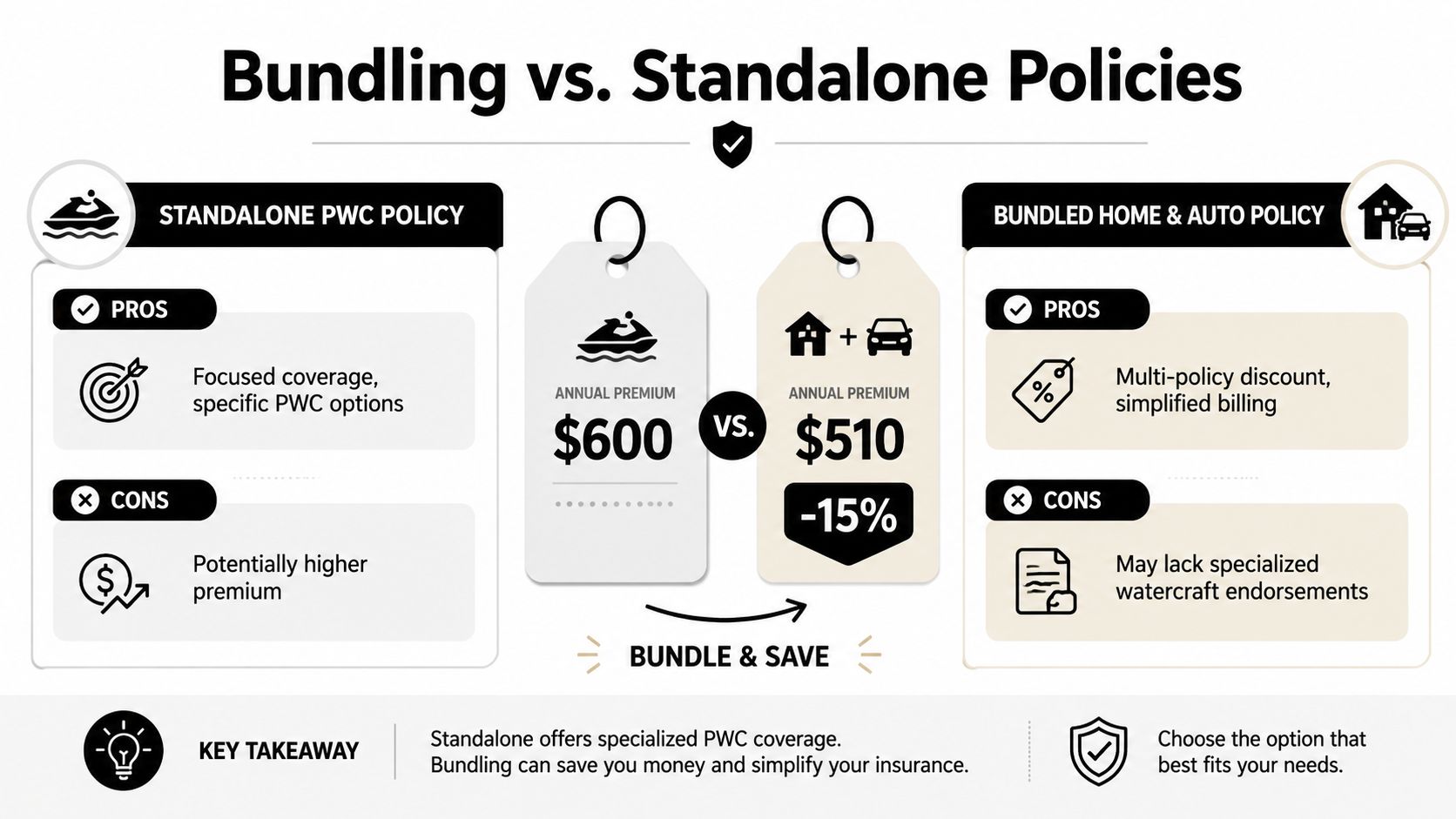
A standalone PWC policy gives you focused coverage with watercraft-specific options. That matters if the jet ski is new, high-value, financed, or used often enough that you want the policy built around the craft itself. The tradeoff is simple, standalone can be sharper on fit, but it may not be the cheapest route.
Bundling with home or auto can make more sense when you already have multiple policies in force. The commercial guidance on PWC pricing notes that multi-policy bundling can shave 10% to 20% off the bill in some setups, and insurers also market discounts for multiple PWCs and clean records (Insured by Ingram). That doesn't mean every bundle is better, it means the conversation should start with your whole household risk picture.
Where bundling wins, and where it doesn't
Bundling helps most when one carrier can see your auto insurance, home insurance, renters insurance, and life insurance in one household profile. That can simplify billing and make the overall account cleaner. It can also reduce the friction of having one carrier handle multiple claims relationships.
The downside is specialization. A bundled package may not automatically include the watercraft-specific endorsements you want, especially if your riding includes towing, trailer storage, or higher-risk use. So the smart move is to compare the package, not just the premium.
The cheapest premium is not always the best value. The right policy is the one that matches how you store, launch, tow, and ride the craft.
If you already carry California auto insurance, it's worth comparing the watercraft add-on against a standalone marine policy before you decide. A good starting point for that comparison is the California auto insurance resource, because the best jet ski decision often starts with the policies you already have.
What to Gather Before Requesting a Same-Day Quote
A fast quote depends on clean information. If you give the agent half the details, the quote slows down or comes back too vague to trust. A same-day request works best when you have the watercraft facts ready before the call.
The checklist that actually matters
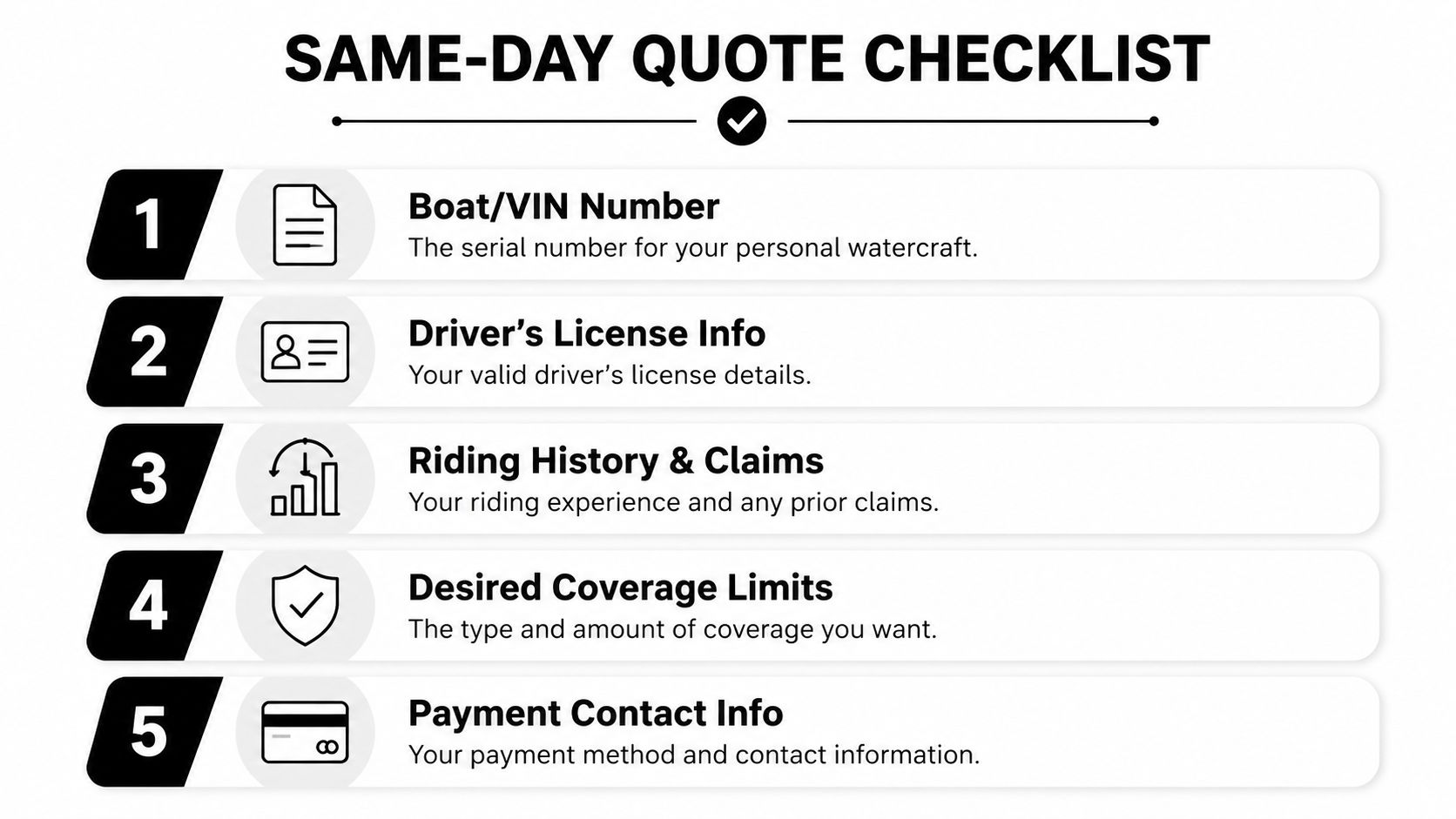
Gather these items before you ask for pricing:
- Make and model, because the insurer needs to know exactly what ski it is.
- Engine power and year, because performance and age affect risk.
- Hull identification number, because the policy has to identify the actual craft.
- Insured value, because replacement cost drives premium and coverage choice.
- Storage and launch ZIP codes, because location changes theft and accident exposure.
- Current registration, because the policy needs a valid ownership trail.
- Operator license status, because the insurer wants to know who is likely to ride.
- Prior claims history, because past losses help shape the quote.
Each of those details feeds underwriting. Leave one out, and the quote can be delayed or built on assumptions that don't match the craft you own. If you want a smooth same-day response, treat this like a quick file prep exercise, not a casual sales call.
How to ask for the quote
Most buyers can request a quote by phone, through an online form, or in person. If you want faster help, having the documents in front of you beats trying to piece things together from memory. The agency's broader quote tools and guidance are collected at the insurance guide hub, which is useful if you're comparing this purchase against other household coverage decisions too.
Common Exclusions and Claims Scenarios That Catch Owners Off Guard
Buyers often get burned. They assume the policy says “jet ski insurance,” so it must cover every normal way they use the craft. It doesn't. The exclusions are usually the difference between a helpful policy and an expensive surprise.
Towing, racing, and commercial use
Policies may exclude racing and towing, which means common recreational behavior can fall outside the promise if you never checked the fine print. If you tow a rider, pull a tube, or use the ski in any organized event, ask whether that use is endorsed. Don't guess.
Commercial use is an even bigger line to respect. A personal policy is built for personal recreation, not rental income. If the ski is being used for business, it needs to be under a commercial structure or the claim can get ugly fast.
Trailer damage, theft, and storage issues
A separately insured trailer can create a coverage split people don't expect. The jet ski policy may not automatically solve trailer damage, and your auto policy won't magically turn into hull coverage just because the ski is attached to the back of the truck. Theft can also turn on where and how the craft was stored, especially if it was left on an open trailer or in an unsecured area.
Saltwater use and agreed territory limits can matter too. If the policy is written around a specific usage profile, pushing outside that profile can create a coverage dispute when a loss happens. That's why the storage and launch questions matter during quoting.
Read exclusions before you read the price. The premium only matters after you know what the policy is refusing to touch.
The fix is straightforward. Add a towing endorsement if that's part of how you ride, ask about trailer coverage if the trailer has its own value, and make sure commercial use is separated from personal recreation. That's the kind of detail work that prevents a claim denial later.
Getting a California Jet Ski Insurance Quote From Mai & Associates
If you want a clean, apples-to-apples comparison, ask for a quote the same way you'd shop auto or home coverage, with all the facts on the table. Mai & Associates gives California buyers a straightforward path to compare carriers and check whether the jet ski belongs on its own policy or inside a broader household package.
How to request the quote
You can start by phone, online, or in person at the Glendale, Westlake Village, Escondido, or Costa Mesa offices. The agency says clients can expect a 24-hour response, and that speed matters when you're trying to get the craft insured before the weekend.
If you also carry home, renters, auto, or life insurance, bring those details into the conversation. That's how you find out whether bundling helps, or whether the PWC needs a separate structure because of how you store or use it. Multilingual support in English, Spanish, Armenian, Russian, and Vietnamese also makes the process smoother for California households that don't want to fight through a language barrier.
What to expect from the quote process
The agency compares rates from multiple top-rated carriers, so you're not stuck with one carrier's answer. That's useful for owners who want to see whether a bundle, a standalone marine policy, or a higher-deductible structure gives the best fit. If you're already comparing coverage options online, the fastest next step is to use the online quote request and have your PWC details ready.

Mai & Associates helps California riders compare jet ski insurance with home, auto, renters, and life coverage so the policy fits the whole household, not just the watercraft. If you want a straight answer on pricing, exclusions, and bundling, visit Mai & Associates and ask for a California quote that matches how you store and use your jet ski.