Is Insurance Cheaper for Older Cars? Discover Why.
Many drivers hear one rule about car insurance: older car equals cheaper insurance.
That rule is often true, but it is not always true in California. A ten-year-old sedan can cost less to insure because it is worth less. An older SUV missing newer safety features can cost more than expected. An older EV can break the usual pattern entirely.
California drivers also deal with factors that national advice often skips. Theft patterns vary by city. Coverage for non-collision events can be shaped by local risks such as wildfire exposure. Bundling auto with home, renters, or life insurance can change the math for the whole household, not just one vehicle.
If you are sorting through coverage options, deductibles, and whether keeping full coverage still makes sense, this guide is for you. If you own an EV, it also helps to understand how gap coverage works in the broader market. This overview of Gap Insurance for Electric Vehicles is useful background reading because depreciation and payout rules do not always line up the way drivers expect.
The Simple Answer and a More Detailed Answer
The simple answer to is insurance cheaper for older cars is yes, often.
A more useful answer is: Older cars are usually cheaper to insure because they are worth less to replace, but age alone does not control the price. Safety equipment, repair costs, theft risk, local claims patterns, and the kind of coverage you keep all matter.
In California, drivers often find challenges here. A basic older commuter in one ZIP code may be inexpensive to insure. A similar older car in Glendale or another theft-sensitive area may not feel cheap at all. A driver in a wildfire-prone area may also notice pricing for non-collision events behaves differently than expected, because this type of coverage handles events beyond crashes, including theft and certain environmental losses.
Why the common advice falls short
The usual internet advice says, “Buy an older car and save on insurance.”
That leaves out two important questions:
- What kind of older car is it
- What coverage are you still carrying
If the vehicle is old but expensive to repair, the savings may be limited. If it lacks newer crash-avoidance features, the insurer may view it as riskier. If you are still paying for collision and protection against theft, vandalism, and other non-crash losses on a low-value car, you may be overinsuring it.
Key takeaway: Car age matters, but vehicle value, local risk, and coverage choices matter more.
California drivers need a local lens
A California policy is not priced in a vacuum. Your city, garaging address, daily mileage, and claim environment all shape the premium.
That is why broad advice from a national blog can miss the point. A household comparing policies in Glendale, Westlake Village, Escondido, or Costa Mesa may need to think about theft, wildfire exposure, commute patterns, and whether bundling auto with homeowners, renters, or life insurance creates better overall value.
If you want a California-specific starting point, this overview of auto insurance in California gives useful local context before you start comparing policy details.
How Vehicle Value Drives Down Your Premium
The biggest reason older cars often cost less to insure is vehicle value.
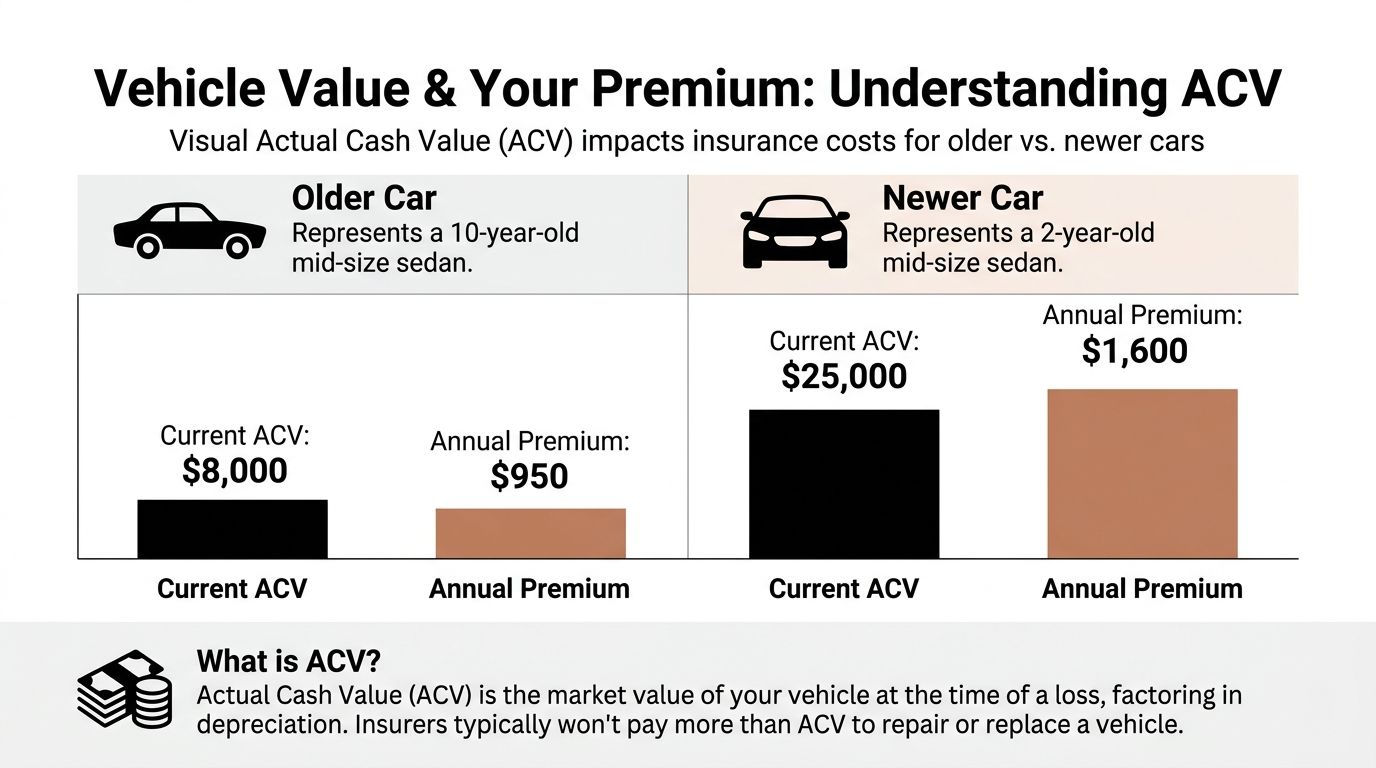
Insurance companies care a lot about what they may have to pay after a covered loss. If your car is totaled, the insurer is usually looking at the car’s Actual Cash Value, often shortened to ACV. That means the current market value of the vehicle at the time of the loss, not what you paid for it years ago.
ACV in plain English
Think about smartphones.
Insuring a brand-new phone is expensive because replacing it costs more. Insuring a phone that is several years old is different. If it breaks beyond repair, the replacement cost is much lower. Cars work the same way.
Your insurer does not look at your car and ask, “How much did this owner love it?” The insurer asks, “What is this vehicle worth in the market today?”
That is ACV.
Why older cars usually cost less to insure
As a car ages, it usually depreciates. That lowers the insurer’s potential payout for collision claims and claims for other non-crash incidents.
According to Progressive’s explanation of whether older cars are cheaper to insure, insurance premiums for older cars are typically 20-40% lower than for new vehicles due to vehicle depreciation and reduced replacement costs. The same source gives a simple example of a car depreciating from $30,000 when new to $4,000 at 10+ years old, which reduces the insurer’s exposure on collision claims and claims for other non-crash incidents.
Where that savings shows up
Not every part of your premium falls just because your car gets older.
The drop usually shows up most clearly in the parts of the policy that pay for damage to your own vehicle, such as:
- Collision coverage for damage from crashes
- Coverage for theft, vandalism, falling objects, and other non-collision losses
If your car is worth far less than it used to be, those coverages become less expensive because the insurer is not protecting a high-value asset anymore.
A quick example
A newer car and an older car can both be driven by careful people.
But if both are totaled, the insurer likely pays much more for the newer one under collision or coverage for other perils.
This core idea explains why the question is insurance cheaper for older cars often gets answered with yes. The value has dropped, so the insurer’s financial exposure has dropped too.
Think of ACV as resale value with insurance consequences. The lower that value goes, the less expensive full coverage often becomes.
For more plain-language insurance explainers, the California insurance guides page is a helpful reference.
When an Older Car Can Cost You More
An older car is not automatically a bargain to insure.
Some older vehicles flatten out in price. Some even get more expensive than drivers expect. In California, that surprise often comes from three places: weaker safety tech, harder-to-find parts, and theft exposure.
Missing safety features changes the risk
A newer car often comes with systems that help drivers avoid crashes or reduce the severity of one. Older vehicles may not.
According to this report on older cars being cheaper to insure but carrying higher risks, older vehicles aged 10+ years show a 12-18% higher accident claim likelihood because they often lack features such as Automatic Emergency Braking (AEB) and Electronic Stability Control (ESC). The same report notes that rates can plateau or rise 5-10% beyond 15 years in major markets like California.
That sounds backward until you look at it from the insurer’s side. A cheaper car is still being driven on the same roads. If it is more likely to be involved in a claim, the insurer does not focus only on the lower value of the vehicle.
Some old parts are cheap. Some are a headache.
Drivers often assume older cars are always cheaper to repair because they have less technology.
Sometimes that is true. Sometimes it is not.
A common problem is parts scarcity. If a model is older, niche, or not widely supported anymore, a body shop may spend longer locating components. That can push claim costs up. In a practical sense, an old fender or module can become more troublesome than a newer part that is readily available through standard repair channels.
Theft risk can be very local
California drivers know that one ZIP code does not behave like another.
A vehicle that seems inexpensive to insure in one city may cost more in another because claims for other perils reflect local patterns. In places where certain older models are targeted more often, carriers may price that risk into the premium. Glendale drivers often notice that model choice matters more than expected, especially with commonly stolen vehicles or cars with parts that are easy to resell.
Wildfire exposure can shape pricing for non-collision perils too. If your car is garaged in an area with elevated wildfire risk, coverage for non-collision perils may not feel as low as the car’s age would suggest.
Classic cars are a separate category
This is the exception that works in your favor.
A true classic car is not just an old daily driver. It is usually a vehicle 20+ years old with collectible value and limited use. Those cars often qualify for specialty insurance that works differently from standard auto coverage.
That is why a well-kept collector car stored in a garage can sometimes insure for less than a regular commuter, even if the classic itself is valuable.
A better question to ask
Instead of asking only, “How old is the car?” ask these:
- Does it have modern safety equipment
- Are replacement parts easy to get
- Is it frequently stolen in my area
- Am I insuring it like a daily driver or a limited-use vehicle
If you want quick answers to common coverage questions before changing a policy, the insurance FAQ page is a useful checkpoint.
Deconstructing Your Policy Liability vs Full Coverage
Many drivers look at a premium as one lump number.
That makes it hard to tell whether an older car should be cheaper to insure. A better approach is to break the policy into parts.
Liability covers other people’s losses
If you cause an accident, liability coverage pays for injuries or damage you cause to others, up to your policy limits.
That cost does not depend much on whether you drive a brand-new sedan or an older one. If you rear-end someone in Westlake Village, the insurer still looks at the damage and injuries you caused. Your car being older does not magically make that liability claim smaller.
This point often complicates matters for California drivers. They expect the whole premium to drop because the car is older. But the liability portion may stay relatively steady because your potential to harm someone else on the road is still there.
Full coverage includes the part tied to your car’s value
When people say full coverage, they usually mean liability plus collision and coverage for theft, vandalism, and other non-crash events.
Those last two pieces are the ones most connected to your car’s own value. If the car is old and worth much less, they become the first place to review for savings.
According to The Zebra’s discussion of whether old cars are cheaper to insure, vehicles 10 years or older are often overinsured with coverage for non-crash perils or collision coverage relative to their worth, which is typically under $4,000. The same source says switching to liability-only can reduce premiums significantly, sometimes halving costs.
Tip: If your car’s value is low, do not ask only, “What is my premium?” Ask, “What is the insurer promising to pay me at most?”
A side-by-side example in plain language
Take two drivers with similar records.
One drives a 2026 sedan. The other drives a 2012 sedan. If both drivers cause the same accident, the liability claim may look similar. But if both cars are totaled, the insurer likely pays much more for the newer one under collision or protection for other perils.
That is why an older car can have a premium that is lower, but not dramatically lower. One part of the policy shrinks. Another part may barely move.
A simple comparison
| Policy part | What it pays for | Does car age matter much |
|---|---|---|
| Liability | Damage or injuries you cause others | Usually less |
| Collision | Damage to your car from a crash | Usually more |
| Protection for other perils | Theft, vandalism, fire, falling objects, other non-collision losses | Usually more |
The practical meaning for California drivers
If you carry full coverage on an older vehicle, you may be paying for protection that no longer matches the car’s value.
That does not mean everyone should drop it. If you cannot comfortably replace the car after a total loss, keeping it may still make sense. But the decision should be deliberate, not automatic.
Smart Strategies to Lower Your Older Car's Insurance
Saving money on an older car is less about finding a secret discount and more about matching the policy to the car you own.
A low-value commuter should not always be insured like a newer financed vehicle. A garage-kept collector should not always be insured like a daily driver. A California household with auto, home, renters, and life insurance should also look at the total insurance picture, not each policy in isolation.
Use the 10 percent rule as a gut check
One useful benchmark appears in the verified guidance above: consider dropping collision when the annual premium exceeds 10% of the car’s ACV.
This is not a law. It is a decision tool.
If your car’s value is modest and your annual cost for collision and protection against other perils feels high relative to that value, review whether those coverages still make financial sense. The question is simple: if the car were totaled tomorrow, would the payout meaningfully help you after the deductible?
Raise deductibles carefully
A higher deductible usually lowers the premium.
That tradeoff works best when you have enough cash set aside to absorb the larger out-of-pocket cost after a claim. If raising the deductible saves money but leaves you unable to handle a repair bill, the savings are not really savings.
Ask whether usage changes the risk
Some older cars are not daily commuters anymore.
They are second cars, neighborhood cars, or weekend-only vehicles. If your mileage is low, make sure your insurer has the right picture of how the vehicle is used. In California, limited use can matter, especially if the car spends more time in the garage than on the freeway.
Look at bundling across the household
This is one of the most overlooked savings tools.
If you carry auto insurance, home insurance, renters insurance, or life insurance, bundling may lower the combined cost and simplify renewals. It also helps households avoid gaps where one policy assumes another policy covers something that it does not.
For California homeowners in wildfire-prone areas, this bigger-picture review matters even more. A car policy, a homeowners policy, and any supplemental property coverage should work together, not sit in separate silos with conflicting assumptions.
Practical advice: Review your entire insurance setup once a year, especially after moving, paying off a car, adding a driver, or switching from renting to owning.
See if the car qualifies for classic coverage
Here, some owners can find substantial savings.
According to this explanation of why classic car insurance can be more affordable, classic cars that are typically 20+ years old can qualify for policies that are 30-43% cheaper than standard auto insurance, with average premiums of $400-$600 annually. These policies usually depend on limited mileage under 5,000 miles per year and secure storage.
That means a 25-year-old collector car may deserve a completely different policy conversation than a 25-year-old commuter sedan.
A simple cost-benefit table
| Coverage Level | Annual Premium | Deductible | Maximum Payout (ACV - Deductible) | Verdict |
|---|---|---|---|---|
| Liability-only | Lower than full coverage | Not applicable to damage to your own car | $0 for your own vehicle | Often worth considering for a low-value car you could replace yourself |
| Full coverage on a low-value older car | Higher than liability-only | Your chosen deductible | Limited by the car’s depreciated value | Review closely if the payout would be modest after deductible |
| Classic car policy | Varies by eligibility | Varies by policy | Based on specialty policy terms | Strong option if the vehicle qualifies and use is limited |
For more consumer-focused insurance reads, you can browse the California insurance blog.
The Future Is Here Older EVs and Insurance Costs
Older gas cars often follow the familiar pattern. They depreciate, and insurance often gets cheaper.
Older EVs can break that pattern.

Why older EVs do not always get cheaper to insure
The issue is repair economics, especially around batteries and specialized parts.
According to Bankrate’s review of insurance for older cars, emerging 2025-2026 data shows older EVs aged 5-10 years can have up to 40% higher repair costs due to battery sourcing issues, and parts scarcity drives claims up 25%. That can keep premiums elevated even after the vehicle itself has depreciated.
This is especially relevant in California, where EV adoption is high and more drivers are now insuring first-generation or early-model electric vehicles as they age.
The California angle matters
A driver may assume a 2018 or 2020 EV should now insure like any other older car.
That assumption can fail fast. If battery-related repairs are expensive or difficult to source, the insurer may still see a costly risk for non-crash perils or collision. Add in the fact that some older EVs lack the newest safety systems, and the premium may not fall the way a gasoline sedan’s premium might.
The usual “drop full coverage” advice needs more care here
With an older gas car, the math can be straightforward.
With an older EV, the repair bill can be unusual enough that you should pause before applying generic used-car advice. The car may have depreciated, but one major component can still drive claim severity in a way that surprises owners.
If you want a broader consumer-friendly overview of how insurers think about EV pricing, this guide on decoding electric car insurance costs adds helpful context.
Bottom line: If you drive an older EV in California, do not assume age alone makes the policy cheap. Check battery-related repair realities, deductible choices, and whether your current coverage still fits the vehicle’s real-world risk.
If you want help reviewing an older car policy, comparing quotes across carriers, or seeing whether bundling auto with home, renters, or life insurance lowers your total cost, Mai & Associates can help you evaluate your options across California with a no-pressure quote review.