Is Earthquake Insurance Worth It in California?

California earthquake insurance reached only 12.71% uptake in 2022, so most homeowners and renters went without it. In practical terms, coverage often costs from the high hundreds to roughly $1,400 per year, but the percentage deductible can matter far more than the premium.
That's why the question “is earthquake insurance worth it?” can't be answered by looking at the annual bill alone. You need to know what your standard home insurance or renters insurance excludes, how much cash you'd need after a loss, and whether you could handle temporary housing, damaged belongings, and repairs while waiting for a claim.
For California households, earthquake insurance is usually a catastrophic-loss tool, not a policy designed to pay for every crack or minor repair. The right decision depends on your home's construction, location, coverage limit, available savings, and tolerance for a large out-of-pocket loss.
Why Most California Homes Go Without Earthquake Coverage
California's earthquake-insurance uptake rate was 12.71% in 2022, according to the state insurance department's annual data call, and the rate hasn't exceeded 16% since 2002 (CREW's earthquake insurance survey). That leaves roughly 84% to 87% of insured California homeowners and renters without dedicated earthquake coverage, despite living in one of the world's most seismically exposed residential insurance markets.
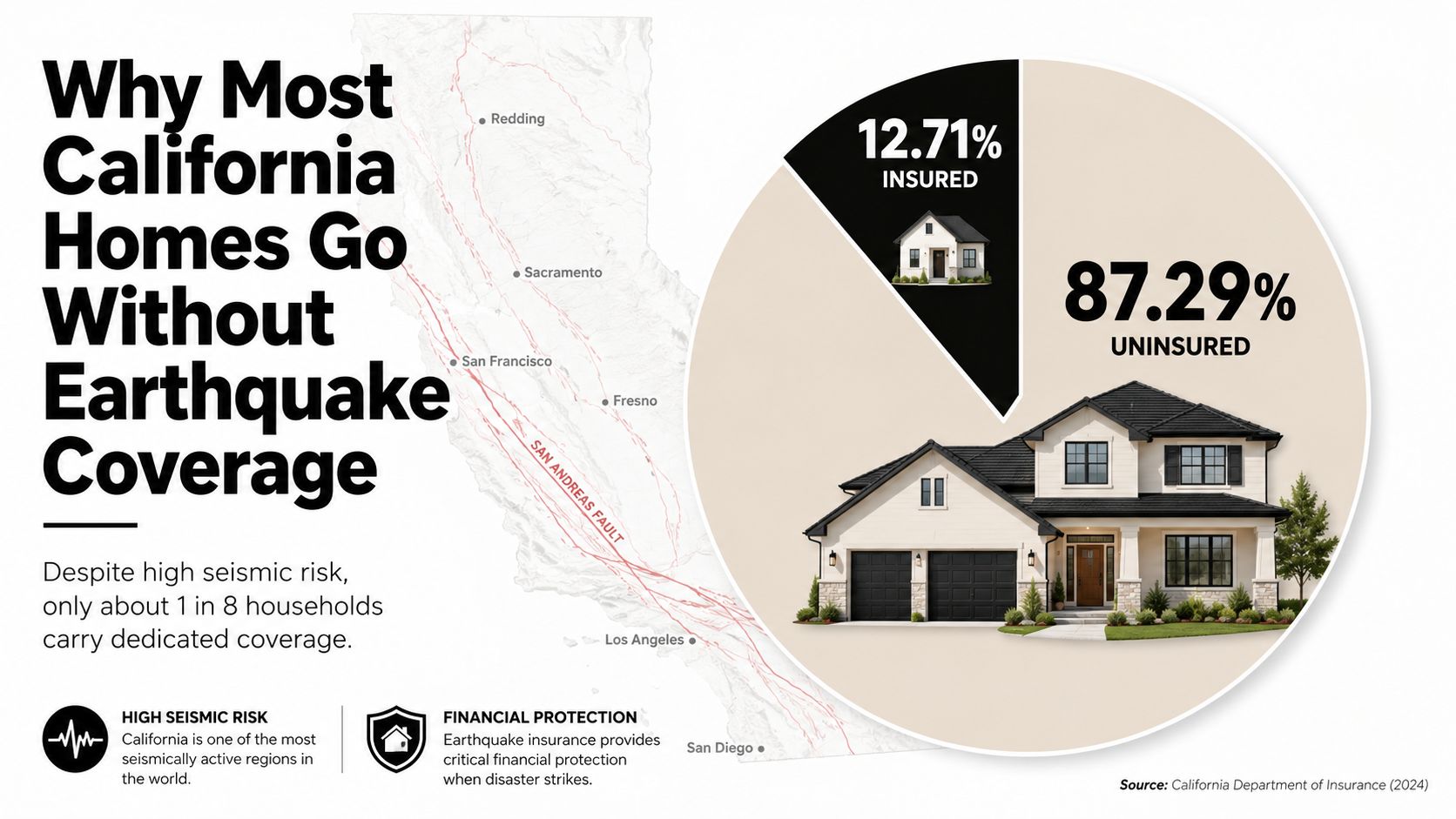
That low participation rate isn't random. Many households see the premium as expensive, while others assume an earthquake is too infrequent to justify buying coverage. The more important issue is that earthquake policies commonly carry percentage-based deductibles, so buyers may pay a meaningful annual premium and still need substantial cash before the insurer contributes to covered repairs.
The market exists, but most people still opt out
The California Earthquake Authority writes about two-thirds of the state's residential earthquake policies, which shows that California has an organized market for this specific protection (CREW's survey). Standard homeowners insurance generally excludes earthquake damage, so the CEA and private insurers fill a gap that a conventional home policy leaves open.
The puzzle isn't whether earthquake risk exists. It's whether a household wants to transfer a potentially severe financial loss when the policy's deductible may still be large. A homeowner with substantial liquid assets may reasonably choose to self-insure. A family with limited savings, a large mortgage, or little flexibility after displacement may reach the opposite conclusion.
Practical rule: Don't judge earthquake insurance by the premium alone. Judge it by the loss you couldn't comfortably fund yourself.
Use four questions to make the decision:
- Coverage: What damage to the structure, belongings, or temporary housing would otherwise be excluded?
- Cost: What annual premium fits your budget without weakening essential auto insurance, home insurance, renters insurance, or life insurance?
- Deductible exposure: How much cash would you need before the earthquake policy starts paying?
- Personal capacity: Could you handle repairs, relocation, and delayed claim payments after a major event?
That framework separates a deliberate decision from a common assumption that “nothing is covered” because the policy feels expensive.
What Earthquake Insurance Covers
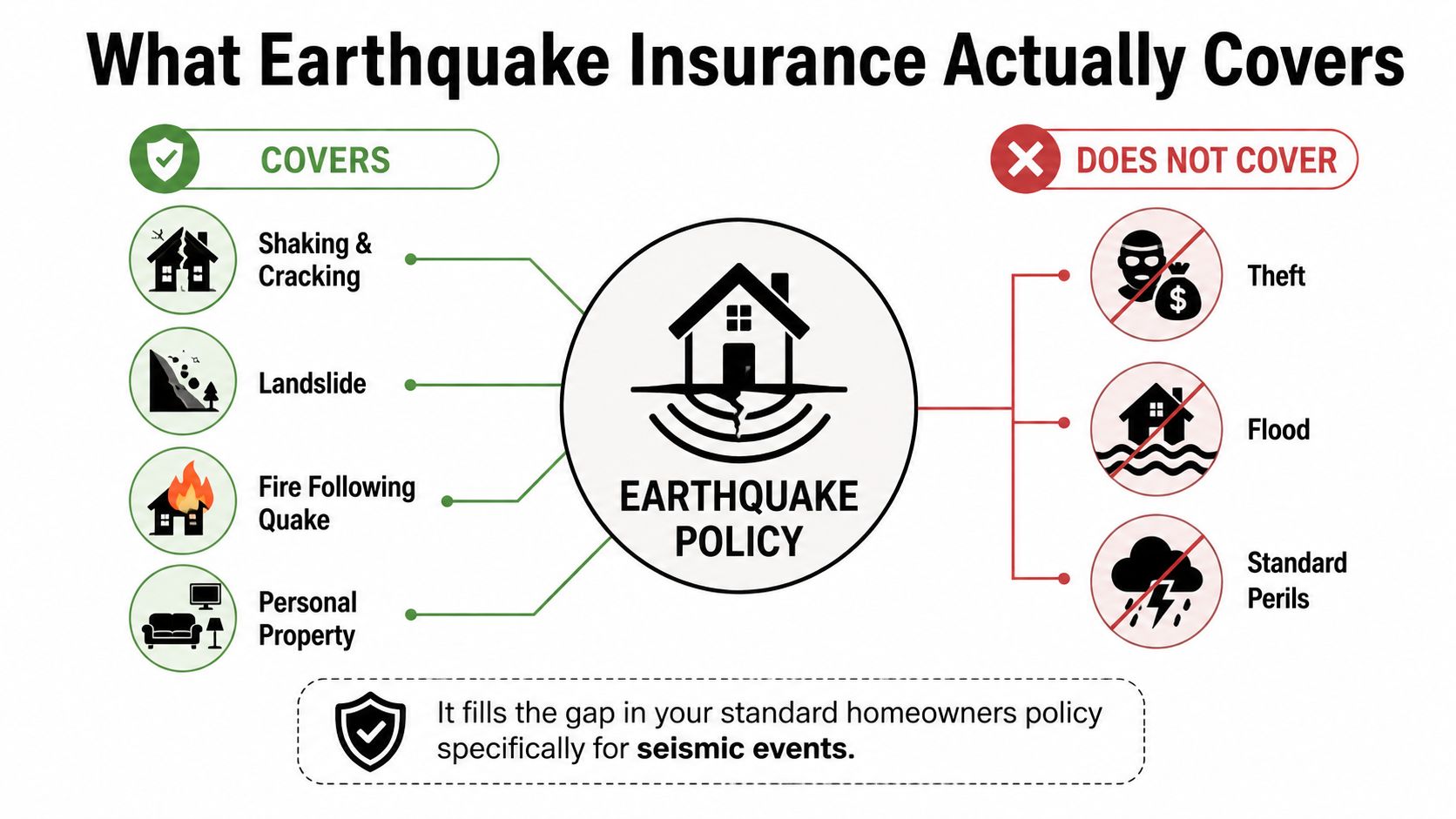
Earthquake insurance fills a gap left by standard homeowners and renters policies, which commonly exclude damage caused by earthquake shaking. The protection still depends on the policy's limits, exclusions, and deductible.
What the data shows about participation
For homeowners, the main insured property is usually the dwelling, including the house and attached structures such as a garage. Depending on the insurer and policy form, coverage may also include detached structures, personal belongings, debris removal, emergency repairs, building-code upgrades, and additional living expenses. Read the declarations page. A sales summary does not define the claim.
Renters face a different exposure. They do not insure the building, because the landlord or property owner handles that responsibility. Their losses can still include furniture, electronics, clothing, household goods, and temporary housing if the unit becomes uninhabitable.
The National Association of Insurance Commissioners reported that 43.4% of homeowners and 67.6% of renters in a 2024 to 2025 multi-state survey did not know earthquakes were excluded from standard homeowners or renters policies. Only 35.1% of homeowners and 9.2% of renters reported having earthquake insurance (NAIC earthquake protection-gap materials).
Renters remain an overlooked audience. A renters policy may cover personal property and liability, yet it generally does not automatically cover belongings damaged by earthquake shaking. Renters earthquake coverage may also include loss of use, helping pay for temporary housing while repairs are underway.
Common exclusions and claim boundaries
Earthquake insurance does not cover every consequence of a seismic event. Review these boundaries before choosing a policy:
- Vehicles: Check auto insurance for earthquake-related vehicle damage.
- Flood: Earthquake-triggered flooding requires separate flood coverage.
- Land and landscaping: Soil movement, land restoration, trees, and landscaping may have limited protection or require separate coverage.
- Standard perils: Fire following an earthquake may fall under a standard homeowners or renters policy, depending on the circumstances.
- Theft: Theft is a separate peril and generally remains subject to the applicable property policy.
Aftershocks need specific attention. An insurer may treat aftershock damage as part of the original earthquake event instead of opening a separate claim with a new deductible. Ask how the policy defines an earthquake occurrence before buying.
For claim-preparation guidance, review these restoration coverage tips for property owners before a disaster reveals gaps between policy language and the repair process.
How Premiums and Percentage Deductibles Actually Work
The premium gets attention because it appears on the quote. The deductible deserves more attention because it determines whether you can access the coverage after damage occurs.
Industry guidance places standard earthquake deductibles at 2% to 20%, while California Earthquake Authority options commonly range from 5% to 25%. These percentages apply to the insured dwelling limit, not to the repair invoice (Adjusters International's earthquake insurance guidance).
A $400,000 dwelling limit with a 15% deductible creates $60,000 of out-of-pocket exposure before the policy pays for covered damage. A $1,000,000 dwelling limit at the same percentage creates $150,000 of exposure. The repair bill might be much higher, but the deductible is calculated from the insured dwelling limit.
The math buyers should see before accepting a quote
| Dwelling Limit | 5% Deductible | 10% Deductible | 15% Deductible | 25% Deductible |
|---|---|---|---|---|
| $400,000 | $20,000 | $40,000 | $60,000 | $100,000 |
| $1,000,000 | $50,000 | $100,000 | $150,000 | $250,000 |
These calculations show why a lower premium isn't automatically a better deal. Choosing a higher deductible can reduce the annual price, but it also moves more risk onto your household. If the deductible would force you to sell investments, borrow heavily, or delay essential repairs, the lower premium may be buying a policy you can't comfortably use.
California premiums vary by location, rebuilding cost, construction type, selected coverage, and deductible. Retrofitting, foundation type, home age, and the carrier's underwriting rules can also affect the quote. Recent California premium summaries place many annual premiums in the high hundreds to roughly $1,400, but a statewide range isn't a substitute for a property-specific quote (California Department of Insurance earthquake premium summary).
A useful way to compare proposals is to record the premium and deductible side by side. You can also use the California insurance glossary when a quote uses terms such as dwelling limit, replacement cost, loss of use, or actual cash value.
The clear recommendation is this: don't buy earthquake insurance until you know the exact dollar deductible. A premium in the high hundreds can sound manageable, but the policy may still require tens of thousands of dollars before payment begins.
Standalone Policy vs Homeowners Endorsement
California homeowners generally choose earthquake protection through a standalone policy or an endorsement attached to an existing homeowners policy. The central comparison is not just convenience or price. It is the coverage available, the percentage deductible, and the cash your household would need after a loss.
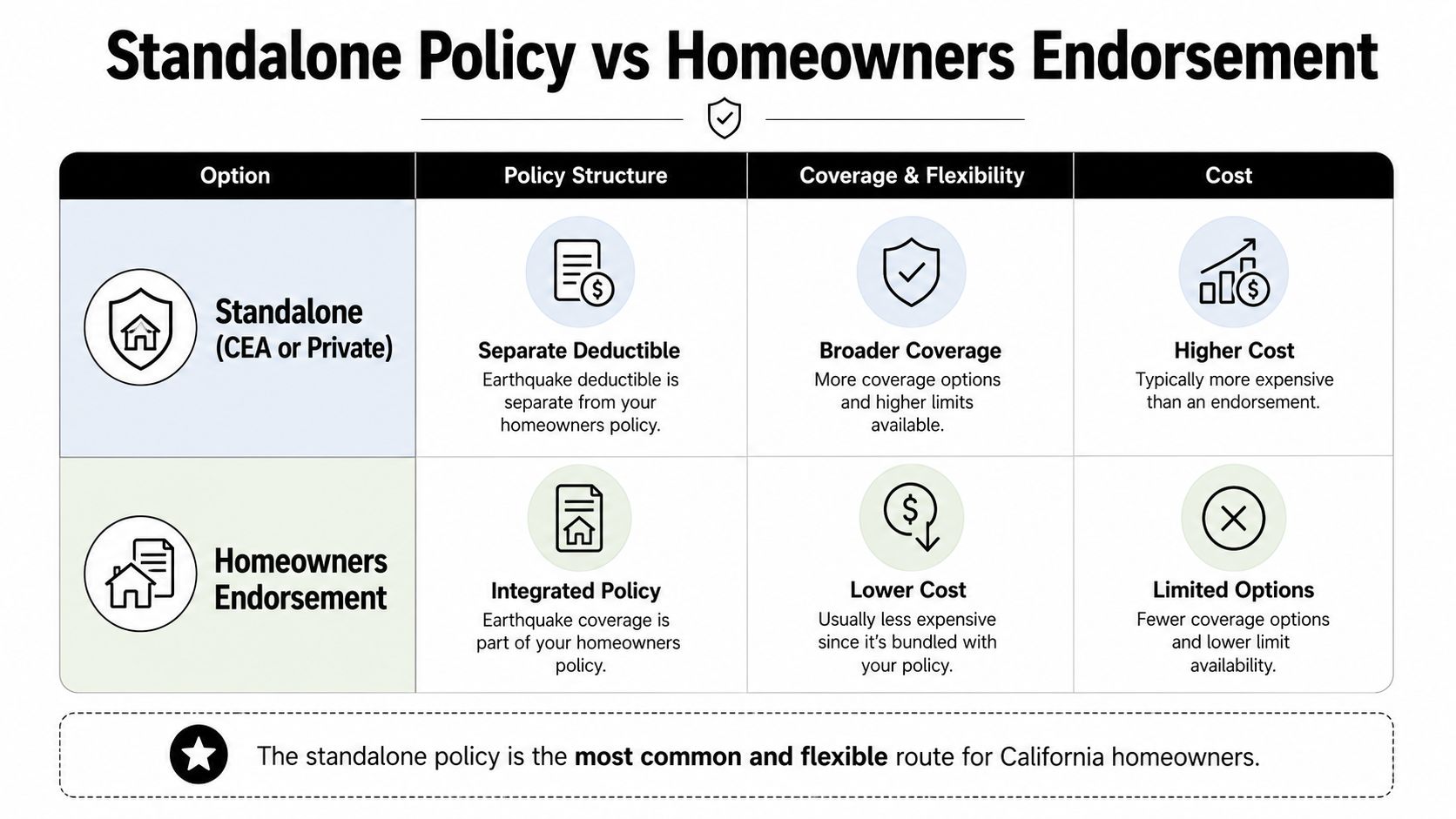
A standalone policy from the California Earthquake Authority or a private carrier creates a separate bill and deductible. It may provide more flexibility for personal property, loss of use, dwelling limits, and optional coverages. Renters should not overlook this route. A standalone policy can address belongings and temporary living expenses even when the renter does not insure the building itself.
An endorsement keeps earthquake protection with the homeowners policy. Billing and policy management are simpler, but availability and coverage vary by carrier and ZIP code. Some endorsements offer narrower choices, so read the form rather than assuming the attached coverage matches a standalone policy.
Compare coverage structure and deductible exposure
| Feature | Standalone policy | Homeowners endorsement |
|---|---|---|
| Policy structure | Separate earthquake contract | Added to the existing homeowners policy |
| Deductible | Usually separately stated and percentage-based | Usually separately stated and percentage-based |
| Coverage options | Often broader or more configurable | May have more limited options |
| Billing | Separate earthquake premium | Integrated with the home policy |
| Availability | CEA and private-market options | Depends on the homeowners carrier and location |
| Best fit | Buyers who want flexibility | Buyers who prioritize simpler administration |
California's deductible rules can narrow the choice. For homes over $1 million, or pre-1980 raised-foundation homes without verified retrofit, the lowest available earthquake deductible under CEA rules is 15% (California Earthquake Authority coverage and deductibles).
That percentage determines the household's initial exposure. If the required cash would be unmanageable, comparing a CEA policy with an endorsement will not solve the problem. The practical choices are accepting the minimum deductible, completing qualifying structural work, or self-insuring.
Retrofitting may improve the property's risk profile and can qualify an older home for discounts of up to 25% when properly completed and documented. Gather permits, engineering records, and retrofit documentation before requesting quotes. A review of California home insurance options can help compare earthquake protection with the underlying homeowners policy. Choose based on the coverage form and exact dollar deductible, not the carrier label.
Reframing the Worth-It Question Around Liquidity
Many buyers ask whether the expected claim value justifies the premium. That approach sounds rational, but it misses the financial emergency an earthquake creates. The more useful question is: Can your household fund the deductible and remain stable while repairs or relocation continue?
On a $1,000,000 dwelling limit, a 15% deductible equals $150,000 before earthquake coverage begins (California's probable maximum loss report). A household can have strong income and substantial home equity yet still struggle to produce that amount in cash. Home equity isn't the same as available liquidity, especially after a disaster disrupts employment, transportation, banking access, or rental availability.
Insurance protects timing as well as property
Earthquake coverage isn't only about receiving a reimbursement for structural repairs. Loss-of-use coverage may help with temporary housing and related living expenses, subject to the policy limit and terms. That matters because a household may need to pay for a hotel, rental, meals, storage, transportation, and other expenses before the home is ready to occupy.
A policy can also protect a household from having to liquidate investments at an unfavorable time or take on debt after a loss. It won't eliminate the deductible, and it won't make every excluded item payable. It can, however, transfer the portion of a catastrophic loss that would otherwise overwhelm the family balance sheet.
The same liquidity issue appears in ordinary home insurance claims. The California Department of Insurance explains that replacement cost coverage pays to repair or replace covered property without subtracting depreciation, while actual cash value subtracts depreciation from the claim payment (California Department of Insurance guidance on replacement cost and actual cash value). A household that hasn't checked this distinction may discover that the broader insurance program pays less than expected even when the claim is covered.
Ask this before buying: If the earthquake deductible were due tomorrow, where would the money come from without sacrificing housing, medical care, transportation, or family obligations?
My recommendation is straightforward. If you can't comfortably fund the deductible and several months of disruption, earthquake insurance deserves serious consideration, even when the annual premium feels inefficient. If you can absorb the deductible, maintain a separate reserve, and accept the possibility of paying for an uncovered loss, self-insuring can be a defensible choice.
FEMA Grants, Emergency Funds, and Retrofit Alternatives
FEMA assistance, savings, and retrofitting each solve a different problem. None should be treated as a complete substitute for earthquake insurance.
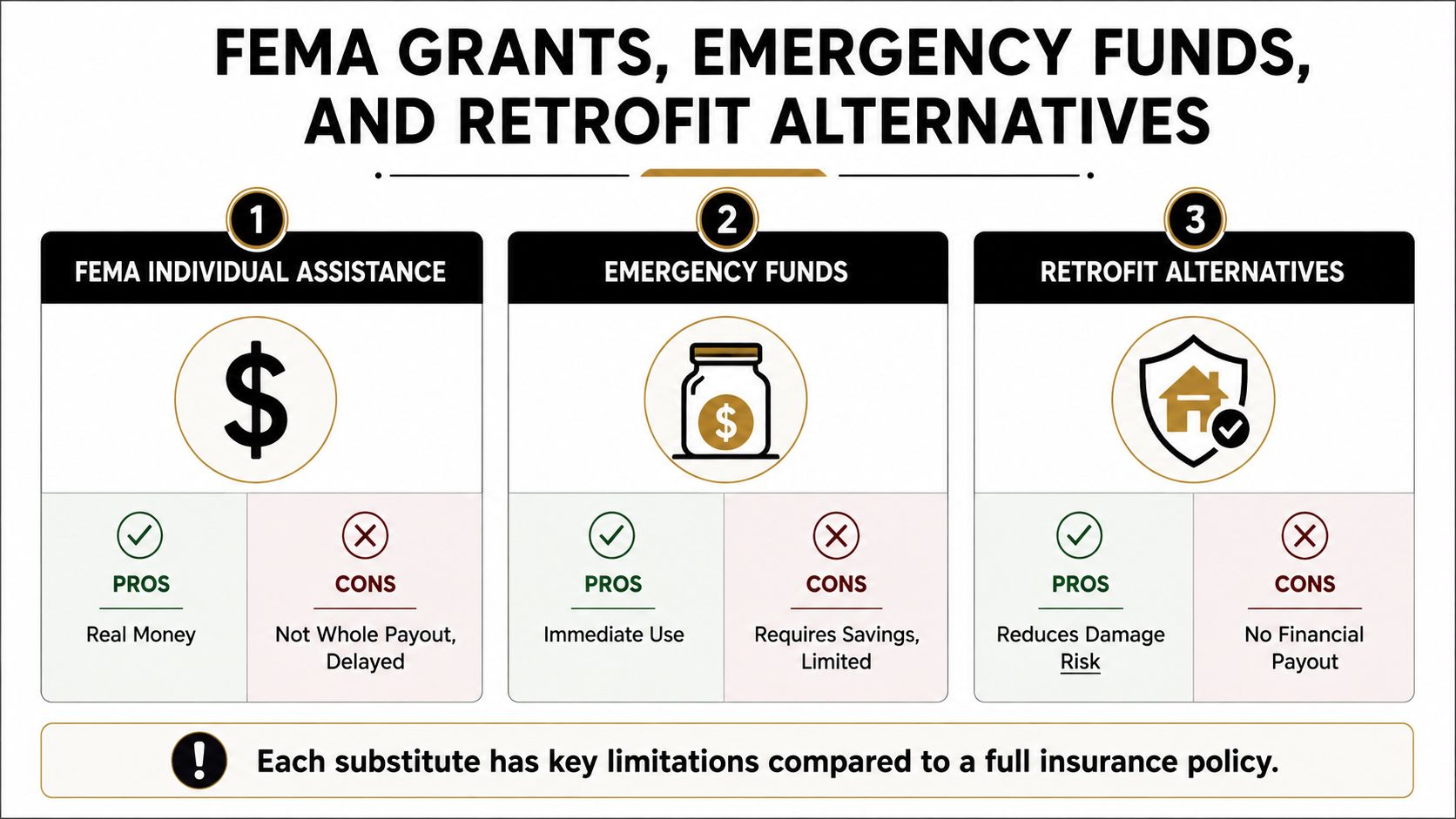
FEMA Individual Assistance can provide meaningful support after an eligible event, but it isn't designed to make a household financially whole. Assistance depends on a federal disaster declaration, eligibility requirements, and the type of loss documented. It can help with immediate needs, but it shouldn't be your rebuilding plan.
An emergency fund gives you immediate control. You can use it for temporary housing, emergency repairs, transportation, deductibles, and replacement belongings without waiting for an insurer or government agency. The weakness is scale. Many households can build a useful reserve but not enough to cover a percentage-based earthquake deductible plus extended displacement.
Seismic retrofitting reduces the chance or severity of certain structural failures. Common work can include bolting the home to its foundation, bracing cripple walls, and installing flexible utility connections. Retrofitting doesn't pay for damage that still occurs, replace belongings, or cover temporary living expenses.
Use the alternatives together
| Option | What it does well | What it doesn't do |
|---|---|---|
| FEMA assistance | Provides possible disaster support | Doesn't guarantee a full recovery payment |
| Emergency fund | Gives immediate access to cash | May not be large enough for the deductible and disruption |
| Retrofitting | Reduces vulnerability to some earthquake damage | Doesn't provide claim funds after a loss |
| Earthquake insurance | Transfers covered catastrophic financial risk | Requires premium payments and a substantial deductible |
Before relying on structural upgrades, obtain a qualified structural integrity assessment that addresses the actual building, foundation, and connection points. A retrofit can be a smart risk-control investment, but it should complement property coverage rather than replace it.
The practical combination often looks like this: retrofit where feasible, maintain an emergency reserve, and insure the loss you couldn't realistically fund. California households reviewing that broader protection mix can also use these insurance guides to identify gaps across home, renters, auto, and related coverage.
Your Decision Checklist Before Calling an Agent
Bring specific questions to the quote. Don't accept a general statement that earthquake insurance is “available” without seeing the actual deductible and coverage form.
- Confirm the policy route: Ask whether your ZIP code offers an earthquake endorsement, a standalone policy, or both.
- Request the dollar deductible: Have the agent calculate the deductible from your dwelling limit at every available percentage.
- Check the structural rules: Ask whether the home's age, foundation, or value triggers a minimum deductible of 15%.
- Document retrofit work: Provide permits, invoices, inspection reports, and other proof that may support a discount of up to 25% for a properly retrofitted older California home (California Department of Insurance earthquake premium summary).
- Review renter exposure: If you rent, calculate the cost of replacing belongings and paying for temporary housing, rather than focusing only on the building.
- Check the full insurance mix: Compare earthquake protection with your auto insurance, car insurance limits, homeowners insurance, renters insurance, and life insurance needs.
- Ask about exclusions: Verify treatment of fire, flood, landslide, vehicles, detached structures, aftershocks, and loss of use.
- Compare the policy, not just the price: Look at limits, deductible, claim settlement terms, and optional coverages before choosing the lowest quote.
A licensed California agency that works with multiple carriers can compare the available structures and explain how the earthquake policy interacts with your existing coverage. The California insurance FAQ can also help you prepare basic questions before the appointment.
For some households, the math favors self-insuring. Most California owners and renters, however, make the decision without realizing which earthquake losses their standard policy excludes or how much cash the deductible requires. That exposure is worth reviewing before the next renewal, not after the ground moves.
Mai & Associates helps California residents compare earthquake coverage options alongside auto insurance, home insurance, renters insurance, and life insurance. Visit Mai & Associates to request a no-obligation policy review and discuss deductible exposure, retrofit documentation, and coverage gaps with a licensed California agent.