Is Car Insurance Mandatory in California? the Complete 2026
You're pulled over in California for a broken taillight, or you've just traded paint with another driver in a crowded parking lot. The first question isn't who's at fault. It's whether you can show valid proof of financial responsibility. If your coverage lapsed, the problem can quickly move from a minor inconvenience to registration trouble, tickets, license consequences, and an impounded vehicle.
Is Car Insurance Actually Mandatory in California
Yes. California requires financial responsibility for every vehicle operated or parked on California roads. Most drivers satisfy that requirement with an auto insurance policy, but the law uses the broader term “financial responsibility” because California also recognizes specific alternatives to a standard policy. The California DMV requires proof for vehicle registration and during traffic stops. California DMV insurance requirements explain the compliance connection clearly.
The current minimum for a standard California auto policy is 30/60/15, effective January 1, 2025. That means:
- $30,000 for one person: Bodily-injury liability coverage for injury or death to one person in a crash you cause.
- $60,000 for one accident: The total bodily-injury liability limit when more than one person is injured or killed.
- $15,000 for property damage: Liability coverage for damage to another person's vehicle or property.
Those limits are the legal starting point, not a guarantee that every loss will be fully paid. If a crash causes injuries or damage beyond your policy limits, you may remain personally responsible for the difference. That's why choosing the cheapest compliant policy without reviewing your assets, driving habits, and vehicle use can be a costly mistake.
What proof you need
Your insurer generally reports coverage information to the DMV, but you should still keep accessible proof of insurance in your vehicle or on your phone. Registration and insurance information need to match the vehicle and the policy. If the DMV doesn't receive proof of insurance, the vehicle's registration can be suspended.
A practical review of California auto and home insurance FAQs can help if you're unsure whether your policy is active, whether a newly purchased vehicle has been added, or whether a coverage change was reported correctly. Don't wait for a traffic stop to discover a paperwork problem.
Practical rule: If you drive or park a vehicle on a California road, keep valid financial responsibility in force continuously. A policy that expired yesterday won't protect you today.
California Minimum Coverage Requirements Explained
The numbers in 30/60/15 are liability limits, not three interchangeable amounts. The first two figures address bodily injury, while the final figure addresses property damage. Your liability coverage pays eligible claims for other people when you're legally responsible, subject to the policy terms and limits.
What each limit means
The $30,000 per-person limit is the most the policy generally provides for bodily injury or death to one person in a covered accident. The $60,000 per-accident limit is the total available for bodily injury claims involving more than one person. If several people make claims from the same crash, that total can be divided among them, and the money may not stretch far.
The $15,000 property-damage limit applies to damage you cause to another person's vehicle or other property. In a crowded California neighborhood, freeway, or commercial area, one collision can involve more than one vehicle or expensive infrastructure. The minimum may satisfy the law while still leaving substantial personal exposure.
| Period | Per Person Injury | Per Accident Injury | Property Damage |
|---|---|---|---|
| 1967 through 2024 | $15,000 | $30,000 | $5,000 |
| January 1, 2025 through 2034 | $30,000 | $60,000 | $15,000 |
| Scheduled from January 1, 2035 | $50,000 | $100,000 | $25,000 |
The prior 15/30/5 standard remained in place from 1967 until the 2025 change, according to this California minimum insurance history and limits overview. The 2025 update doubled the bodily-injury minimums and tripled the property-damage minimum. California's scheduled increase on January 1, 2035 will raise the limits again to 50/100/25.
Legal minimum versus sensible protection
California's Department of Insurance treats the minimum as a legal baseline, not complete protection. Liability coverage doesn't automatically pay to repair your own vehicle after a collision, and uninsured or underinsured motorist coverage is separate. Collision, other optional coverages address different risks.
If another driver causes the crash, the question of who pays your deductible can be confusing. A plain-language resource on the not at fault deductible in CA can help you understand the issue before you file a claim. For a broader review of limits, deductibles, and policy options, compare the guidance on California auto insurance coverage.
My recommendation is straightforward. Use 30/60/15 only when your budget leaves no realistic alternative, and ask for higher liability limits if you have savings, property, business interests, or income that a claimant could pursue. A slightly higher limit can be more valuable than adding features you're unlikely to use.
Alternatives to Standard Auto Insurance in California
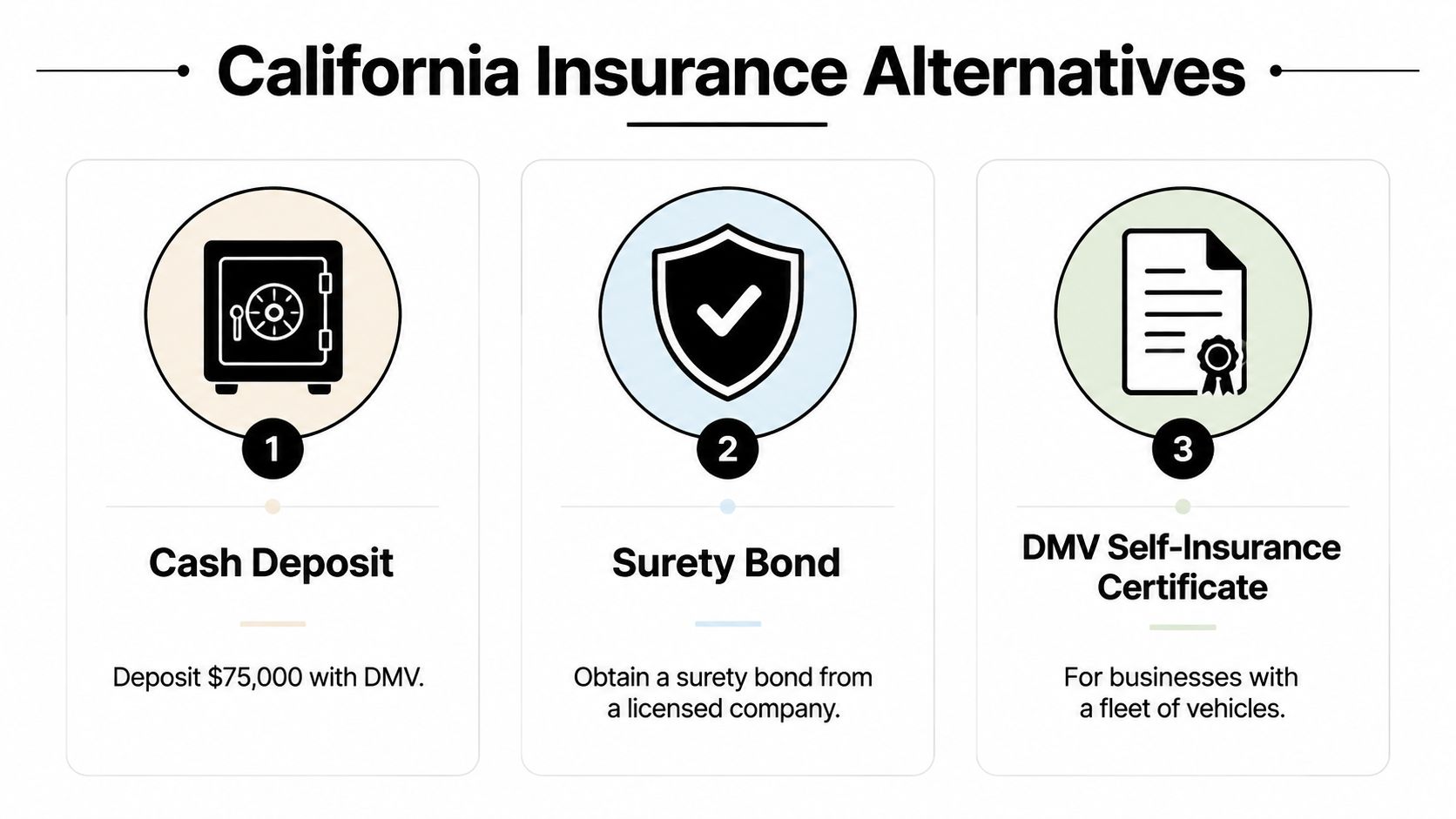
California doesn't require every driver to purchase a retail auto policy. The state allows other forms of financial responsibility, but these choices aren't casual workarounds. They require substantial resources, formal documentation, or both.
The three recognized paths
Cash deposit with the DMV requires a $75,000 deposit. This can work for someone with substantial liquid funds who prefers to post money directly rather than pay an insurer. The drawback is obvious: the funds are tied up, and the deposit doesn't provide the broader service and claims structure that comes with a conventional policy.
A $75,000 surety bond is another option. A licensed surety company issues the bond, but the driver still needs to qualify and pay the associated cost. A bond is not the same as insurance. It's a financial guarantee, and the company may seek reimbursement from the person responsible for a covered obligation.
A DMV certificate of self-insurance is generally aimed at businesses or operators with a fleet of vehicles and enough financial strength to handle their own obligations. It's not the practical choice for most households with one car.
The California DMV identifies these options alongside the current liability requirements in its financial responsibility and collision guidance. The 2025 increase also raised the alternative threshold to $75,000, making non-insurance compliance more capital-intensive than it was under the previous framework.
Which option fits your situation
| Driver profile | Practical choice | Why |
|---|---|---|
| Everyday driver with one vehicle | Standard liability policy | Usually easier to maintain than tying up cash or arranging a bond |
| High-net-worth individual | Policy or cash deposit | Depends on liquidity, risk tolerance, and desired claims support |
| Business with a fleet | Commercial policy or self-insurance review | Fleet size and financial capacity may justify specialized handling |
| Driver seeking a simple low-cost solution | Standard policy comparison | Alternatives can require significant capital or formal approval |
For most consumers, standard California auto insurance is the sensible answer. It keeps proof of coverage straightforward, spreads risk through an insurer, and avoids placing a large deposit with the DMV. If you're evaluating a nonstandard path, use the California insurance guides as a starting point, then confirm the exact DMV process before canceling an existing policy.
Penalties for Driving Without Valid Insurance in California
A coverage lapse can start without warning. An automatic payment fails, a policy renewal notice gets missed, or a newly purchased vehicle isn't added promptly. The driver may not realize there's a problem until the DMV, a police officer, or another driver asks for proof.
What can happen after a lapse
The California DMV states that a vehicle registration can be suspended if it doesn't receive proof of insurance. A driver without proper financial responsibility can also face tickets, license suspension, and vehicle impoundment. Those consequences can interfere with commuting, work, school, and the ability to renew or use the vehicle legally.
The immediate financial impact isn't limited to a citation. A lapse can make future underwriting more difficult, and reinstating coverage may require extra documentation or a revised payment arrangement. If your vehicle is impounded, recovering it can create additional costs and logistical problems.
After a collision: Don't assume a minor-looking accident is financially minor. Exchange information, document the scene, notify the appropriate insurer, and use a practical car accident recovery checklist to avoid overlooking important steps.
If you cause a crash while uninsured
Without liability insurance, you lose the insurer that would normally investigate the claim, negotiate with the other party, and pay covered damages up to the policy limits. You may have to respond personally to property-damage and injury demands, and your personal assets can be exposed to a civil claim.
If your license or driving privileges are suspended and you're trying to restore them, the DMV may require evidence of financial responsibility before reinstatement. High-risk drivers may also need an SR-22 filing, which is a form submitted by an insurer to demonstrate qualifying coverage. The exact reinstatement process depends on the reason for the suspension and the DMV's requirements.
The fix is simple in principle, but timing matters. Stop driving the vehicle, contact a licensed agent or insurer, secure valid coverage, confirm that the DMV has the required proof, and verify that registration and driving privileges are active before returning to the road.
How to Get Affordable Compliant Auto Insurance in California
Affordable coverage starts with accurate comparison, not with choosing the first policy that displays a low premium. Ask every carrier to quote the same liability limits and the same optional coverages so you're comparing equivalent protection. Otherwise, a cheaper quote may have lower limits, higher deductibles, or fewer protections.
Shop with a consistent checklist
Start by confirming that the quote meets California's current 30/60/15 requirement. Then review the parts that the minimum doesn't address:
- Uninsured and underinsured motorist coverage: Consider whether you want protection if the other driver has inadequate insurance.
- Collision coverage: Review this if repairing or replacing your vehicle would be difficult without insurance.
- Other-than-collision coverage: Evaluate protection for non-collision losses, subject to the policy terms and deductible.
- Deductibles and exclusions: A low premium can carry a deductible or exclusion that makes a claim harder to manage.
- Household drivers and vehicle use: List regular drivers accurately and disclose commuting, business, or other relevant use.
A licensed California agency can compare multiple top-rated carriers, explain differences in plain language, and help match limits to your budget. Mai & Associates offers auto insurance services, same-day quotes, multilingual support, and offices in Glendale, Westlake Village, Escondido, and Costa Mesa. The agency serves clients across more than 50 California cities, so it's one practical resource to include in your comparison, not a substitute for comparing the coverage itself.
Budget for the law's scheduled change
The current 30/60/15 limits apply from January 1, 2025, through 2034, and California has scheduled a move to 50/100/25 on January 1, 2035, as described in this California auto insurance law overview. Treat that schedule as part of long-term planning. Ask how your insurer handles limit changes, review your renewal documents, and avoid assuming that an old policy automatically remains compliant.
For a direct comparison, request a California auto insurance quote with your current declarations page available. That lets an agent identify whether your existing limits, drivers, vehicles, and deductibles still fit your needs.
Your California Insurance Compliance Checklist
Use this checklist before you drive, renew registration, or switch carriers:
- Confirm the liability limits: Verify that your standard policy meets at least 30/60/15, the current California minimum.
- Check the effective dates: Make sure the policy is active today, not merely scheduled for renewal or payment.
- Match the vehicle details: Confirm the vehicle identification information, garaging address, and listed drivers are accurate.
- Verify DMV reporting: Check that the DMV has received proof of insurance and that your registration remains active.
- Carry proof: Keep an insurance card or approved electronic proof available during traffic stops.
- Review the gaps: Decide whether minimum liability is enough, then consider higher limits, uninsured or underinsured motorist coverage, and collision protection.
- Understand your alternatives: If you're considering a cash deposit, surety bond, or self-insurance certificate, confirm the DMV requirements before ending a standard policy.
- Plan ahead: Remember that California has scheduled a future move to 50/100/25 on January 1, 2035, so review limits at renewal rather than waiting for a compliance problem.
- Coordinate other policies: If you own a home, rent, or need family financial protection, review auto, home insurance, renters insurance, and life insurance together. Combining decisions can reveal coverage gaps that a stand-alone auto review misses.
The right answer to “is car insurance mandatory in California” is yes for practical purposes, even though the law technically requires financial responsibility and recognizes alternatives. Most drivers should maintain a standard policy, keep proof current, and select limits based on financial exposure rather than the legal floor alone.
Mai & Associates can compare California auto insurance options, provide same-day quotes, and help you review home insurance, renters insurance, and life insurance alongside your vehicle coverage. Visit Mai & Associates to request a no-obligation quote and get guidance from a licensed California agent.