How to Compare Insurance Quotes in California

A nonrenewal notice arrives while you're already juggling a mortgage, commuting costs, vehicle repairs, and family expenses. The first quote you receive may look affordable, but a lower premium can hide a larger deductible, narrower coverage, or an insurer that won't write your property in its ZIP code.
Comparing insurance quotes in California requires more than entering the same name and address into several websites. You need matching inputs, identical coverage limits, a clear view of exclusions, and a plan for what happens if a voluntary-market insurer declines the risk. The same discipline applies to auto insurance, car insurance, home insurance, renters insurance, condo insurance, and life insurance.
A California Family Trying to Get the Right Quote
Maria, a Glendale rideshare driver, sits at her kitchen table with a nonrenewal notice open on her laptop. She owns a Studio City condo, carries an HO-6 policy because her lender requires it, insures two vehicles, and bought a small term life policy after her daughter was born.
Her declarations pages don't line up. One auto quote has a higher collision deductible than the other. A second carrier won't write the property in her ZIP code. The cheapest HO-6 quote excludes earthquake coverage and limits water-backup protection, but the price looks attractive until Maria compares what she would have to pay after a loss.

Her Spanish-speaking neighbor has a different problem. The neighbor submitted a quote request but couldn't get a same-day callback, so she accepted the first policy offered without confirming whether personal property was covered at replacement cost or actual cash value. That decision may not matter until a serious claim exposes the gap.
California adds another layer. Proposition 103, approved by voters on November 8, 1988, requires insurers to justify rate changes through regulatory review and generally obtain prior approval before using new rates. The law also required property-and-casualty premiums to be reduced by at least 20% from the rates charged on November 8, 1987, subject to stated exceptions. The California Legislative Analyst's Office analysis of Proposition 103 documents those historical requirements.
Practical rule: A quote is useful only when you know exactly what the premium buys.
Maria needs four answers before she signs anything: which fields must match across carriers, where the California FAIR Plan fits, when a wildfire moratorium expiration matters, and whether a local agency can consolidate the comparison in one conversation.
Information to Gather Before Requesting Any Quote
Prepare one complete information packet before requesting California insurance quotes. A broker can compare more accurately when every carrier receives the same facts, and you'll spend less time correcting applications after an insurer verifies the details.
Auto information
For every licensed household driver, collect the driver's license number, years of driving experience, safety record, recent claims, and violations. Add the VIN for each vehicle, annual mileage, the overnight garaging address, vehicle use, and your current declarations page.
California rating plans must include driver safety record, annual mileage, and years of driving experience as mandatory factors for each applicable coverage. Insurers can also apply approved additional factors and discounts. The California Department of Insurance rating-plan instructions explain why incomplete or inconsistent information can change the final premium.
Home and condo information
For an HO-3 homeowners policy or HO-6 condo policy, gather the property address, year built, square footage, construction class, roof material and age, protective devices, prior losses, occupancy, and lender or HOA requirements. Include a replacement-cost estimate based on rebuilding the structure, not its market value.
Also document wildfire mitigation work, such as defensible space, ember-resistant vents, roof improvements, and other completed hardening measures. Identify the property's wildfire risk tier using the Cal Fire Hazard Severity Zone map, and check whether the ZIP falls inside a declared wildfire moratorium zone.
Life information
For life insurance, prepare the applicant's age, health status, tobacco use, income, existing coverage, beneficiaries, debts, and the financial needs the policy should address. A term quote and a permanent-policy quote aren't comparable merely because both show a death benefit.
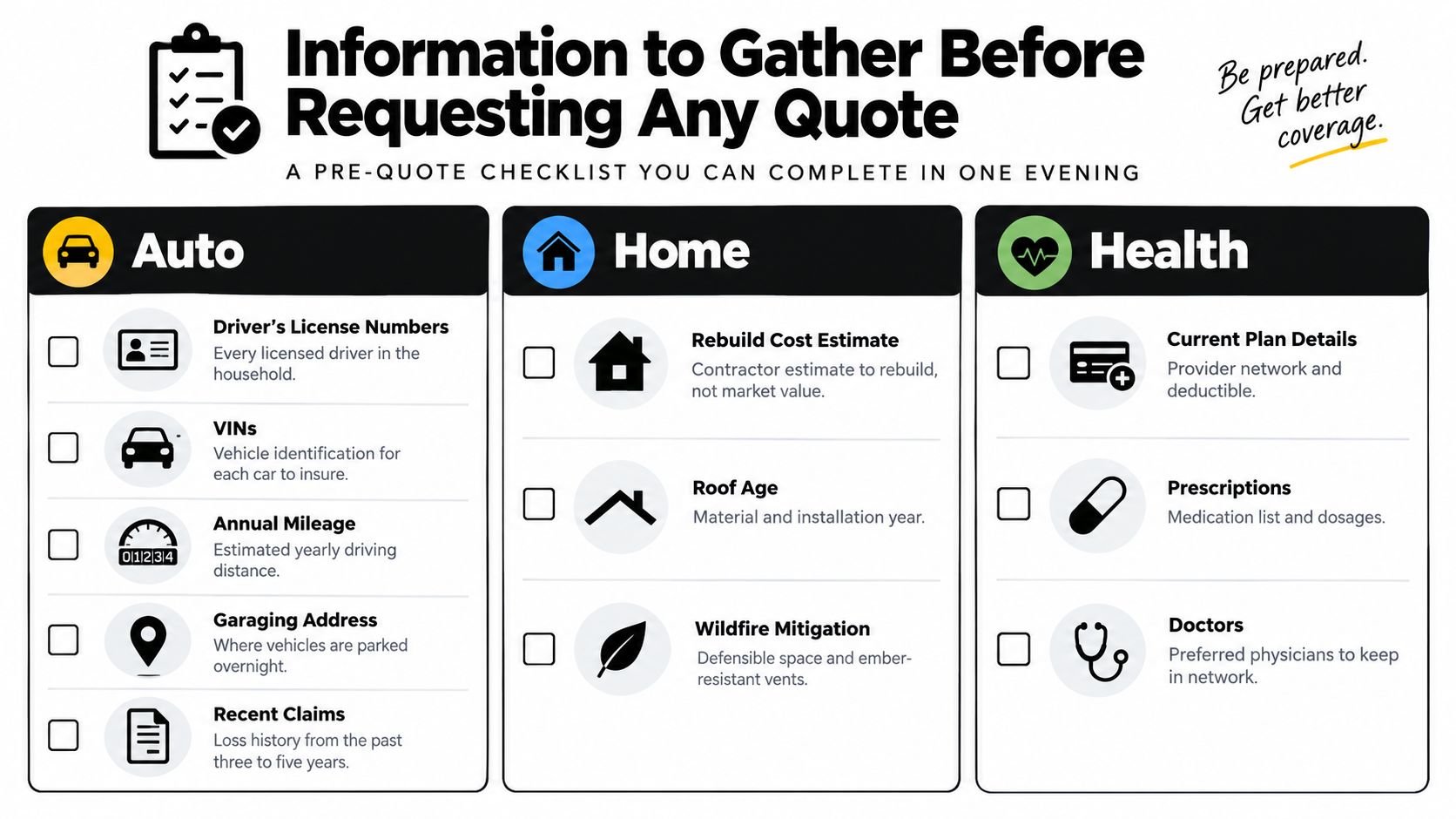
Send the packet in one email when possible. The fastest route to comparable quotes is a complete submission with the same applicant details, property facts, vehicle information, and existing declarations page attached to every request.
Comparing Auto Insurance Quotes the Right Way
The most common auto-quote mistake is comparing premiums while changing the coverage underneath them. Lock the liability limits, uninsured-motorist protection, medical-payments coverage, full-vehicle-loss and collision deductibles, vehicle use, garaging ZIP code, and annual mileage before asking carriers to price the risk.
California's minimum liability limits are $15,000 for bodily injury or death to one person, $30,000 for bodily injury or death to multiple people in one accident, and $5,000 for property damage in one accident. Those limits protect others when the insured driver causes a covered accident. They don't automatically pay to repair the insured vehicle. The California Department of Insurance auto insurance guide explains the difference between required liability protection and optional collision, other-than-collision, medical-payments, and uninsured or underinsured-motorist coverage.
Read the declarations page
Find the named insured, listed drivers, vehicles, garaging address, use classification, mileage, liability limits, deductibles, discounts, and endorsements. Confirm whether rideshare coverage applies during the periods your personal policy may exclude business use. Also look for OEM parts endorsements, glass deductible waivers, and loan or lease gap coverage. Each can change the premium or the claim result.
A PNI, or Price Need Index, may appear in a carrier's rating explanation. Don't assume it means the same thing across insurers. Ask the agent to explain how the carrier applied it and whether the quote depends on documentation, driver training, academic standing, continuous insurance, or another discount.
A controlled comparison
Use a table like this before choosing a carrier. The entries should contain the actual quoted limits and deductibles, not vague labels such as “standard coverage.”
| Coverage Field | Carrier A (Voluntary) | Carrier B (Non-standard) | Carrier C (Direct-to-consumer) |
|---|---|---|---|
| Liability limits | Match exactly | Match exactly | Match exactly |
| Uninsured motorist | Same limits and selection | Same limits and selection | Same limits and selection |
| Comprehensive deductible | Same amount | Same amount | Same amount |
| Collision deductible | Same amount | Same amount | Same amount |
| Rideshare protection | Included, excluded, or endorsed | Included, excluded, or endorsed | Included, excluded, or endorsed |
| OEM, glass, and gap options | List each endorsement | List each endorsement | List each endorsement |
| Discounts and documentation | Identify each condition | Identify each condition | Identify each condition |
A broker can standardize the application fields and request matching limits at no charge in many quote conversations. You still need to verify every driver, mileage estimate, garaging address, endorsement, and deductible on the final application. For a second review of California auto coverage, use this California auto insurance comparison resource.
Reading a Homeowners Quote Beyond the Premium
A home insurance quote starts with the amount needed to rebuild the structure, not the property's sale price or tax assessment. Construction labor, materials, debris removal, permits, and current building requirements can make reconstruction materially different from the home's market value.
Compare the structure line by line
Review dwelling coverage, other structures, personal property, additional living expense, ordinance-and-law or code-upgrade coverage, liability, medical payments, exclusions, and deductibles. Confirm whether contents settle at replacement cost or actual cash value. Actual cash value may account for depreciation, while replacement-cost protection is designed to fund comparable new items subject to the policy's conditions.
Don't overlook the coinsurance language or any condition that limits recovery when the property is underinsured. Ask the carrier to explain how the policy responds if the dwelling limit is lower than the cost to rebuild under current California requirements.
A homeowner should also review the broader cost of ownership, not just the premium. A guide to the monthly cost of owning a home can help place insurance, mortgage, taxes, maintenance, and other recurring obligations in the same household budget.
Voluntary coverage and FAIR Plan options
The California FAIR Plan is a residual-market option for homeowners who can't obtain coverage through the traditional market. Department data cited in the state's climate strategy showed more than 140,000 FAIR Plan policies in force in 2015 and approximately 4% of California's residential market in 2023. A later Assembly Insurance Committee document reported 668,609 policies in force as of December 2025, which was 146% higher than September 2022. The California Department of Insurance sustainable insurance strategy provides the market context.
The FAIR Plan generally covers fire or lightning, internal explosion, and smoke. It doesn't provide liability protection under the standard fire policy and may exclude burglary and other perils. Its residential maximum for all coverages combined is $3 million, according to the California Department of Insurance residential insurance guide.
| Coverage Element | Voluntary Market | FAIR Plan | DIC Wrap |
|---|---|---|---|
| Fire protection | Usually included within a broader policy | Core purpose of the policy | Coordinates with primary coverage |
| Liability | Usually available | Not provided by the standard fire policy | May provide liability protection |
| Personal property | Policy-specific | Limited and policy-specific | May fill selected gaps |
| Water damage and theft | Review exclusions and limits | Generally not included as broad homeowners protection | Designed to address excluded perils, subject to terms |
| Deductibles and limits | Compare each line | Can be substantial or policy-specific | Must coordinate with the FAIR Plan |
| Loss of use | Review the additional-living-expense limit | Don't assume it exists | Check the wrap's terms |
A Difference in Conditions policy, often called a DIC wrap, may supplement FAIR Plan fire coverage, but it isn't automatically a complete homeowners policy. Map the wildfire, smoke, ash, water, theft, liability, personal-property, debris-removal, code-upgrade, and loss-of-use provisions before choosing the lowest premium. A side-by-side California home insurance quote review should show those differences plainly.
What to Do Before a Wildfire Moratorium Expires
A California wildfire nonrenewal moratorium is temporary protection, not a permanent replacement for private coverage. The state generally prevents cancellation or nonrenewal for one year after a qualifying gubernatorial emergency declaration. In September 2025, a Department of Insurance order protected approximately 124,000 homes in 39 ZIP Codes for one year, illustrating why homeowners need to track the actual protection end date. The California Department of Insurance moratorium information explains the rule and its limits.
When the protection ends, a carrier may reassess underwriting information, property condition, wildfire scoring, mitigation records, and its appetite for the ZIP code. A homeowner who waits until the notice arrives may have fewer voluntary-market choices and could need a FAIR Plan policy paired with supplemental coverage.
A 90-day preparation schedule
Start with the policy file. Confirm the moratorium's start date and expected end date. Request the current declarations page, endorsements, loss history, underwriting notices, and the carrier's written explanation for any nonrenewal concern.
Document the property. Take dated photographs of the structure, roof, outbuildings, interior contents, vegetation clearance, vents, windows, and other mitigation features. Confirm the roof's age and material, then gather invoices, inspection reports, brush-clearance records, and defensible-space documentation.
Request replacement quotes early. Ask at least two voluntary carriers and one broker market to review the risk. Request a FAIR Plan indication and a DIC comparison if standard coverage isn't available. Compare the total protection package, not the FAIR Plan base premium alone.
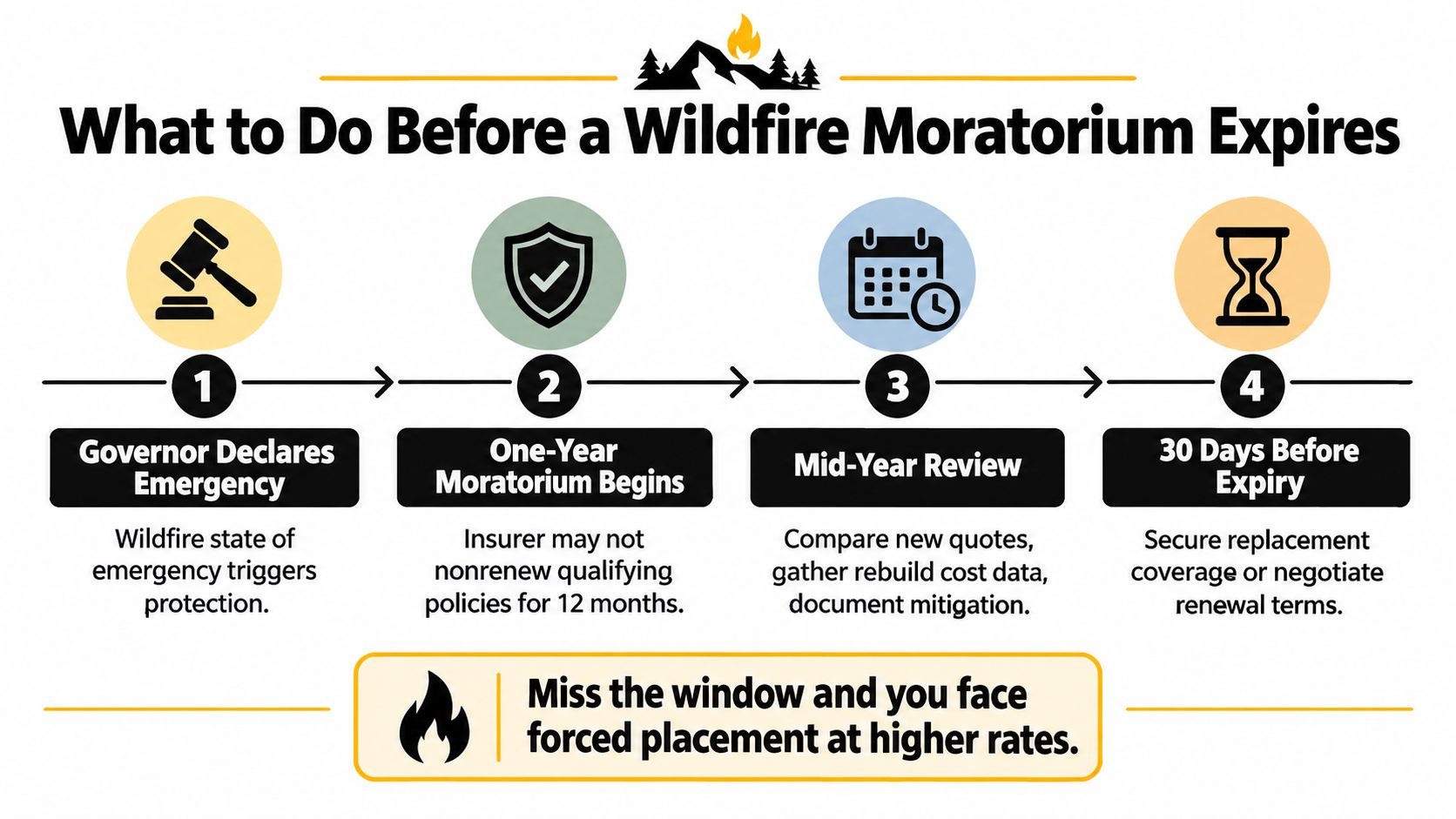
Use the final weeks for decisions. Ask the current insurer whether mitigation records can support renewal, confirm every deductible and exclusion, and avoid allowing the existing policy to lapse before replacement coverage is bound. If a FAIR Plan placement becomes necessary, coordinate the dwelling limit and supplemental policy so one doesn't leave a major gap beside the other.
Renters and Life Insurance Quotes in California
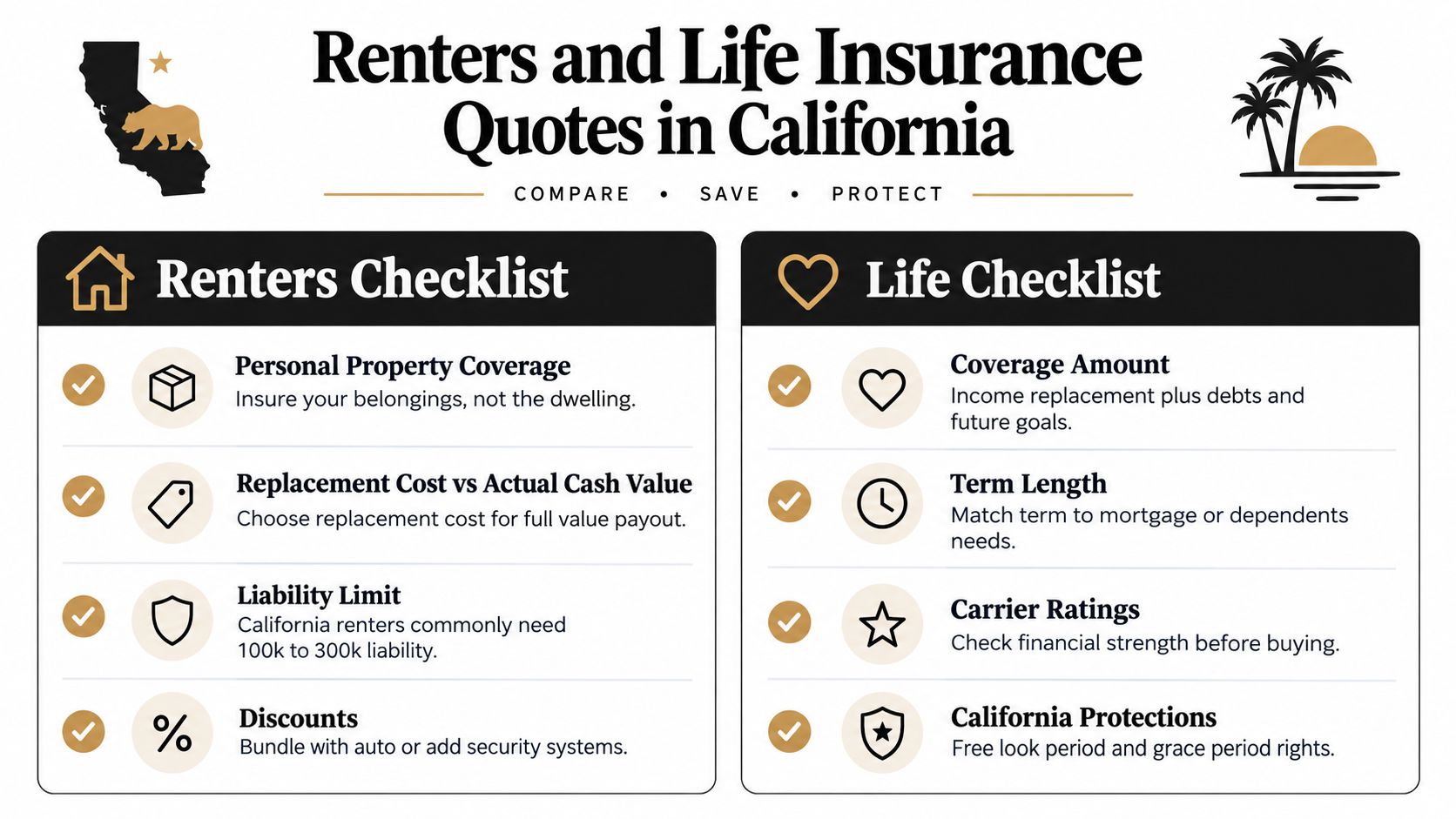
Renters insurance is simpler than homeowners insurance in one important respect. You don't insure the building itself. You insure your belongings, personal liability, and the expenses you may face if a covered loss makes the rental temporarily uninhabitable.
Compare personal-property limits, replacement-cost versus actual-cash-value settlement, liability protection, additional living expense, deductibles, exclusions, and endorsements for jewelry, electronics, bicycles, or business equipment. An HO-4 renters policy should also reflect every household member whose belongings need coverage. Don't choose a policy because it has the lowest monthly price if it settles damaged contents after depreciation or excludes a risk you assumed was covered.
Use the same applicant address, occupancy details, security information, claims history, property limit, liability limit, and deductible with each carrier. A California renters insurance guide can help you organize those comparisons before requesting quotes.
Life insurance needs a different comparison
Life insurance quotes depend on the applicant's age, health, tobacco use, income, coverage need, beneficiaries, existing policies, and desired term or permanent structure. Compare the same death benefit, term length, payment schedule, riders, conversion rights, exclusions, and underwriting class across carriers.
California provides a free-look period of at least 10 days, during which the owner can return the policy for a full refund of amounts paid if dissatisfied. A replacement transaction receives an unconditional refund period of 30 days beginning when the replacement policy is delivered. California life policies must also provide a grace period of at least 60 days from the premium due date, and that grace period doesn't run concurrently with paid coverage. The California Department of Insurance life insurance guide explains these protections.
Don't cancel an existing life policy until the replacement has been issued, delivered, reviewed, and accepted. Compare beneficiaries, cash values, premiums, exclusions, and replacement consequences before making the switch.
Working With a Local California Agency
A local independent agency earns its place when it can solve the problems a quote website can't. One carrier may decline a Glendale ZIP, another may restrict wildfire coverage, and a third may price a rideshare vehicle differently. A local agent can submit the same controlled profile to multiple markets and explain why the answers differ.
Ask the agency these questions before you authorize a submission:
- Market access: Can the agency compare voluntary carriers, non-standard auto options, and a FAIR Plan pathway when a standard homeowners policy isn't available?
- Coverage coordination: Can it pair a FAIR Plan review with a DIC discussion and identify liability, water, theft, personal-property, loss-of-use, and deductible gaps?
- Language access: Can the team communicate clearly in English, Spanish, Armenian, Korean, Tagalog, Mandarin, or another language your household uses?
- Turnaround: Will you receive a same-day response, and who handles follow-up when an underwriter requests roof, mitigation, claims, or driver documentation?
- Policy administration: Can the agency help with EZ-Pay setup, DMV SR-22 filings, and declined-coverage offers when those needs arise?
The agent should deliver a side-by-side comparison with identical limits, deductibles, and endorsements. The written premium breakdown should identify the California Low Cost Auto eligibility check, Good Driver Discount verification, and any documented homeowner mitigation credits, including a Wildfire Prepared Home designation when applicable. Ask the agent to show what is included, what is excluded, and what requires separate coverage.
You don't need a dozen vague quotes. You need a small set of comparable options and an explanation you can act on. Schedule a 20-minute quote review, request bilingual documents if your household needs them, and set a 12-month reminder to requote before a nonrenewal notice arrives. To start a controlled comparison, use this California insurance quote request.
Mai & Associates provides personalized California quotes for auto, home, renters, and life insurance, including FAIR Plan reviews, wildfire protection strategies, and comparisons from multiple carriers. Visit Mai & Associates to request a no-obligation review and discuss the coverage gaps, deductibles, and renewal risks in your current policies.