Insurance Policy Comparison in California: 2026 Guide
You're sitting at the kitchen table with three quotes open on your phone. One looks cheap, one looks confusing, and one looks expensive enough to make you want to close the tab. In California, that's usually the moment people realize they're not comparing the same policy at all, they're comparing labels, limits, deductibles, and exclusions that may have very little in common.
That's the trap. A real insurance policy comparison in California starts with one rule: normalize the coverage first, then judge the price. If you skip that step, a lower quote can mean weaker protection, a different policy form, or a deductible that shifts the risk back onto your household.
| Insurance Type | What You Must Normalize First | What Usually Misleads Shoppers |
|---|---|---|
| Auto | Liability limits, deductibles, endorsements, effective date | A lower premium that hides higher out-of-pocket risk |
| Home | Dwelling limit, ACV vs RCV, exclusions, endorsements | Cheap pricing that underinsures rebuilding cost |
| Renters | Personal property limit, liability, exclusions | A tiny premium that leaves valuables and liability thinly protected |
| Life | Coverage amount, term length, term vs permanent structure | A small permanent policy that looks affordable but does less work |
Why California Insurance Shoppers Need a Real Comparison Framework
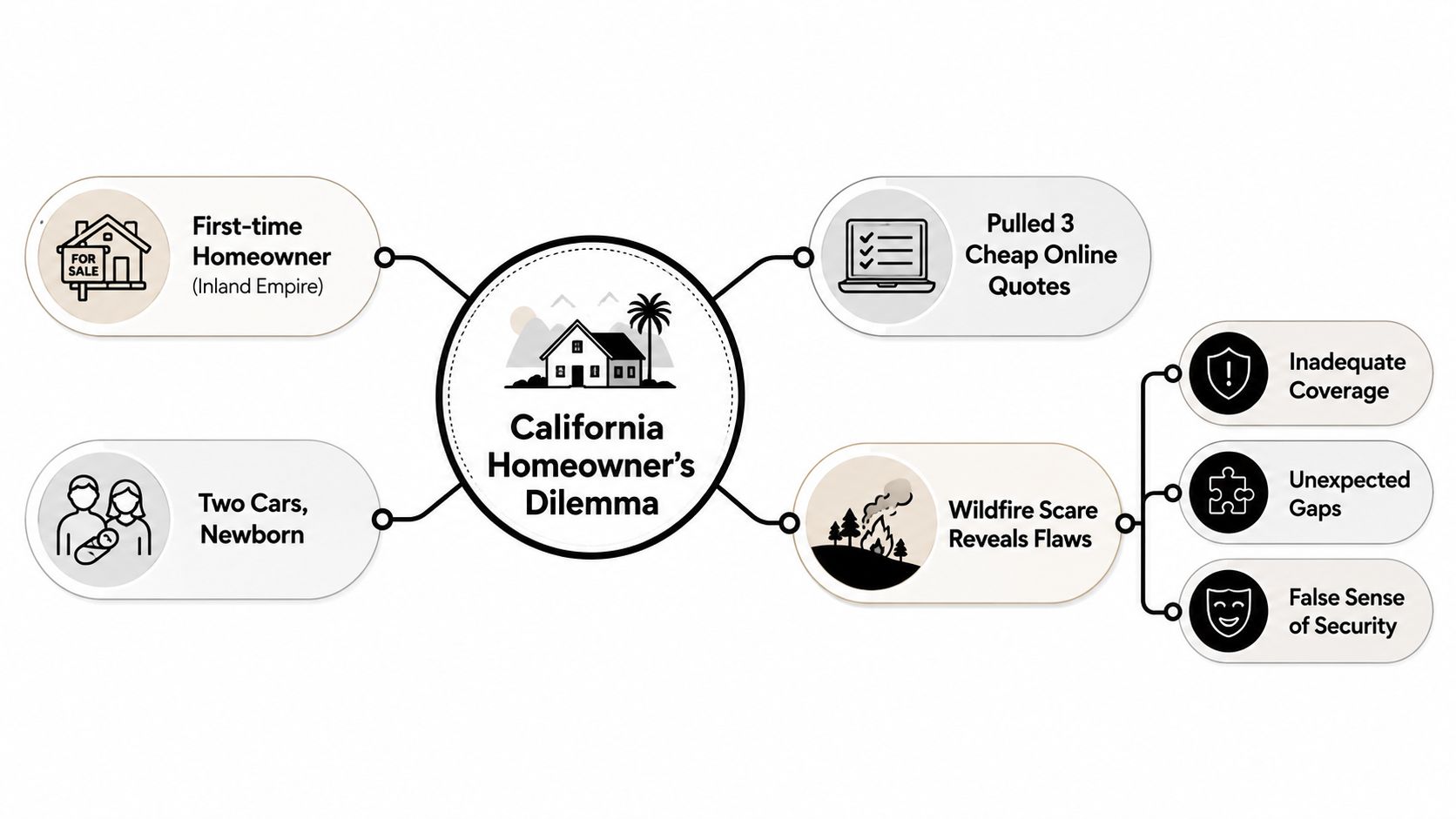
A first-time homeowner in the Inland Empire with two cars and a newborn can pull three online quotes, feel good for about five minutes, then get rattled after a wildfire scare. That's when the fine print starts to matter. The cheapest quote often assumes the buyer won't notice the missing coverage, the higher deductible, or the policy structure that looks similar on a screen but acts very differently when there's a loss.
California shoppers need a framework because prices move for reasons that have nothing to do with real value. The Insurance Information Institute reports that the countrywide average auto insurance expenditure rose 14.0% in 2023, from $1,127 to $1,282, and that interstate variation is huge, with averages of $1,865 in Florida, $1,754 in Louisiana, and $1,753 in New York in 2023 (III auto insurance facts). In a market that large, and this uneven, a casual premium-only comparison is a bad habit. Policy comparison matters because geography, coverage structure, and risk all move the number.
What this guide is built to do
You need a repeatable system, not a one-time shopping trick. That means comparing the same limits, the same deductibles, the same policy form, and the same service expectations every renewal cycle. It also means stress-testing the quote against California realities, especially wildfire, earthquake, and rebuilding costs.
The point is simple. Cheap is only cheap if the policy covers the loss you're likely to face. For broader shopping help, keep this California coverage guide hub handy while you compare.
Practical rule: if two quotes don't match on coverage, they don't deserve a price comparison yet.
The Core Elements You Must Compare in Every California Policy
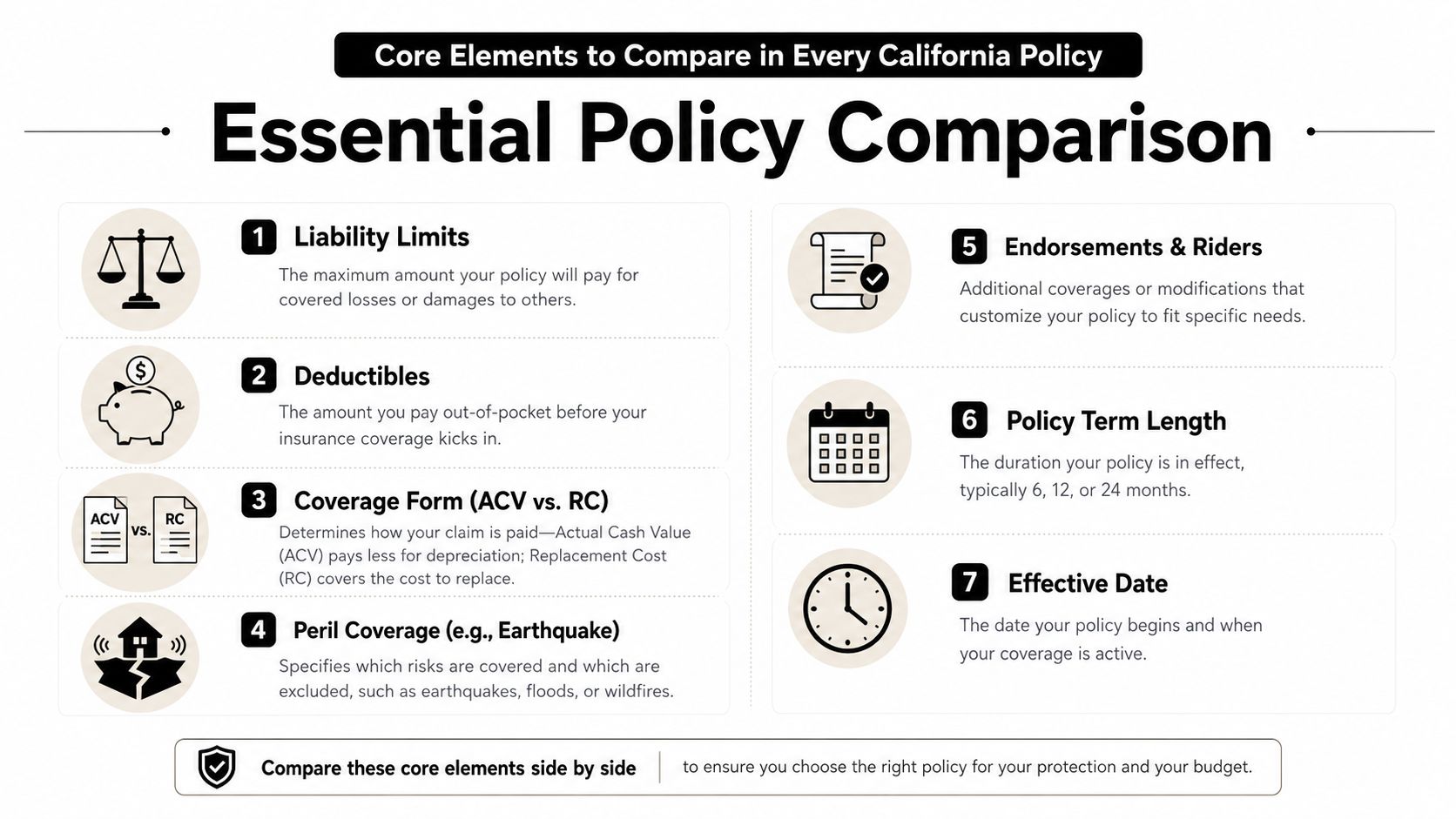
Strip away the branding and most policies come down to the same comparison fields. If you don't normalize them, you're comparing a better contract against a weaker one and calling it a bargain. That's not comparison. That's confusion with a premium attached.
Start with the parts that change the outcome
For auto insurance, the obvious fields are bodily injury liability, property damage liability, and the other physical damage and collision deductibles. Those numbers decide how much protection you have when you hurt someone, damage property, or need repairs after a covered loss. For home insurance, start with the dwelling limit, then check whether personal property is paid on an actual cash value (ACV) or replacement cost value (RCV) basis, because that choice changes what gets paid after a claim. For renters, the key fields are usually personal property and liability, because those are the parts most likely to save you from a painful out-of-pocket bill. For life insurance, compare the coverage amount, the term length, and whether the policy is term or permanent.
Don't ignore exclusions and term structure
Exclusions matter because a policy can look generous until the event you care about is carved out. Endorsements matter for the same reason, because a quote may be cheap only because it omits protection you assumed was included. California shoppers need discipline, not optimism.
For a clear glossary while you compare policy language, the California insurance glossary can help you decode the terms without guessing. If you want a more technical lens on limits, the explanation of aggregate vs per-occurrence limits is worth reading before you decide that two liability quotes are equivalent.
Normalize the policy first, then judge the price.
California-Specific Risks That Change the Comparison
Out-of-state shopping advice usually misses the part that matters most here. California isn't just another zip code on a national pricing grid, it's a state where wildfire exposure, earthquake risk, and rebuilding costs can make two policies look similar while behaving very differently after a claim. That's why a quote that seems fine on paper can fall apart under real local stress.
Wildfire and the last-resort market
If a home sits in a high-risk fire area, you need to ask whether standard coverage is even realistic, and if not, whether the California Fair Plan is part of the picture. The Fair Plan is the last-resort option for homeowners who can't get standard coverage, so the comparison question becomes whether you're pairing it with enough supplemental protection to close the gaps. A cheap quote that ignores wildfire exposure isn't a bargain, it's incomplete.
Earthquake and rebuilding pressure
Earthquake coverage is usually not something you should assume comes baked in. Buyers need to ask whether it's available as an endorsement or a standalone policy, and whether the home policy's dwelling limit is enough to rebuild at current construction costs. That rebuilding question matters even more in areas where replacement labor and materials are expensive, because underinsurance often shows up only after a loss.
The other comparison issue is cost of living and replacement-cost inflation. Inland Empire and coastal households can both be exposed to gaps between the policy limit and the actual rebuild bill, so you should check whether a quote includes extended replacement cost or any similar cushion.

Urban auto risk still drives the auto side
Auto shopping also changes in California because dense traffic, repair costs, and liability exposure can push the conversation away from the lowest quote and toward the right limits. For California drivers, the relevant question is whether the quote reflects the protection level you truly want, not just the smallest monthly number. That's especially true if one carrier is subtly quoting a skinnier liability structure than another.
The comparison test is blunt. Ask whether the dwelling limit can rebuild the house, whether earthquake is included or separate, whether wildfire exposure was acknowledged, and whether the auto quote is built on the same protection standard you'd choose if a serious claim hit tomorrow.
A Sample Side-by-Side Comparison Across Auto, Home, Renters, and Life
A real comparison gets easier once you stop thinking in carrier names and start thinking in households. The same quote can mean different things for a renter in Los Angeles, a family buying in Riverside County, and a couple in Orange County planning for retirement. That's why the policy has to be normalized before the premium can tell you anything useful.
Normalized side-by-side comparison sample
| Household Profile | Auto Normalized Field | Home or Renters Normalized Field | Life Normalized Field |
|---|---|---|---|
| Single renter in Los Angeles | Same liability limits, same comprehensive and collision deductibles, same term length | Renters coverage matched on personal property and liability, with exclusions checked carefully | Term life compared by coverage amount and term length |
| Young family buying in Riverside County | Same liability limits, same endorsements, same effective date | Home policy matched on dwelling limit, then ACV vs RCV and exclusions reviewed | Coverage amount and term length matched to income replacement needs |
| Pre-retirement couple in Orange County | Same liability limits, same deductibles, same policy term | Home coverage checked for dwelling limit and any replacement-cost protection | Term vs permanent structure compared, along with coverage amount |
For renters shopping, this California renters resource is a useful way to keep the comparison focused on personal property and liability instead of getting distracted by the lowest premium.
What each household should notice
The renter in Los Angeles should care about how much personal property is protected, not just the monthly bill. The Riverside family needs to look hard at whether the home policy really rebuilds the house or merely pays a reduced value after a loss. The Orange County couple has to decide whether they want temporary protection that fits a planning horizon or a permanent structure that costs much more and serves a different purpose.
The most common blind spot is assuming the cheapest quote wins before you've normalized the coverage.
How to Get Accurate Quotes and What to Ask California Agents
If you want a clean quote comparison, you have to force every carrier to play by the same rules. That means the same liability limits, the same deductibles, the same endorsements, the same term length, and the same effective date. A quote that comes in lower after those fields change is not a better price, it's a different deal.
What to say before the carrier quotes you
Tell the agent you want an apples-to-apples comparison and that every quote needs the same limits and deductible structure. Ask whether the home quote uses ACV or RCV for personal property, whether earthquake is excluded, and whether any wildfire-related considerations changed the offer. If you're shopping auto, ask whether the quote reflects the same bodily injury, property damage, physical damage, and collision setup across every carrier.
A workable script is direct: “Please quote the same coverage structure across all carriers, and list any difference in exclusions, endorsements, or term length in writing.” Then follow with the practical checks. Ask:
- Are the liability limits identical on every quote?
- Are the deductibles exactly the same?
- Is this home coverage ACV or RCV for personal property?
- Does this quote include or exclude earthquake?
- Are endorsements and riders listed item by item?
- Is the effective date the same across every option?
- What service support do you provide after binding?
The red flags are easy to spot. An agent who won't itemize the quote is making comparison harder on purpose or by habit. A quote that changes after a short phone call needs a second look. If the language is vague about ACV versus RCV, the customer is being asked to guess, and guessing is expensive. In California, comprehension is part of the product, so a carrier or agent who can explain the policy in the customer's language is offering real service value.
For quote shopping help, this California quote request page is a straightforward way to begin collecting like-for-like offers.
Why the Cheapest Quote Often Is Not the Best Policy
Cheap home insurance can be a trap when it cuts dwelling limits below rebuilding cost or switches personal property from RCV to ACV. The premium may drop, but the risk doesn't disappear, it gets handed back to the homeowner after a loss. That's why a policy that looks efficient on the front end can become expensive exactly when the family needs it most.
Life insurance has the same problem, just in a different form. A properly sized 20-year term policy usually does more for a young California family than a small permanent policy that costs 5 to 15 times more than term life, because the family gets meaningful protection without crowding out rent, childcare, savings, and the rest of the budget (Policygenius via the life insurance comparison data). Price matters, but the structure matters more.
Best value is not the lowest premium. It's the policy that pays what your household actually needs, when it needs it.
Service quality matters too. The most useful performance signals are claim settlement cycle time, retention rate, and the combined ratio, because those are the numbers that tell you whether the carrier can handle claims efficiently and keep customers over time (OpsDog insurance KPI guidance). That's a better comparison lens than a pretty quote sheet.
Your Next Steps and When to Bring in a Licensed California Agent
Start with a one-page list. Write down every policy, every renewal date, and the current limits and deductibles on each contract. Then normalize the coverage, gather at least three like-for-like quotes, and compare the same risks side by side before you decide anything.
Bring in a licensed California agent when the situation gets messy. High-risk wildfire ZIP codes, California Fair Plan policies that need a review, multilingual households, and life coverage that has to support income replacement planning are all situations where self-service comparison starts to break down. That's where a licensed agency can save time and reduce mistakes by lining up multiple carriers and explaining the tradeoffs clearly.
Mai & Associates helps Californians compare rates across multiple carriers for auto, home, renters, and life insurance, and it offers same-day quotes, a 24-hour response, and support in English, Spanish, Armenian, Russian, and Vietnamese. That kind of service matters when the quote is only part of the decision and the policy language still needs to be understood.
A strong insurance policy comparison protects what matters most. The right next step is to turn the framework into action, save the money where you can, and strengthen the safety net where you shouldn't cut corners.
If you want help comparing your current coverage against real California risks, visit Mai & Associates and ask for a quote review. Their licensed team can line up multiple carriers, explain the differences plainly, and help you spot the gaps before they become a claim problem.