Getting Insurance on a Salvage Title: 2026 Guide
You're probably looking at a car that seems underpriced for the year, mileage, or trim, and then you notice the problem in the listing: salvage title.
That's the moment when a cheap car can turn into an expensive lesson. In California, the hard part usually isn't just buying the vehicle or fixing it. The hard part is getting from a damaged, branded car to something you can legally register, drive, and place on a usable insurance policy.
Insurance on a salvage title is possible in the broader sense, but California drivers need to think in stages. A true salvage vehicle and a rebuilt or revived salvage vehicle are not the same thing. That distinction controls whether the car can be driven, whether an insurer will even look at it, and what kind of claim payment you can expect later if the vehicle is damaged again.
Most buyers focus on the purchase price. The smarter move is to focus on the sequence. Buy the right car, document every repair, complete the California inspection process in the right order, and only then shop for the right kind of auto insurance. If you skip steps, you can end up with a repaired car that still sits uninsured.
Is a Salvage Title Car a Bargain or a Burden
A salvage-title car can be either. It depends on why it was branded, how well it was repaired, and whether the total project still makes sense once you factor in California registration and insurance reality.
The reason these cars attract buyers is obvious. The asking price can look much better than a clean-title version of the same model. For some people, that works. If you understand vehicle damage, have access to quality repairs, and can tolerate coverage limits later, a rebuilt vehicle can fill a practical transportation need.
For many buyers, though, the low price conceals its full cost. The title brand follows the car. Insurers see it. Future buyers see it. Claims adjusters see it. That means your bargain can come with stricter underwriting, fewer carrier options, and weaker claim outcomes than a standard car insurance policy on a clean-title vehicle.
What usually works
A rebuilt vehicle tends to work best when the buyer is disciplined about paperwork and realistic about coverage.
- Documented repairs: Receipts, photos, and inspection records matter.
- Simple ownership goals: If you want a commuter car and can accept liability-focused protection, the deal may still pencil out.
- Patience with the process: California doesn't treat this like a routine used-car purchase.
What usually goes wrong
Problems start when buyers assume the vehicle will insure like any other used car.
Practical rule: If the deal only works when you assume easy full coverage and a strong future payout, it probably doesn't work.
Common mistakes include buying first and checking insurance later, relying on the seller's verbal description of repairs, and confusing “fixed” with “insurable.” Those are not the same thing.
A salvage title should make you slow down, not speed up. Before you spend money, verify the title status, understand where the car is in the California process, and decide whether you're comfortable with a vehicle that may never have the same insurance options as a clean-title equivalent.
Understanding Salvage vs Rebuilt Titles in California
A lot of confusion comes from using the words “salvage” and “rebuilt” as if they mean the same thing. They don't.
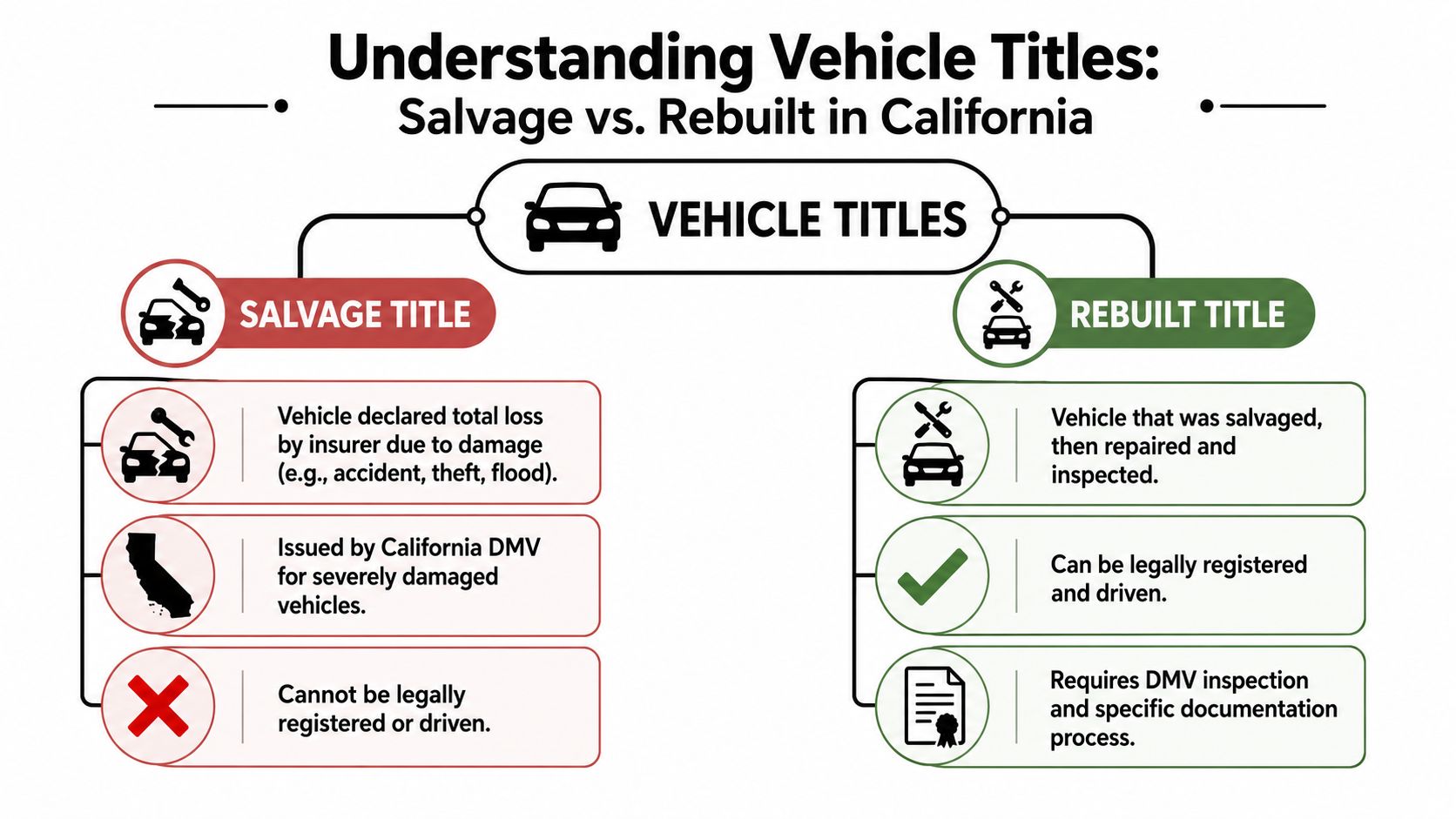
A salvage title is the state's way of saying the vehicle was severely damaged and treated as a total loss. A rebuilt or revived salvage title means the vehicle was later repaired and went through the state process required to return it to legal road use. That second status is the one most buyers are trying to reach.
What a salvage title means
A salvage title is generally issued only after an insurer declares the vehicle a total loss because estimated repair costs exceed a jurisdiction threshold tied to market value. In North America, that threshold varies from 50% to 95%, with many jurisdictions, including many cases around California, clustering near 75% according to Wikipedia's salvage title overview.
Consider a house that has been red-tagged after major damage. It still exists. It may even be repairable. But it is not back to normal legal use just because someone wants to fix it.
What a rebuilt or revived salvage title means
A rebuilt title is closer to a renovated property that has been brought back up to code. The damage history doesn't disappear, but the vehicle has gone through the process required to return to the road.
That's the distinction that matters for insurance on a salvage title. In plain terms:
| Title status | What it means in practice |
|---|---|
| Salvage | The vehicle has been branded as a total loss and is not in normal insurable, road-ready condition |
| Rebuilt or revived salvage | The vehicle has been repaired, inspected, and retitled for legal use, though insurance choices remain narrower |
If you want a broader explanation of how write-offs and title branding work conceptually, AutoProv's write-off guide is a useful companion read. For California-specific policy and title terminology, the Mai & Associates insurance glossary can also help decode the language buyers run into during quotes and DMV paperwork.
A salvage title tells you what happened to the car. A rebuilt title tells you where the car is now in the legal process.
That one distinction prevents a lot of bad assumptions. Buyers often ask whether they can insure a salvage-title car. The better question is whether the vehicle is still salvage, or whether it has already been revived and documented properly.
The Official California Path from Salvage to Rebuilt
California follows a sequence, and the order matters. If you try to skip around it, you create delays for yourself and red flags for insurers.
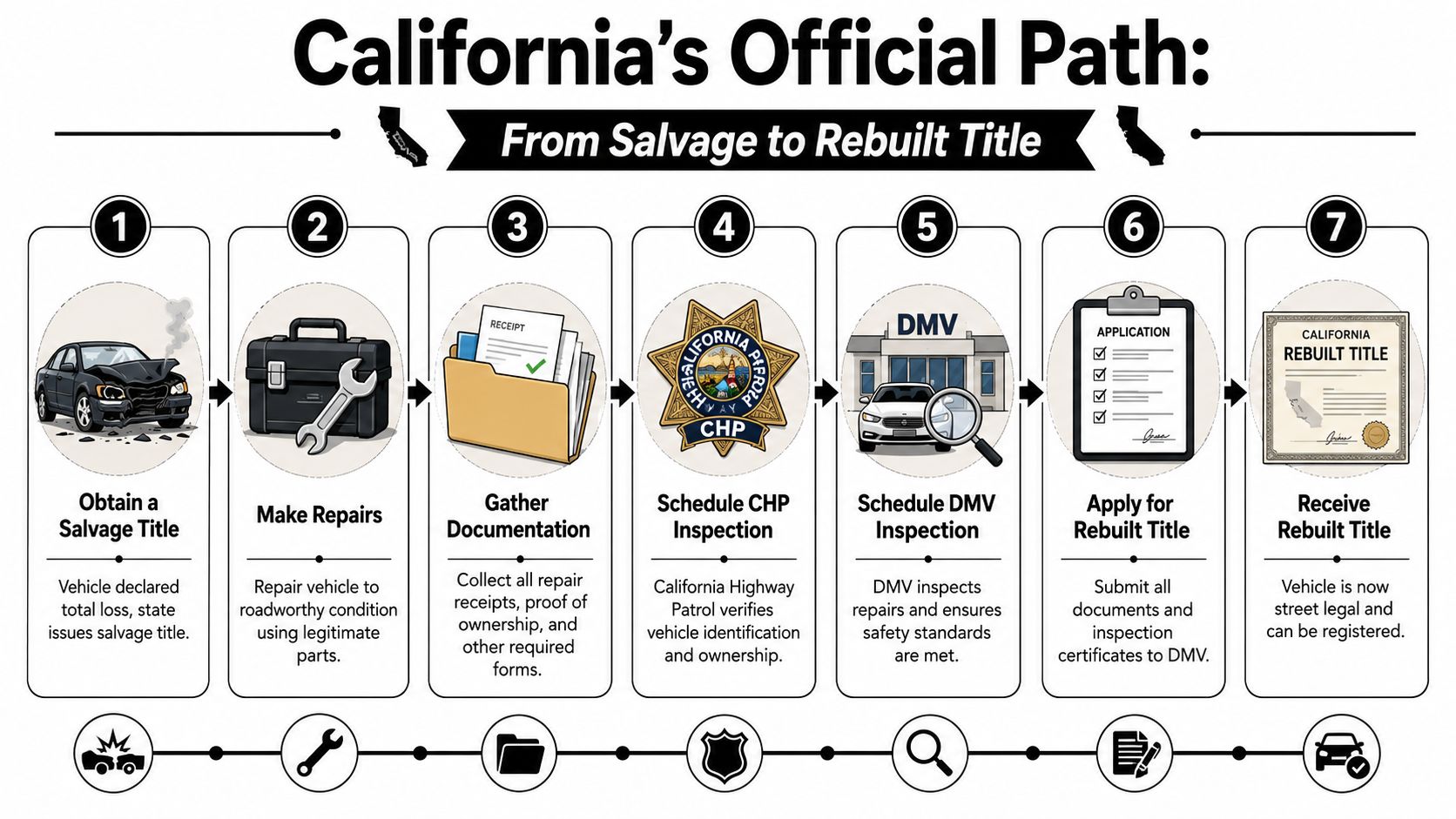
The broad rule is straightforward. In California, a salvage vehicle generally must be fully repaired, pass a state-run inspection, often involving the CHP, and be officially reclassified as a rebuilt or revived salvage vehicle before standard road use and insurance are possible, as summarized by Credit Karma's California salvage insurance explainer.
The sequence California drivers need to follow
Start with proper ownership documents
Before any repair strategy matters, you need a valid paper trail showing who owns the vehicle and what title status it currently carries.Complete the repairs first
The vehicle has to be brought back to roadworthy condition. Cosmetic work alone isn't enough if safety systems, lighting, body alignment, or structural issues remain unresolved.Keep every receipt
Save invoices for parts, labor, and any outside shop work. If a component came from another source, document that too. Missing paperwork can turn an otherwise repairable project into an inspection headache.Obtain the required inspection-related documents
California buyers often discover this late. If the vehicle needs brake and lamp certification, get those documents from the appropriate inspection sources before you expect the title process to move smoothly.Schedule state verification and inspection
Depending on the case, the DMV and CHP may both become part of the process. The state wants to confirm identity, ownership, and roadworthiness.Apply for revived salvage status
Once the car is repaired and the inspection paperwork is in order, the title can move from salvage to revived salvage or rebuilt status.
The uninsurable gap that catches people off guard
This is the issue most online guides gloss over.
A vehicle can be physically repaired and still not be in the legal state insurers want to see. That creates a gap between “the work is done” and “the title is revived.” During that period, the car may not fit normal underwriting guidelines for standard California auto insurance.
Watch for this gap: repaired does not automatically mean insurable.
That gap matters in real life. If the vehicle is being stored, moved, or waiting on final paperwork, you need to be careful about assumptions. Buyers often think once the shop work is complete, they can just call an insurer and activate coverage. Many carriers won't treat the file that way.
How to avoid delays
The easiest way to stay out of trouble is to run the project like an audit file.
- Photograph the vehicle before, during, and after repairs
- Match receipts to the work performed
- Keep title documents organized in one folder
- Use legitimate repair sources and identifiable parts
- Don't schedule insurance as your first step. Schedule it after the title path is ready
If you're doing some of the labor yourself, it helps to understand proper repair standards before you begin. For owners trying to get smarter about bodywork basics, learn car body repair techniques before you commit to a project that may later face DMV and insurer scrutiny.
California can be very manageable here, but only if you respect the sequence. Most setbacks come from poor documentation, incomplete repairs, or trying to bind coverage before the legal status is ready.
Securing California Auto Insurance for Your Rebuilt Car
Once the title has been revived, the insurance conversation becomes real. It still won't feel like a standard clean-title quote, but at least now you're speaking to carriers from the correct starting point.
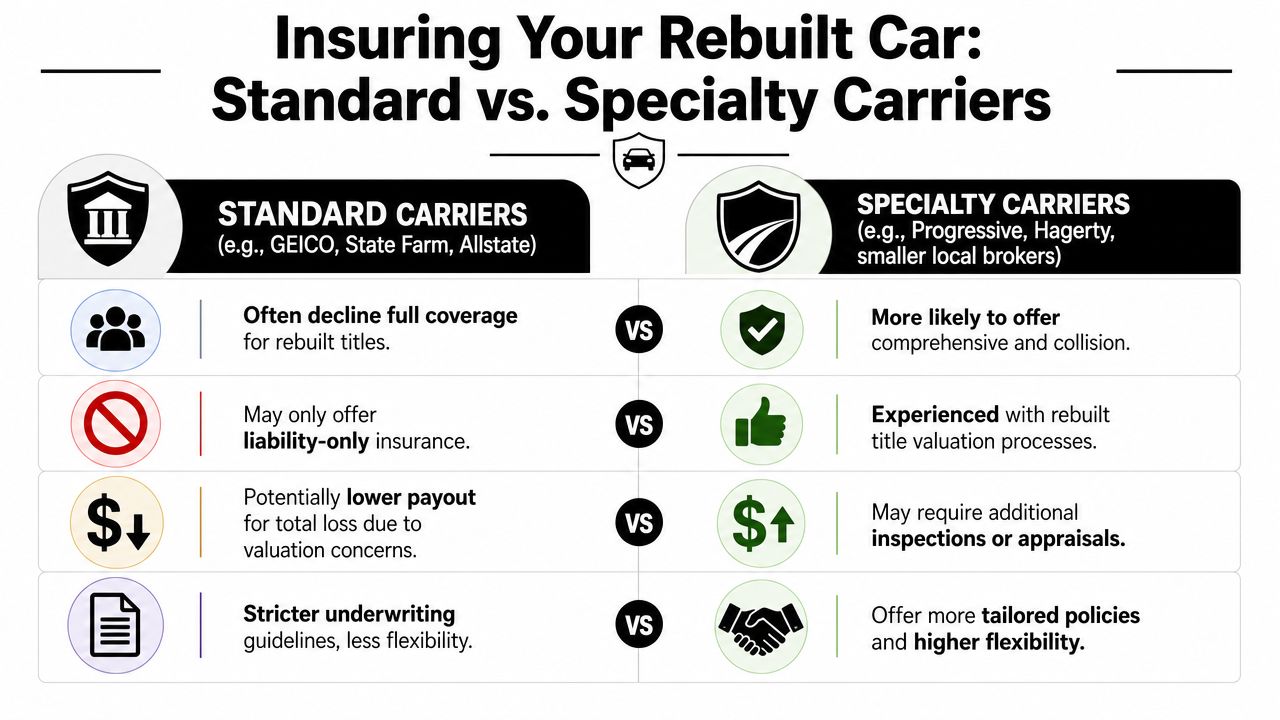
The core issue is underwriting uncertainty. After a rebuilt title is issued, many major insurers will only offer minimum liability coverage, while full coverage, meaning collision and other non-collision coverage, is often unavailable or sharply limited because the vehicle's post-repair value and structural integrity are harder to verify, according to Bankrate's review of salvage car insurance.
What standard carriers usually do
Many large carriers are built around predictable risks. A rebuilt title is the opposite of predictable. The insurer may not know the full quality of repairs, the exact current market value, or how a future total-loss calculation should be handled.
That's why standard carriers often respond in one of these ways:
- Decline the file entirely
- Offer liability only
- Request extra documentation before considering physical damage coverage
- Apply stricter underwriting than they would for a clean-title vehicle
If you're comparing options for California auto insurance, expect rebuilt vehicles to fall outside the easiest quoting path.
Liability only versus broader protection
Here's the practical comparison most drivers need to make.
| Coverage type | What to expect on a rebuilt vehicle |
|---|---|
| Liability only | Usually the most realistic starting point once the title is properly revived |
| Comprehensive and collision | Harder to secure, more conditional, and often paired with valuation concerns |
| Specialty or tailored coverage | Sometimes available for unusual vehicles, but usually requires stronger documentation |
Liability coverage protects other people when you cause injury or property damage. It doesn't solve the owner's biggest concern, which is the value of their own rebuilt vehicle after another loss. That's why some buyers feel “insured” but still remain financially exposed.
When specialty carriers make more sense
A specialty market can be more flexible if the vehicle is well documented, unusual, collector-oriented, or repaired to a very high standard. Those carriers are often more familiar with non-standard valuation issues and may ask for photos, appraisals, or inspection files before making an offer.
That doesn't always mean better economics. It just means the conversation may be more realistic. A specialty carrier is more likely to understand the file. A standard carrier is more likely to reject it quickly.
Ask two questions before accepting any rebuilt-title policy. What exactly is covered, and how will the vehicle be valued after a claim?
That second question matters as much as the premium. A low premium on weak coverage isn't a win.
How Rebuilt Status Affects Your Rates and Payouts
Most buyers understand that a rebuilt vehicle can be harder to insure. Fewer understand what happens after a claim.
The most important financial issue is diminished market value. A rebuilt vehicle usually isn't valued the same way as a similar clean-title vehicle. Even when the repairs look excellent and the car performs well, the branded history tends to pull down what the market says the vehicle is worth. That lower value can shape both underwriting and claim settlement.
According to Roehr Insurance's discussion of salvage-title claims, physical damage or collision payouts on rebuilt vehicles are typically based on that lower, diminished value. In plain English, the policy may exist, but the economics of the payout may be much weaker than owners expect.
Why the premium isn't the whole story
People often assume the rebuilt title should guarantee cheap car insurance because the car was bought at a discount. That's not how insurers look at it.
An underwriter may see a file that has:
- Uncertain repair quality
- Harder valuation
- A higher chance of documentation disputes after a loss
- Less confidence in replacement-cost comparisons
So the premium might not feel as low as the buyer expected, especially compared with the vehicle's purchase price. The better way to evaluate the policy is not “Is this cheap?” It's “If this car is damaged again, will the claim result feel fair?”
How to protect yourself before the claim
The best defense is documentation and realistic expectations.
- Keep a repair file: Hold onto receipts, inspection records, and photos.
- Ask how the carrier values rebuilt vehicles: Don't assume the settlement process will mirror a clean-title claim.
- Read the exclusions and limits carefully: Rebuilt-title coverage often has more caveats.
- Look at your whole insurance budget: California drivers sometimes offset auto costs by bundling with home insurance or renters insurance when the carrier mix allows it.
If you own property, rent an apartment, or are reviewing family protection more broadly, it's smart to look at auto insurance together with home insurance, renters insurance, and life insurance rather than treating each policy in isolation. That won't erase rebuilt-title limits, but it can make the overall insurance plan more efficient.
Your Step-by-Step Guide to Getting Your Rebuilt Car Insured
If you want insurance on a salvage title vehicle in California, the cleanest path is to treat it as a pre-purchase and post-repair project, not a last-minute quote request.
Use this checklist before money changes hands and again before you drive the car.
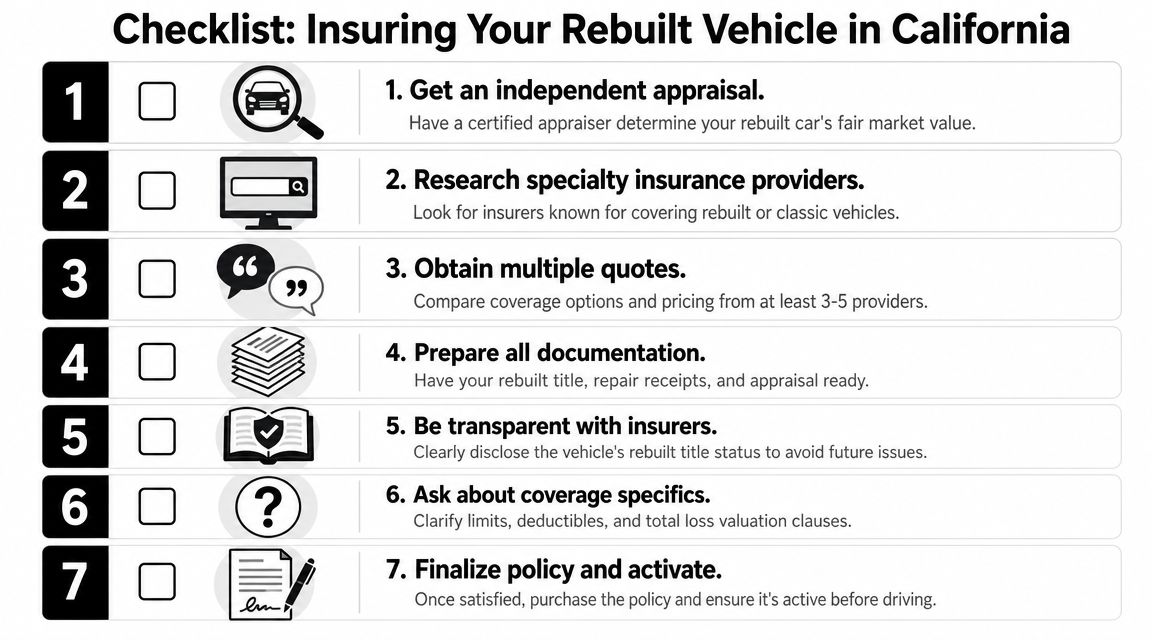
Before you buy
Start by checking whether the car is still salvage or already revived. That one fact changes the insurance conversation.
Then get a quote scenario in advance. Don't wait until after purchase. If you need a starting point for that process, request a California insurance quote before you commit to the vehicle.
The practical checklist
Confirm title status first
Ask for the current title document and verify whether it's salvage or already rebuilt or revived salvage.Inspect the paperwork, not just the paint
Sellers often focus on how the car looks now. You need receipts, prior damage details, and proof of what was repaired.Follow the California process in order
If the vehicle is still salvage, complete repairs and inspections before expecting ordinary insurance access.Build a complete insurer packet
Include title records, repair receipts, photos, and inspection results. The easier you make the underwriting review, the better your odds.Compare coverage types, not just premiums
A liability quote and a broader quote are not interchangeable products. Compare what each actually protects.Ask valuation questions before binding If collision or other broad coverage is offered, ask how the insurer handles total-loss valuation on a rebuilt vehicle.
Activate coverage before road use
Don't assume registration and insurance timing will line up automatically. Confirm the policy is active before the car is driven.
What to say when you call for quotes
Be direct. Tell the carrier or agent the vehicle has a rebuilt or revived salvage title. Trying to soften that detail only creates trouble later.
“The title brand isn't a detail to slide past. It's the first fact the insurer needs.”
Transparency helps in two ways. It avoids misrepresentation issues, and it gets you to the right market faster. Rebuilt-title underwriting is a niche corner of California auto insurance. The fastest route is usually the most honest one.
A simple decision filter
Ask yourself these three questions before you finalize the policy:
| Question | Why it matters |
|---|---|
| Can I accept liability-only coverage if that's the only viable option? | This is often the realistic outcome |
| Do I understand how a future claim may be valued? | A lower payout can wipe out the apparent bargain |
| Have I seen every repair and inspection document? | Weak documentation creates problems with both DMV and insurers |
If any answer is no, pause the purchase or the policy decision until you can fix that gap.
Avoid Common Pitfalls and Partner with an Expert
The most expensive mistakes with rebuilt vehicles are usually predictable. Buyers trust the seller's story instead of the paperwork. They assume a repaired car is automatically insurable. They focus on the monthly premium and ignore how the claim would be paid.
California adds another layer because the process is sequential. The vehicle has to be repaired, inspected, and properly retitled before the insurance market opens up in a meaningful way. Miss that sequence and you can end up with a car you own, can't drive, and can't insure the way you expected.
Another common mistake is thinking this is only an auto issue. It isn't. Most households should review auto insurance alongside renters insurance, home insurance, and life insurance so the full protection plan makes sense together. If you want answers to common California coverage questions before moving forward, the Mai & Associates FAQ page is a useful place to start.
A salvage-title vehicle can still make sense. It just requires more discipline, more paperwork, and more realism than a standard used car purchase.
If you need help sorting out rebuilt-title auto coverage in California, Mai & Associates can help you compare real options across carriers and review the bigger picture at the same time, including auto, home, renters, and life insurance. That's especially useful when you want one agency to spot coverage gaps, explain trade-offs clearly, and help you protect more than just the car.