What Is Insurance Loss of Use in California?
Picture this: a California wildfire forces you out of your home, or a car crash on a busy freeway leaves you without a vehicle. You're already dealing with the shock and disruption, but now you have a second problem—where will you live, and how will you get to work? This is where loss of use coverage in your California insurance policy steps in. It's the part of your home, renters, or car insurance that acts as a financial backstop, covering the extra costs you rack up when your property is suddenly unusable.
It’s not about rebuilding your home or fixing your car; other parts of your policy handle that. Loss of use is all about helping you maintain your normal standard of living while repairs are underway.
What Is Insurance Loss of Use in California?
Think of loss of use as a temporary expense account funded by your insurance company. When a covered disaster strikes, this coverage kicks in to pay for the increase in your living expenses. It’s a lifeline, especially here in California, where unique risks like wildfires and earthquakes can displace families for months at a time. And with our crowded roads, being without a car isn't just an inconvenience—it can bring your life to a standstill. This is why having adequate loss of use in your California auto insurance and home insurance is critical.
The Two Pillars of Loss of Use Coverage
Loss of use isn't a standalone policy. It's a specific type of coverage that shows up in two main places: your home insurance and your car insurance. Each one serves a vital, but different, purpose for California residents.
For Homeowners & Renters: In this context, it’s called Additional Living Expenses (ALE). If a fire, major water leak, or other covered event makes your home uninhabitable, your California home insurance or renters insurance ALE is what pays for your hotel, a short-term rental, and even the extra cost of eating out if you don't have a kitchen.
For Car Insurance: Here, it’s usually called Rental Reimbursement or Transportation Expense coverage. When your car is out of commission after a covered accident, this benefit in your California car insurance policy pays for a rental car so you can still get to work, school, and run your daily errands.
The whole point of loss of use is to prevent a disaster from turning into a second financial crisis. It stops you from having to pay your mortgage on a home you can't live in plus a massive hotel bill.
A Quick Comparison
To make it even clearer, let's look at how this coverage works side-by-side for your California home and auto insurance policies.
Loss of Use Coverage at a Glance
| Coverage Type | What It Covers | Common Scenarios | Policy Type |
|---|---|---|---|
| Additional Living Expenses (ALE) | Temporary housing, increased food costs (e.g., restaurants), moving/storage fees, laundry services, and other necessary expenses above your normal budget. | A house fire, severe water damage from a burst pipe, or a mandatory evacuation order due to a wildfire or earthquake. | Homeowners, Renters, or Condo Insurance |
| Rental Reimbursement | The daily cost of a rental vehicle up to your policy's per-day and per-incident limits. May also cover public transit or rideshare fees. | Your car is in the shop for repairs following a covered collision, theft, or other comprehensive claim. | Auto Insurance |
This table shows how each type of coverage steps in to solve a very specific problem—keeping your life moving forward when your property can't be used.
Why This Matters for Californians
Let's be honest: living in California is expensive. An unexpected financial hit can wipe out savings in the blink of an eye. Having the right amount of loss of use coverage on your home insurance and auto insurance policies provides a crucial layer of stability when you need it most. It lets you focus on the important stuff—like rebuilding your life—without the constant stress of ballooning daily expenses.
How Additional Living Expenses Protect Your Home
When a disaster forces you out of your house, whether it's a wildfire, a burst pipe, or a collapsed roof, your first thoughts are about safety. But what happens next? Where will your family live while your home is being repaired? How on earth will you afford it?
This is precisely where Additional Living Expenses (ALE) coverage steps in. It’s a vital, but often overlooked, part of your California home insurance or renters insurance policy that acts as a financial backstop when you need it most.
Think of ALE as a safety net designed to help you maintain your normal standard of living. It isn't a blank check for a luxury vacation, and it won't cover your existing mortgage. Its purpose is to cover the extra costs you rack up simply because you can't live at home.
The goal is to prevent a physical disaster from becoming a full-blown financial one. ALE coverage ensures you aren’t crushed by the burden of paying for two households at once—the damaged one you can't use and the temporary one you desperately need.
What ALE Typically Covers
Let's make this real. Imagine a family whose home is severely damaged in a California wildfire. They're told it will be at least three months before they can move back in. This is where their ALE coverage kicks in to help with a range of necessary, above-and-beyond costs.
- Temporary Housing: This is usually the biggest expense. It could be the rent for a comparable house in a nearby neighborhood or the cost of an extended-stay hotel.
- Increased Food Costs: If your temporary rental doesn't have a kitchen, you'll be eating out a lot more. ALE can cover the difference between restaurant bills and your normal grocery spending.
- Moving and Storage: The policy can cover the cost of movers to get your salvageable belongings out of the damaged house and into a storage unit, plus the monthly storage fees.
- Pet Boarding: What if your temporary apartment has a strict no-pets policy? The cost to board your dog or cat can be a covered expense.
- Extra Commuting Costs: If your temporary place is farther from your job or your kids' school, ALE can reimburse you for the extra gas or public transit expenses.
It’s critical to remember that ALE only pays for expenses that are additional to what you’d normally spend. For example, if your family's monthly food budget is typically $800 but being forced to eat out pushes that cost to $2,000, ALE would reimburse the $1,200 difference.
Understanding Your Policy Limits
ALE coverage isn't unlimited. Your California insurance policy will spell out exactly how much you can claim, and it's usually calculated in one of two ways:
- As a Percentage: The most common method. Your ALE limit is set as a percentage of your main dwelling coverage (Coverage A), typically somewhere between 20% to 30%. So, if your home is insured for $500,000, you likely have $100,000 to $150,000 in ALE coverage.
- As a Time Limit: Some policies put a cap on the duration of the benefit, such as 12 or 24 months, no matter the dollar amount. Once that time is up, the coverage stops.
For those of us in California, paying close attention to these limits is non-negotiable. With wildfires becoming more frequent and destructive, rebuilding and repair times can drag on. Globally, the modeled average annual property loss from natural catastrophes has hit USD 152 billion, with North America facing extreme wildfire risk. Disasters like the 2025 Palisades and Eaton fires caused up to USD 65 billion in economic losses, underscoring just how massive the financial fallout can be.
Crucially, ALE does not cover expenses you would have paid anyway, such as your mortgage payment, pre-existing utility bills, or the cost of home renovations unrelated to the covered damage.
What ALE Does Not Cover
Knowing what isn't covered is just as important as knowing what is. Misunderstandings here can lead to some painful, unexpected bills down the line. Generally, ALE will not pay for:
- Your Mortgage: You’re still on the hook for your mortgage payments, even if the house is unlivable.
- Regular Utility Bills: The electric and water bills for your primary residence are still your responsibility.
- Property Damage: The actual repairs to your home fall under other parts of your policy, like your dwelling coverage.
- Upgrades: If you decide to use the repair process to upgrade your old laminate countertops to granite, that extra cost is on you.
The best defense is a good offense—a robust policy that's been reviewed and updated for today's risks. You can learn more about what that looks like by reading our complete guide to home insurance in California. A well-designed policy ensures you have the financial breathing room to get back on your feet without wiping out your savings.
Keeping You on the Road: Rental Reimbursement Coverage
While your homeowner's policy covers your living situation, its auto insurance counterpart, loss of use, is all about keeping you mobile. For California drivers, this is better known as rental reimbursement coverage, and it’s your ticket to staying on the road when your car is out of commission.
It's an optional add-on to your California car insurance, but I've seen countless times how invaluable it can be. The concept is simple: if your car is in the shop for repairs after a covered incident—like a crash or even theft—this coverage foots the bill for a rental vehicle. Without it, you’re left either bumming rides or paying out-of-pocket for a rental, which, as we all know, gets expensive fast here in California.
How Rental Reimbursement Really Works
Now, this coverage isn't a blank check. It works within specific limits that you select when you set up your policy. Getting these limits right from the start is the key to making this benefit truly work for you.
Your coverage is almost always broken down by two numbers:
- A per-day limit: This is the max your insurer will pay for a rental for a single day. Think $30, $40, or $50 per day.
- A per-claim limit: This is the total maximum the policy will pay for the entire rental period for one claim, like $900, $1,200, or $1,500 in total.
So, if your policy has limits of $40 per day / $1,200 total, you could rent a car for up to 30 days, as long as the daily rate doesn't go over $40. If the only car available costs $50 a day, you’d just have to cover that $10 difference yourself. Pretty straightforward.
Real-World Scenarios in California
Let's put this into perspective with a couple of common situations California drivers face. How long your car is stuck in the shop is really what determines how much you'll lean on this coverage.
The Minor Fender Bender: Someone backs into you in a parking lot. Your car needs a new bumper and a paint job. The body shop says it’ll take four days. With a $50 per day limit, your policy has you covered for up to $200 in rental costs. You're back on the road without missing a beat.
The Major Collision: This one's more serious. Your car has frame damage, and the necessary parts are on backorder (a very common problem these days). The shop estimates it could be five weeks until you get your car back. With a $1,500 total limit and a $50 daily cap, you have 30 days of rental coverage. For that final week, you'd be on your own for the rental costs.
A quick note from experience: insurers expect you to rent a vehicle that’s a "like-for-like" replacement. If you drive a Honda Civic, your policy isn’t going to cover the rental cost for a brand-new Escalade.
What if the Other Driver Was at Fault?
This is a great question. If the other driver is clearly at fault for the accident, their insurance company is technically on the hook for all your costs, including the rental car. This is handled through a third-party claim, where you file for "loss of use" damages against their liability coverage.
The catch? Dealing with someone else's insurer can be a slow, frustrating process. You have two choices: wait for them to investigate, accept liability, and finally set up a rental, or simply use your own rental reimbursement coverage to get a car today. Your insurance company will then go after the at-fault driver's insurer to get their money back. This process is called subrogation, and it saves you a major headache.
Choosing the right limits is a balancing act. Take a look at daily rental rates in your part of California and be honest about how much you depend on your car. Bumping your coverage from $30 to $50 a day often costs just a few dollars more per month but delivers a whole lot more peace of mind. To make sure you’re set up for success, our guide to auto insurance in California breaks down all the coverages you need to be truly protected on the road.
A Step-by-Step Guide to Filing Your Claim
Knowing you have loss of use coverage in your California insurance policy is one thing; actually getting the money you’re owed is another. When a disaster hits, whether it’s your home or your car, the claims process can feel overwhelming. But a little bit of know-how goes a long way.
Let’s walk through exactly how to file a claim in California, so you can get the support you need without any extra headaches. The key is to be methodical and document everything, even when things feel chaotic.
Immediate Steps for Homeowners and Renters (ALE Claims)
If your home is suddenly unlivable, your first job is to get your family to safety. Your very next call should be to your insurance company. Here’s what to do.
Notify Your Insurer Right Away: Don't wait. Call your agent or the carrier's 24/7 claims hotline as soon as it's safe to do so. This first call officially starts the process and gets you assigned to a claims adjuster who will be your main point of contact.
Clarify Your Coverage: Once you have your adjuster on the line, ask them to spell out your Additional Living Expenses (ALE) limits from your home or renters insurance. You need to know the total dollar amount you have to work with and if there are any time limits on the coverage. Knowing this upfront is crucial for budgeting.
Document Everything. Seriously. I can't stress this enough. Keep every single receipt for every expense you incur because you've been displaced. Hotel bills, meals out, laundry services, pet boarding, even mileage—it all adds up. I recommend starting a simple spreadsheet or even just a dedicated folder to stash all your physical receipts.
Get Approval for Big-Ticket Items: Before you go out and sign a six-month lease on a fancy rental, run it by your adjuster first. They need to sign off on major expenses to ensure they’re considered "reasonable" under your policy. A quick phone call can prevent a huge financial headache down the road.
Following these steps provides the proof your insurer needs and helps you get reimbursed for everything you're entitled to while you’re out of your home.
Filing an Auto Rental Reimbursement Claim
Compared to a home claim, getting a rental car after an accident is usually a much quicker process. Still, you need to follow the right steps with your California auto insurance.
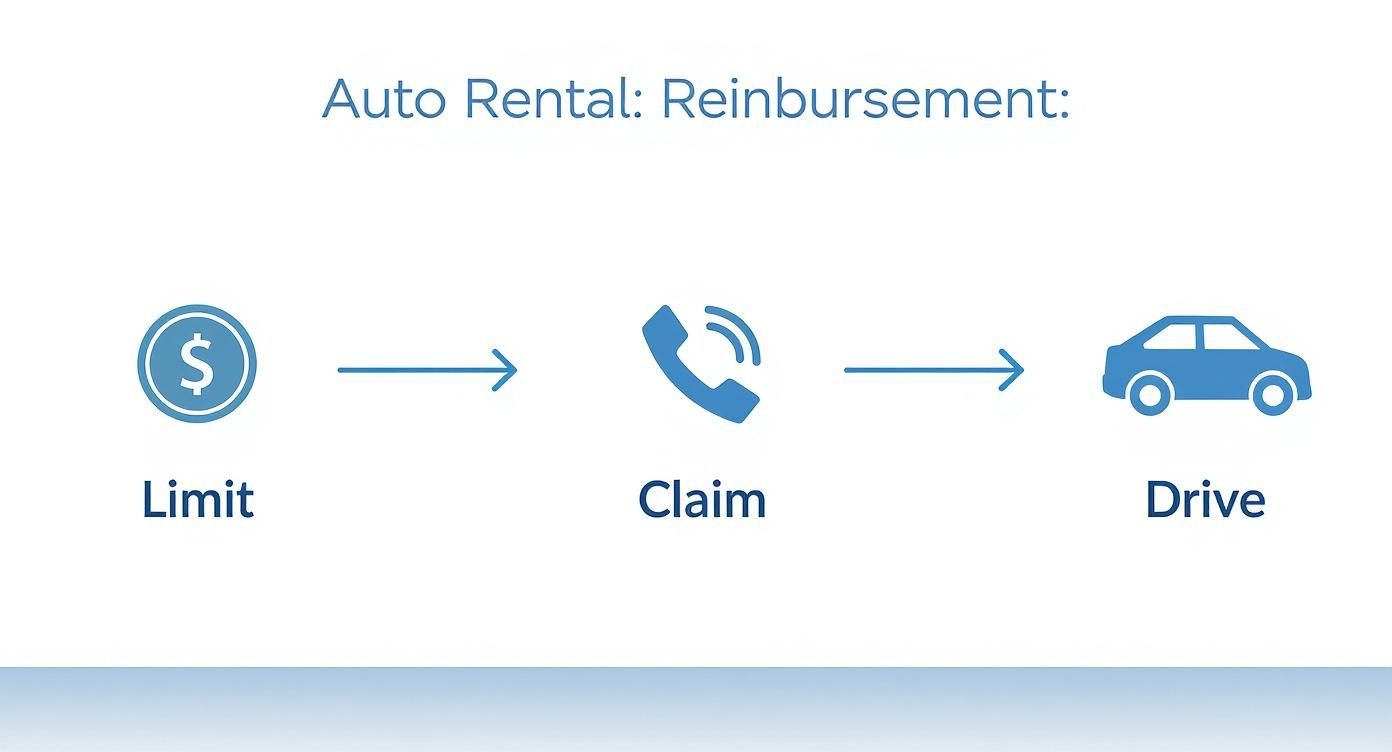
This process is pretty straightforward, but a common mistake can cause a lot of frustration.
Key Insight: Don't wait for the other driver's insurance company to sort things out. If you have rental reimbursement coverage, use it immediately. Your own insurance company will front the cost and then go after the at-fault party's insurer for reimbursement later (a process called subrogation). It saves you so much time and stress.
Here’s how to get it done:
- Confirm Coverage When You Report the Accident: As you’re on the phone reporting the accident, make it clear that you need to use your rental reimbursement coverage.
- Let the Adjuster and Body Shop Coordinate: Your adjuster will confirm that your car is undrivable or officially in the shop for repairs. They’ll then authorize the rental, often setting it up directly with one of their preferred rental agencies, so the billing is handled for you.
- Rent a “Like” Vehicle: Your policy is designed to cover a car similar to your own. If you drive a compact car, your $40 per day limit is perfect for another compact—not a luxury SUV. Keep it comparable to avoid paying out of pocket.
Overcoming California-Specific Hurdles
Here in California, major events like wildfires can trigger a massive number of claims all at once, which can sometimes slow things down. If you run into delays or feel your claim is being handled unfairly, you aren't alone and you have options.
The California Department of Insurance (CDI) is a state agency dedicated to protecting consumers. They are your advocate.
If you hit a roadblock, keep a detailed record of every conversation with your insurer—names, dates, what was discussed—and don't hesitate to file a formal complaint with the CDI if necessary.
Being informed is your best defense. For more detailed advice on navigating different California insurance scenarios, feel free to check out our library of California insurance guides.
California's Unique Insurance Challenges
Living in the Golden State is incredible, but it also means dealing with a set of risks that can turn your life upside down in an instant. For homeowners and renters, disasters like massive wildfires and earthquakes don't just hit one house; they can wipe out entire neighborhoods, creating a ripple effect that complicates recovery for everyone. The entire California insurance market, from home and auto insurance to life insurance, is shaped by these unique challenges.
When a catastrophe strikes, it’s not just your home that’s affected. Suddenly, thousands of families are simultaneously looking for a place to live. This triggers a massive surge in claims for Additional Living Expenses (ALE), and everyone is competing for the same limited pool of temporary housing, contractors, and even basic building materials. The local rental market gets squeezed hard, prices shoot through the roof, and finding a decent place to land becomes a battle.
This is exactly why having the right amount of insurance loss of use coverage is non-negotiable in California. The standard limits on a policy might look fine on paper, but they can evaporate in a heartbeat when you're facing a long-term rebuild after a widespread disaster.
The California FAIR Plan Explained
As private insurers have become more cautious about covering high-risk areas, many Californians have had to turn to the California Fair Access to Insurance Requirements (FAIR) Plan. It’s important to see the FAIR Plan for what it is: a last-resort safety net that provides basic fire insurance when no one else will.
But a standard FAIR Plan policy is far from a complete package. It’s designed to cover the bare bones—primarily, the fire damage to your physical structure.
Key Insight: The basic FAIR Plan policy does not automatically include substantial loss of use or ALE coverage. This is a critical gap that can leave you paying out-of-pocket for all your temporary living costs if a fire forces you from your home.
To get the well-rounded protection you actually need, you almost always have to buy a separate "difference in conditions" (DIC) policy from a private insurer. Think of it as a companion policy that fills in the holes the FAIR Plan leaves behind. A DIC policy adds crucial coverages like liability, theft, and most importantly, Additional Living Expenses. Without it, you’re on your own.
The Rising Tide of Catastrophe Claims
The financial toll of these large-scale disasters is staggering, and it's only getting worse. We're seeing a clear upward trend in global insured losses from natural catastrophes, which puts enormous pressure on the entire insurance market. In the first half of 2025 alone, the United States was responsible for over 90% of all insured losses worldwide, with severe storms racking up USD 44 billion in claims. You can dive deeper into this data by reading the full natural catastrophes trend analysis from SwissRe.
This rising financial burden has a direct impact on California homeowners. When insurers are paying out billions in claims, they have to re-evaluate their risk. The result? Higher premiums, tighter underwriting rules, and in many cases, dropping coverage altogether in fire-prone areas.
Getting a handle on these California-specific issues is vital. The reality of wildfire risk, combined with the limitations of plans like the FAIR Plan, shows why having enough loss of use coverage isn't just a smart move—it’s an essential part of your financial survival kit. It’s the buffer that lets you put your life back together without wiping out your savings during a long and stressful recovery.
Let's Make Sure You're Actually Covered
Getting your head around the details of insurance loss of use is a great start, but what really matters is knowing your policy will actually come through for you when you need it. Here in California, having the right coverage isn't just a nice-to-have; it's a critical safety net that protects your financial stability if you're ever forced out of your home or can't use your car.
The right limits on your policy can honestly be the difference between a temporary, manageable headache and a full-blown financial disaster.
Why Expert Guidance Makes All the Difference
This is where having an expert in your corner becomes so important. California's insurance world is a tricky one to navigate on your own, and a dedicated partner can help you sidestep the common pitfalls. At Mai & Associates, our entire team is focused on one thing: helping Californians analyze their auto insurance, home insurance, renters insurance, and even life insurance policies to find those dangerous coverage gaps before a catastrophe hits.
Get a Personalized Policy Check-Up
We're big believers in being proactive. Why wait for a claim to find out your policy has a weak spot? We offer a complimentary, no-strings-attached review to see exactly where you stand. Our licensed agents will walk you through your current protection and give you personalized, practical advice.
We’ll dig into the most important areas:
- Your Additional Living Expenses (ALE) limits: Are they high enough to cover the reality of California's cost of living, especially when a major event like a wildfire makes temporary housing scarce and expensive?
- Your auto rental reimbursement: Do the daily limits on your auto policy actually match up with what it costs to rent a car in your area? You don't want to be paying the difference out of your own pocket.
- Potential gaps in your renters policy: We'll check to see if you're left exposed if your apartment building is declared uninhabitable.
The worst time to find out your coverage isn't enough is when you're in the middle of filing a claim. A quick review today can literally save your financial future tomorrow.
Our goal is simple: to make sure your coverage fits your real life and your budget. We'll give you clear, straightforward options for securing solid protection for your home, your car, and your family.
Ready to feel confident that you're truly protected? Connect with the experts at Mai & Associates for a complimentary policy review. Let us help you get the peace of mind you deserve.
Answering Your Top Questions About Loss of Use
Insurance policies can be full of confusing terms, and it's easy to get lost in the details. To make things clearer, we've put together some plain-English answers to the questions we hear most often from Californians about loss of use coverage for their homes and cars.
Getting a handle on these key points can be a game-changer if you ever find yourself needing to make a claim. Let’s tackle some of the most common uncertainties about California insurance.
How Is My Additional Living Expense (ALE) Limit Calculated?
Your ALE limit isn't just a number pulled out of thin air. It’s directly linked to your main coverage amount.
For homeowners, the limit is typically a set percentage of your dwelling coverage (Coverage A), usually falling between 20% to 30%. So, if your home is insured for $600,000, your ALE coverage would likely be somewhere between $120,000 and $180,000.
Renters policies work in a similar way, but the percentage is based on your personal property coverage limit. The best way to know for sure is to check the declarations page of your policy—it’ll spell out the exact amount.
Can I Pick My Own Hotel or Rental Car?
Yes, for the most part, you're in the driver's seat. You can choose your own temporary housing or rental vehicle. But there’s a catch: your choices have to be "reasonable."
The whole point is to maintain a standard of living similar to your normal one, not to upgrade. So, if you normally drive a family sedan, your policy will cover the cost of a similar rental, not a luxury sports car. It's always a good idea to chat with your claims adjuster before signing a long-term lease or booking an extended hotel stay, just to make sure the costs will be approved.
What Happens If Repairs Take Longer Than My Coverage Lasts?
This is a really important question, especially here in California where a major wildfire or earthquake can lead to widespread construction delays. If your temporary housing costs or rental car expenses go beyond your policy's limits, you'll have to pay the difference out of your own pocket.
For example, if your car insurance policy has a 30-day cap on car rentals but the body shop needs 45 days to finish repairs, you are on the hook for those extra 15 days. This is precisely why it’s so critical to make sure you have adequate limits from the get-go.
Is Loss of Use Included in My Renters Insurance?
You bet. Loss of use coverage is a standard feature in virtually all California renters insurance policies (often called an HO-4 form). It works just like it does for homeowners, covering your extra living costs if your rented home or apartment becomes unlivable after a fire, burst pipe, or other covered disaster.
You can find more answers to common insurance questions on our general California insurance FAQ page.
Are you sure your current policies have what it takes to see you through a major disruption? The team at Mai & Associates specializes in reviewing home insurance, auto insurance, and renters insurance policies to make sure Californians have the protection they truly need, not just the bare minimum. Get in touch with us for a free, no-obligation policy review today.