Insurance for Uninsured Drivers: Find Coverage in 2026
You're not reading this because insurance is an interesting hobby. You're reading it because something happened, or you're worried something is about to happen.
Maybe your policy lapsed and you've been hoping not to get pulled over. Maybe the DMV sent a notice. Maybe you had a ticket, an accident, or a registration problem, and now you need car insurance fast. That situation feels heavy, but it's fixable. In California, there are real paths to get legal again, even if your record isn't clean and your budget is tight.
Consequently, insurance for uninsured drivers becomes practical, not theoretical. The right auto insurance policy gets you back on the road legally. The right structure can also support the rest of your protection plan, including renters insurance, home insurance, and life insurance, so one problem with a car doesn't spill into the rest of your finances.
The Reality of Driving Uninsured in California
You get pulled over on the way to work. The officer asks for proof of insurance, and you realize the card in your glove box is from an old policy. That is the moment an insurance lapse stops being paperwork and turns into a legal and financial problem.
In California, driving uninsured creates two separate risks at the same time. The state can penalize you for not carrying proof of financial responsibility, and any crash you cause can become your personal bill. Those are very different problems, but they hit fast and often together.
California also has a large share of uninsured drivers on the road. In 2023, California had an uninsured driver rate of 20.4%, meaning about 1 in 5 drivers operated without liability insurance coverage, according to this California uninsured driver analysis. That matters to you even if you are trying to get legal today, because it affects claim disputes, repair delays, and what other drivers may carry on their own policies.
As of January 1, 2025, the state minimum liability limits are 30/60/15. If you still have the old minimums in mind, update that immediately. A lot of drivers get caught by outdated advice from friends, old ID cards, or expired quote emails.
What actually goes wrong
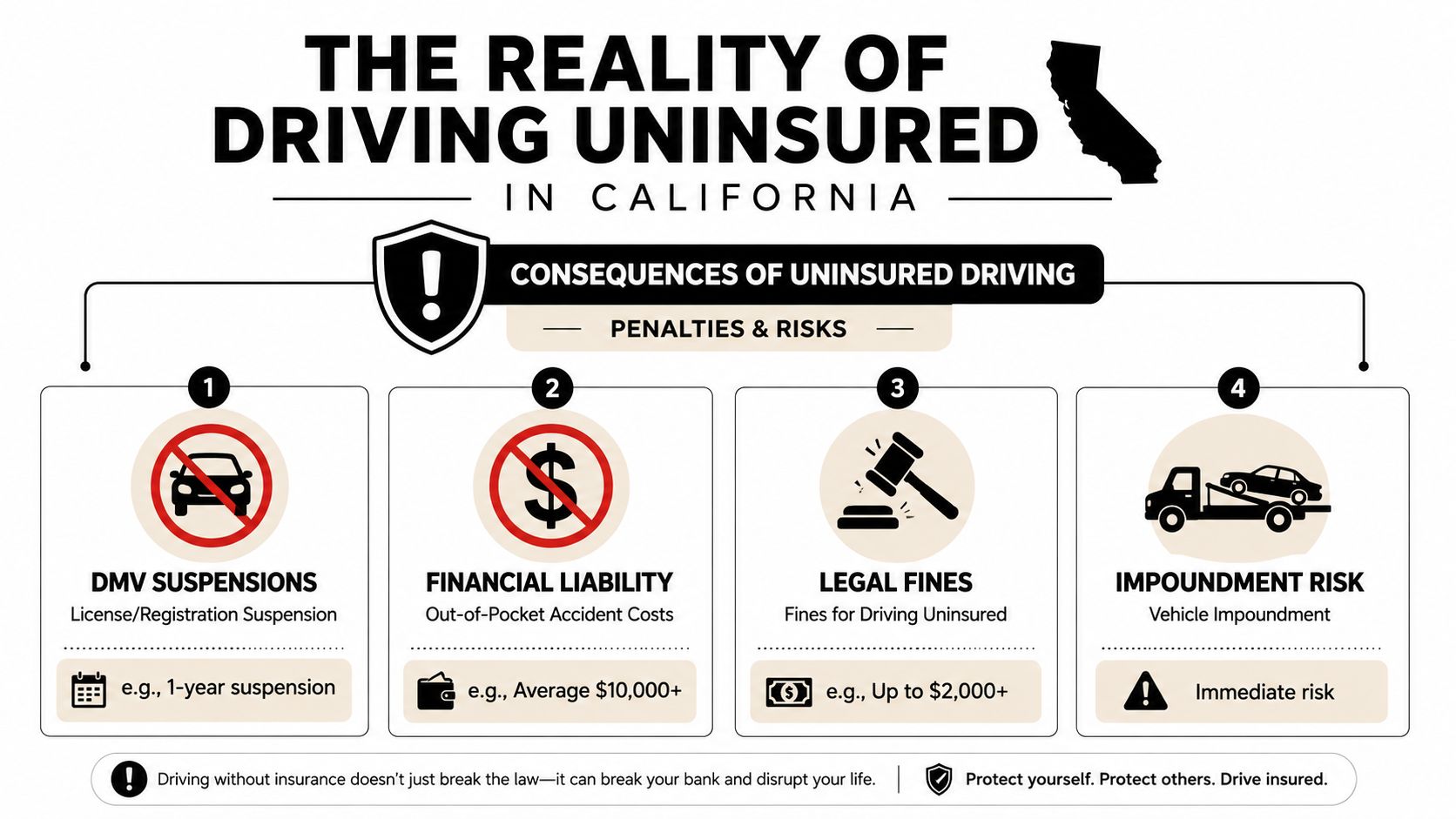
The first problem is usually a ticket. For a first offense, California can issue a fine in the $100 to $200 range before added assessments and court costs. In real life, the amount people pay is often higher once the case works through the system.
The second problem is administrative, and many drivers miss it until registration gets tangled up. If insurance reporting is not on file with the DMV, registration can be suspended. Then the car cannot legally be driven, and in some situations it cannot even be parked on a public street.
The third problem is the one that does the most damage. If you cause a crash without liability coverage, there is no insurer stepping in to pay covered injuries or property damage for the other party. That can mean repair bills, medical demands, collections, wage garnishment pressure, or a lawsuit.
I tell clients this all the time. The ticket is painful, but the uninsured accident is what can follow you for years.
The practical reason to act now
Drivers usually end up uninsured for ordinary reasons. A payment bounced. Renewal mail went to the wrong address. A carrier non-renewed the policy. The fix is to get legal coverage in place quickly, then improve it once the immediate risk is under control.
Start with a policy you can keep. Cheap coverage that cancels in 30 days because the deposit was too high or the payment plan did not fit your budget is not a solution. If you need a starting point, review basic California auto insurance options with the legal minimums and payment structure in mind, not just the headline monthly price.
If you also want to understand the other side of this problem, especially what happens when the at-fault driver has no insurance, Total Loss Northwest: UM explained is a useful plain-English resource.
Your First Step to Getting Legal Car Insurance
You missed a payment, your policy canceled, and now you need legal coverage before the next commute. In California, the fastest fix usually starts in one of two places. Check whether you qualify for the state's low-cost program, or shop the standard market with an agent who can place lapse or high-risk business.
Start with CLCA if price is the reason you went uninsured
California created the California Low Cost Automobile Insurance Program, or CLCA, for drivers who need a legal way back on the road at a lower price point. I recommend looking at it first when the problem is simple: you need liability coverage now, and your budget is tight.
CLCA has helped many uninsured Californians get legal again. Since its inception, CLCA has provided coverage to over 226,577 drivers, and in 2023, 73% of applications came from motorists who were uninsured when they applied, according to the CLCA legislative report.
The basic screening questions are straightforward:
| Requirement | What to know |
|---|---|
| Age | You must be at least 16 years old |
| License | You need a valid California driver's license, including AB 60 licenses |
| Vehicle value | The car must be worth $25,000 or less |
| Income | You must meet household income guidelines |
If those boxes line up, CLCA can be the quickest practical answer.
Know what CLCA does, and what it does not do
CLCA gets you legal with liability insurance. It does not pay to repair your own car after a crash, theft, or weather loss the way collision and other physical damage coverages can.
That trade-off matters.
If the car is older, paid off, and you mainly need to stop driving uninsured, CLCA often makes sense. If the vehicle is financed, recently purchased, or expensive to repair, a standard policy may be the better fit even if it costs more. The right first policy is the one you can afford to keep active, not the one that looks cheapest for one month.
Drivers dealing with a license issue should also confirm whether insurance is only part of the fix. If your problem includes a suspension, review this 2026 suspended license guide so you do not solve one problem and miss the next one.
Use the standard market when you need more flexibility
If you do not qualify for CLCA, do not assume no one will insure you. California carriers price lapse history, prior cancellations, tickets, ZIP code, and vehicle type differently. One company may decline. Another may offer a workable down payment and payment plan the same day.
Before you shop, gather these items:
- Driver's license information
- Vehicle identification number
- Garaging address
- Any notice from the DMV or court
- Prior insurance details if you had a recent lapse
Then request a California car insurance quote for drivers with a recent lapse or urgent coverage need. Ask about the down payment, the monthly installment, and the earliest effective date. Those three details matter more right now than a polished quote with coverages you cannot carry.
One agent tip. Be honest about the lapse and any DMV notice upfront. Carriers usually find it during underwriting anyway, and fixing a bad application after binding can slow down proof of insurance when time matters most.
Navigating High-Risk Situations and SR-22 Filings
You get pulled over on the 5, hand over your license, and the officer tells you the DMV now wants an SR-22 before your driving privilege can be cleared. That is usually the moment the stress spikes. Drivers hear "SR-22" and assume they need some rare policy that takes days to find.
What they usually need is a standard auto policy set up correctly, plus the filing.
What an SR-22 really is
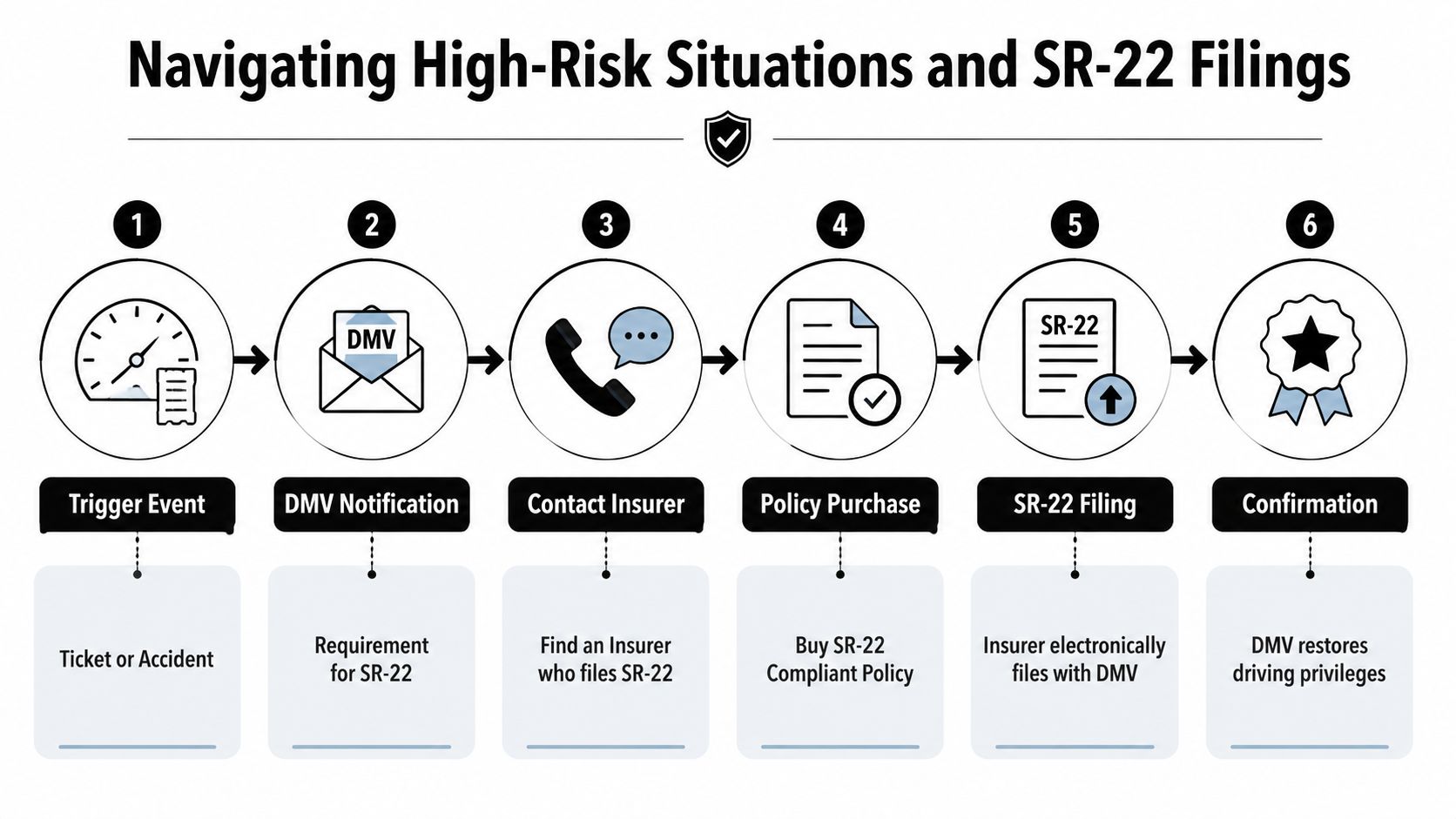
An SR-22 is a form your insurance company files with the California DMV to show you carry the required liability coverage. It is proof on file, not a separate type of insurance. Depending on your situation, the DMV may require an owner policy if you have a car, or a different filing arrangement if you do not.
The sequence usually looks like this:
How to handle the filing without making it worse
The biggest mistakes happen after the driver decides to fix the problem. They buy a policy that does not include the filing, they pick an effective date that is too late, or they miss the first payment and end up back in trouble.
A better approach is simple:
- Read the DMV notice line by line: Confirm what the state requires and whether there is a deadline tied to reinstatement.
- Tell the agent you need the SR-22 before you pay: Do not assume every carrier or every quote includes it automatically.
- Ask how fast the filing is sent: Some insurers file electronically the same day. Others take longer, and that timing matters if you are trying to reinstate quickly.
- Get the total monthly cost, not just the down payment: A low first payment does not help if the second payment is what causes the policy to cancel.
- Keep proof and confirmation numbers: Save the ID card, payment receipt, and any filing confirmation in one place.
One agent tip. If your record is messy, say so early. Tickets, a prior lapse, a registration problem, or a DUI history can change which companies will accept the filing and how quickly they can issue it.
If standard carriers will not take you
High-risk does not mean uninsurable in California. It usually means fewer carrier options, a higher upfront payment, or stricter billing terms.
That trade-off matters. A policy that files the SR-22 today and stays active for the full filing period is better than a cheaper option that is likely to cancel in 30 days.
If your license is suspended, insurance may be only one part of the fix. This 2026 suspended license guide explains how insurance and reinstatement issues often overlap. If you want more help on filings, reinstatement problems, and common California policy setups, review these California insurance guides for SR-22 and high-risk drivers.
How to Compare and Buy Your First Policy
You finally have a few quotes in front of you. One has the lowest down payment. Another costs more each month but includes better protection. If you are trying to get legal fast after a lapse, this is the point where a bad choice can cost you twice.
The first job is simple. Buy a policy that starts on time, matches your actual driving situation, and stays paid. Everything else comes after that.
Get your quote information together first
Clean information gets cleaner quotes. Before you call, go online, or sit down with an agent, pull together the details that usually hold up the process:
- Driver details: License status, date of birth, and address
- Vehicle details: VIN, year, make, model, and where the car is kept
- Usage details: Personal driving, commuting, or business use
- Compliance details: Any SR-22 requirement, lapse history, or recent ticket notice
That cuts down on quote changes, missed discounts, and last-minute surprises at binding.
A standard online quote page can help you organize the basics before you speak with anyone. If you want a plain-English reference for common policy terms while you shop, this California auto insurance FAQ page can help.
Compare coverage before you compare price
California requires minimum liability coverage, as noted earlier in this article. Meeting the minimum keeps you legal. It may not leave much room if you cause a serious crash or hit a newer vehicle.
That is why I tell drivers to compare four parts of the quote in the same order every time:
| Coverage decision | What to ask |
|---|---|
| Liability limits | Does the policy meet California requirements, and would higher limits fit your budget? |
| Uninsured and underinsured protection | If the other driver has little or no coverage, what would your own policy pay for injuries or damage? |
| Deductibles | Could you actually pay that amount this month if you had a claim? |
| Payment plan | Is the monthly bill realistic enough to keep the policy active? |
A starter policy should do three things well. It should keep you legal, protect you from a basic loss, and fit your real budget.
What works better than chasing the lowest number
The cheapest quote often looks best for about five minutes. Then the billing schedule shows up, the deductible is higher than expected, or an exclusion leaves the household driver off the policy. Those are the details that create claim problems and new lapses.
A better approach is to ask one practical question before you buy: "Can I keep this policy active for the next six to twelve months?" If the answer is shaky, the lower price is not really lower.
I also tell California drivers to ask whether roadside assistance, rental reimbursement, or physical damage coverage are worth adding now or later. The right answer depends on the car. A financed vehicle usually needs more protection. An older paid-off car may not justify every extra.
For general budgeting ideas, this guide to lowering Georgia car insurance is written for another state, but several of the habits still apply when you are trying to keep a new policy affordable and active.
For many households, auto coverage is the first piece of a bigger protection plan. Once the car is handled, it can make sense to review renters insurance, home insurance, or life insurance based on what you need and what you can carry without missing payments.
Proven Ways to Lower Your Car Insurance Premiums
The fastest way to lower your premium is usually not switching to the bare minimum. It is fixing the rating details that carriers use against you and cutting extras that do not match your car or budget.
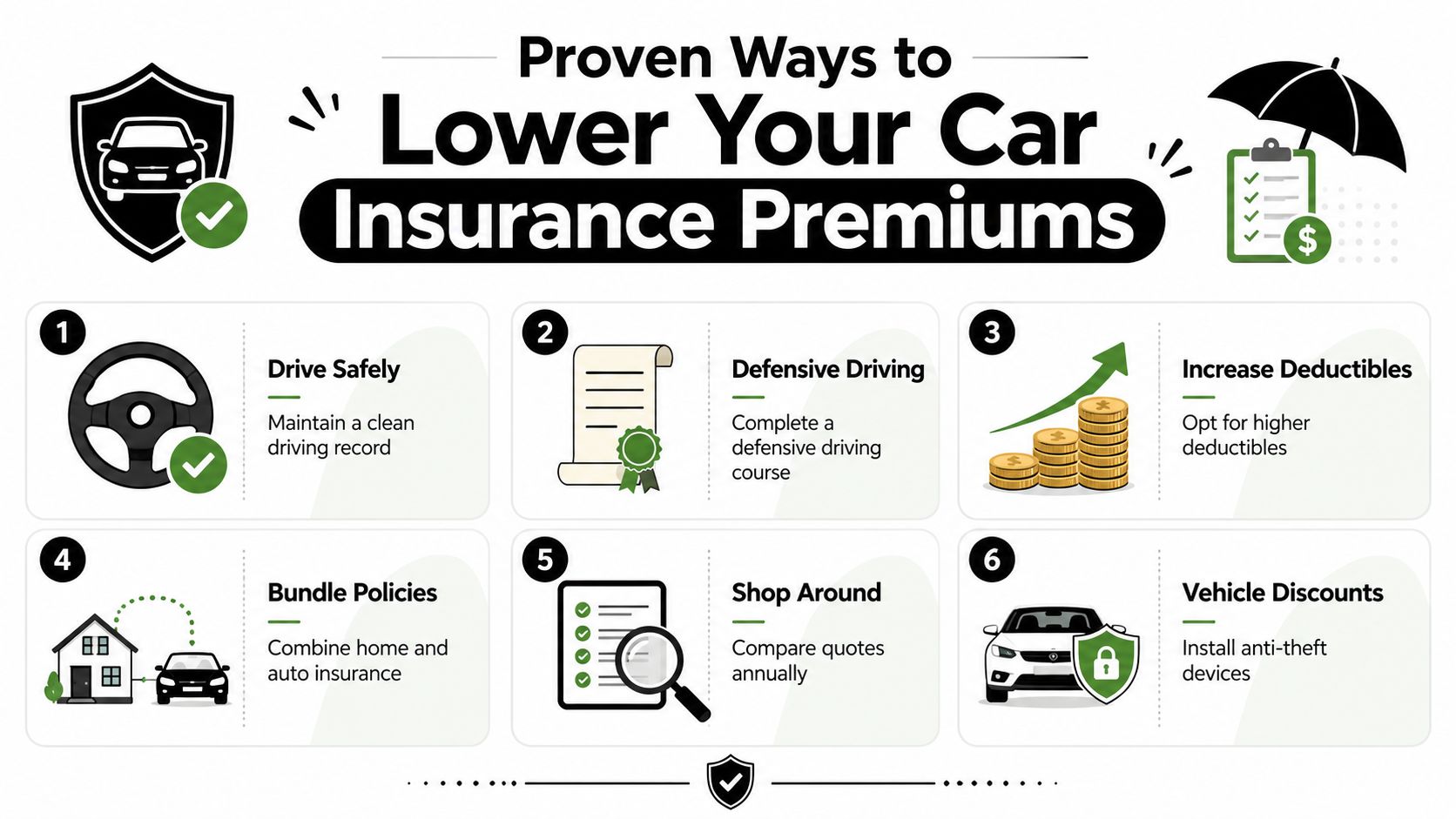
A lot of California drivers who were recently uninsured ask the same question: "What can I change today that moves the price?" The answer is usually a handful of small corrections, not one dramatic discount.
The savings moves worth asking about
Start with the parts of the quote that affect price the most.
- Set the deductible at a number you could pay: Raising it can lower the premium, but only if that higher out-of-pocket cost would not put you right back in a financial hole after a claim.
- Report your mileage accurately: Lower annual mileage can help with some carriers. If your commute changed, say so.
- Review who is listed and how the car is used: Household drivers, commute use, business use, and garaging address all affect rate. Small errors here can cost you every month.
- Bundle only if the total bill improves: Adding renters insurance or home insurance can reduce the auto premium, but check the full combined price, not just the auto line.
- Ask about paid-in-full, autopay, and paperless discounts: These are not huge on their own, but together they can make a starter policy easier to keep.
- Keep your driving record clean from this point on: One quiet renewal period can open better options than many drivers expect.
If you want a broader outside checklist, this guide to lowering Georgia car insurance is written for another state, but several budgeting habits still apply.
Cuts that save money, and cuts that backfire
Some reductions are smart. Some create a claim problem.
For an older paid-off car, dropping collision or rental reimbursement may make sense if you could replace the car or handle repairs yourself. For a financed vehicle, or a car you rely on to get to work every day, stripping coverage too far often creates more risk than savings.
I also see drivers chase a lower number by choosing billing plans they cannot maintain. A monthly premium that is slightly higher but stable is often the better deal than a cheap quote that leads to a missed payment and another lapse.
California also recognizes alternatives to a standard auto policy, such as a DMV cash deposit or surety bond, as noted earlier. For nearly every driver I talk to, a regular policy is still the more realistic option because it is easier to set up, easier to show as proof, and easier to keep in force.
Use a simple review routine
Run this check at every renewal:
- Confirm mileage, address, and vehicle use
- Ask which discounts are already applied, and which are missing
- Review whether collision and rental coverage still fit the car
- Compare the full account cost if you add renters or home coverage
- Get fresh quotes before renewal if your record has improved
If you want plain-English help with deductibles, coverage choices, or billing questions, a California insurance FAQ for common policy questions can save you from making a change that looks cheaper but costs more later.
Staying Insured and Protecting Your Future
Getting insured once is a relief. Staying insured is what changes your situation.
A lot of drivers fix the immediate problem, then drift back into risk because a payment date gets missed or renewal paperwork gets ignored. If you've gone through the stress of being uninsured, the smartest move is to make your next lapse much less likely.
Keep the policy active on purpose
The best habits are boring, and that's exactly why they work.
- Use automatic payments if your budget allows it: That removes the most common reason policies lapse.
- Open every insurer notice right away: Billing, underwriting, and renewal mail all matter.
- Save your proof of insurance in more than one place: Keep digital access and a backup copy you can pull up quickly.
- Report major changes promptly: New address, new car, added driver, or changed use should be updated before they become claim problems.
A stable insurance history helps you far more than one month of chasing the lowest possible price.
Turn one policy into a real safety net
Auto insurance is often the first policy people buy because the law requires it. But once you've stabilized that piece, it makes sense to look at the rest of the household.
Renters insurance protects the things inside your apartment or rental home. Home insurance protects the structure, your liability exposure, and your long-term equity. In California, that conversation is especially important for homeowners in wildfire-prone or otherwise high-risk areas. Life insurance protects your family's future if your income supports other people.
Insurance stops feeling like a punishment and starts acting like a plan. Your car insurance keeps you legal on the road. Your renters or home insurance protects where you live. Your life insurance protects the people who depend on you.
The bigger win
The true win isn't just avoiding a ticket. It's getting back into a position where one setback doesn't knock everything else loose.
If you need insurance for uninsured drivers in California, start with the fastest legal option you can keep in force. Then improve your coverage, reduce your premium where possible, and build out the rest of your protection over time. That's how people move from scrambling to stable.
If you want help comparing California auto insurance, renters insurance, home insurance, or life insurance without guesswork, Mai & Associates makes it easy to review options, compare carriers, and find coverage that fits your budget and your situation.