Your Ultimate Guide to Insurance for Landlords in California

If you own a rental property in California, your standard homeowner's insurance policy is a major financial risk. It's simply not built for the job. Landlord insurance is a completely different product, designed specifically to protect your rental as the business investment it is. It shields you from tenant-related risks and income loss that a regular policy won't touch. While we specialize in all forms of California insurance, from auto insurance to home insurance, this guide focuses on the unique needs of landlords.
Why Landlord Insurance Is a Necessity, Not a Suggestion

Think of your rental property as a small business. Just like a professional chef needs commercial-grade ovens, not a home kitchen range, a landlord needs specialized business insurance. A standard homeowner's policy is designed for one thing: an owner-occupied home. It was never intended to cover the unique liabilities that come with having tenants.
This isn't just a technicality; it's a critical distinction, especially in a litigious state like California. Homeowners insurance covers your personal belongings and your liability for guests. Landlord insurance, on the other hand, is all about business-related risks.
The Critical Coverage Gap
So, what happens when things go wrong? Imagine a tenant's guest slips on a staircase you were meant to repair and decides to sue you for their medical bills. Or what if a kitchen fire makes your unit unlivable for six months, completely stopping your rental income?
In both scenarios, your homeowner's policy would almost certainly deny the claim. Why? Because the property is being used as a business, which voids the coverage. This leaves you exposed to potentially devastating financial losses.
Landlord insurance is built to plug these exact holes. It’s a financial safety net that typically covers three core areas:
- Property Damage: This protects the physical building—the dwelling and other structures—from things like fire, storms, or even vandalism by a disgruntled ex-tenant.
- Liability Protection: This is huge. It covers you if you’re found legally responsible for an injury that occurs on your property, paying for legal fees and medical bills up to your policy limit.
- Loss of Rental Income: If a covered event (like that kitchen fire) forces your tenants to move out while you make repairs, this coverage reimburses you for the rent you would have collected.
It's no surprise that more investors are catching on. The global landlord insurance market was valued at $20.7 billion in 2023 and is projected to hit nearly $41 billion by 2032. This explosive growth shows that seasoned investors don't see this insurance as optional—they see it as a fundamental part of protecting their assets.
Homeowners Insurance vs. Landlord Insurance at a Glance
To see the difference clearly, it helps to compare the two policies side-by-side. A standard homeowner's policy is great for the home you live in, but it leaves massive gaps when that same home becomes a rental property. When considering your overall California insurance portfolio, distinguishing between home insurance for your residence and insurance for landlords is key.
| Coverage Area | Homeowners Insurance (Owner-Occupied) | Landlord Insurance (Tenant-Occupied) |
|---|---|---|
| Primary Dwelling | Covered. Protects the structure of the home you live in. | Covered. Protects the structure of the rental property. |
| Personal Property | Covered. Protects your furniture, clothes, electronics, etc. | Not Covered. Does not cover the tenant's personal belongings. |
| Liability | Covered. Protects against injuries to guests in your home. | Covered. Protects against tenant or guest injuries on the rental property. |
| Loss of Use | Covered. Pays for your living expenses if your home is uninhabitable. | Not Covered. This is for owner-occupants only. |
| Loss of Rent | Not Covered. Homeowner's policies don't account for rental income. | Covered. Reimburses lost rent if the unit is uninhabitable due to a covered loss. |
As the table shows, relying on homeowner's insurance for a rental property means you have zero protection for the unique risks of being a landlord, like liability for tenant injuries or the loss of your rental income stream.
More Than Just a Policy
Smart property management in California isn't just about having the right insurance policy. It's also about understanding your legal duties to provide a safe, habitable home for your tenants. Failing to meet these obligations can quickly lead to lawsuits and other headaches, driving up your risk profile.
A standard homeowner's policy is for personal living; landlord insurance is for professional investment. Confusing the two is like using a family car for a commercial delivery service—the moment something goes wrong, you discover you're not actually covered.
Protecting your investment starts with knowing your obligations. Taking the time to understand the essential landlord responsibilities in California will help you prevent problems before they start. Combining that proactive knowledge with the right landlord insurance policy is the foundation of a secure and profitable rental business.
Breaking Down Your Landlord Insurance Policy

When you first look at a landlord insurance policy, the jargon can feel overwhelming. But once you get past the industry terms, you’ll find it’s really just a bundle of specific protections designed to keep your investment property safe from financial ruin. Most landlord policies, often known as a DP-3 (Dwelling Property Form 3), are built from a few key pieces that work together.
Think of it this way: you have insurance for the building itself, for legal trouble, and for your rental income. Each part has a distinct job to do.
Dwelling Protection: The Armor for Your Building
First up is dwelling protection, which is the core of any insurance for landlords. This is what protects the actual physical structure—the house or building itself. It covers everything from the foundation and walls to the roof, and even other structures on the property, like a detached garage, shed, or fence.
This coverage comes into play when the property is damaged by a "covered peril." Common examples include:
- Fire and smoke
- Windstorms and hail
- Vandalism
- Damage from the weight of ice and snow
Let’s say a major winter storm tears through, ripping a hole in the roof and letting rain pour in. Dwelling protection is what would cover the cost of repairing the roof and fixing the subsequent water damage inside. Without it, you're on the hook for that entire, often massive, repair bill.
Liability Protection: Your Financial Shield
Next is liability protection, and for any California landlord, this might be the most important piece of the puzzle. It’s your financial shield if someone gets hurt on your property and decides to sue you.
Picture this: a tenant’s guest trips on a loose step you hadn't gotten around to fixing, suffers a serious injury, and names you in a lawsuit for their medical bills. Your liability coverage handles the legal defense—which alone can cost tens of thousands—and pays for any settlement or court-ordered judgment, right up to your policy limit.
In a state as litigious as California, having solid liability coverage isn't just a good idea; it's a fundamental business requirement. One lawsuit could easily threaten your personal assets, far beyond the rental property itself.
This is a key difference from a standard homeowner's policy, which is designed to cover personal liability for an owner who lives in the home. If you want to dive deeper into how that works for your own home, take a look at our guide on home insurance in California.
Loss of Rent Coverage: Your Income Lifeline
So, what happens to your cash flow if a covered event, like a kitchen fire, makes your rental uninhabitable for months? Your tenant has to move out, and suddenly your rental income is gone. This is exactly why loss of rent coverage (sometimes called "fair rental value") is so crucial.
This coverage reimburses you for the rent you lose while the property is being repaired after a covered claim. It’s a lifeline that keeps the income flowing so you can still meet your mortgage payments and other property expenses, even when it’s sitting empty. It’s essentially business interruption insurance for your rental.
Critical Add-Ons Every California Landlord Needs to Consider
A standard DP-3 policy is a great start, but it absolutely does not cover everything. In California, a couple of major risks are almost always excluded, and you need to address them with separate endorsements or policies. This strategy applies to other coverage types as well, including auto insurance where comprehensive coverage may not include everything.
- Earthquake Insurance: Standard policies do not cover earthquake damage. Here in California, that’s a massive gap in coverage. You need a separate earthquake policy to protect your building from the structural devastation a tremor can cause.
- Flood Insurance: Like earthquakes, damage from flooding is also excluded. This coverage has to be bought separately, either through the National Flood Insurance Program (NFIP) or a private flood insurer.
Ignoring these two add-ons, especially if your property is in a high-risk area, is a gamble. You're leaving your investment completely exposed to two of the most destructive forces in the state. The first step in building a truly protective policy is to honestly assess your property’s specific risks.
What Your Policy Actually Covers and What It Leaves Out
One of the biggest lessons you learn as a landlord is that your insurance policy is a detailed contract, not a magic wand. Knowing what it covers is only half the battle; understanding what it doesn't cover is what truly protects your investment and prevents nasty surprises.
Think of your policy as a very specific agreement. It clearly lists the sudden, unexpected events it will pay for and, just as importantly, the situations that fall squarely on your shoulders. Let's draw a clear line between what's covered and what's excluded.
What Your Landlord Policy Typically Covers
At its core, your landlord policy is there for the big, accidental disasters that could otherwise sink your rental business. These are the sudden events that cause significant property damage or land you in legal trouble.
Here are a few real-world examples where your insurance becomes your financial lifeline:
- A Kitchen Fire: Your tenant accidentally starts a grease fire. The damage to the cabinets, walls, and ceiling is extensive. Your policy is designed to cover these structural repairs.
- A Tenant Lawsuit: A delivery person trips on a loose step you hadn't fixed, breaks an ankle, and sues you for medical bills and negligence. Your liability coverage would handle the legal fees and any resulting settlement, up to your policy limit.
- Vandalism to the Property: Someone smashes your rental's windows and spray-paints the siding. Your policy should cover the cost to repair this malicious damage.
- Loss of Rental Income: After that kitchen fire, the unit is uninhabitable for three months. Your "loss of rent" coverage would step in to pay you the $7,500 in rent you lost during the repair period (based on a $2,500 monthly rent).
These coverages are the bedrock of your protection, shielding you from major financial hits that are often completely out of your control.
What Your Landlord Policy Leaves Out
Now for the other side of the coin: the exclusions. This is where many landlords get tripped up. It's a critical mistake to assume your policy covers everything that goes wrong. Insurers are very clear about what they won't pay for, and these items usually involve maintenance, normal aging, or a tenant's own responsibilities.
To help you get a clearer picture, this table breaks down some common situations.
Common Scenarios Covered vs. Not Covered
| Scenario | Typically Covered? | Key Consideration |
|---|---|---|
| A burst pipe suddenly floods the kitchen. | Yes | This is a "sudden and accidental" event. The policy covers water damage and pipe repair. |
| A pipe drips slowly for months, causing mold. | No | This is considered gradual damage resulting from a lack of maintenance, not a sudden event. |
| A guest trips on a rug and sues you. | Yes | Your liability coverage protects you from claims of bodily injury on your property. |
| Your tenant's TV and laptop are stolen. | No | Your policy only covers your property. The tenant's personal belongings are their own responsibility. This is why renters insurance is so important. |
| A hailstorm damages the roof. | Yes | This is a covered peril (weather event) that causes direct physical damage to the structure. |
| The 15-year-old furnace stops working. | No | This is considered equipment failure due to age and wear. It's a maintenance and upkeep cost. |
This distinction is crucial. Your policy is there for accidents, not for the inevitable costs of owning and maintaining a property.
It’s a common misconception that landlord insurance covers anything and everything that goes wrong with a rental property. In reality, it covers specific, named perils—not general upkeep or a tenant’s personal losses.
Let's look closer at some scenarios your landlord policy will not cover:
- A Tenant's Stolen Laptop: If a burglar breaks in and steals your tenant's computer, jewelry, and furniture, your policy won't pay a dime for their lost items. This is precisely why smart landlords require tenants to have their own coverage. You can point them to our guide on renters insurance in California to help them understand their options.
- Gradual Damage from a Slow Leak: You finally notice a soft, moldy spot on the drywall caused by a pinhole leak that's been dripping for months. Because the damage wasn't sudden, the insurer will likely deny the claim, classifying it as a maintenance issue you were expected to catch.
- Normal Wear and Tear: Carpets get worn, paint fades, and countertops get scuffed. These are the costs of doing business and are considered routine maintenance, not insurable losses.
- Equipment Breakdown: If the HVAC unit you provide gives out or the dishwasher simply dies of old age, the bill for repair or replacement is yours to pay.
Finally, remember that your insurance policy and your legal duties are two different things. It’s wise to stay current on the landlord tenant laws in California, as this helps clarify your responsibilities for things like maintenance and property conditions, which directly impacts what your insurance is—and isn’t—for.
Calculating the Cost of Landlord Insurance in California
Alright, let's get down to the bottom line. For any property owner, the most pressing question is simple: what is this actually going to cost me? Budgeting for this is crucial, and the first thing to know is that it will cost more than a standard homeowner's policy.
In California, you can generally expect landlord insurance to be 15% to 25% higher than an equivalent homeowner's policy for the same property. This isn't just an arbitrary markup. It’s a direct reflection of the increased risk an insurer takes on when your property is tenant-occupied instead of owner-occupied. The presence of renters introduces more variables—and a higher chance of liability claims or property damage—which gets priced into your premium. This risk assessment is similar to how rates are set for other products like car insurance and life insurance.
Key Factors That Drive Your Premium
Insurers don’t just pull a number out of thin air. Your premium is the result of a detailed calculation, where they weigh all the risk factors tied to your specific property. Think of each factor as a dial that can turn your final cost up or down.
Here are the biggest things that move the needle on your landlord insurance premium:
- Property Location: Where your rental is located is a massive factor. A property in a low-crime neighborhood with a great fire department rating will be cheaper to insure than one in an area with more crime. Here in California, being near a wildfire zone or an earthquake fault will also significantly push your rates up.
- Property Age and Construction: Older homes can cost more to insure, especially if they have aging plumbing or electrical systems that pose a higher risk of failure. The materials matter, too; a classic wood-frame house is typically more expensive to cover against fire than a building made of brick or stucco.
- Replacement Cost: This isn't what you could sell the property for—it's what it would cost, from the ground up, to rebuild it today. A higher replacement cost requires higher coverage limits, which naturally leads to a higher premium.
- Your Personal Claims History: If you’ve filed multiple insurance claims in the past (for any property, not just your rental), insurers will see you as a higher risk. A clean claims history goes a long way.
- Safety and Security Features: Insurers love to see landlords who are proactive about safety. Installing deadbolts, smoke detectors, fire sprinklers, or a monitored security system can often earn you some nice discounts.
So what does this look like in practice? A single-family rental in a low-risk California area might run you $1,200 to $2,500 annually. But take that same house and place it in a high-risk wildfire zone or find an older building in a dense city, and that premium could easily jump to over $4,000 a year.
The price of your policy is a direct reflection of risk. Your goal as a landlord should be to actively reduce that risk, which in turn will lower your insurance costs.
Smart Strategies to Lower Your Landlord Insurance Costs
While you can’t exactly pick up your property and move it, you do have control over plenty of other factors that can lead to real savings. Being a smart, risk-conscious landlord isn’t just good business—it’s good for your wallet.
Here are three actionable strategies to help lower your bill:
- Require Renters Insurance: This is one of the single best moves you can make. When you make renters insurance a mandatory part of your lease, you’re ensuring your tenants have their own policy to cover their belongings and personal liability. This creates a critical buffer, making it far less likely that a small incident will turn into a claim against your policy. Insurers definitely notice this.
- Install Protective Devices: An investment in safety is a direct investment in lower premiums. Things like monitored security systems, automatic water shut-off devices to prevent major leaks, and fire sprinkler systems are all big wins in the eyes of an insurer and can unlock some serious discounts.
- Bundle Your Policies: This is often the easiest win. Most carriers offer multi-policy discounts for customers who buy more than one type of insurance from them. By bundling your landlord policy with your personal auto insurance, home insurance, or even an umbrella policy, you could easily save up to 15-20% on each one. An independent agent can shop around to find the best bundling deals for all your California insurance needs.
Your Step-by-Step Guide to Finding the Right Policy
Finding the right insurance for your rental property can feel overwhelming, but it doesn't have to be a puzzle. Think of it as a clear, four-step journey. Following this simple roadmap will take you from feeling uncertain to being confident you have the right protection for your California investment.
Step 1: Audit Your Property’s Risks
First things first, you need a clear picture of what you're up against. Before you can even think about quotes, you have to understand the specific risks tied to your property's location. Is it in a high-risk wildfire zone or near an earthquake fault line? What about flooding?
These aren't just minor details; they're critical. A standard landlord policy will not cover earthquake or flood damage. You need to add those protections separately through endorsements or entirely different policies. Pinpointing these vulnerabilities from the get-go ensures you don't end up with a devastating coverage gap when you need it most.
Step 2: Gather Your Key Documents
With a handle on your property's unique risks, it's time to get your paperwork in order. To give you an accurate quote, an insurer needs specifics. Having all your documents ready to go makes the whole process faster and smoother.
Create a file—digital or physical—with these key details:
- Property Information: The address, year it was built, square footage, and type of construction (e.g., wood frame, stucco).
- Safety Features: A list of any protective devices you have, like smoke detectors, fire sprinklers, deadbolts, or a security alarm system.
- Rental Details: The number of units you rent and your total monthly rental income.
- Your Personal Information: Your name, contact info, and any past insurance claims you've made.
Step 3: Compare Quotes From Multiple Insurers
This is where the real work—and the real savings—happens. Never, ever accept the first quote you get. You should aim to compare offers from at least three different insurance carriers to see how their rates and policy features stack up.
Working with an independent agent is a game-changer here. Instead of you having to call company after company, an agent does the legwork for you, shopping the market and instantly comparing dozens of top-rated carriers. They can spot opportunities for bundling your car insurance or home insurance for a discount and lay out the strongest options for you. You can see this in action by getting a same-day quote for your California insurance and easily comparing your choices.
A landlord's worst nightmare is thinking you're covered when you're not. One cautionary tale involves a landlord who accepted a tenant's certificate of insurance without verifying it. After a tornado, it turned out the policy was millions short of what was needed, leading to years of expensive litigation for the landlord. Diligence isn't just a good idea; it's fundamental to protecting your assets.
Step 4: Review the Fine Print
Once the quotes are in, it's tempting to just pick the cheapest one. Don't. A low price tag can hide major gaps that leave you exposed. Now is the time to sit down and carefully read through the policy documents. Pay close attention to coverage limits, deductibles, and especially the exclusions.
Ask yourself some tough questions. Is the liability limit high enough for a place like California, where lawsuits are common? Is the deductible so high that you couldn't actually afford to pay it out-of-pocket in an emergency? This final review is your last chance to spot and fix a problem before it turns into a denied claim.
The infographic below offers a few smart strategies you can use to lower your costs while making your coverage even stronger.
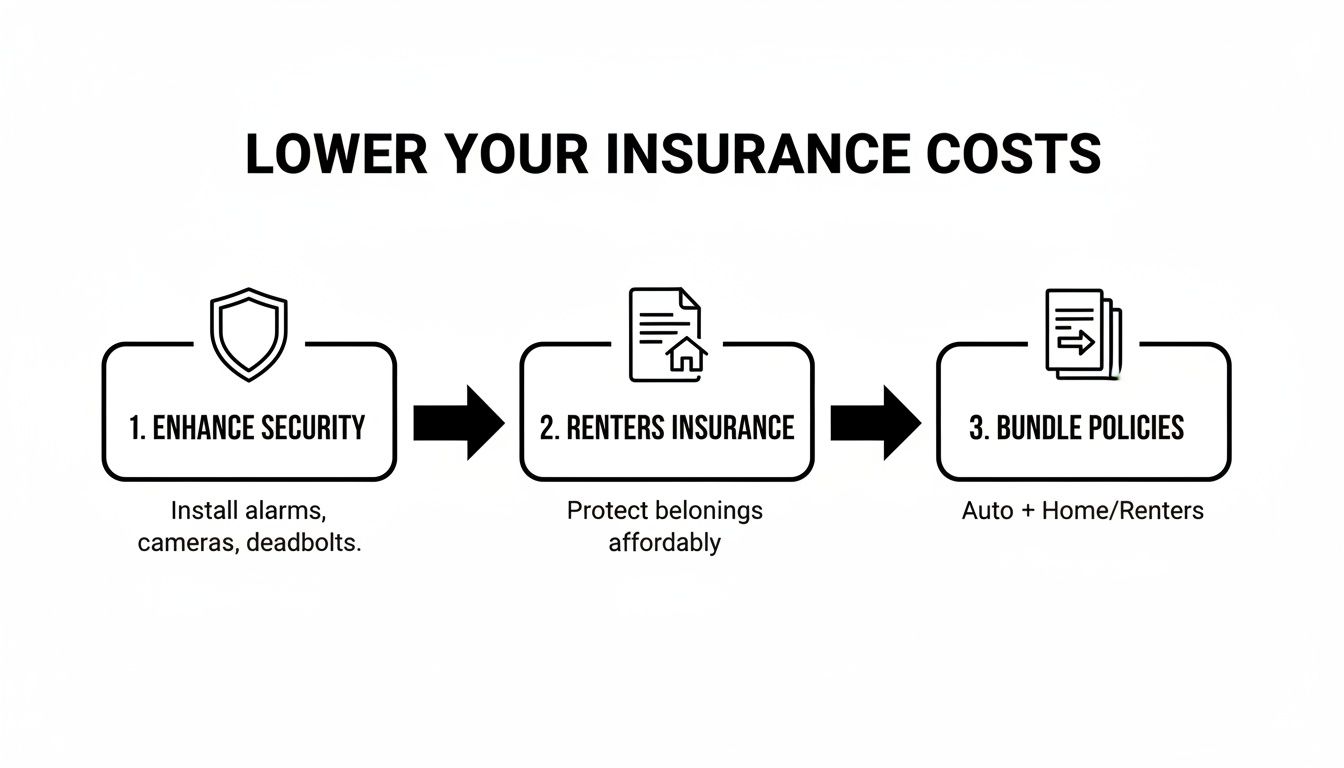
As you can see, taking proactive steps like improving your property's security or bundling policies isn't just about safety—it directly translates into lower insurance premiums.
How an Independent Agent Simplifies Your Insurance Search

Trying to find the right insurance for landlords on your own can feel like taking on a second job. You spend hours calling different companies, getting quotes that are impossible to compare side-by-side, and trying to make sense of dense policy documents. This is where working with an independent insurance agency like Mai & Associates completely changes the experience.
Think of it like this: a captive agent works for one specific company and can only offer their products. An independent agent works for you. Their loyalty is to you, not an insurance carrier. They act as your personal shopper, scouring the entire market to find the policy that truly fits your rental property portfolio, saving you a massive amount of time and frustration.
Instant Comparisons and Same-Day Quotes
One of the biggest headaches of shopping for insurance is the sheer amount of time it takes. An independent agent cuts through all of that. Because they have access to a network of dozens of top-rated carriers, they can input your information once and generate multiple, competing offers almost instantly.
What this means for you is a same-day quote without the hassle. Even better, they can see which carriers offer the best bundling discounts. An agent can strategically package your landlord policy with your auto insurance or home insurance, unlocking savings you would likely never find on your own.
An independent agent is your advocate. They translate the confusing jargon into plain English and give you real advice. Their goal isn't just to sell a policy—it's to find the right solution that protects your investment and respects your budget.
Deep Expertise in the California Market
The California insurance market is a tough one, plain and simple. With unique risks like wildfires and earthquakes, getting the right coverage isn't always straightforward. This is where an agent's local knowledge becomes invaluable.
We see it all the time. A landlord in a high-risk fire zone might only be able to get a bare-bones policy through the California Fair Plan. An experienced agent knows this and can immediately find a supplemental policy to fill the gaps, ensuring you're not dangerously underinsured. They know which carriers are friendliest to certain types of properties and which ones have the most competitive bundles for car insurance or renters insurance.
This expertise is about more than just finding a cheap policy; it's about finding the right policy and building a relationship. You have a direct line to an expert who can answer your questions, review your coverage as your needs change, and guide you if you ever have to file a claim.
Finally, we know that clear communication is everything. At Mai & Associates, we provide support in English, Spanish, Armenian, Russian, and Vietnamese. We want to make sure every landlord can protect their assets with confidence, guided by an expert who speaks their language and is committed to finding the most affordable and reliable California insurance for their needs.
Your Top Questions About California Landlord Insurance
Even after you get the basics down, you're bound to have a few specific questions. It's only natural. Here are some clear, real-world answers to the questions we hear most often from California landlords.
Do I Need Landlord Insurance If I Just Rent Out a Room?
Yes, you absolutely do. This is a common point of confusion, but the answer is a firm yes. Your standard home insurance policy is written to cover you living in your own home, not to cover business activities—and renting out a room is a business activity.
If a tenant-related incident happens, like a fire they start or a slip-and-fall in their part of the house, your standard homeowner's policy will almost certainly deny the claim. To get the right protection, you need to add a specific endorsement for the rental or, better yet, switch to a proper landlord policy. It's a small step that prevents a massive financial risk.
Can I Require Tenants to Have Renters Insurance?
Yes, and you absolutely should. In California, it's perfectly legal to make renters insurance a mandatory part of your lease agreement. Think of it as creating a financial firewall.
If there's a disaster, your landlord policy pays to fix the building itself. The tenant's renters policy, on the other hand, covers their own lost belongings. It also gives them liability coverage, which can prevent them from suing you if their guest gets hurt in their apartment.
Requiring renters insurance is one of the smartest and simplest risk management moves you can make. It clarifies who is responsible for what, dramatically reduces potential disputes, and helps keep claims off your policy, which is key to keeping your premiums low.
It’s a win-win that protects your investment while ensuring your tenant has a way to recover their own losses. For more answers like this, head over to our comprehensive FAQ page.
What Does the Claims Process Look Like?
When something goes wrong, knowing what to expect can make a huge difference. While every situation is unique, the claims process generally follows a predictable path.
- Secure the Scene: Your first job is to stop any further damage and make sure everyone is safe.
- Document Everything: Before anything is moved or cleaned up, take plenty of photos and videos of the damage. Write down a list of everything that was affected.
- Call Your Agent: Report the claim immediately. Your agent is your guide through this process, so give them all the documentation you’ve gathered.
- Meet the Adjuster: Your insurance company will send an adjuster to inspect the property in person. They'll evaluate the scope of the damage and write up an official estimate for repairs.
- Review and Settle: The adjuster will go over their findings and the settlement amount. Once you agree, the insurer issues the payment (minus your deductible) so you can get repairs underway.
Protecting your rental is a critical part of your financial strategy, but it's not the only part. From your car insurance to life insurance, a solid plan covers all your bases. The team at Mai & Associates is dedicated to building comprehensive protection for Californians. We shop the top insurance carriers to find you the right coverage for your rental properties, auto, and home, all at a price that makes sense.
Get Your Free, No-Obligation Insurance Quote Today at cahomeauto.com