A Guide to Insurance for High Value Homes in California
When you own a home with significant value, a standard insurance policy just won't cut it. It’s like trying to protect a custom-built masterpiece with a generic, one-size-fits-all cover. For properties with a replacement cost over $1 million, you need a specialized protection strategy known as high-value home insurance. This is a critical part of a comprehensive California insurance portfolio, which should also include adequate auto insurance and life insurance to protect your family's financial future.
This isn't just about higher numbers; it's a completely different approach designed to protect custom architecture, rare materials, and significant personal collections. For homeowners in a high-risk state like California, relying on standard home insurance isn't just a poor fit—it's a massive financial gamble.
What Makes High Value Home Insurance Different

Think of a standard home insurance policy like an off-the-rack suit. It works well enough for most people and covers the basics, much like basic renters insurance protects tenants. But when your home is built with unique architectural details, imported marble, or extensive custom millwork, that off-the-rack approach leaves you dangerously exposed.
This is where insurance for high-value homes comes in. It's the bespoke, custom-tailored equivalent. We’re not just talking about increasing the dollar amount on the policy; we’re talking about a fundamental shift in how the coverage is structured to account for the unique risks and assets of a luxury property.
Beyond Standard Coverage Limits
One of the biggest differences is how these policies are constructed. A standard policy often has frustratingly low sub-limits on valuable items like jewelry or art and might only pay you for their depreciated value (what they're worth today, not what it costs to replace them). For a high-value property, that's a recipe for a huge financial loss.
A standard policy might cap jewelry coverage at $1,500—nowhere near enough to cover even a single high-end watch, let alone an entire collection. High-value insurance solves this with higher, more flexible limits and specific endorsements for your valuables.
This superior protection is critical in California. Here, the cost to rebuild can soar far beyond a home's market price due to skilled labor shortages and ever-stricter building codes. The average California homeowner is already feeling the squeeze, with monthly payments on mid-tier homes jumping by 74% since January 2020. For luxury homeowners, these inflated costs make the threat of underinsurance even more severe.
A Tailored Strategy for Complex Assets
At its core, high-value home insurance is about protecting a lifestyle, not just a building. It understands that affluent households have needs that extend far beyond the four walls of their home, touching on everything from high-end car insurance to personal liability. This means better, broader protection across the board.
- Higher Liability Protection: Standard policies typically top out at $300,000 to $500,000 in liability coverage. For high-net-worth individuals, who can be seen as targets in a lawsuit, that’s dangerously low. High-value policies start with much higher limits, often in the millions.
- Broader Coverage Terms: These policies are often written on an "all-risk" (or open-peril) basis. This means you're covered for everything except for what is specifically excluded in the policy. It’s a much wider safety net than the "named-peril" coverage in most standard plans, which only covers the specific risks listed.
- Specialized Services: Insurers in this space often provide valuable complimentary services. This can include risk consultations to help you prevent losses, professional home appraisals, and even background checks for domestic staff to manage potential liabilities proactively.
Navigating this world requires an expert partner. A specialized agency like Mai & Associates deeply understands the nuances of the California insurance market. We can build a comprehensive defense for your most valuable asset, ensuring every unique detail of your home and lifestyle is properly protected.
Key Differences: Standard vs. High-Value Home Insurance
When your home and lifestyle grow, your insurance needs to do more than just scale up the numbers on the page. Moving from a standard policy to one built for high-value homes is like swapping out a family sedan for an armored vehicle. It’s not just more protection; it’s a completely different kind of protection.
A standard policy can look fine on paper, but after a major disaster, its limitations can become painfully clear. These policies are often built on a restrictive framework that can leave significant financial gaps for owners of custom or high-end homes. Let's look at two of the biggest upgrades you get with a specialized policy.
From a Hard Cap to a Firm Promise on Rebuilding
The first major shift is in how your policy handles Coverage A (Dwelling)—the part that protects the actual structure of your house. Most standard policies use Replacement Cost Value (RCV). That sounds great, but there's a catch: it comes with a strict limit. If your home is insured for $1.5 million, that's the absolute most you'll get, period.
Imagine a wildfire sweeps through your Southern California neighborhood. Suddenly, everyone needs to rebuild at once. The demand for lumber, concrete, and skilled builders goes through the roof, and construction costs can easily spike 20%, 30%, or more. Your RCV policy limit that seemed perfectly adequate a month ago is now nowhere near enough, and that shortfall comes directly out of your pocket.
This is where high-value policies really shine. They offer two powerful alternatives:
- Extended Replacement Cost: This adds a crucial safety net, typically an extra 25% to 50% on top of your insured limit, giving you a buffer to absorb those post-disaster price hikes.
- Guaranteed Replacement Cost: This is the ultimate peace of mind. It’s a promise to rebuild your home exactly as it was, with the same unique features and quality craftsmanship, no matter what it costs.
If your custom-built home, insured for $2 million, is destroyed in a fire, and post-disaster inflation pushes the actual rebuilding cost to $2.8 million, Guaranteed Replacement Cost covers the entire amount. A standard policy would cap out, leaving you with an $800,000 bill.
Superior Protection for Your Personal Belongings
The other game-changer is how your possessions are covered under Coverage C (Personal Property). A typical home insurance policy uses a "named perils" approach. This is exactly what it sounds like: your belongings are only covered if they’re damaged by a disaster specifically named in the policy, like fire or theft. If it’s not on the short list, you’re out of luck.
High-value home insurance flips that model around completely by providing "open perils" coverage.
This far broader approach covers your property against everything, unless a cause of loss is specifically excluded (things like flood or earthquake usually require a separate policy). It’s a subtle but powerful shift that provides a much wider safety net for your valuables, from art and jewelry to high-end electronics.
For instance, say an expensive sculpture is accidentally knocked over and broken during a party. An "open perils" policy would likely cover it. A standard "named perils" policy almost certainly would not, since "accidental breakage" isn’t a listed disaster. It’s this comprehensive, real-world protection that ensures your entire lifestyle, not just the house itself, is properly secured.
To see these differences at a glance, it helps to compare the two policy types side-by-side.
Standard Home Insurance vs High Value Home Insurance
| Coverage Feature | Standard Policy (HO-3) | High Value Policy (HO-5) |
|---|---|---|
| Dwelling Coverage | Named Perils (often limited) | Open Perils (covers all risks unless excluded) |
| Personal Property | Named Perils (restrictive) | Open Perils (comprehensive) |
| Rebuilding Limit | Replacement Cost (hard cap) | Extended or Guaranteed Replacement Cost |
| Valuable Items | Low sub-limits (e.g., $1,500 for jewelry) | Higher sub-limits & options for blanket coverage |
| Liability Coverage | Typically $300k - $500k | $1 million or more, often with personal umbrella options |
| Water Backup | Optional, with low limits | Often included with higher limits |
| Loss of Use | Capped by a percentage of dwelling coverage | Generous coverage with fewer limitations |
As you can see, the high-value policy isn't just a bigger version of the standard one—it’s fundamentally better, designed from the ground up to protect a more complex set of assets.
Essential Coverages Your California Luxury Home Needs
Protecting a high-value California home isn't about buying a single, off-the-shelf policy. It’s about building a strategic portfolio—a carefully selected blend of specialized coverages that work in concert to protect both your property and your lifestyle from the state's unique risks. A standard homeowner's policy just doesn't have the muscle to cover a luxury property's true replacement cost or its valuable contents.
So, let's look past the basics and get into the non-negotiable policies and endorsements that form the real foundation of financial security for a luxury homeowner.
This diagram shows the fundamental structure of a high-value policy, breaking it down into two core pillars: protecting the house itself and protecting the valuable things inside it.
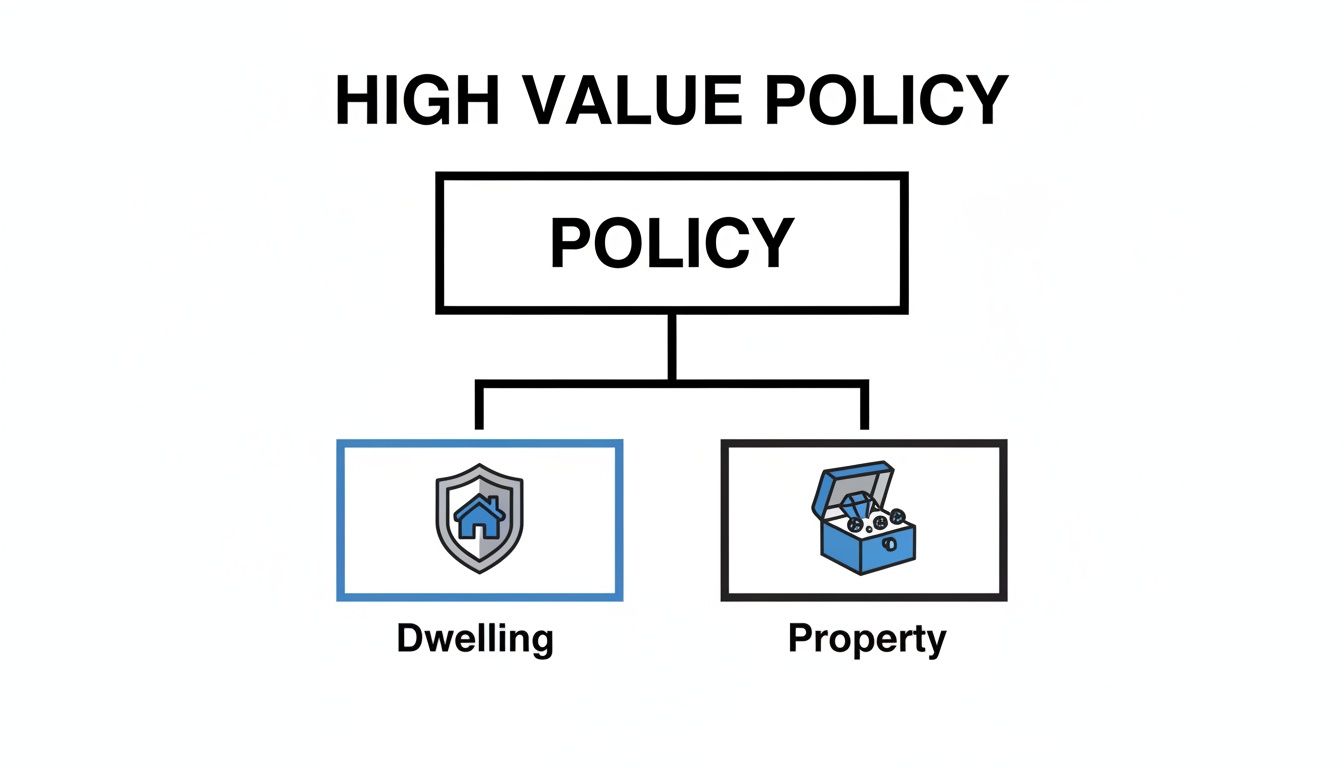
Think of these as the base of your protection. From here, we add specific endorsements to build a complete defense against any threat.
Protecting Your Passions with Scheduled Personal Property
Here’s a hard truth: a standard home insurance policy has disappointingly low limits on high-value items. It might offer a mere $1,500 to cover all your jewelry—a figure that wouldn't even replace a single luxury watch, let alone an entire collection.
This is where an endorsement for Scheduled Personal Property becomes absolutely essential. It’s like creating a dedicated mini-policy for each of your most treasured possessions. We can schedule items like:
- Fine art and sculptures
- Jewelry and watches
- Wine or spirits collections
- Antiques and rare collectibles
By "scheduling" an item, you insure it for its full, professionally appraised value. Better yet, this coverage is often "all-risk," meaning it protects against scenarios like accidental breakage or even mysterious disappearance—things a standard policy would never cover. It ensures your prized possessions are protected for what they’re actually worth.
Guarding Against Inflation with Guaranteed Replacement Cost
We've mentioned this before, but for California homeowners, its importance can't be overstated. After a widespread disaster like a wildfire, the demand for construction materials and labor skyrockets, sending rebuilding costs through the roof.
Guaranteed Replacement Cost is your ultimate shield against this. It is a promise from your insurer to rebuild your home exactly as it was, with the same quality of materials and craftsmanship, regardless of the final cost. This coverage acts as a powerful buffer against post-disaster inflation, making sure you aren't left with a massive out-of-pocket bill just to get back to whole.
Tackling California-Specific Threats
Living in California means facing risks that are non-existent in other parts of the country. Standard policies universally exclude damage from earthquakes and, in high-risk zones, often fall short on providing adequate fire coverage.
No matter how robust your primary high-value home insurance is, it will not cover damage from an earthquake. This is a critical exclusion that requires a separate, dedicated policy.
A truly complete protection strategy for a California luxury home must include:
- Earthquake Insurance: This is a separate policy, and it's absolutely non-negotiable. Skipping it means you are choosing to self-insure your multi-million dollar asset against a catastrophic—and entirely possible—event.
- Wildfire Protection Strategy: In areas where traditional insurers are pulling back, the California FAIR Plan can provide a foundational layer of fire coverage. But it's a very basic, bare-bones policy. It must be paired with a comprehensive "Difference in Conditions" (DIC) policy to cover everything else, like liability, water damage, and theft.
Shielding Your Entire Net Worth with Umbrella Insurance
The risks tied to a high-value property go far beyond its physical structure. A serious accident on your property—or one involving your family members anywhere in the world—could easily trigger a lawsuit that targets your entire net worth. Standard liability limits are simply not enough for a high-net-worth individual.
This is where a high-limit Umbrella Insurance policy steps in as your most important financial defender. It adds an extra layer of liability protection, typically from $1 million to $50 million or more, that activates once the limits on your home and auto insurance policies are maxed out.
For instance, if you're found liable for $2 million in damages but your home insurance liability caps out at $500,000, your umbrella policy would cover the remaining $1.5 million. It's an incredibly affordable way to shield everything you've worked for—from your home and investments to your future earnings—from a financially devastating lawsuit. You can learn more about how these coverages interact by exploring our guide to home insurance in California.
Understanding the Cost of Insuring a Luxury Property
Seeing the insurance premium for a high-value home can be a bit of a shock. That number isn't just pulled out of a hat; it’s the result of a very detailed risk assessment, a complex calculation where every single detail of your California property matters. Once you understand what drives that cost, you can see the premium not just as an expense, but as a precise reflection of the risk the insurance company is taking on.
Think of it like this: insuring a standard tract home is like insuring a reliable family sedan. The risks are pretty well-known and predictable. Insuring a luxury California property, on the other hand, is like insuring a rare, high-performance sports car—the potential for a massive claim is much, much higher, and the price of that California insurance reflects that elevated risk.
Location: The Undeniable Driver of Cost
In California, geography is destiny when it comes to insurance rates. The first question an insurer will always ask is, "Where is the home?" That one answer determines its exposure to the state's biggest threats, which dramatically shapes the final cost.
- Wildfire Zones: A home nestled in a high-risk fire zone is going to have a significantly higher premium than one in a dense urban center. Insurers use sophisticated mapping tools to analyze everything from ember drift patterns and vegetation density to how quickly the local fire department can respond.
- Coastal Proximity: Properties right on the coast face a different set of threats—storm surges, high winds, and gradual erosion. These factors increase the likelihood of a major claim, pushing premiums up.
- Earthquake Fault Lines: Even though earthquake damage requires a separate policy, your home's proximity to major fault lines is a critical factor. The overall seismic risk of the region can still influence the pricing of your main home policy.
Even the specific neighborhood plays a part. Local crime rates and the quality of emergency services can either add a little more to your premium or help bring it down. For a deeper look at how location impacts rates in a major metro area, you can explore our guide on securing home insurance in San Francisco.
Your Home's Unique DNA
Beyond where it’s built, the physical characteristics of your home are put under a microscope. Custom-built luxury properties are, by nature, unique, and these one-of-a-kind features translate directly into insurance costs.
Insurers will look very closely at:
- Construction Materials: That imported Italian marble, custom-milled hardwood, and rare stone are all far more expensive to replace than standard builder-grade materials. The higher the replacement cost, the higher the premium.
- Special Features: Amenities like swimming pools, elaborate outdoor kitchens, detached guest houses, and private home theaters are often called "attractive nuisances." They increase your liability risk, which in turn increases the cost of your policy.
- Age and Updates: An older, historic home might carry a higher premium if its core systems—electrical, plumbing, HVAC—haven't been updated recently, as they pose a greater risk of failure.
Personal and Global Factors
Finally, factors related to you personally and the broader market come into play. Your own claims history is a huge indicator for insurers. A history of frequent claims, especially for something like water damage, suggests you're a higher future risk and will lead to a higher premium.
It's not just about your home; it's about the world. Macro-economic trends, such as the rising cost of reinsurance—the insurance that insurance companies buy to protect themselves—and the financial impact of recent global catastrophes, directly affect the rates you pay in California.
This is especially true as climate-driven events become more intense. High-value homes, often needing coverage well over $1 million, are facing skyrocketing premiums because of this. National averages for new policies are projected to hit $1,966 in 2025, a 9.3% jump from 2024. This trend is even more pronounced in risk-prone states, where premiums have surged dramatically. You can get more insights on this from Matic's 2025 Home Insurance Report.
Understanding these moving parts helps you see your policy's price clearly, setting the stage for strategies to manage that risk effectively.
Practical Ways to Lower Your Insurance Premiums
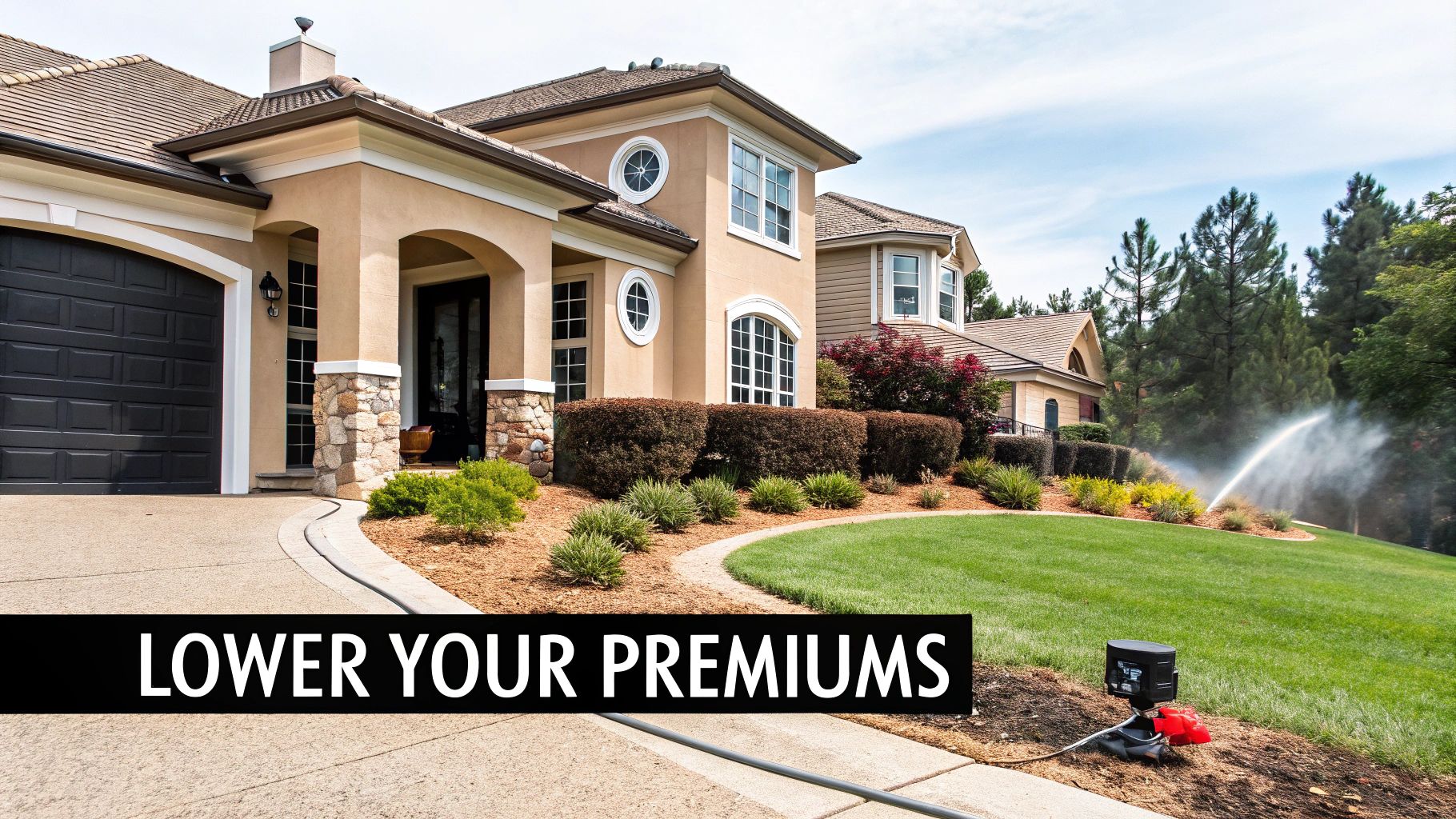
While the cost of insuring a luxury home in California can be steep, you have more control over your premium than you might realize. Think of it like a partnership with your insurance carrier—when you take clear, proactive steps to make your home safer and less risky, they reward you with lower rates.
These aren't just about saving money, either. They're smart investments that fortify your home and give you invaluable peace of mind. By showing an underwriter that you're serious about preventing losses, you can directly influence your annual premium for the better.
Fortify Your Home Against Common Risks
One of the quickest ways to see a discount on your insurance for high value homes is to upgrade your property's protective systems. Insurers absolutely love features that stop common claims like theft, fire, and water damage before they start.
A multi-layered approach to security and prevention doesn't just protect your family; it makes your home a much more attractive risk to insure.
- Centrally Monitored Security Systems: A system that automatically contacts the police or fire department is a game-changer. It's a powerful deterrent that significantly reduces the potential for a major loss.
- Automatic Water Shut-Off Devices: Water damage is a nightmare for homeowners and one of the most common claims. Smart sensors that detect a leak and instantly shut off the main water supply can turn a potential catastrophe into a minor inconvenience.
- Permanent Backup Generators: Power outages can knock out your security systems, sump pumps, and refrigerators. A generator keeps everything running, preventing secondary damage that can quickly spiral.
Address California-Specific Wildfire Threats
If your home is in a wildfire-prone area, mitigating that risk is non-negotiable. It's often the key to not only lowering your premium but also securing coverage in the first place. Insurers are laser-focused on finding homes that have been "hardened" against wildfires.
When you actively manage your property's wildfire exposure, you send a clear message to insurers: you are a proactive partner in risk prevention. This is the single most effective thing you can do to lower your premium in a high-risk zone.
Here are the two most critical steps:
- Create Defensible Space: This means clearing all flammable vegetation, dead leaves, and overgrown brush within a 100-foot radius of your home. This buffer is crucial—it can rob an approaching fire of its fuel and give firefighters a chance to defend your property.
- Upgrade Building Materials: Swap out vulnerable materials for fire-resistant ones. This includes installing a Class A fire-rated roof, using non-combustible siding like stucco, and retrofitting vents with ember-proof mesh to keep windblown sparks out of your attic.
Make Strategic Financial Adjustments
Beyond physical upgrades to your home, a few smart financial moves can also lead to immediate savings on your premium. These strategies involve taking on a small, calculated amount of risk yourself in exchange for a lower bill.
The easiest win is often to bundle your policies. When you insure your home, luxury vehicles (car insurance), and an umbrella policy with the same company, they’ll almost always give you a multi-policy discount. This simplifies your life and can lead to significant savings across all your policies.
Another powerful lever is your deductible. By agreeing to a higher deductible—say, moving from $2,500 to $5,000 or even $10,000—you're telling the carrier you'll handle smaller claims out-of-pocket. In return, they'll reduce your annual premium, sometimes substantially. We can help you run the numbers to find that perfect balance where the savings make sense for your financial situation.
How to Find the Right High Value Home Insurance
Securing the right coverage for a luxury property, especially in California's tricky market, is less about buying a product and more about executing a smart strategy. It all starts with a crystal-clear understanding of what you need to protect. This isn't just about getting a check after a disaster; it's about being able to rebuild your life and home exactly as they were.
The whole process hinges on knowing your numbers. Before you can properly insure your home, you need to know what it would actually cost to bring it back from a total loss.
Start with a Professional Appraisal and Inventory
The bedrock of any solid high-value home policy is an accurate replacement cost valuation. This number is often confused with market value, but they're completely different. We're talking about the real-world cost to rebuild your home from the ground up, using the same unique materials and custom craftsmanship. The only way to get a reliable figure is through a professional appraisal.
At the same time, you'll want to create a detailed home inventory. Walk through your home, room by room, and document everything of value. Take photos, and gather any receipts or appraisals for specific collections like art, jewelry, or wine. This documentation is absolutely critical, not just for getting an accurate quote but for making the claims process smooth if you ever need it.
Partner with an Independent Insurance Agent
Once you know the value of what you're protecting, your next move is the most important one: choosing the right partner. Instead of calling a single insurance company, you'll get far better results by working with an independent agent like us at Mai & Associates. The advantage is simple: we work for you, not for one specific carrier.
An independent agent opens the door to a portfolio of elite insurance carriers that specialize in the high-net-worth market. These are often insurers the general public can't access on their own, and they offer superior coverage and more competitive pricing for luxury homes.
We know this exclusive market inside and out. Our job is to shop around on your behalf, comparing policies from these top-tier providers to find the perfect mix of protection and value. This is a particularly smart move right now. The global insurance market for high-value properties saw rates drop by 8% in late 2025, thanks to new players entering the space. We're even seeing double-digit rate reductions here in the U.S., so it's a great time to see what's out there. You can read more about these shifts in Marsh's Global Insurance Market Index.
Prepare for a Detailed Quoting Process
To get the best possible terms, you'll need to have your information ready. Your agent will need that professional appraisal and home inventory. You'll also want to provide details on any risk-reduction features you've put in place, like a monitored security system or wildfire hardening measures you've taken.
As the quotes come in, you need to ask the right questions to spot any potential gaps:
- Is this policy offering Guaranteed or Extended Replacement Cost?
- Are my valuables covered for their full, appraised value, or is there a cap?
- What are the specific sub-limits for categories like jewelry or fine art?
- Does the liability limit truly protect my total net worth?
Doing this homework upfront ensures you don't end up with a policy full of unpleasant surprises.
Here at Mai & Associates, our team makes this whole process straightforward. We use our deep local knowledge of communities from Glendale to Escondido to build a protection plan that fits your life perfectly. If you’re ready to see what your options look like, you can get a customized insurance quote from our specialists today.
Common Questions About High Value Home Insurance
When you're protecting a significant asset like a luxury home, it's natural to have questions. Let's walk through some of the most common things California homeowners ask, so you can feel confident in your coverage.
Is My Standard HO-3 Policy Enough?
It's a common misconception, but even an HO-3 policy with high limits probably isn't enough. Think of it this way: a standard policy is like an off-the-rack suit—it might cover you, but it won't fit perfectly.
These policies almost never include Guaranteed Replacement Cost, which is a huge problem when post-disaster demand sends construction prices soaring. They also have frustratingly low limits on things like jewelry, art, and wine, and their liability coverage often falls far short of what a high-net-worth family truly needs.
A real high-value policy is custom-tailored from the start to cover these exact gaps, something that's absolutely critical here in California with our sky-high labor and building costs.
How Does the California FAIR Plan Fit In?
The California FAIR Plan is a lifeline, not a complete solution. It's a very basic, last-resort fire insurance policy for homeowners who can't find coverage elsewhere. For a luxury property, it’s only the first piece of the puzzle.
To get the comprehensive protection you need, you have to pair the FAIR Plan with a second, specialized policy called a "Difference in Conditions" (DIC). The DIC policy essentially wraps around the FAIR Plan, covering everything it misses—like liability, water damage, and theft. Putting this two-part structure together correctly is a job for an expert who knows how to make sure no gaps are left between the two policies.
Why Do I Need Separate Earthquake Insurance?
This one is non-negotiable in California. Absolutely no standard or high-value home insurance policy covers damage from an earthquake. It is always a specific exclusion.
In a state with constant seismic activity, skipping this coverage is a massive gamble. A separate earthquake policy is the only way to protect your home's structure and your belongings from the financial devastation of a quake. If you choose to go without it, you're self-insuring against a catastrophic loss. Climate-related risks have already pushed the global insurance protection gap to a staggering 60%, a trend you can read more about in EY's 2025 Global Insurance Outlook.
For more answers to your insurance questions, you might be interested in our comprehensive FAQ page.
Protecting your most significant asset requires expert guidance and a strategy built for your unique needs. At Mai & Associates, our licensed agents specialize in creating customized insurance portfolios for California homeowners, ensuring every detail is covered. We offer transparent advice and access to elite carriers to secure the best protection for your home, auto insurance, and family. Secure your peace of mind with a no-obligation quote from Mai & Associates today.