Best Insurance for Driving Schools: California 2026
You're probably in the same spot most new school owners hit. You've lined up a car, maybe two. You've thought about instructors, scheduling, DMV paperwork, a small classroom, and how you'll attract students. Then insurance shows up and turns into the most confusing part of the launch.
That confusion is expensive.
A driving school isn't just another small business with a company car. You're putting inexperienced drivers behind the wheel, handing instructors responsibility for safety, and inviting families to trust you with high-risk training. If you buy the wrong policy, the first serious claim can put your school, your savings, and your reputation in danger. If you buy only the legal minimum, you may stay compliant while still staying exposed.
This guide is built for California owners who want to make smart insurance decisions the first time. It covers the legal baseline, the policies that matter, the hidden gaps most operators miss, and the practical steps for getting quotes without wasting weeks.
Starting Your California Driving School The Right Way
Starting a driving school in California usually begins with optimism and a spreadsheet. You price lesson packages, compare cars, check office space, and try to estimate what your first year will look like. Then you realize the business's core isn't just teaching people to drive. It's managing risk every single day.
That risk is larger than many first-time owners expect. The U.S. driving schools industry includes over 23,946 active businesses as of 2025 and is projected to reach a $2.0 billion market size in 2026, which shows how much demand exists for specialized protection in this field (IBISWorld industry data). In other words, insurance for driving schools isn't a niche afterthought. It sits inside a large, active market where carriers already know what can go wrong.
Why a standard small business policy falls short
A driving school creates overlapping exposures that a generic package policy often won't handle well:
- Student driving risk means your vehicle isn't being driven like a normal business auto.
- Instruction risk means a family can claim your school failed to teach properly.
- Premises risk means injuries can happen in classrooms, offices, or parking lots.
- Employment risk means instructors and staff create workers' compensation and liability issues.
- Administrative risk means enrollment forms, payment systems, and student records need protection too.
If you've ever looked at how other education-based businesses organize operations, there's a useful lesson in how tutoring centers manage operations. The businesses are different, but the operational challenge is similar. Scheduling, staff oversight, student records, and repeatable systems all affect how underwriters view your school.
Practical rule: Buy insurance for the business you're actually running, not the one you describe in a quick application.
The right mindset at launch
The strongest new operators treat insurance as part of setup, not cleanup. They decide early which vehicles will be used, who will instruct, where lessons start, whether instructors ever use personal cars, and how student practice is documented.
That approach does two things. It helps you get better quotes, and it reduces the chance that a carrier fights you on a claim later. Both matter more than shaving a little premium off the first invoice.
Understanding California's Mandatory Insurance Requirements
California gives you a legal floor. Treat it as a floor, not a target.
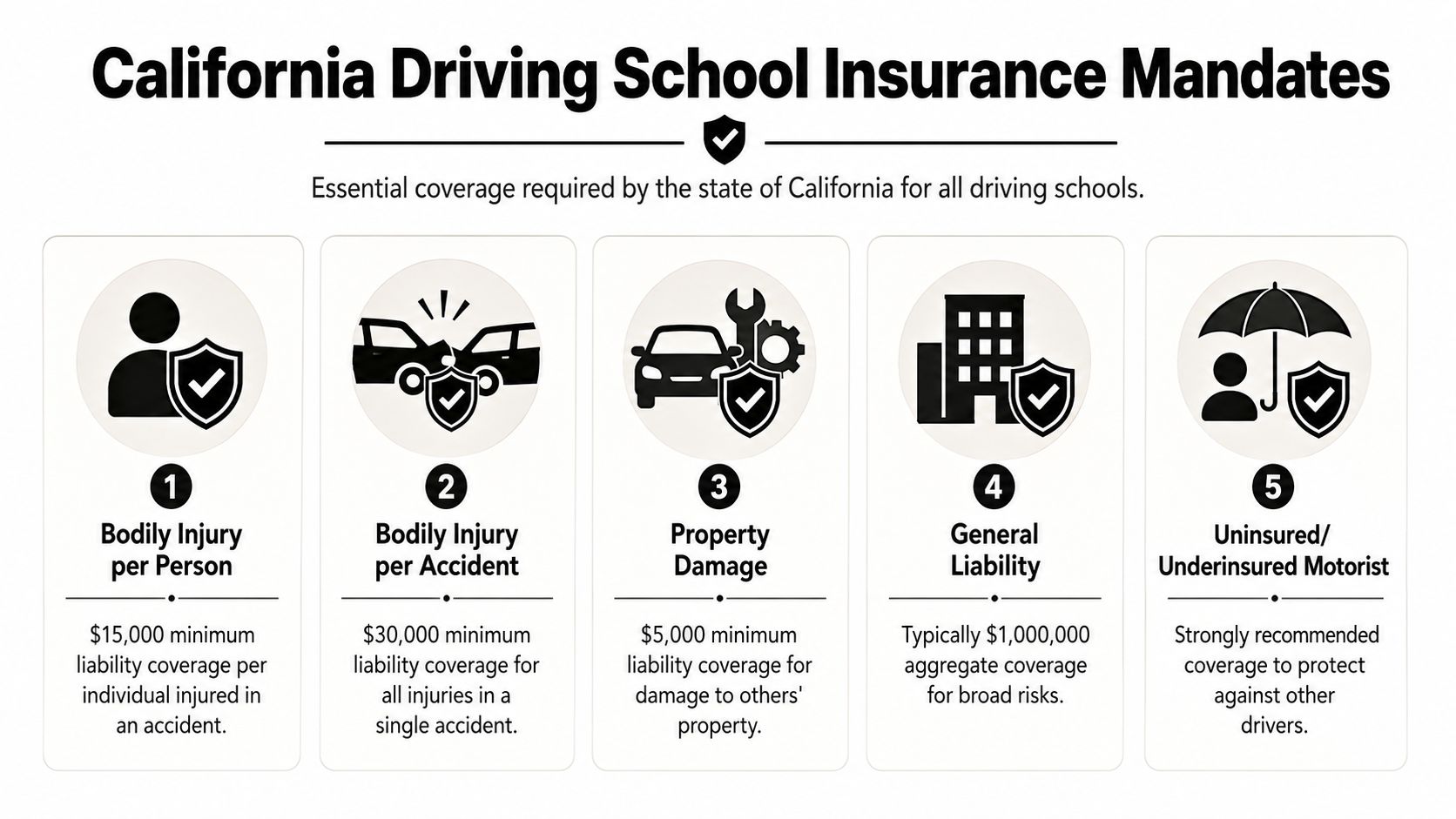
As of January 1, 2025, California raised its mandatory auto liability minimums to $30,000 for bodily injury per person, $60,000 for bodily injury per accident, and $15,000 for property damage, and those limits are scheduled to increase again in 2035 to 50/100/25 (California minimum liability update). If your school uses vehicles on public roads, this matters immediately.
What the 30 60 15 structure actually means
These limits aren't complicated once you translate them into plain language:
- $30,000 per person means the policy can pay up to that amount for bodily injury to one injured person.
- $60,000 per accident means the policy caps bodily injury payments for the full accident at that amount.
- $15,000 property damage applies to damage your vehicle causes to someone else's property.
For a driving school, that legal minimum is often too thin. One bad collision can burn through those limits quickly. That's why owners who think like operators usually buy above the minimum from day one.
Other ways California lets you prove financial responsibility
California doesn't force every business to use a standard liability policy as the only option. The DMV also recognizes proof of financial responsibility through a $75,000 cash deposit, a $75,000 surety bond, or a self-insurance certificate, alongside a liability policy option (California DMV financial responsibility options).
For most new driving schools, those alternatives are a poor fit.
A cash deposit ties up capital you need for vehicles, payroll, and marketing. A surety bond can satisfy a legal requirement, but it doesn't function like a broad commercial insurance program. Self-insurance usually isn't realistic for a new or small operator.
What to do in practice
Use this sequence:
- Start with commercial auto liability. Don't rely on a personal car insurance setup and hope the carrier ignores instructional use.
- Match every listed vehicle to actual operations. If a car is used for lessons, list it correctly.
- Ask how instruction is classified. A policy that covers normal business driving may still restrict driver training activity.
- Plan beyond California's minimums. If you grow, your exposure grows faster than the legal minimum.
If your business also touches transportation rules in adjacent operations, resources that help manage your FMCSA compliance can sharpen your discipline around documentation and insurance review, even if your driving school itself isn't operating like a trucking fleet.
For owners comparing options, this is also the point where it helps to review broader California auto insurance choices so you can see how state minimums differ from practical protection.
California tells you what gets you legal. It doesn't tell you what keeps you solvent after a claim.
The Core Four Policies Every Driving School Needs
If you're building insurance for driving schools the right way, four policies do most of the heavy lifting. They work together. Skip one, and the gap usually shows up at the worst possible time.
Commercial auto liability
This is the center of the program because your biggest risk is still the car in motion.
Commercial auto liability covers injury and property damage your school causes while a covered vehicle is being used in business. For a driving school, that means lesson vehicles, instructor use, and the added underwriting concern that learners are operating the car.
California's legal minimum exists, but it's not where I'd stop. A better benchmark comes from regulated markets where schools must carry much more. In Washington, licensed driver-training schools must maintain at least $1,000,000 in combined auto liability and $1,000,000 in general liability, which reflects what many consider a practical protection standard for modern claims (Washington driving school insurance requirements).
If your broker quotes only minimum-limit auto liability and calls it a day, keep shopping.
General liability
General liability handles the non-driving side of the business. Think office injuries, classroom accidents, or damage tied to your premises and routine operations.
A parent slips on a wet entryway before a student's session. A student trips over a bag in the classroom. A visitor claims your staff caused accidental property damage during an off-site event. Those aren't commercial auto claims. They fall into the general liability lane.
Professional liability and E&O
Driving instruction is advice, supervision, and professional judgment. That creates professional liability, often written as errors and omissions coverage.
Example: a family claims your instructor failed to teach a critical safety maneuver, passed a student through training too quickly, or didn't supervise properly during a lesson sequence. Whether that claim is fair doesn't matter at first. You still need defense.
The schools that get burned aren't always the reckless ones. Often, they're the ones who assumed a general liability policy covered instructional mistakes.
Workers' compensation
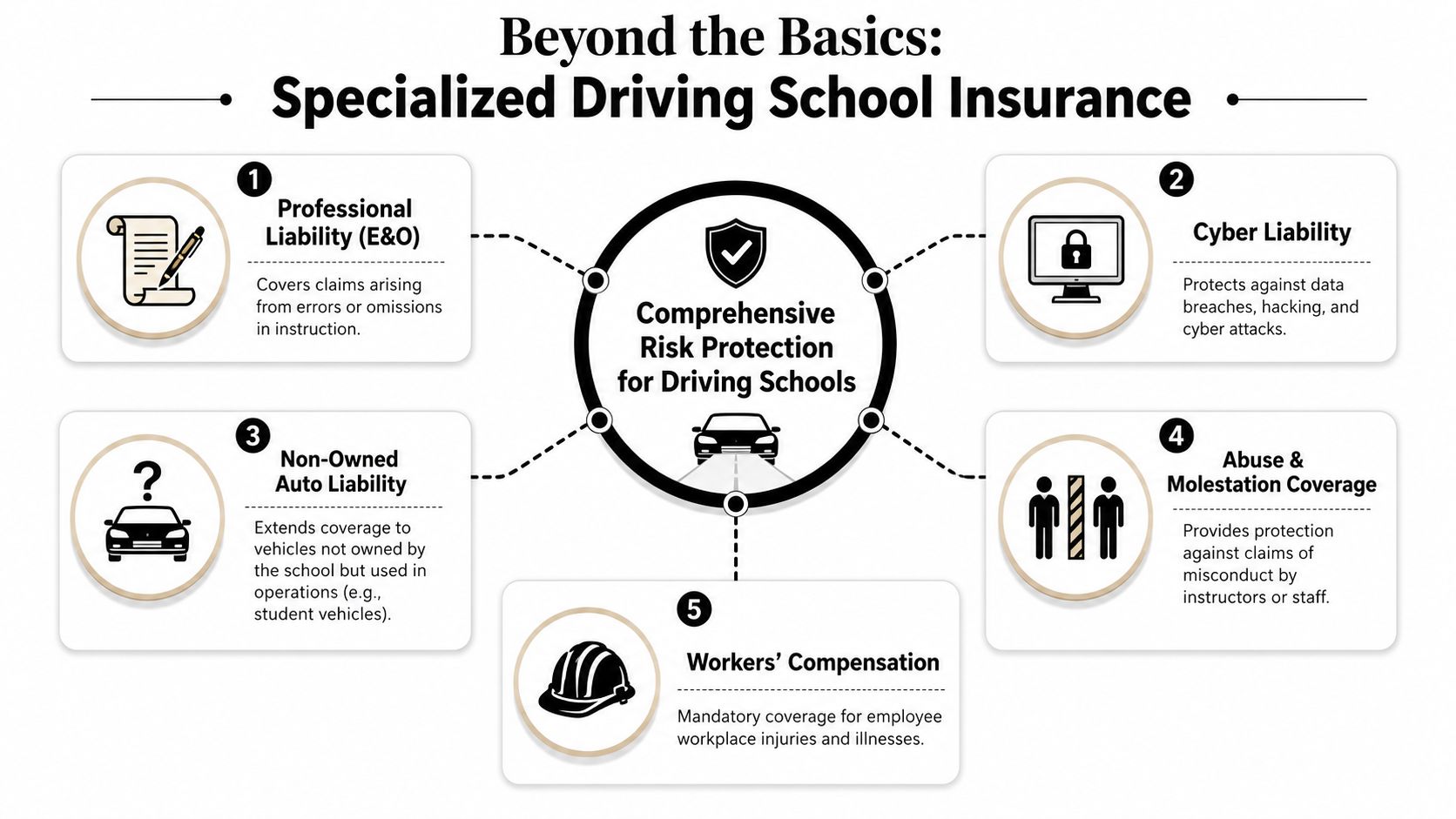
If you have employees, workers' compensation belongs in the core stack. Instructors spend time in moving vehicles, around anxious learners, and in environments where repetitive stress or sudden injury can happen. Office staff can be injured too.
Without workers' compensation, one employee injury can become a direct business problem instead of an insured event.
How the policies fit together
Here's the cleanest way to view them.
| Policy Type | What It Covers | Example Claim Scenario |
|---|---|---|
| Commercial Auto Liability | Injury or property damage caused by covered school vehicles during business use | A student driver causes a collision during a supervised lesson |
| General Liability | Third-party bodily injury or property damage tied to premises and routine operations | A parent falls in your classroom lobby before a lesson |
| Professional Liability (E&O) | Claims tied to instruction, supervision, or alleged training mistakes | A family alleges your instructor failed to teach defensive driving adequately |
| Workers' Compensation | Employee job-related injuries or illnesses | An instructor suffers an injury while conducting a lesson |
My recommendation on limits
Don't anchor your buying decision to the cheapest premium. Anchor it to the size of a lawsuit and the cost of defense. Your legal minimum might satisfy the DMV, but your actual risk profile calls for stronger limits and cleaner wording.
That's especially true if you want your operation to last. A policy set that merely checks boxes isn't protection. It's paperwork.
Specialized Coverage for Unique Driving School Risks
The biggest mistakes in insurance for driving schools usually don't happen in the obvious areas. They happen in the edge cases. That's where claims get denied and owners learn, too late, that “covered” had conditions attached.
The gap most owners miss
One of the most important hidden exposures involves practice outside formal lessons. A documented concern in the market is that a driving school may face liability for accidents during unlicensed student practice sessions outside formal instruction, and some policies may deny the claim if the event falls outside the policy's definition of supervised instruction (coverage gap involving unsupervised or non-lesson practice).
That should change how you buy coverage.
If your school allows any activity that isn't tightly documented as an official lesson, ask direct questions. Does the policy cover only scheduled instruction? Does it require a valid permit? Does it exclude informal practice? Don't accept vague answers.
Coverages that close real-world gaps
A solid program often adds several specialized layers:
- Hired and non-owned auto liability applies when employees use vehicles the school doesn't own for business purposes.
- Commercial property insurance protects your office, classroom contents, signage, computers, and teaching materials.
- Cyber liability matters because student files, payment data, and scheduling systems create digital exposure.
- Umbrella liability adds extra protection above your underlying limits for catastrophic claims.
- Abuse and molestation coverage deserves a serious discussion when your staff work one-on-one with minors.
Some schools also need sharper wording around student-owned vehicles used during instruction. If you ever teach in a vehicle the school doesn't own, review the policy form line by line.
Questions to ask before you bind coverage
Use these questions when reviewing proposals:
- Does the policy define instruction clearly?
- Are only school-owned vehicles covered, or also non-owned vehicles used in operations?
- Is after-hours practice excluded?
- Are student records and online payments protected?
- Do umbrella limits sit over both auto and general liability?
For broader education on comparing protection and spotting weak policy language, a practical California insurance guides library can help you sharpen the questions before you commit.
If an exclusion sounds technical, assume it matters. Technical language is where denied claims usually live.
Pricing Factors and Tips for Reducing Your Premiums
Insurance pricing isn't random. Carriers look at your school and ask one question: how likely are you to produce claims, and how expensive will those claims be if they happen?
That means your premium is partly about market conditions, but it's also about your operating discipline.
California gives you one useful budget reference point. Average annual premiums for full coverage personal auto insurance in the state can range from $1,700 to $2,400, depending on profile and ZIP code (California premium baseline). Commercial instruction vehicles usually cost more to insure than standard personal-use cars, so treat that range as a baseline, not a quote.
What pushes premiums up
Carriers usually focus on the same practical issues:
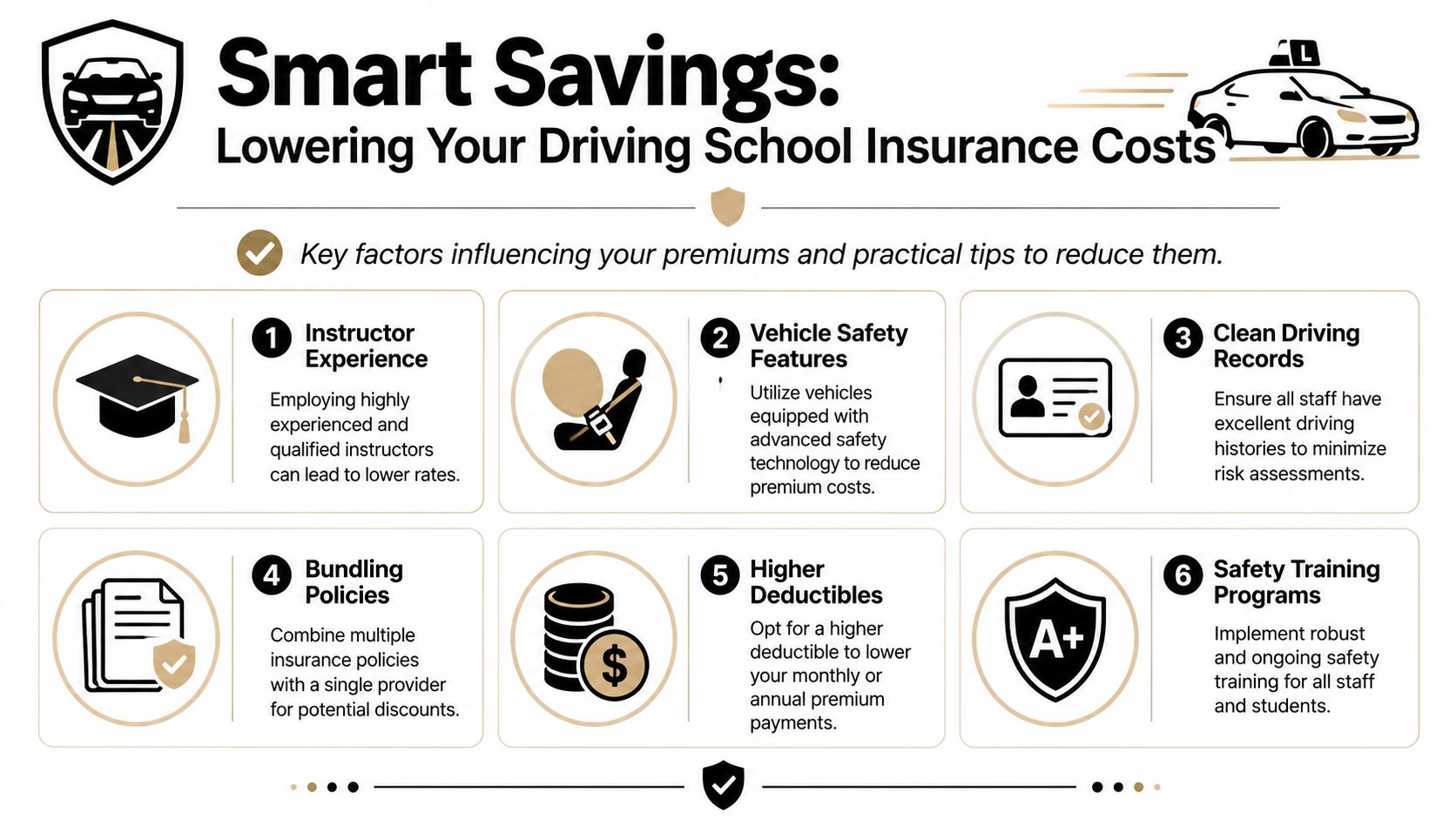
- Who teaches for you matters. Instructor driving history, experience, and hiring standards affect how underwriters see your risk.
- What you drive matters. Vehicle age, repair cost, safety features, and lesson use all affect pricing.
- Where you operate matters. Dense traffic, theft exposure, and local claim patterns can increase rates.
- How you buy limits matters. Higher limits and broader endorsements cost more, but they may be the right trade.
- Your internal controls matter. Sloppy records suggest sloppy operations.
The moves that usually pay off
You have more control than most owners think.
- Tighten hiring. Screen instructor records carefully and document the review.
- Standardize training. Use written lesson procedures so carriers see repeatable operations.
- Document vehicle maintenance. A clean maintenance file supports your underwriting story.
- Install dash cams or telematics if the carrier allows them. Evidence helps in claims and can support a better risk profile.
- Use strong student agreements. Clear lesson terms, supervision rules, and practice boundaries reduce confusion.
- Bundle intelligently. If one carrier can write auto, liability, property, and related lines well, ask for a package approach.
My opinion on cutting cost
The worst way to save money is to buy weak limits. The better way is to become easier to insure.
If you want practical examples of how California consumers compare policies and save on protection across vehicles and households, the Mai & Associates blog is useful reading. The same principle applies here. Better risk presentation often beats bargain shopping.
A cheap premium can become the most expensive decision you make if the policy is narrow, underwritten poorly, or full of exclusions.
Your Checklist for Getting the Right Insurance Quotes
Most quote problems start before the first application is submitted. Owners rush, guess at exposures, and send incomplete information. Then they wonder why the quotes are inconsistent or expensive.
Use a checklist and do it once.
Gather your underwriting file
Before you talk to any broker or carrier, collect the basics:
- Vehicle details including VINs, usage, garaging address, and ownership
- Driver information for every instructor and employee who may operate a vehicle
- Business details such as entity name, address, lesson model, and planned territory
- Operational documents including student agreements, training procedures, and hiring standards
- Prior insurance and claims history if the business has operated before
The cleaner your file, the cleaner your quotes.
Compare proposals the right way
Don't compare quotes by premium alone. Compare them on the details that decide claims.
Ask each broker to show:
- Liability limits
- Covered vehicles and drivers
- Instruction-specific wording
- Key exclusions
- Deductibles
- Whether umbrella, property, cyber, or non-owned auto is included or separate
If one quote looks dramatically cheaper, assume something is missing until proven otherwise.
Choose a broker who knows commercial risk
A driving school needs more than a website form and a fast price. You need someone who can explain endorsements, identify exclusions, and tell you when a carrier's appetite doesn't fit instructional driving.
Start your comparison by requesting a California insurance quote online, then use the results to ask sharper questions. The goal isn't just speed. The goal is getting to a bindable policy that still looks good when a claim arrives.
One last rule. If the broker can't explain how the policy responds during a lesson, keep moving.
Choosing the Right Insurance Partner for Your School
A driving school owner doesn't need a quote collector. You need an advisor who understands how commercial auto, premises liability, instruction risk, employee exposure, and policy wording fit together in California.
That partner should do three things well. First, they should translate legal requirements into practical coverage decisions. Second, they should flag gaps before you buy. Third, they should stay involved after binding so your policy evolves as your school adds vehicles, instructors, and locations.
This matters beyond your business. The same agency that helps commercial clients think clearly about risk often brings that same discipline to California insurance for families and individuals, including auto insurance, car insurance, home insurance, renters insurance, and life insurance. That broader perspective is useful because good advisors don't just chase low premiums. They look for coverage fit, claims readiness, and long-term protection.
If you're serious about building a stable school, choose an insurance partner who challenges your assumptions. The best ones will tell you when your limits are too low, when your forms are weak, and when your operations need cleaner documentation before the market will reward you.
Cheap advice is easy to find. Competent guidance is what protects a business.
If you want a California agency that can compare coverage from multiple carriers and help you sort through auto insurance, car insurance, home insurance, renters insurance, life insurance, and business-related protection questions without turning the process into a maze, contact Mai & Associates. Their team can help you review options, spot coverage gaps, and move from quote shopping to a policy that fits how you operate.