Insurance for Driver with Permit California Guide
Your teen is in the passenger seat, hands at ten and two, while you scan the road, the mirrors, and the insurance card in the glove box. The driving lesson may feel like the biggest event of the day, but the coverage question matters just as much: Is a permit holder covered, or must the driver be added before practice begins?
California families often receive unclear answers because the law, the insurance policy, and the carrier's internal rules don't always use the same language. A learner's permit allows supervised driving, but it doesn't remove the vehicle's financial-responsibility requirements or guarantee that every policy treats the permit holder the same way.
This guide explains insurance for a driver with a permit in California, beginning with the required foundation, then moving through household coverage, permissive use, policy updates, cost changes, DMV proof, and practical steps. It focuses on California auto insurance, while also showing how a new-driver review can connect with home insurance, renters insurance, car insurance, and life insurance planning.
California's rules are the focus here, not a universal answer for every state. Families comparing states can also review this plain-language resource on liability insurance basics Georgia to see why state requirements differ. For California-specific help with auto, home, renters, or life insurance, families can review California auto insurance options before the first supervised drive.
Introduction to Insurance for Permit Drivers in California
A learner's permit creates a strange middle ground. The teen can drive, but only under supervision. The parent may remain the primary policyholder, yet the teen's regular access to a household vehicle can still matter to the insurer. That uncertainty is why a family shouldn't rely on a casual assumption such as, “The car is insured, so everything is fine.”
The safest way to think about permit insurance is to separate the vehicle requirement from the driver disclosure question. California requires the vehicle to satisfy financial-responsibility rules. Your insurer may then have its own requirements for notifying the company, identifying household drivers, or changing the policy when the permit holder becomes licensed.
A useful rule: A permit may authorize supervised practice, but it doesn't answer every coverage question in your policy.
Learner drivers are generally among the lowest-risk driver groups while supervised. Risk rises sharply after the transition to solo driving. Queensland transport officials state that young drivers face their highest risk during the first year of provisional licensing, and that it takes about three years of solo driving for crash risk to fall to the level of a more experienced driver. In Great Britain, government material says one in five drivers of all ages is involved in a crash within the first year of driving, while one in eleven new drivers reported a collision during the first six months of unsupervised driving. These figures help explain why insurers treat the permit-to-license transition as an important underwriting event. (Queensland Transport and Main Roads discussion paper)
The immediate task is simple. Before practice begins, confirm that the car is insured, ask the carrier how it treats the permit holder, and find out when the company expects a formal policy update. That short conversation can prevent a coverage surprise later.
How California Financial Responsibility Works for Permit Holders
California's financial-responsibility rule is the safety net beneath every permitted drive. The learner may be practicing, but the car still operates on public roads. The vehicle must have insurance or another accepted form of financial responsibility before it is used.
California requires proof of insurance while driving and for the DMV drive test. The California Department of Motor Vehicles states that the standard minimum liability limits are $30,000 for injury or death to one person, $60,000 for injury or death to multiple people in one accident, and $15,000 for property damage. (California DMV financial-responsibility requirements)
Those limits are not a special permit policy. They're the minimum benchmark attached to the vehicle and its financial-responsibility obligation. Before the first lesson, check that the policy on the car meets those limits and that the insurance card is available in the vehicle or through an accepted digital format.
The California minimums in practical terms
Liability insurance pays for covered harm you cause to other people or their property, subject to the policy limits. It doesn't automatically pay to repair your own car after a collision. Collision and complete coverage are separate decisions, and a lender may impose its own requirements on a financed vehicle.
California's current 30/60/15 structure took effect on January 1, 2025, replacing the older 15/30/5 structure that had been in place since 1967. (California insurance-limit overview) The DMV's current minimums remain the practical starting point for a permit holder's vehicle, but families may choose higher limits when they want more protection from a serious claim.
California recognizes alternatives to an ordinary insurance policy for certain higher-risk arrangements. They include a $75,000 cash deposit, a DMV self-insurance certificate, or a surety bond. These options are uncommon for ordinary family driving, so most parents should focus on confirming an active auto policy.
A lapse can create more than a billing problem. California may suspend registration or driving privilege when required proof isn't maintained. Review California insurance and coverage guides if you need a broader explanation of the documents and policy choices involved.
Who Is Actually Covered and When to Update Your Policy
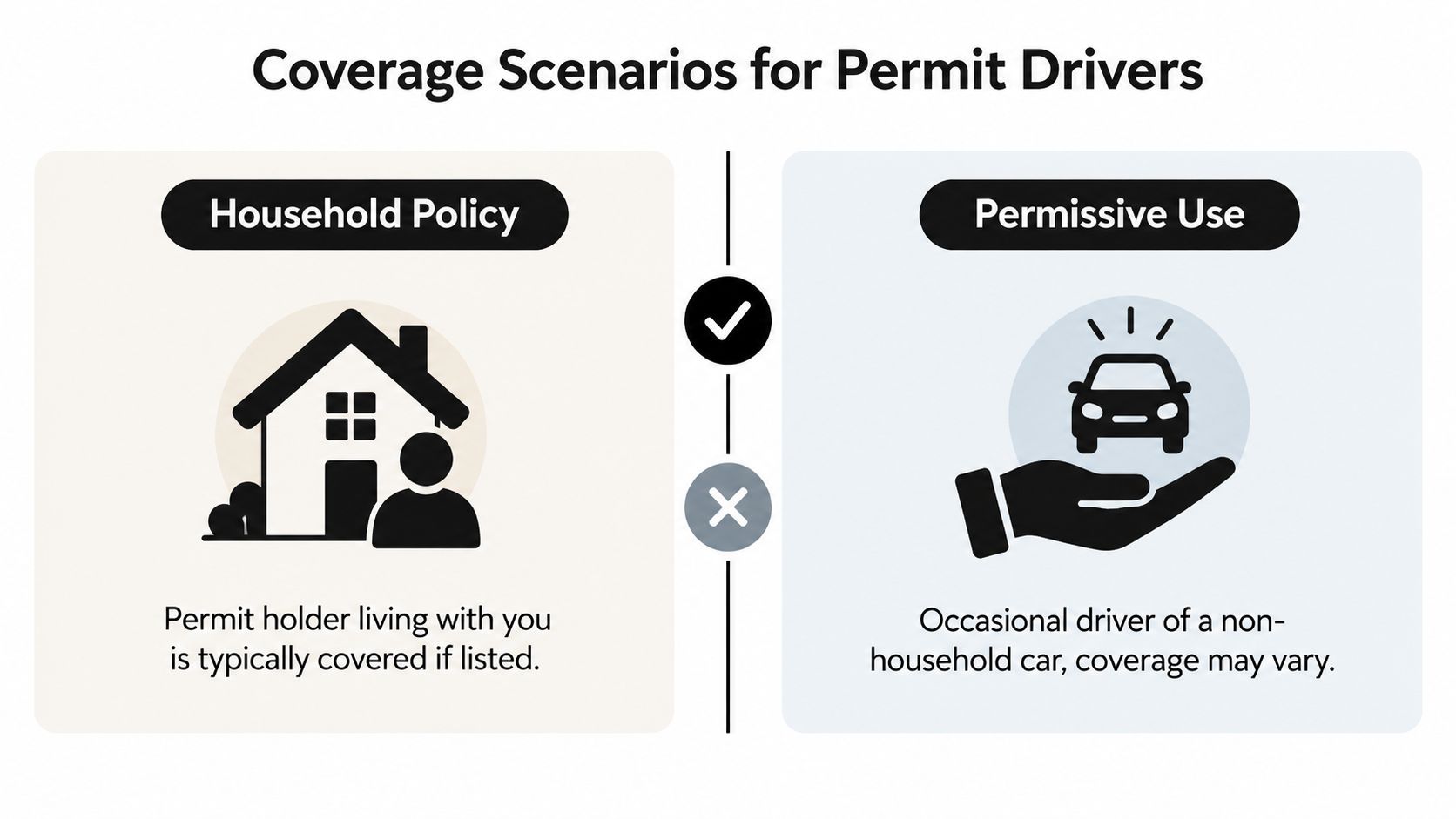
The phrase “automatically covered” can hide several different meanings. It might mean the vehicle has active liability insurance. It might mean the policy recognizes a household member. Or it might refer to permissive use, which can apply differently to an occasional driver using someone else's car.
A teen who lives with a parent and practices in a family vehicle is usually the clearest household-policy situation. Many carriers may not require formal addition at the learner-permit stage, particularly before the teen receives a provisional license, but they may still expect notification. The carrier's contract and underwriting rules control the result, not a general internet statement.
Household use is different from occasional permission
Permissive use usually concerns a person who occasionally borrows an insured car. A permit holder who lives in the household and drives regularly may not fit the practical meaning of an occasional user, even if the parent gives permission every time. Frequency, residence, vehicle ownership, and the policy's definition of a covered driver can all affect the analysis.
Consider two examples:
- Teen living at home: The teen practices in a parent's vehicle and has regular access to it. The parent should notify the carrier and ask whether the teen is recognized during the permit stage, even if formal listing isn't required until provisional licensing.
- Adult permit holder with a separate car: The adult owns or regularly operates a vehicle that isn't a family car. A standalone policy or a specific policy change may be necessary, and the family shouldn't assume permissive-use protection applies.
Independent insurance guidance confirms that permit holders can often join a parent or guardian policy or seek standalone coverage, but standalone insurance is often materially more expensive. It may also become necessary when the permit holder doesn't live with a parent or guardian or attend school. (Progressive guidance on learner's permit insurance)
Ask the carrier this exact question: “Does your policy cover this specific permit holder as a household member, listed driver, or permissive user, and what changes when the permit becomes a provisional license?”
California consumer guidance also emphasizes that answers vary by state and policy. Some families may be covered under an existing household policy, while others must notify the insurer or address a separately owned vehicle. The important question isn't, “Do I need a separate permit policy?” It's whether the current policy's definitions include the person and vehicle involved. Families can use the California insurance FAQ as another place to organize questions before calling the carrier.
How to Add a Permit Holder to Your California Auto Policy
Adding or notifying the insurer doesn't have to be complicated. Treat it like updating a school or medical record. Gather the relevant information, explain the household arrangement, and ask the carrier to identify the exact point when the policy must change.
Follow a documented conversation
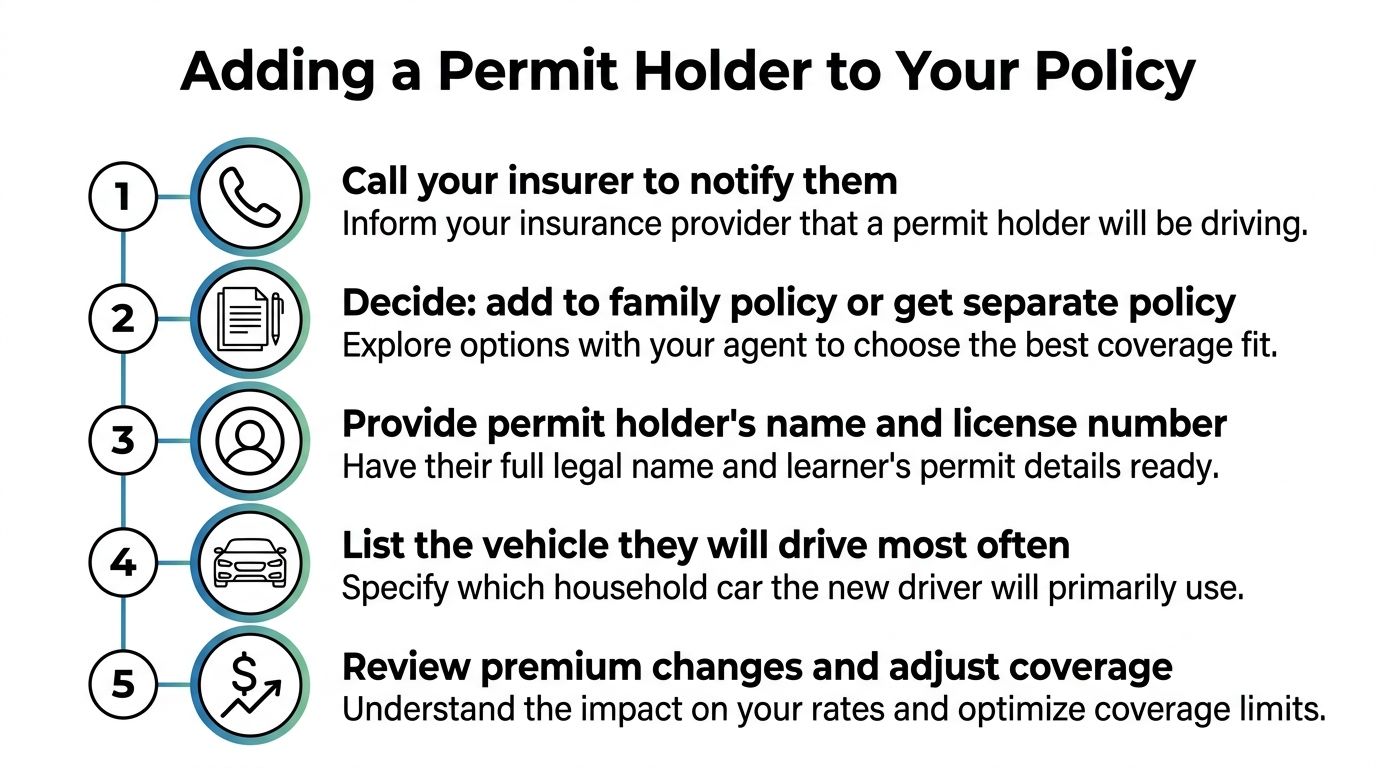
Call before practice starts. Tell the insurer that the person has a California learner's permit and identify every vehicle they may drive. Don't wait until after a collision or until the DMV appointment is already scheduled.
Describe the living arrangement. Explain whether the permit holder lives in the household, attends school away from home, or maintains a separate residence. Residence can affect whether the carrier treats the person as a household member.
Provide the permit information. Have the permit holder's name and permit or license information available. The carrier may request additional personal or vehicle details before confirming how the driver will be handled.
Identify the primary practice vehicle. If the household owns multiple cars, say which one the permit holder will drive most often. The insurer can explain whether the vehicle assignment affects rating or eligibility.
Ask about the provisional-license trigger. Confirm whether formal listing is required when the permit holder receives a provisional license, and ask how much advance notice the carrier wants before the DMV test or licensing appointment.
Request written confirmation. Save the email, letter, endorsement, or account note showing what the representative told you. If the carrier says no policy change is needed yet, ask for that answer in writing and record the date of the call.
Verify the vehicle separately
The policy conversation doesn't replace the vehicle check. Confirm that the car carries at least California's required liability limits, that registration information matches the policy, and that proof of insurance is available for ordinary driving and the drive test.
An insurer's rulebook can be stricter than the legal minimum. One carrier may permit notification without formal listing, while another may require a policy update based on household access or vehicle ownership. Follow the carrier's written instructions, especially before the permit holder begins driving regularly.
What Drives Cost for Permit Drivers and How to Save
A family may see little or no immediate premium change when a teen begins supervised practice, then face a larger adjustment after the teen receives a provisional or full license. The reason is simple: a permit holder is practicing under supervision, while a licensed driver can operate independently. Those are different risk questions for an insurer.
The largest price change often arrives at licensure, not at the first lesson. Ask the carrier for a written estimate before the DMV appointment so the household can budget for the new rated driver.
A recent report found that adding a 16-year-old driver to a U.S. policy increased annual premiums by an average of $3,252, or about 157.9%. That figure is not a California quote and cannot predict your household's price. It does show why the post-license premium deserves attention before the teen drives alone. (Forbes reporting on teenage-driver insurance costs)
State rules can also produce different permit-stage outcomes. Florida, for example, has a rule affecting premiums for certain minors with a learner's driver license. California families should treat that as a pricing comparison, not as a California coverage rule. The insurer's underwriting guidelines and the driver's transition to independent driving control the actual quote.
Compare the main pricing levers
- Driving history: A permit holder has little independent record, so the insurer is pricing limited information. Safe driving may improve the risk profile over time, but each carrier sets its own method and timing.
- Supervision: Practice with a qualified adult generally presents a different exposure from solo driving. Regular access to a household vehicle can still matter even while supervision is required.
- Vehicle selection: A newer, more expensive, or heavily protected vehicle may produce a different premium than a modest family car. Request quotes before assigning the teen to a vehicle.
- Household placement: Keeping the teen on an existing family policy may cost less than arranging separate coverage. Compare both options with the same driver and vehicle details.
- Discount eligibility: Ask about good-student discounts, approved driver education, and safe-driving or usage-based programs. Availability depends on the carrier and policy.
The vehicle works like the household's risk container: its value, repair cost, and use affect the price surrounding the driver. Review those details together rather than judging the teen's premium alone.
Bundling can change the household's overall insurance picture. Compare auto insurance with home insurance or renters insurance when reviewing protection. California renters insurance is commonly estimated at roughly $144 to $171 per year, or about $12 to $14 per month, which gives renters a concrete budget reference. (California renters insurance estimates)
Common Pitfalls and Proof You Need for the California DMV
Most permit-insurance problems begin with an assumption. A parent assumes the teen is covered because the car is insured. A teen assumes the digital card can be found later. Another family waits until the provisional license is issued before asking the carrier any questions.
California requires proof of insurance when driving and for the drive test. Keep current proof accessible, and verify that it identifies the vehicle being used. The policy should satisfy California's minimum 30/60/15 liability limits, including $30,000 for one person's injury or death, $60,000 for multiple people's injury or death, and $15,000 for property damage. (California DMV insurance requirements)
Use this prevention checklist
- Before the first lesson: Confirm the vehicle has active coverage and ask the carrier how it treats the permit holder.
- Before regular household use: Tell the insurer whether the permit holder lives in the household and which vehicles they drive.
- Before the DMV test: Confirm the proof required for that appointment and make sure the vehicle's insurance is current.
- Before provisional licensing: Ask when the driver becomes a rated operator and request a revised premium estimate.
- After every policy change: Save the updated declarations page, insurance card, and written carrier instructions.
- After a move or vehicle purchase: Report the change promptly because residence, ownership, and regular access can affect eligibility.
Permissive use deserves particular caution. Occasional permission to borrow a non-household vehicle isn't automatically the same as regular household use, and policy restrictions may apply. The more often the permit holder drives, the less sensible it is to rely on an informal assumption.
The broader lesson is simple: proof of insurance and proof of coverage are related, but they aren't identical. The insurance card shows that the vehicle has a policy. The carrier's written explanation confirms how that policy treats the specific permit holder.
Next Steps to Get the Right Coverage With Mai and Associates
A sensible California decision follows three questions. First, does the vehicle meet the state's financial-responsibility minimums? Second, has the insurer confirmed whether the permit holder is covered, needs notification, or must be listed? Third, what premium change should the family expect when supervised practice becomes licensed driving?
Those questions also create an opportunity to review the rest of the household's protection. A new driver may expose gaps in auto liability limits, while a home or renters insurance review can clarify whether the family has adequate personal-property and liability protection. Life insurance belongs in the same wider conversation when parents depend on their income to support a household.
Mai & Associates provides California insurance support for auto, home, renters, and life insurance. The agency offers same-day quotes from multiple top-rated carriers, a 24-hour response, four offices in Glendale, Westlake Village, Escondido, and Costa Mesa, and service across more than 50 California cities. Multilingual support is available in English, Spanish, Armenian, Russian, and Vietnamese.
Families in wildfire-prone areas can also ask about California FAIR Plan reviews, earthquake coverage options, and wildfire protection strategies. The California FAIR Plan's residential dwelling coverage cap is $3 million, increased from $1.5 million under an Insurance Commissioner order effective April 1, 2020. (California FAIR Plan coverage-cap information) That home-policy discussion is separate from permit insurance, but bundling reviews can help households evaluate their full protection instead of focusing on one premium line.
Start by gathering the permit, vehicle information, current declarations page, and insurance card. Then request a written coverage explanation and a post-license quote through California insurance quote support, so you can compare the available options before your teen drives alone.
Mai & Associates can review your California auto policy, explain whether your permit holder must be notified or listed, and compare coverage for the licensing transition. Visit Mai & Associates to request a no-obligation quote and connect auto insurance with home, renters, or life insurance where it fits your household.