How to Find and Close Insurance Coverage Gaps in California
You bought California insurance to feel protected, not to discover during a claim that the protection stops several feet short of the damage. A wildfire reaches your neighborhood, a pipe backs sewage into the house, or another driver crosses the center line. Then the adjuster asks about your dwelling limit, ordinance-and-law coverage, replacement cost, water backup endorsement, or uninsured-motorist selection. Those answers matter more than the premium you paid.
A policy can remain active while becoming dangerously outdated. Construction costs change, family responsibilities grow, California regulations shift, and wildfire or earthquake exclusions remain buried in familiar paperwork. The practical question isn't whether you have insurance. It's whether your auto insurance, home insurance, renters insurance, car insurance, or life insurance will respond to the loss you face.
When a Policy Is Not What You Think It Is
A Sonoma County homeowner watches smoke drift across the property and assumes her homeowners insurance will rebuild whatever the fire destroys. When the adjuster arrives, the conversation turns to the dwelling limit, ordinance-and-law coverage, and the debris-removal cap. Her policy is real, but its promises are narrower than she remembered.
A Sacramento driver has a similar shock on I-80 at dusk. An uninsured motorist causes a collision, and the driver expects his “full-coverage” car insurance to handle the injuries and vehicle damage. The declarations page shows collision coverage, but uninsured-motorist protection was declined. The policy pays for some damage, not the entire financial problem.
Practical rule: Never use “full coverage” as a substitute for reading the declarations page. It isn't a defined promise that every loss will be covered.
The gap usually starts before the loss. A policy bought years ago may still renew automatically while the home costs more to rebuild, the household owns more valuable property, or a new job involves rideshare driving. The insurer follows the contract. It doesn't automatically adjust every limit to match your life.
Start with the declarations page, then read the endorsements and exclusions that modify it. Identify the limit for the building, personal property, loss of use, liability, medical payments, uninsured motorists, and any scheduled items. If you can't explain what each limit does, ask for a written explanation before renewal.
This article is the checklist those two California policyholders needed before the smoke or the collision. The objective isn't to buy every optional feature. It's to identify the precise point where the standard policy ends, then close the gap with a higher limit, an endorsement, a separate policy, or a better policy combination.
What Insurance Coverage Gaps Actually Mean
A coverage gap exists when a real loss is larger than the protection your policy promises. Think of a coffee mug with a hairline crack. It holds water during ordinary use, but pressure exposes the weakness. Insurance can feel complete during years without a claim, then fail at the exact point where the loss becomes expensive.
Three terms describe different problems:
- Underinsurance means the policy limit is too low. A San Diego homeowner may have replacement-cost coverage but a dwelling limit that doesn't reflect current rebuilding requirements.
- An exclusion means the policy doesn't cover that peril at all. Flood and earthquake damage commonly require separate protection rather than a standard homeowners endorsement.
- A coverage gap is the resulting shortfall. It can come from a low limit, a missing endorsement, an exclusion, or several restrictions operating together.
Actual cash value creates another common problem. If a policy values an older roof or personal property after depreciation, the settlement may be less than the amount needed to buy a comparable replacement. Replacement-cost coverage can address that valuation issue, but only if the policy includes it and the insured satisfies its requirements.
Auto insurance has the same distinction. A Bay Area driver who uses a personal vehicle for rideshare activity may have liability protection for ordinary personal use but a gap during app-based work if the policy excludes or limits that activity. Collision coverage doesn't automatically solve a liability or business-use exclusion.
Insurance language is technical, so use a reliable insurance glossary for California policy terms while reviewing the documents. For roof-related questions, roof warranty coverage tips for homeowners can help separate maintenance obligations and warranty issues from insurance-covered damage. Those are different contracts, and confusing them can delay the right fix.
The test is simple: name the event, name the policy section that responds, and name the maximum payment. If you can't do all three, you have an unresolved insurance coverage gap.
The Most Common Coverage Gaps in California
California households usually don't suffer from one mysterious flaw. They suffer from ordinary policy choices that become expensive under extraordinary pressure. The four categories below deserve a direct review.
Home insurance gaps
Many homeowners insure the purchase price rather than the cost to rebuild. Market value includes land and local demand, while reconstruction involves labor, materials, debris removal, permits, and current building requirements. A home can be worth less on the market and still cost more to rebuild.
Ordinance-and-law coverage matters after a partial or total loss requires upgrades to meet current codes. Without enough of that coverage, the homeowner can receive payment for the damaged structure but still fund required improvements personally. Water backup and sewer damage also need attention because standard policies commonly stop at the exclusion unless an endorsement changes the contract.
The debris-removal limit deserves its own line-item review. A total loss can consume funds removing ash, damaged materials, and hazardous remnants before reconstruction starts. Review the policy language governing Coverage A, ordinance or law, debris removal, water backup, and replacement cost.
Auto insurance gaps
California's new minimum liability structure under Senate Bill 1107 took effect January 1, 2025, with limits of $30,000 per person, $60,000 per accident for bodily injury, and $15,000 for property damage, as explained by this California SB 1107 liability summary. Those limits are higher than the older 15/30/5 structure, but they can still leave personal assets exposed after a serious crash.
California's uninsured-driver rate is about 20.4%, or roughly one in five motorists, according to the cited California uninsured-driver summary. Declining uninsured and underinsured motorist coverage leaves you depending on the other driver's nonexistent or inadequate liability policy. The responsible wording appears in the declarations page and the UM/UIM selection or rejection forms.
Renters insurance gaps
A landlord's policy generally protects the building, not the tenant's furniture, electronics, clothing, or personal liability. Renters who skip their own policy may discover the landlord's insurance won't replace their belongings after a fire or theft.
California Department of Insurance guidance says renters policies generally provide loss of use at 20% of Coverage C, personal liability generally subject to a minimum of $100,000, and medical payments to others generally subject to a minimum of $1,000, as described in the state's residential insurance guide. Those limits are starting points, not proof that the policy matches your possessions. The responsible provisions are Coverage C, Coverage D, liability limits, and personal-property valuation language.
Life insurance gaps
Life insurance limits often remain frozen at the amount selected when the policy began. That amount may no longer reflect children, a mortgage, education responsibilities, business obligations, or a partner's dependence on your income.
Review the death benefit, term length, beneficiaries, ownership, and conversion rights after major household changes. The gap comes from the policy's stated face amount and beneficiary provisions, not from a vague feeling that the policy is old. On property claims, homeowners can also find overlooked supplement items, especially when repair estimates fail to capture covered work required by the policy.
Real California Scenarios Where Gaps Bite Hard
A Los Angeles-area homeowner carries a California FAIR Plan policy because voluntary-market insurance isn't available at an acceptable price. A wildfire damages the home and nearby structures. The FAIR Plan responds to its named perils, but the homeowner learns that liability, theft, water damage, and earthquake aren't included in the same way as a broad homeowners package. Code upgrades, smoke-related losses outside the covered structure, and replacement-cost limitations create additional shortfalls.
The FAIR Plan residential dwelling limit is $3.0 million to $3.3 million, according to an independent summary of the plan's limits and structure, California FAIR Plan coverage details. The plan covers fire, lightning, internal explosion, and smoke, while excluding liability, theft, water damage, flood, and earthquake unless separately arranged. A Difference in Conditions policy can supply important wrap-around protection, but the homeowner must compare the two contracts rather than assume the DIC duplicates everything.
A Sacramento driver with state-minimum liability is hit by an uninsured motorist. The January 2025 SB 1107 limits of 30/60/15 may satisfy the legal minimum, but they don't guarantee enough money for medical bills, lost wages, vehicle damage, or extended transportation needs. If the driver's own policy lacks matching UM/UIM protection, the financial recovery can be sharply limited.
That driver should have reviewed the auto declarations page before the crash. The homeowner should have paired the FAIR Plan with broader protection before the fire. A careful California home insurance review compares the policy stack, not just the existence of one policy.
These aren't arguments for buying every add-on. They're reminders that a named peril, a liability limit, and a dwelling limit each solve different problems. The right question is which loss you can absorb personally and which one would damage your household for years.
A Step-by-Step Plan to Close the Gaps
Use this sequence during the current policy year. Start with documents, not a sales quote.
Collect every declarations page. Pull your active home, auto, renters, life, umbrella, earthquake, and FAIR Plan documents. Mark limits, deductibles, endorsements, exclusions, valuation methods, and renewal dates. If an endorsement isn't listed, don't assume it exists.
Fix auto liability and UM/UIM first. Confirm your limits meet the post-January 2025 SB 1107 structure of 30/60/15, then ask for UM/UIM at matching or higher limits. Collision coverage repairs your vehicle under its terms. It doesn't replace uninsured-motorist bodily-injury protection.
Recalculate the dwelling limit. In high-risk wildfire areas, including the state's higher-risk zones, ask for a current reconstruction estimate. Purchase price isn't a rebuilding estimate, and a home's appearance doesn't reveal the cost of permits, code compliance, labor, and debris removal.
Build the FAIR Plan combination correctly. If a voluntary carrier has non-renewed the property or won't write it, request a FAIR Plan quote and then evaluate a DIC or other supplemental policy. Confirm whether the supplemental coverage addresses wildfire-related property, smoke, loss of use, liability, water damage, and replacement-cost differences. Earthquake remains a separate decision.
Add only targeted endorsements. Water backup, ordinance-and-law, equipment breakdown, scheduled personal property, and rideshare coverage each address a particular failure point. Ask about sublimits and exclusions instead of accepting an endorsement by name alone.
Consider an umbrella policy. A personal umbrella can sit above home and auto liability limits, often in amounts such as $1 million to $2 million, but the insurer will require underlying policies that meet its conditions. It won't repair an excluded home peril or replace missing earthquake coverage.
Schedule an annual review. Tie the review to renewal dates, household changes, major renovations, new valuables, employment changes, and Cal Fire hazard reassessments. California wildfire eligibility can change, so don't wait for a cancellation notice to assemble a replacement strategy.
Ask for the gap in dollars, not just the premium difference. A useful review identifies what you would pay after the policy limit or exclusion applies.
Your Coverage Gap Checklist and Questions for Your Agent
Print this list or keep it beside your declarations pages. Check each item only after reading the actual policy language.
Homeowners
- Rebuild cost: Verify the dwelling limit reflects current construction costs in your area.
- Code upgrades: Confirm ordinance-and-law coverage, including whether the selected limit is adequate for your property.
- Water backup: Review the endorsement, limit, deductible, and exclusions.
- Wildfire combination: If you use the FAIR Plan, confirm DIC or supplemental coverage and its treatment of smoke, loss of use, and replacement cost.
- Valuables: Schedule jewelry, art, collectibles, or other property subject to sublimits.
Renters
- Personal property: Confirm replacement-cost valuation rather than assuming the landlord's policy protects your belongings.
- Liability: Carry at least $100,000 of personal liability, consistent with the general California guidance cited earlier.
- Away-from-home property: Ask how electronics and other belongings are covered while traveling or stored elsewhere.
Auto
- Liability: Confirm 30/60/15 or higher.
- UM/UIM: Match or exceed your bodily-injury liability limits.
- Medical payments: Ask whether this coverage is available and appropriate.
- Rental reimbursement: Confirm the daily limit and maximum duration.
Life and umbrella
- Income protection: Review whether the death benefit still reflects household income, debts, and dependents.
- Umbrella: Consider at least $1 million above qualifying home and auto liability limits.
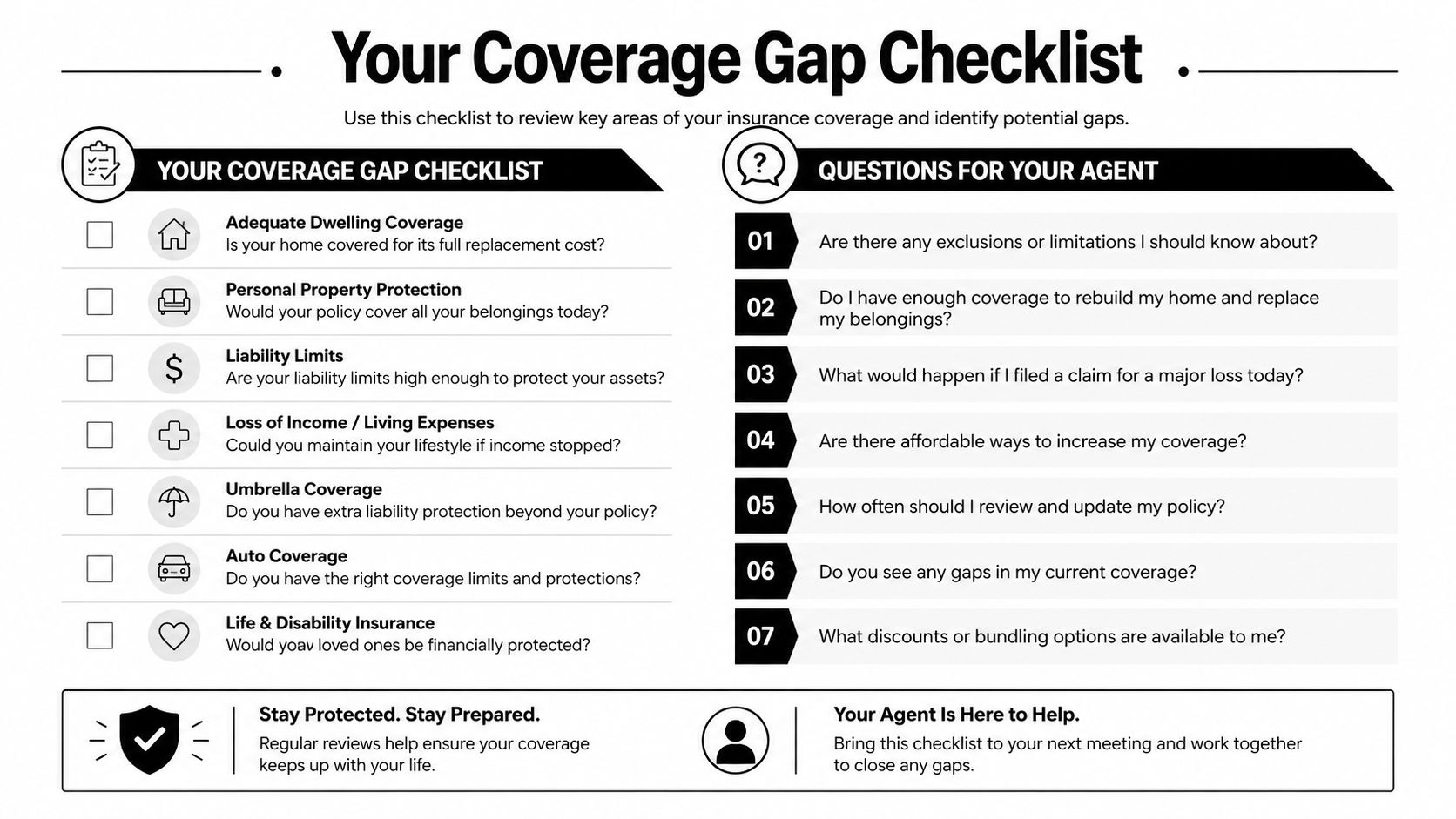
Bring these ten questions to your agent:
- Does my dwelling limit reflect current construction costs in my zip code?
- Is my home valued at replacement cost or actual cash value?
- What ordinance-and-law limit applies after a total loss?
- What water backup damage is excluded or limited?
- What peril specifically is excluded in my FAIR Plan policy that I need a DIC to cover?
- Does my auto policy cover rideshare use?
- Do my UM/UIM limits match my liability limits?
- Are my renters belongings covered at replacement cost?
- Which valuables need scheduled-property endorsements?
- Does my life insurance benefit still fit my household obligations?
Closing the Gaps With a Local California Team
Insurance coverage gaps are easiest to fix before renewal, not after a claim. California residents need someone who understands how standard policies interact with the FAIR Plan, California Automobile Assigned Risk Plan, California Earthquake Authority supplemental coverage, and Difference in Conditions policies. A general quote comparison won't answer whether a forced-place or named-peril policy leaves liability, water, earthquake, smoke, or replacement-cost holes.
Mai & Associates has four California offices and a multilingual team serving clients across the state. Its agents work with auto insurance, home insurance, renters insurance, life insurance, FAIR Plan reviews, earthquake coverage options, and wildfire protection strategies. The agency's FAIR Plan review can examine an existing policy and determine whether a standard carrier may write the home again, rather than treating the FAIR Plan as the permanent answer.
The timing matters. SB 1107's higher minimum liability limits began January 1, 2025, and California's approximately 20.4% uninsured-driver rate makes UM/UIM protection a serious protection decision, not a minor checkbox. Drivers should compare their liability limits and UM/UIM selections before the next collision.
Treat the appointment as a one-time coverage audit. Bring every declarations page, renewal notice, FAIR Plan document, supplemental policy, vehicle-use detail, and life-policy beneficiary record. You can request an insurance quote and coverage review, call the agency, book online, or bring the documents to an office in Glendale, Westlake Village, Escondido, or Costa Mesa.
Mai & Associates can review your California auto, home, renters, and life insurance for missing limits, exclusions, and endorsements, including FAIR Plan combinations and uninsured-motorist protection. Visit Mai & Associates with your current declarations pages and schedule the review before your next renewal cycle.