Insurance Claim Denial in California: The Complete Guide
You've just filed a claim after a California car accident, roof leak, wildfire-related loss, or family member's death. Then the insurer sends a letter saying the claim is denied. The wording may point to an exclusion, missing information, a policy condition, or a disagreement about the facts. You're left wondering whether the decision is final, whether you'll have to pay everything yourself, and how to respond without making the situation worse.
A denial is a decision, not automatically the end of the dispute. The right response depends on the type of insurance, the policy language, the evidence, and whether the insurer followed California's claims-handling requirements.
Understanding Insurance Claim Denials in California
A homeowner in wildfire-prone Ventura County might submit a claim after storm damage affects the roof and interior of the house. The insurer may respond that the damage resulted from long-term deterioration rather than the covered storm event. In Los Angeles, a driver might report a fender bender and receive a denial because the carrier interprets an exclusion, driver restriction, or vehicle-use provision against the policyholder.
Both people have received an insurance claim denial, but the underlying questions differ. The homeowner needs to establish what caused the damage and whether the policy covers that cause. The driver needs to examine the exclusion, the vehicle's use, the listed drivers, and the facts surrounding the collision.
A denial can be based on a genuine coverage limitation, but it can also result from incomplete documentation, coding problems, inaccurate claim information, or a disagreement about policy interpretation. In health insurance, for example, KFF reported that ACA marketplace insurers received about 496 million claims in 2024, with roughly 85 million in-network claims denied. That represented a 19% in-network denial rate and a 20% combined denial rate, even though 91% of the reported claims involved in-network services. KFF's 2024 analysis shows why a denial shouldn't automatically be treated as proof that the patient used the wrong provider or did something improper.
Practical rule: Read the denial as a list of issues to test, not as a final judgment about your honesty or the validity of your loss.
The first document to inspect is the written denial itself. Look for the claim number, policy number, date of loss, stated reason, cited exclusion or condition, requested documentation, and appeal deadline. Then compare the explanation with the declarations page, endorsements, exclusions, receipts, photographs, repair estimates, police reports, and communications you provided.
California policyholders can also use a plain-language insurance glossary when a letter relies on unfamiliar terms. Keep every email, call note, attachment, and delivery confirmation in one file. That record helps you distinguish a real coverage gap from a correctable administrative problem.
Common Reasons Your Claim Gets Denied by Policy Type
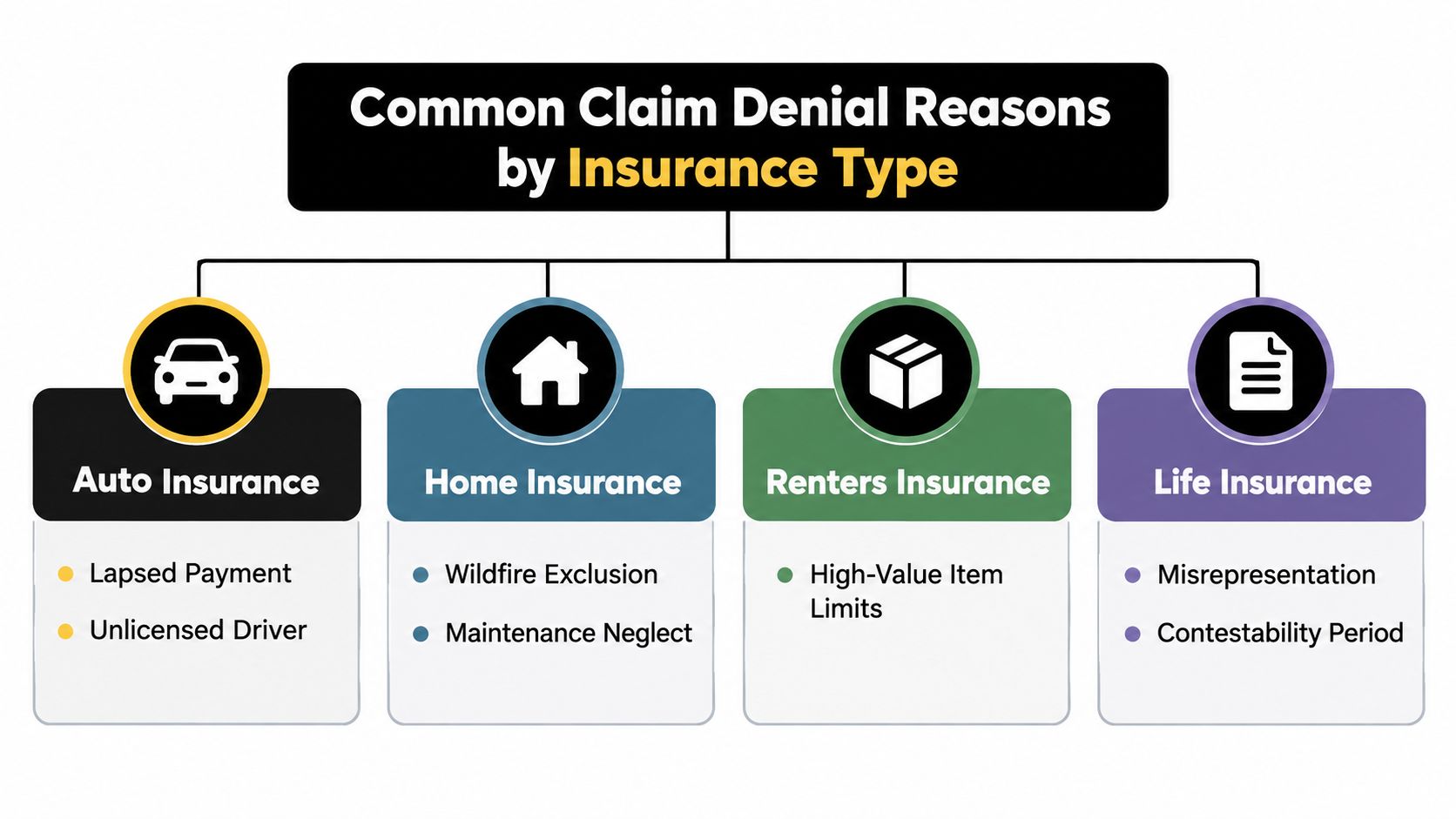
Auto, home, renters, and life insurance don't use the same coverage logic. A denial that may be reasonable under one policy can be irrelevant under another, so start by identifying the policy-specific issue rather than searching for a generic appeal argument.
Auto insurance disputes
An auto insurer may question whether the driver was covered, whether the vehicle was being used as reported, or whether a listed exclusion applies. Common examples include an uninsured motorist dispute, an excluded driver using the car, or a vehicle used for delivery, rideshare, or another purpose that wasn't disclosed. A lapse in payment can create a separate problem, but the carrier still needs to connect its decision to the policy status and relevant dates.
Check the declarations page, driver list, garaging address, vehicle description, usage information, and endorsements. For a collision, preserve photographs, the police report, witness information, repair estimates, and any communication with the other driver.
Home insurance questions
Home claims often turn on cause of loss. A sudden storm event may be treated differently from wear and tear, deferred maintenance, seepage, flooding, earth movement, or another excluded cause. A carrier may also dispute code upgrades, particularly when the policy provides limited or no ordinance-and-law coverage.
Ask the adjuster to identify the exact exclusion or limitation and explain how it applies to the observed damage. An engineer's report, contractor estimate, maintenance records, weather documentation, and photographs can help establish when and how the damage occurred.
Renters insurance limitations
Renters insurance generally addresses covered personal property and certain liability risks, but policies can contain sublimits for jewelry, collectibles, electronics, cash, or other high-value belongings. A denial may also involve business equipment, excluded causes of loss, or insufficient proof that the property belonged to you.
Create a room-by-room inventory using receipts, photographs, purchase records, serial numbers, and account statements. If business property is involved, review the policy's business-property wording instead of assuming personal-property coverage applies. California renters can review coverage basics through this guide to renters insurance in California.
Life insurance documentation
Life insurance disputes often involve application information, beneficiary paperwork, proof of death, or questions arising during a policy's contestability period. The carrier may request medical or application records if it believes a material statement was inaccurate. A beneficiary may also face delays when documents do not clearly establish identity or entitlement to proceeds.
Compare the denial with the application, policy, beneficiary designation, death certificate, and correspondence from the insurer. Don't assume a request for records means the claim will be denied, but don't ignore a deadline or incomplete explanation either.
California Claim Denial Timelines and Legal Requirements
A denial can feel final when it arrives in the mail. In California, however, the insurer must follow procedural rules that create useful checkpoints. Those checkpoints do not establish coverage, but they can show whether the carrier investigated promptly, explained its position, and followed the required process. The California claims-handling overview and these California insurance guides provide broader context for comparing requirements across auto, home, renters, and life insurance.
Investigation and decision deadlines
Under California's Fair Claims Settlement Practices regulations, an insurer must begin investigating a claim within 15 days after receiving notice. Prompt investigation matters because vehicle damage, property conditions, and witness memories can change. A delay may leave important evidence undocumented, whether the dispute involves auto, home, renters, or another covered loss.
For a first-party claim, the insurer must accept or deny the claim within 40 calendar days after receiving proof of claim. The carrier may accept the entire claim, pay part of it, or deny it. A denial must be in writing and identify all factual and legal grounds then known to the insurer, along with any relevant policy provision, statute, or condition. It must also explain how that authority applies to the facts. The governing language appears in the California regulation.
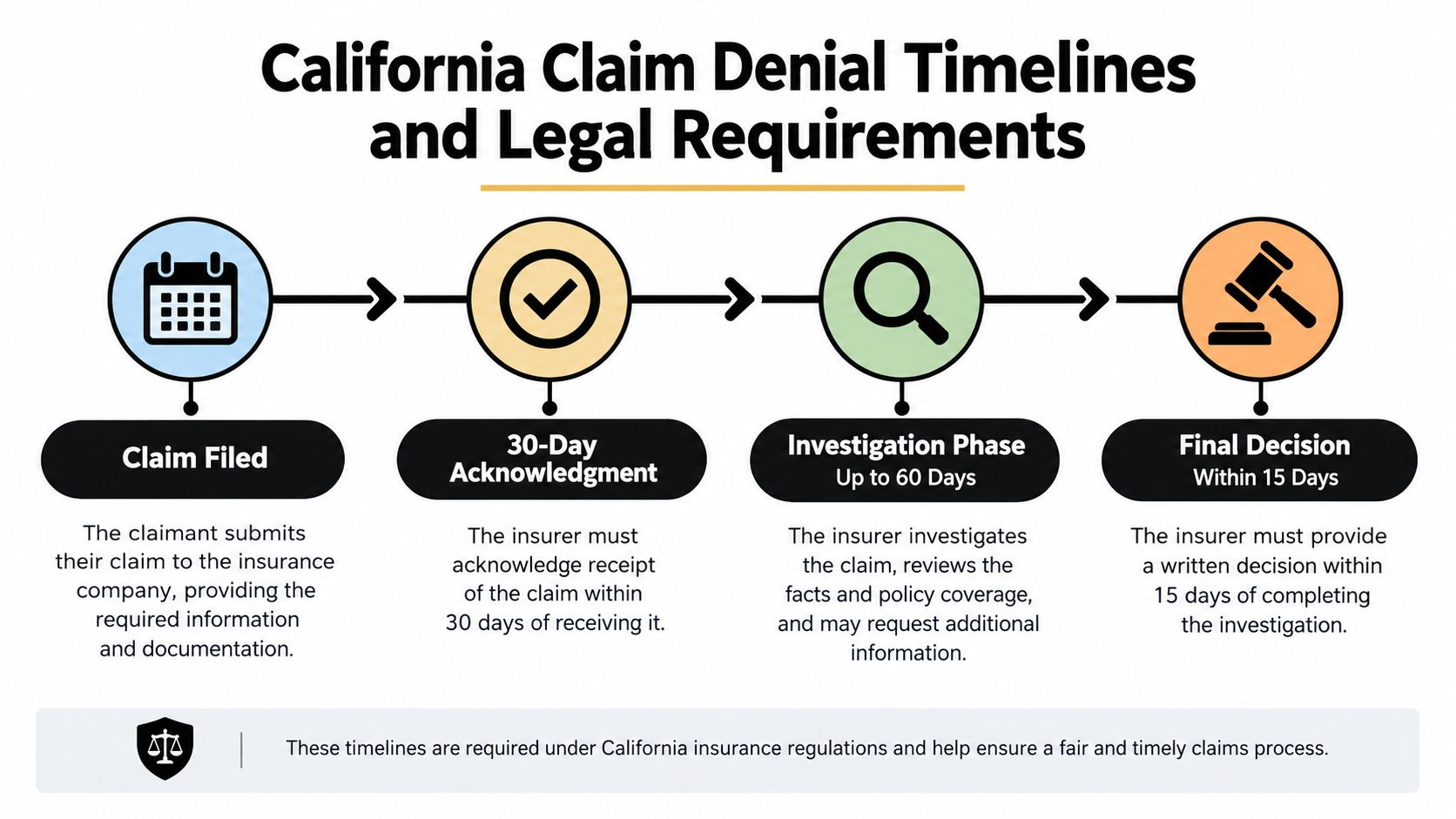
Use the infographic as a general visual aid, not as a substitute for the policy or regulation. The facts of the loss, the type of insurance, and the documents submitted can affect which deadline applies.
Special rules for property and life claims
For residential property claims, the insurer may request information reasonably necessary to decide the claim. A request should connect to a genuine coverage or damage question rather than demand records without explanation. California's Residential Property Claims Guide states that a denial notice must also tell the claimant that the matter may be reviewed by the California Department of Insurance.
Life insurance follows a separate payment rule. California law requires payment within 30 days after the insurer receives due proof of death and proof of the claimant's right to the proceeds. Many life policies also include a two-year contestability period, when the insurer may examine alleged application misstatements more closely before its ability to deny becomes more limited. Keep the policy, application, beneficiary records, proof of death, and insurer correspondence together.
Create a simple date record: notice of loss, proof of claim, investigation contacts, and written decision. If the carrier appears to have missed a deadline, list those dates in your appeal and ask for a specific explanation of the delay.
How to Appeal an Insurance Claim Denial in California
A strong appeal answers the denial point by point. Emotional frustration is understandable, but an adjuster or examiner needs a clear connection between the policy language, the facts, and the evidence.
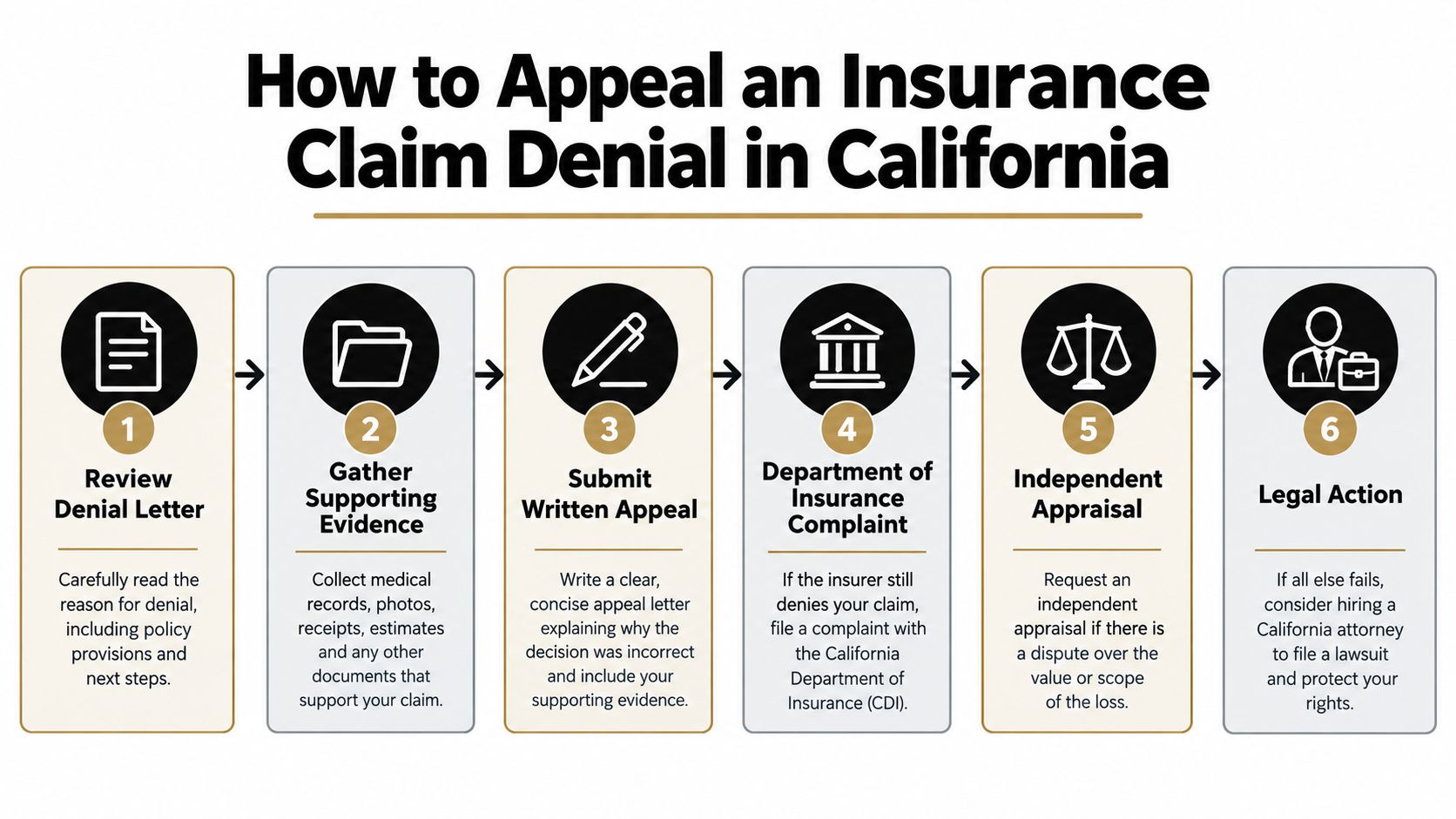
Start with the denial file
Review the letter carefully. Identify every reason, exclusion, limitation, missing document, factual assumption, and appeal deadline. Don't respond to only the first paragraph if the insurer lists several grounds.
Request the claim materials. Ask for the documents the carrier relied on, including inspection reports, photographs, recorded statements, estimates, policy provisions, expert opinions, and internal explanations that can be disclosed. Keep your request and the insurer's response in writing.
Check for correctable errors. Compare names, addresses, dates, vehicle details, loss descriptions, invoices, codes, and payment information. Technical mismatches can matter. In health insurance, KFF's earlier ACA analysis found that common denial categories included administrative reasons, excluded services, and missing prior authorization or referral, while only 6% of in-network denials were based on lack of medical necessity. The AJMC discussion of those categories illustrates why paperwork and rule-based edits deserve close attention.
Build and submit the appeal
Organize evidence around each denial reason. Auto claims may need repair estimates, photographs, a police report, and vehicle-use records. Home claims may require contractor opinions, maintenance records, weather evidence, and proof of the damaged condition. Renters claims benefit from inventories and ownership records. Life claims require policy and beneficiary documents, proof of death, and a precise response to any alleged application misstatement.
Use a simple structure:
- Claim identification: State your name, policy number, claim number, loss date, and the date of the denial.
- Stated reason: Reproduce the insurer's wording accurately.
- Response: Explain why the facts and policy language support coverage or require further investigation.
- Evidence list: Name every attachment and connect it to a specific argument.
- Requested action: Ask for reconsideration, payment, correction of the record, or a written explanation identifying the remaining factual dispute.
Submit the appeal through the method required by the policy or denial letter. Use a trackable delivery method and retain the complete submission. For broader background on challenging claim denials, focus on the same principle: evidence should answer the insurer's stated reason rather than repeat the original claim narrative.
Escalate carefully
If the internal appeal fails, review the final decision for new reasons, unanswered evidence, and procedural omissions. For California auto, home, or renters disputes, a complaint to the California Department of Insurance may help identify regulatory concerns, although the department isn't a substitute for legal advice or a court.
A policyholder should consider an insurance attorney when the loss is substantial, the coverage wording is complex, the insurer changes its explanation, or the denial may involve unfair claims handling. You can also use a policyholder-focused insurance FAQ to clarify basic terms before contacting the carrier.
When to Seek Legal Help or Agent Review for Your Denial
Self-advocacy makes sense when the denial appears to result from a missing receipt, incorrect date, incomplete inventory, or another issue you can fix quickly. An agent review can be useful when you need help understanding declarations, endorsements, deductibles, exclusions, policy limits, or whether your current policy was designed for the risk you faced.
Legal advice becomes more important when the insurer relies on several overlapping exclusions, refuses to explain the decision, ignores relevant evidence, or delays without a clear reason. A serious injury, extensive wildfire damage, disputed liability, high-value personal property, or a life insurance benefit may justify professional review because the consequences of an incorrect decision can be difficult to reverse.
| Scenario | Recommended Approach | Typical Cost | Expected Outcome |
|---|---|---|---|
| A clear clerical error or missing document | Correct the record and submit it to the insurer | Often no separate professional fee | Faster reconsideration may be possible |
| Unclear policy wording or uncertainty about endorsements | Ask an independent agent to review the policy | Depends on the agent's arrangement | Better understanding of coverage and gaps |
| Large property, auto, or life insurance dispute | Consult an insurance attorney before signing releases | Varies by attorney and matter | Advice on rights, strategy, and potential recovery |
| Evidence suggests an incomplete investigation or unsupported exclusion | Obtain legal review and preserve the claim file | Varies by representation agreement | Stronger escalation and documentation |
| The insurer's position changes after you respond | Seek legal advice promptly | Varies by representation agreement | A professional can assess whether the new position is defensible |
| A modest claim with a straightforward explanation | Handle the internal appeal yourself | Usually limited to copying and delivery costs | A concise evidence-based appeal may resolve the issue |
Your current insurer's agent can explain what the policy says, but the agent usually doesn't control the carrier's claim decision. An independent insurance professional can help you understand coverage and future protection, while an attorney represents your legal interests in a dispute.
A useful dividing line is complexity, not just claim size. If you can't explain the denial in one sentence and identify the document that would defeat it, professional review is worth considering.
Don't sign a broad release, accept a settlement, or discard damaged property before understanding the consequences. Preserve evidence, follow the policy's notice requirements, and get advice before a deadline passes.
How Mai & Associates Can Help You Navigate Claim Denials
Mai & Associates offers licensed California insurance guidance for policyholders reviewing auto, home, renters, and life insurance coverage. Its agents can examine the denial letter and policy documents, identify apparent coverage gaps, and help clarify whether the dispute involves an exclusion, an inaccurate application detail, a documentation problem, or a mismatch between the policy and the risk.
The agency also helps California residents evaluate protection before the next loss occurs. That can include reviewing California Fair Plan arrangements, considering earthquake coverage options, and assessing wildfire protection strategies for higher-risk areas. Better policy design and organized documentation won't guarantee claim payment, but they can reduce avoidable confusion when a loss happens.
Mai & Associates provides multilingual support in English, Spanish, Armenian, Russian, and Vietnamese, along with same-day quote capabilities and service from offices in Glendale, Westlake Village, Escondido, and Costa Mesa. Its agents can compare available coverage options, explain limits and endorsements in plain language, and help clients understand how auto, home, renters, and life policies differ.
Before contacting an agency, gather your denial letter, declarations page, policy endorsements, claim number, photographs, estimates, receipts, and a dated list of communications. Ask focused questions: Which policy provision did the insurer cite? Does the evidence support that interpretation? Is the problem a coverage exclusion or a correctable documentation issue? What should you preserve before appealing?
If the denial involves a complex legal dispute, a large loss, or possible unfair claims handling, an agent review shouldn't replace advice from a qualified insurance attorney. It can, however, give you a clearer picture of the policy and help you identify the next practical step.
Mai & Associates can also help you review future coverage so the policy reflects your vehicle use, home risks, belongings, beneficiaries, and financial priorities. A denial often exposes a gap that existed before the claim. Addressing that gap now may be more useful than waiting for another loss.
Mai & Associates offers California policy reviews, coverage comparisons, and practical guidance for auto, home, renters, and life insurance claim concerns. If you've received an insurance claim denial or want to reduce future coverage surprises, visit Mai & Associates to request professional assistance.