Protect Your Family with Individual Life Insurance: A Smart Guide for Californians

At its core, individual life insurance is a straightforward promise. It’s a private contract you set up with an insurance company, ensuring that the people you care about most receive a tax-free payout when you’re no longer around. This provides them with a critical financial cushion during a difficult time, especially for families navigating the high cost of living in California.
Why Individual Life Insurance Is a Cornerstone of California Financial Security
A personal life insurance policy is about so much more than just covering final expenses. It’s a way to secure your family's future. Unlike a policy you might get through work—which often disappears if you change jobs and usually provides just basic coverage—an individual policy is completely yours. You own it, you control it, and it moves with you no matter where your career takes you.
For anyone living in California, this kind of personal protection is especially vital. The high cost of living here means that the loss of an income can quickly put a family’s financial stability at risk, threatening their ability to pay the mortgage, cover bills, and maintain their way of life. A well-structured individual policy creates the continuity they’ll need, forming a key part of a comprehensive California insurance plan.
A Foundation for Your Entire Protection Plan
Think of individual life insurance as the concrete foundation of your family’s financial house. It provides the solid base needed to support all your other coverage, like auto insurance, home insurance, or even renters insurance.
Here’s what that foundation helps you build:
- Income Replacement: The death benefit can replace years of your salary, allowing your family to manage daily expenses without scrambling.
- Debt Repayment: It can be used to pay off a mortgage, car insurance loans, or credit card balances, lifting a massive weight off your loved ones’ shoulders.
- Future Funding: The funds can secure long-term goals, like ensuring your kids can afford college or that your spouse has a comfortable retirement.
More and more people are recognizing this need. In the first nine months of 2026, sales of U.S. individual life insurance policies saw significant double-digit growth. New annualized premiums hit an impressive $12.7 billion, a 12% jump from the previous year, while the number of policies sold rose by 6%. A big driver of this growth was Indexed Universal Life (IUL), which made up 25% of the total market as people looked for robust financial protection.
This renewed focus on personal financial planning is a clear sign of the times. If you're just starting to explore these ideas, getting a general overview of Life Insurance can be a great first step. At Mai & Associates, our job is to help Californians build a complete protection plan that secures their financial legacy. If you come across any unfamiliar terms, our glossary has clear, simple definitions. You can find it right here: https://cahomeauto.com/glossary
Choosing Your Policy: Should You Rent or Own Your Coverage?
When it comes to individual life insurance, the easiest way to wrap your head around the options is to think about real estate. Are you looking to rent or own? This simple question cuts right to the heart of the matter, helping you decide what kind of protection fits your budget, your timeline, and your family's needs.
Your decision will ultimately lead you to one of three main types of life insurance: Term, Whole, or Universal. Each is built for a different purpose, much like a starter apartment versus a forever home.
But before we get into the specifics, let's answer the most basic question of all. Do you even need it? This simple flowchart can give you a quick gut-check.
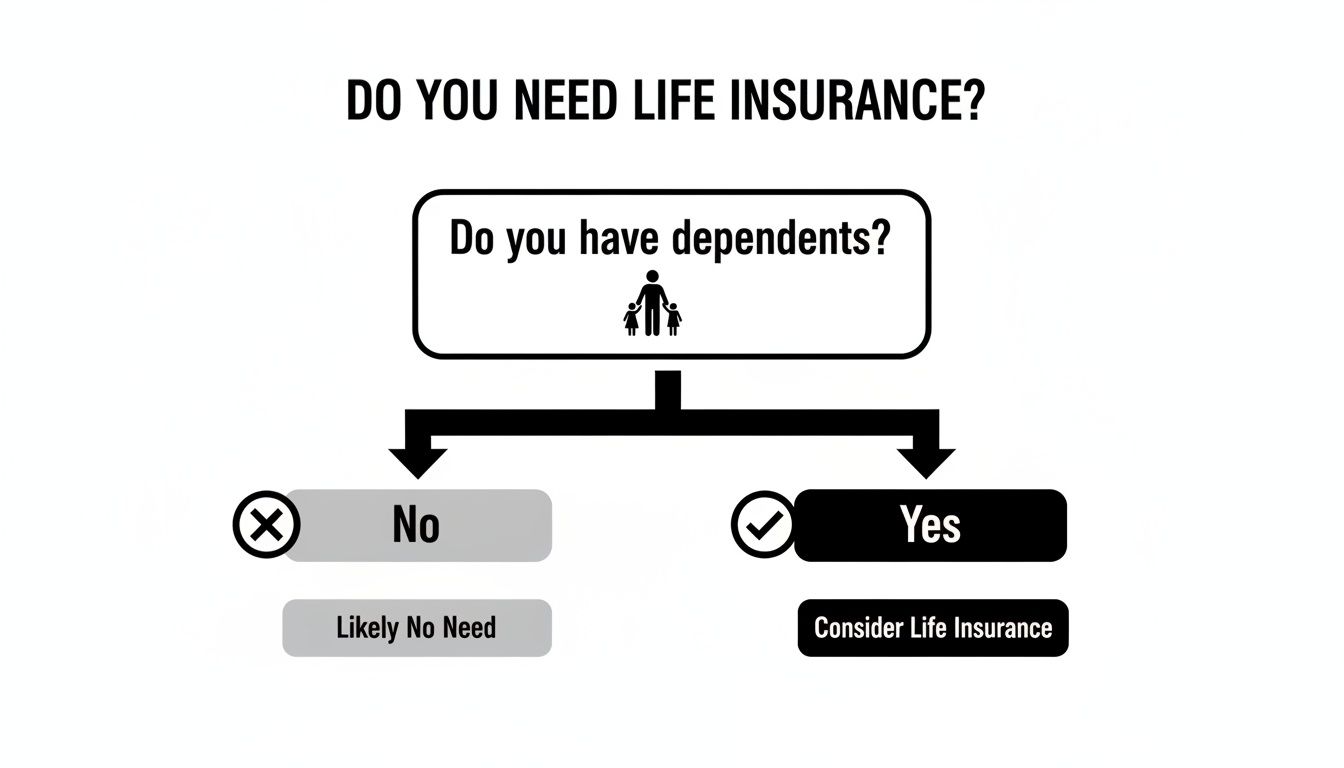
As you can see, the answer is usually straightforward. If people rely on your income to live, you need a plan to protect them.
Term Life Insurance: The "Rental" Approach
Think of Term life insurance as “renting” your coverage. It’s the most straightforward and budget-friendly option out there. You pick a coverage amount and a "term"—typically 10, 20, or 30 years—and that's it.
If you pass away within that term, your family gets the payout. If you outlive the policy, the coverage just ends, like a lease expiring. No muss, no fuss. This makes it an incredibly powerful tool for covering financial responsibilities that have a clear finish line.
When Term Life Makes Sense: It's perfect for covering large, temporary obligations. The most common uses are to ensure a mortgage gets paid off or to replace your income until your kids are grown and out of the house. For most California families, it’s the best way to get a lot of protection when they need it most, without breaking the bank.
This approach gives you the biggest bang for your buck, securing maximum coverage for the lowest cost during your peak earning years.
Whole Life Insurance: The "Ownership" Approach
If Term is renting, then Whole life insurance is owning the property. It's permanent coverage that lasts your entire life—it never expires as long as premiums are paid. It's designed not just as a safety net, but as a financial asset you own.
The key feature here is the cash value component. Part of every premium you pay gets funneled into a savings account that grows at a guaranteed, tax-deferred rate. This cash value becomes an asset you can borrow against or withdraw from down the road.
This blend of a death benefit and a savings vehicle is a cornerstone of long-term financial planning. It’s no surprise that Whole Life policies represent $4.6 billion in new premiums and have seen an 11% jump in policy sales as more people look for permanent financial solutions.
Universal Life Insurance: Flexible "Ownership"
Universal Life (UL) insurance is another form of permanent "ownership," but its defining trait is flexibility. Like Whole Life, it lasts a lifetime and builds cash value. The big difference? You can adjust your premium payments and even your death benefit over time.
This adaptability is a huge advantage. Have a great year financially? You can put extra toward your policy to build cash value faster. Facing a tight month? You might be able to lower your payment or even use the cash value you've built up to cover the premium.
This modern flexibility is catching on fast. Premiums for some types of Universal Life recently jumped by 30% year-to-date, reaching $1.9 billion.
Term vs. Whole vs. Universal Life Insurance at a Glance
So, how do these three stack up side-by-side? This table breaks down the core differences to help you see which one aligns with your goals.
| Feature | Term Life Insurance | Whole Life Insurance | Universal Life Insurance |
|---|---|---|---|
| Coverage Duration | For a specific period (e.g., 20 years) | Lifelong, as long as premiums are paid | Lifelong, with flexible premium options |
| Cost | Most affordable option | Higher premium than term | Premium is flexible; can be high or low |
| Cash Value | No cash value component | Yes, grows at a guaranteed rate | Yes, growth depends on interest rates |
| Best For | Covering temporary debts like a mortgage | Estate planning, lifelong needs, building an asset | Those who want permanent coverage with flexibility |
Ultimately, choosing the right individual life insurance is about matching the product to your personal financial strategy, budget, and long-term vision. It's a key part of a well-rounded financial plan. Just as you might look for renters insurance in California to protect your personal belongings, a life insurance policy is there to protect your family's entire future.
How Much Does Life Insurance Actually Cost in California?
So, what's the bottom line on cost? When it comes to the peace of mind that individual life insurance brings, there's no single price tag. Instead, insurers look at a handful of key details about you to figure out what your premium will be. For residents seeking California insurance, understanding these factors is the first step toward finding a policy that fits your budget.
Getting a handle on these factors is the first step toward finding a policy that fits your budget. It pulls back the curtain on how insurers think and shows you what you can—and can’t—control.
What Drives Your Premium?
Insurance companies are essentially in the business of managing risk. The less risk they see in insuring you, the lower your monthly premium will be. For life insurance, this really boils down to a few core things.
- Your Age: This is the big one. The younger and healthier you are when you lock in a policy, the cheaper it will be. Why? Because, statistically, you have a longer time ahead of you to pay premiums.
- Your Health: Insurers will take a close look at your medical history, any current health issues, and your family's health background. Things like high blood pressure or diabetes can bump up your rate, but don't assume you can't get covered. Many people with pre-existing conditions still find affordable policies.
- Your Gender: On average, women tend to live longer than men. This simple statistic often translates into slightly lower premiums for female applicants.
- Tobacco Use: This is a major factor. If you smoke or use other tobacco products, you can expect to pay significantly more than a non-user. The good news? Quitting for at least one year can slash your premiums.
It’s not just about the big four, either. Insurers also look at your lifestyle. A spotty driving record, which also impacts your car insurance rates, a high-risk job, or even adventurous hobbies like skydiving can sometimes play a role in setting your final rate.
Sample Monthly Premiums in California (20-Year Term)
Let's put some real numbers to this. To give you a ballpark idea, here are some estimated monthly premiums for a healthy, non-smoking person in California looking for a 20-year term life policy.
| Age | $250,000 Coverage | $500,000 Coverage | $1,000,000 Coverage |
|---|---|---|---|
| 30 | $15 - $25 | $25 - $40 | $45 - $65 |
| 40 | $20 - $35 | $35 - $55 | $60 - $90 |
| 50 | $45 - $70 | $80 - $125 | $150 - $220 |
As you can see, the difference is dramatic. Buying early locks in a much lower rate for decades. A 30-year-old can often secure $1,000,000 in coverage for less than a 50-year-old might pay for just $250,000. These numbers really drive home the financial benefit of acting sooner rather than later.
Why You Should Always Shop Around
Looking at these price ranges makes one thing crystal clear: grabbing the first quote you get is almost always a mistake. Every insurance carrier uses its own unique formula to calculate risk, which means one company might see you as a much better bet than another.
Think of an agency like Mai & Associates as your personal shopper for California insurance. We bring the quotes to you, sourcing options from dozens of top-rated carriers so they have to compete for your business. This process is designed to find you the most competitive rate for the protection your family deserves.
The world of individual life insurance is also getting more sophisticated. We're seeing more personalized products hit the market, with average U.S. policy face amounts projected to climb to $178,000 by 2026. This shows a growing awareness among consumers to secure more complete protection, including a 17% increase in policies that add riders for things like critical illness or long-term care.
By comparing your options, you're not just saving money; you're finding the carrier that’s the best fit for your specific life situation. Whether you have a health condition to navigate or just want the absolute best price, an independent agent does the legwork for you. Building out your full financial safety net is a smart move, so feel free to explore our other guides on insurance topics to round out your knowledge.
How Much Coverage Do You Actually Need?

Figuring out the right amount of individual life insurance can feel like a shot in the dark. You know it’s important, but what’s the magic number? Is it half a million? A million? Let’s put the guesswork aside and build a number that’s actually based on your family’s reality.
Instead of pulling a random figure out of thin air, the best way to get it right is to simply add up your financial responsibilities. This approach grounds your coverage in the real world, giving you genuine peace of mind that you’ve got things handled.
Use the DIME Method to Start
A fantastic and straightforward way to get a solid estimate is the DIME method. It's a simple acronym that makes sure you cover the four biggest financial hurdles your family would face if you were gone.
Here’s a quick breakdown:
- D - Debt: Add up all your non-mortgage debts. This means everything from car insurance loans and student debt to those lingering credit card balances. Your policy should be able to wipe the slate clean.
- I - Income: How many years of your salary would your family need to stay afloat? A good rule of thumb is to multiply your annual income by the number of years until your youngest child is out of the house.
- M - Mortgage: What’s the remaining balance on your home loan? The death benefit should be enough to pay it off completely, eliminating your family’s single largest expense.
- E - Education: Project the future costs of college or trade school for your kids. By planning for this now, you're making sure their future opportunities are protected.
Once you add those four numbers together, you'll have a realistic and personalized target for your life insurance coverage.
Another Quick Guideline: The 10x Income Rule
If you’re looking for a faster, though less precise, starting point, the 10x income rule is a common benchmark. Just multiply your current yearly income by ten. So, if you earn $80,000 a year, this rule would point you toward an $800,000 policy.
While it’s simple, this method doesn't factor in specifics like a hefty mortgage or the cost of sending three kids to college. It’s best used as a quick gut check, whereas the DIME method gives you a much clearer picture of what your California family would actually need. To get an even more granular look, you can explore a full guide on how much life insurance you actually need.
When to Review Your Coverage
Life insurance isn't a "set it and forget it" product. Your needs will absolutely change over time, and major life milestones are a signal that it’s time to take another look at your policy.
Think of your individual life insurance policy like your home insurance or auto insurance—you have to adjust it as your life changes. A policy that was perfect when you were single and renting won’t cut it once you’re married with a new mortgage and a baby on the way.
It’s smart to re-evaluate your policy whenever you hit a big life event, such as:
- Getting married or divorced
- Buying a new home
- Welcoming a child to your family
- Getting a major promotion or salary increase
- Starting your own business
Each of these moments shifts your financial landscape. A quick policy review ensures your family’s safety net remains strong and has no gaps. An agent at Mai & Associates can help you adjust your coverage to match your journey, ensuring your loved ones are always protected, no matter what comes next.
Your Checklist for Buying Life Insurance in California

So, you're ready to get this done and protect your family's financial future. That's a huge step. The good news is that buying individual life insurance in California isn't nearly as complicated as it might seem. When you break it down, it's just a series of straightforward steps.
Think of this as your personal game plan. We’ll walk through the process together, helping you move from a few initial questions to having an approved policy in hand, all without the usual stress and guesswork.
Step 1: Calculate Your Coverage Needs
First things first: you need a number. Before looking at a single policy, it's essential to figure out exactly how much coverage your family would need.
A great starting point is using a method like DIME (Debt, Income, Mortgage, Education) or the simple 10x income rule we talked about earlier. This gives you a concrete, realistic estimate to build on. This number is your North Star for the rest of the process.
Step 2: Choose the Right Policy Type
With your target number in mind, it's time to decide if you want to "rent" or "own" your coverage.
Is a simple, budget-friendly Term Life policy the best tool for the job—perfect for covering the mortgage while your kids are growing up? Or do you have longer-term goals, like estate planning, that make a permanent Whole Life or Universal Life policy a smarter fit? Your answer will hinge on your budget, your timeline, and what you need the money to do.
Step 3: Gather Your Information
To get quotes that are actually accurate, you'll need to pull together some personal details. Insurers use this information to get a clear picture of who they're covering.
Have this info handy to make things go much more smoothly:
- Your birth date, height, and weight.
- Details on any pre-existing medical conditions.
- Your immediate family's health history (things like cancer or heart disease).
- Lifestyle info, especially whether you use tobacco.
- Your job and any high-risk hobbies (like scuba diving or flying).
Step 4: Compare Quotes from Multiple Carriers
This is where you can save a significant amount of money, so don't skip it. Never, ever just take the first quote you're offered. Every insurance company has its own way of calculating risk, meaning the price for the exact same coverage can vary dramatically between carriers.
This is where working with an independent agency like Mai & Associates really pays off. Instead of you calling a dozen different companies, we do the heavy lifting. We take your profile and shop it to a wide network of top-rated insurers, letting them compete for your business. It’s the most effective way to ensure you’re getting a great individual life insurance policy at the most competitive rate possible.
Step 5: Complete the Application and Underwriting
Once you’ve picked a company and a rate you’re happy with, you’ll fill out the official application. From there, it moves into underwriting, which is just the insurer's process for verifying all your information. For many policies, this step includes a quick and easy medical exam, which they'll schedule at your home or office for free.
Step 6: Review and Accept Your Policy
After the underwriters have done their review, you'll receive a final policy offer. This is your last chance to look everything over—the death benefit amount, your premium, any extra features (riders), and the fine print. Once you give it the final okay, you'll sign the documents and make your first payment. Just like that, your coverage is active.
More and more people are recognizing the need for this protection. In 2024, global life insurance premiums hit €2,902 billion, fueling a 10.4% jump in the life insurance sector. For Californians, who often face unique concerns like wildfire risk, an agency like Mai & Associates can help fit your life insurance into a holistic plan that includes your home insurance and auto insurance. You can learn more about what's driving this growth by exploring these insights on the expanding life insurance market.
Common Questions About California Life Insurance
As you start to think seriously about individual life insurance, you’re bound to have some practical questions. It’s one thing to understand the concept, but it's another to figure out how it all works in the real world.
We get it. These details are what give you the confidence to move forward, knowing you’re making a smart choice for your family. Let’s tackle some of the most common questions we hear from our California clients.
Can I Get Life Insurance With A Pre-existing Condition?
This is a big one, and the answer is almost always yes. Having a health condition like high blood pressure or diabetes will certainly play a role in what you pay, but it rarely means you can't get coverage. You should never assume you're uninsurable.
Many insurance carriers specialize in what's known as "impaired-risk" underwriting. The golden rule is to be 100% honest on your application. Hiding a condition is the surest way to have a claim denied down the road, which defeats the entire purpose of having a policy.
For those with more significant health issues, there are even "guaranteed issue" policies that skip the medical exam entirely. A good independent agent can discreetly shop your profile to find carriers who look favorably on your specific condition, giving you the best shot at a fair rate for your California insurance needs.
What Happens When My Term Life Policy Expires?
Think of your term policy like a lease—when the term is up, the agreement ends. That means your coverage stops. But you’re not left without options. You have a few clear paths forward.
Many term policies come with a conversion privilege. This is a powerful feature that lets you convert some or all of your term coverage into a permanent policy (like whole life) without a new medical exam. It’s a great safety net if your health has changed for the worse.
Your other options include:
- Buy a new policy: You can always apply for a new plan, but the price will be based on your current age and health, so it will be more expensive than what you paid before.
- Let it expire: If you've paid off your mortgage and your kids are on their own, you might decide you simply don't need the coverage anymore.
How Is This Different From My Life Insurance At Work?
The life insurance you get through your employer is a fantastic perk, but it’s no substitute for a personal individual life insurance policy. There are a couple of crucial differences.
For starters, group life insurance is tied to your job. If you leave your company, that coverage is usually gone. An individual policy is yours and stays with you, no matter where you work.
The biggest issue is the coverage amount. A typical work policy only offers 1-2 times your salary. For most California families, that’s barely enough to make a dent in a mortgage, let alone replace years of lost income and fund college.
A work policy is a nice supplement, but a private policy provides the substantial, long-term foundation your family needs to be truly secure.
Why Use An Independent Agent Instead Of Going Direct?
Going straight to a single insurance company is like shopping for a new car but only visiting one dealership. You’ll only see their models and their prices. An independent agency, like Mai & Associates, works more like a personal shopper. We work for you, not for an insurance company.
This gives you two huge advantages: unbiased advice and a full view of the market. We pull quotes from dozens of top-rated carriers, making them compete for your business to find you the best possible value. If you have more questions, we've compiled a ton of answers on our FAQ page. You can find more information on our FAQ page.
This is especially true here in California. For families and homeowners in areas prone to wildfires, Mai & Associates excels at bundling life insurance with auto insurance, home insurance, and even earthquake coverage. With the global demand for comprehensive coverage growing, as detailed in these insights into the expanding global insurance market, our multilingual agents and instant rate comparisons make finding the right blend of protection seamless. This expertise ensures your coverage is truly aligned with your life and budget.
Ready to get a clear, no-obligation quote and see how affordable protecting your family can be? The licensed, multilingual team at Mai & Associates is ready to help. We compare top carriers to find you the best rate for your auto, home, and life insurance needs. Visit us online to get started today: https://cahomeauto.com.