Independent Insurance Agent Guide for Californians 2026
You're probably dealing with one of three headaches right now. A carrier sent a non-renewal, your auto rate jumped after one claim, or you're trying to prove you've got the right home coverage in a wildfire-prone ZIP code and the answer you're getting back is vague. In California, that's the problem, not whether an agent can recite a slogan about “multiple carriers.”
That's why the independent insurance agent matters. The right one doesn't just pull quotes, they catch coverage gaps, explain carrier appetite, and tell you when a policy looks cheap because it's missing something you'll regret later. In this state, that difference shows up fast, especially on auto insurance, home insurance, renters insurance, car insurance, and life insurance.
The California Insurance Problem Most Shoppers Miss
A lot of California shoppers start with price and stop there. That's a mistake. The pain point is usually a carrier decision you didn't see coming, a renewal you can't absorb, or a policy that technically exists but doesn't solve the problem you have.
The real issue is fit, not just cost
If you're a homeowner in a harder-to-place area, a renter who needs proof of coverage fast, or a driver trying to keep a family policy intact after a claim, you already know the market doesn't behave like a simple shopping cart. Carriers change their appetites. Renewal letters arrive with little explanation. The cheapest quote can turn out to be the least useful quote.
That's where the agent type matters. A good independent insurance agent is built to compare options across carriers and spot when one company's rules block a clean fit. In California, that matters more than in most states because wildfire exposure, home insurance pressure, and uneven carrier participation all change the game.
Practical rule: If an agent only talks about price and never about coverage gaps, endorsements, or renewal risk, you're talking to a quote-puller, not an advisor.
You should also expect real service, not just a form fill. That means help with renewals, claims conversations, and the messy middle between “I got a quote” and “I'm properly protected.” For California shoppers, that middle is where most bad insurance decisions are made.
What an Independent Insurance Agent Actually Is
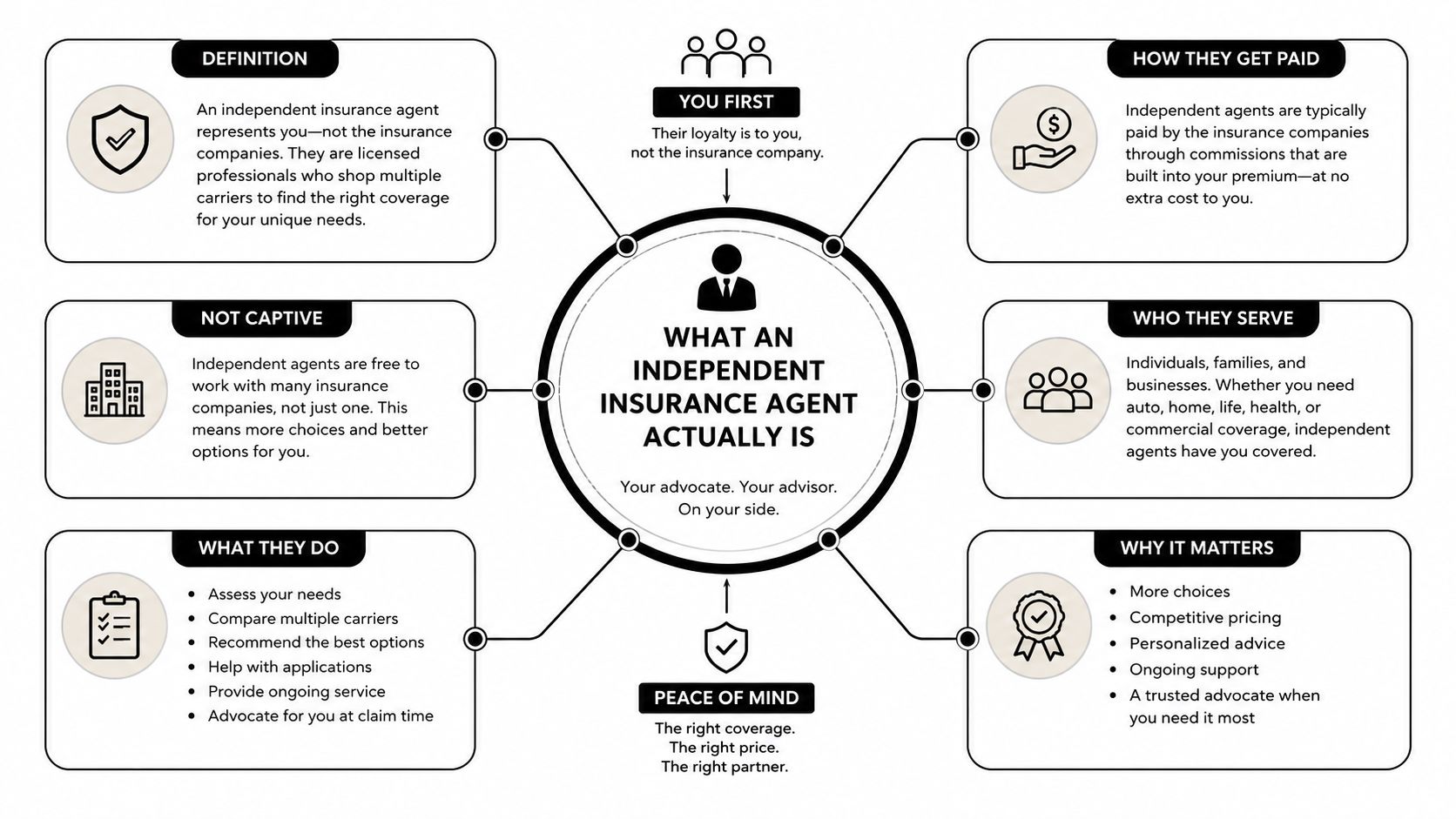
An independent insurance agent is a licensed professional who can work with more than one carrier. Think of them as a personal shopper for insurance, except the shelf is made of carrier appointments, not retail brands. They're there to compare options, explain differences, and place the policy that fits your situation.
Why that structure matters
The legal and operational point is simple. The U.S. Bureau of Labor Statistics says insurance sales agents must be licensed in the states where they work, so this isn't casual referral work, it's a regulated profession. That licensing requirement matters because you want someone who can place business, not just recommend that you “look into” coverage on your own. The BLS insurance sales agent overview also makes clear this is a large, ongoing sales channel, not a niche side hustle.
An independent agent is paid by commission from the carrier you choose, and their carrier relationships are governed by contract. That means they're not employed by one company's captive storefront, and they're not limited to one product line. They're closer to a buyer's agent in real estate than a single-brand salesperson.
Where people get confused
Captive agents and brokers get lumped into the same bucket, but they're not the same. Captive agents sell one company's products, so if that company isn't the right fit, your options are narrow. Brokers can also compare carriers, but the relationship is often more transactional than advisory. That difference matters when you're trying to assemble auto, home, renters, and life coverage into one coherent household plan.
If you want a plain-language glossary before you start comparing terms, the insurance glossary is useful for getting the labels straight. But the bigger point is this, the independent model exists to give you choices without forcing you to become an insurance expert first.
Independent Agents vs Captive Agents vs Brokers
California shoppers should compare this choice the same way they'd compare a lender, a contractor, or a doctor. The title matters, but so does the way the professional works. One agent may give you breadth, another may give you convenience, and a third may give you a narrower but very structured path.
| Criterion | Independent Agent | Captive Agent | Broker |
|---|---|---|---|
| Carrier choice | Multiple carriers | One carrier only | Multiple carriers |
| Pricing leverage | Can compare options across appointments | Limited to one company's pricing | Can compare options, often transactionally |
| Claims advocacy | Usually more hands-on because they placed the business | Tied closely to one carrier's process | Varies by firm and service model |
| Fit for California | Strong for wildfire, FAIR Plan, auto, home, renters, life | Good if one carrier fits and stays competitive | Useful when shopping is the main need |
| Service style | Advisory, coverage-focused | Brand-specific | Often quote-led |
For a broader industry perspective, the Ashby and Graff career guide is a straightforward way to see how agents and brokers differ in practice. The key takeaway is that the structure of the relationship changes what you can buy and how much help you get after the sale.
What California buyers should watch
Captive agents can be fine if their one company is a fit. But in California, that can be a hard bet when carriers tighten underwriting or pull back from certain ZIP codes. Brokers can help with shopping, but they may not spend as much time on long-term policy shaping or renewal strategy.
An independent agent is usually the better fit if you want one person to look at the whole household. That includes auto, renters, home, and life, plus the awkward edge cases that show up in California, like a home pushed toward the FAIR Plan or a policy that needs wildfire-oriented review.
Coverage Lines an Independent Agent Typically Handles
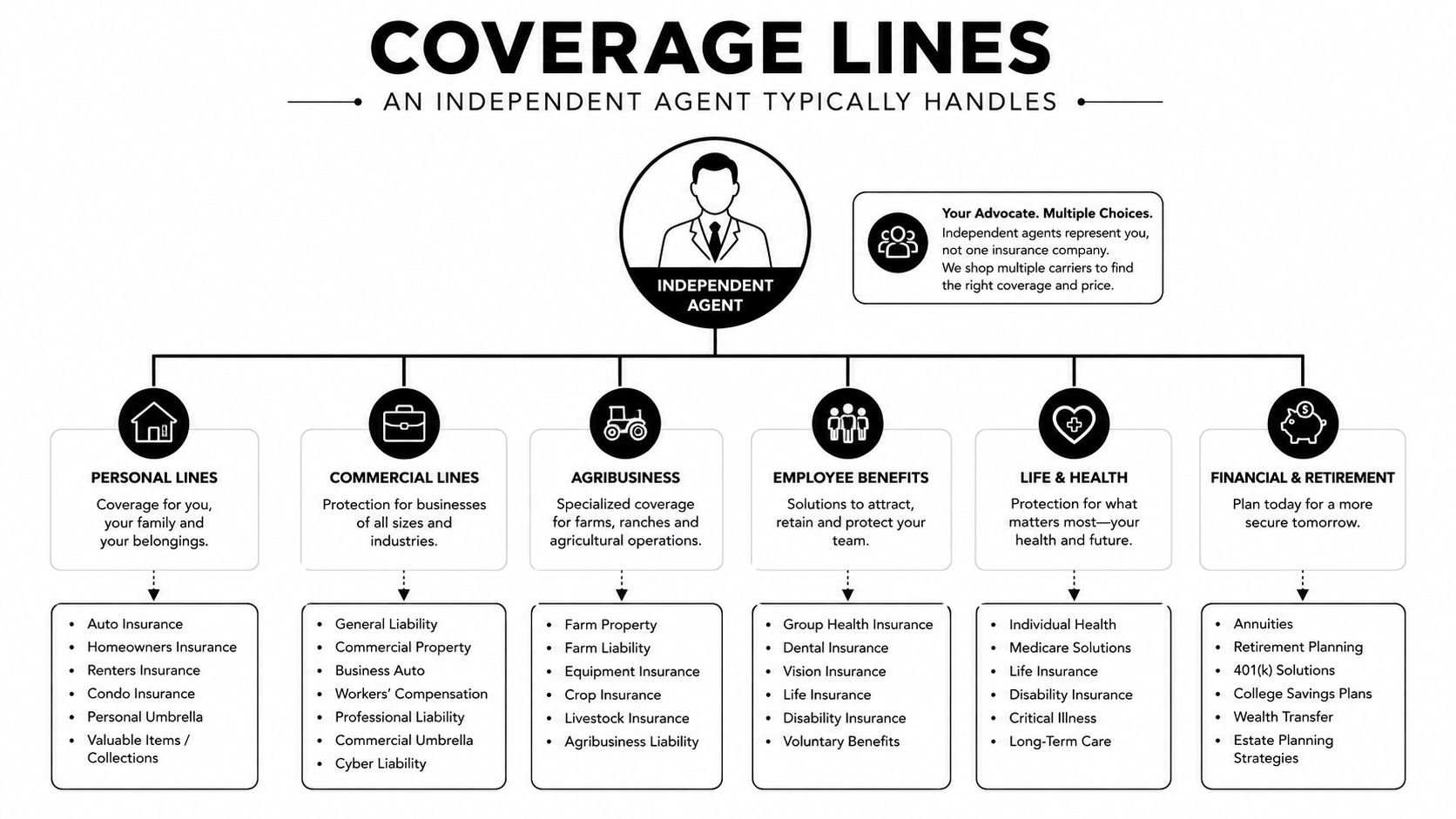
A good independent agent in California doesn't think in isolated products. They think in layers. Your car, your home, your rental, your family's income protection, and your catastrophe exposure all sit on top of each other, whether you've organized them that way or not.
Household coverage should be built together
For most California households, the foundation starts with auto insurance and home insurance or renters insurance. Add life insurance if anyone depends on your income, and in some cases disability income coverage if you'd be in trouble after a job loss or injury. The point isn't to sell every line. The point is to keep the household from having one weak spot that destroys the rest of the plan.
In California, specialty coverage matters too. Earthquake is a separate conversation from standard homeowners coverage. Wildfire exposure changes renewal strategy. And if a homeowner gets pushed out of the private market, the California FAIR Plan becomes a major part of the discussion.
Important: The California FAIR Plan is the state's insurer of last resort for homeowners who can't get coverage in the private market, and it covers direct physical loss from fire, lightning, internal explosion, smoke, and limited water damage caused by firefighting efforts. Many homeowners still need additional coverage beyond the base policy, because exclusions and separate endorsements leave real gaps. The NAIC consumer explanation lays out that reality clearly.
Don't confuse a policy with a complete solution
That's why an independent agent should review more than the premium. A homeowner might need a FAIR Plan plus another policy layer. A renter may need a simple but solid liability setup. A driver may need help keeping a clean auto file after a claim. Those are different jobs, even if they all live under the same insurance account.
For a practical look at how household and commercial protection can be framed, the insurance and liability page from Stormhammer Security, Inc. is a useful reminder that coverage is always about the risk behind the policy, not just the document itself.
If you want to compare your own situation against a California-specific checklist of policy types, the home and auto guides can help you sort the basics before you call.
Why the Real Value Goes Beyond Price Comparison
The independent agent's job is often misunderstood as simply finding the lowest premium. That's too shallow. Value is found in identifying coverage you'd miss if you only compared numbers on a screen.
The hidden gaps are usually the expensive part
Independent-agent thought leadership has been blunt about the coverage misses that show up all the time, things like too-low liability limits, loss assessment coverage, uninsured jewelry, art or collections, service line, and equipment breakdown coverage. Those aren't luxury add-ons in every case. They're the exact places where a “good price” can turn into a bad claim experience.
California gets tricky. Wildfire markets shift. Carrier appetite changes. Underwriting rules move. A shopper can't keep up with all of that while also trying to interpret policy forms. A serious independent agent does that work for you and tells you what changed, what's excluded, and what should be reviewed before you bind.
Carrier access is part of the job
There's also a carrier-side problem that many readers miss. Recent J.D. Power findings showed only 56% of personal lines and 57% of commercial lines independent agents said carriers meet basic expectations around clearly communicating risk appetite, signaling who qualifies, and showing flexibility on new policies. That means many agents are doing real translation work between the carrier's rules and the customer's needs. J.D. Power's carrier-expectations findings make the point directly.
So no, the value isn't just “multiple quotes.” It's interpretation. It's knowing when a policy is missing a wildfire wrinkle, a renters liability issue, or a home coverage gap that will matter the day after the loss.
A cheap policy that leaves out the part you need isn't savings, it's deferred pain.
How to Vet an Independent Agent in California
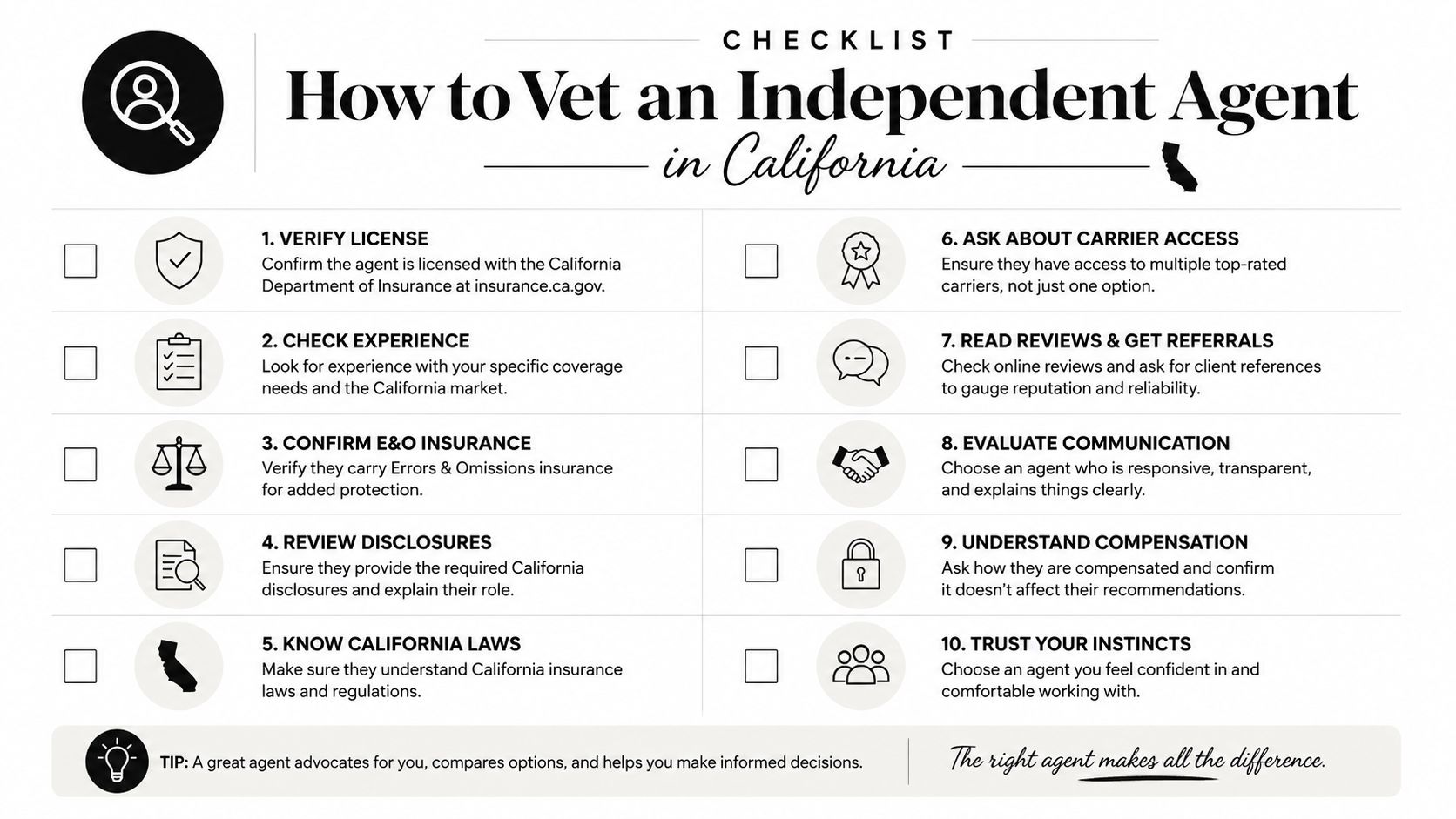
Start with the basics and don't apologize for being direct. A serious independent agent won't be offended by good questions. If anything, the better ones welcome them.
What to verify before you hand over your information
- License status: Confirm they're licensed in California and can legally write the lines you need.
- Carrier appointments: Ask which carriers they're appointed with, because appointment depth tells you what they can quote.
- Line expertise: Make sure they handle your mix of auto, home, renters, life, FAIR Plan, or earthquake instead of only one line.
- Response time: Ask when you should expect a quote and how fast they answer follow-up questions.
- Coverage review habits: Ask whether they review existing policies for gaps at renewal, not just at the first sale.
- Multilingual support: If your household needs it, confirm they can communicate clearly in the language you use at home.
A good California agent should sound comfortable discussing wildfire exposure, the FAIR Plan, and what a renewal review looks like in practice. If they dodge those topics, keep looking. If they push one carrier too hard without explaining why it fits, that's a red flag too.
For readers who want a broader company view, Mai & Associates is a licensed California agency that offers multi-carrier comparisons for auto, home, renters, and life insurance, plus help with California Fair Plan reviews and earthquake options. That's the kind of operational mix you should expect from a serious independent shop.
If you want to see how quote shopping fits into the process, the get-insurance-quote page is a practical next step after you've asked the right questions.
Questions to Ask and the Process From Quote to Claim
Ask the questions that expose whether the agent is really going to do the work or just forward forms. You don't need a script full of jargon, you need a short list that forces clarity.
Ask these questions first
- Which carriers will you quote for my situation?
- How do you handle a claim after binding?
- Will you review my coverage at renewal, or only when I ask?
- Do you check for gaps like wildfire exposure, FAIR Plan layering, or renters liability?
- How do you handle policy changes when a carrier tightens its rules?
A strong agent should answer each one plainly. If the answer is vague, that usually means service is vague too.
The workflow should feel steady. First comes discovery, where the agent asks about your household, driving history, property details, and risk concerns. Then comes multi-carrier comparison, followed by a recommendation with a reason, not just a premium number. After binding, there should be ongoing service and claims help, not silence until renewal.
If you want a deeper read on claims and appraisals, the Auto Appraisal Expert settlement guide is a useful companion for understanding how claims conversations can unfold after a loss. Knowing that process ahead of time makes it easier to judge whether an agent is going to stand with you.
Putting It Together With a California Example
A multilingual family in Glendale with a car, a rented apartment, and a future home purchase shouldn't have to piece together coverage from five different places. A competent independent agent can compare multiple carriers for the auto and renters policies, review life coverage for the household, and explain whether a FAIR Plan review is even relevant if the family later buys in a wildfire-adjacent ZIP code. If earthquake or wildfire-related gaps show up, those need to be discussed before binding, not after.
That's what good service looks like in California, multi-carrier comparison, plain-language advice, and ongoing support in the language the household speaks. If you're comparing options for renters insurance in California, start by treating the agent as a coverage partner, not a vending machine.
Mai & Associates helps Californians compare auto, home, renters, and life insurance across multiple carriers, with licensed guidance that includes FAIR Plan reviews, earthquake options, and wildfire-aware coverage checks. If you want a straight answer from a California independent insurance agent, visit Mai & Associates and ask for a no-obligation quote review.