How to Reduce Homeowners Insurance Premiums in California

It’s not just you. If you opened your latest homeowners insurance renewal and felt a jolt of sticker shock, you're in good company. All across the Golden State, homeowners are watching their premiums climb, and it's easy to feel powerless. From home insurance to auto insurance, the cost of living in California is on the rise.
But here’s the good news: you have more control than you think. You can absolutely lower your premium by making smart moves like raising your deductible, bundling your home and auto policies, and grabbing every discount you qualify for. Taking it a step further, fortifying your home against risks like wildfires and regularly shopping around for better quotes are powerful strategies that can lead to some serious savings on your California insurance coverage.
Why Your California Home Insurance Keeps Going Up

The feeling that your insurance costs only go in one direction—up—is frustratingly common right now. But these increases aren't happening in a vacuum. A few powerful, specific forces are reshaping the entire insurance landscape in California, making it more critical than ever to understand the why behind the price hikes.
We're not talking about minor upticks, either. The entire country is seeing dramatic increases, but California has been hit especially hard. Nationwide, the average annual premium is on track to jump from $2,520 in 2021 to a staggering $3,785 by 2025. That's a 50% increase. For us here in California, the projected 21% rate hike in 2025 alone pushes our average premium to $2,930 per year.
The Key Drivers Behind Soaring Premiums
So, what's behind this? A few major factors are at play, with the most significant being the escalating frequency and intensity of natural disasters, especially wildfires. Insurance companies have paid out billions upon billions in claims, forcing them to completely rethink how they calculate risk. In many cases, they’ve simply stopped offering coverage in high-risk areas.
But it’s not just about environmental risks. Economic pressures are also adding to the problem:
- Rising Construction Costs: Everything from lumber and drywall to labor has gotten more expensive. The cost to rebuild a home today is worlds away from what it was just a few years ago.
- Supply Chain Snags: Delays in getting materials not only slow down repairs but also drive up costs, and that gets passed on to policyholders.
- Reinsurance Costs: Your insurance company has its own insurance, called reinsurance, to protect them from massive losses. As their risk exposure grows, their reinsurance costs soar, and that directly impacts the premium you pay.
Knowing what’s behind the rate hikes is the first step toward regaining control. You can’t stop a wildfire or control inflation, but you can make strategic choices about your policy, your home, and your insurance partner to actively bring your costs down.
Your Quick Savings Checklist
Get a head start with this scannable overview of the top strategies for cutting your homeowners insurance costs. Find the right move for you.
| Strategy | Potential Savings | Effort Level |
|---|---|---|
| Increase Your Deductible | 10-25% | Low |
| Bundle Home & Auto | 15-25% | Low |
| Home Hardening (Wildfire) | 5-20% | Medium-High |
| Install Safety Devices | 5-15% | Low-Medium |
| Improve Your Credit Score | Varies | Medium |
| Shop Around for Quotes | Varies | Low |
Each of these is a real, tangible way to put money back in your pocket. We'll break down exactly how to tackle them in the sections ahead.
Setting the Stage for Smart Savings
This guide is designed to shift you from feeling overwhelmed to feeling empowered. We’re going to walk through practical, actionable steps you can take right now to lower your insurance costs without leaving yourself under-protected. From simple policy tweaks to long-term home improvements, real savings are well within your reach.
Navigating this complex market is much easier with an expert in your corner. An independent agency like Mai & Associates lives and breathes the California insurance landscape. We understand the nuances, including crucial options like the FAIR Plan, and can shop your policy across multiple carriers to find the best possible value for all your needs, including home, auto, and life insurance.
Before we dive in, getting a solid grasp of the fundamentals of home insurance in California can give you a great foundation for the savings strategies to come.
Quick Wins: Adjust Your Policy for Immediate Savings
While big projects like home hardening pay off in the long run, you don't have to wait for a contractor to start saving money. Some of the most effective ways to lower your homeowners insurance premium are simple policy adjustments you can make right now. Let's look at a few quick wins that can have a surprisingly big impact on your bottom line.
Rethink Your Deductible
Your deductible is simply the amount you agree to pay out-of-pocket on a claim before your insurance company starts paying. Think of it as your share of the risk. If a pipe bursts and causes $10,000 in damage, and your deductible is $2,500, you'll cover the first $2,500, and your insurer handles the remaining $7,500.
It’s a straightforward trade-off: the more risk you're willing to take on (a higher deductible), the lower your premium will be. Insurance companies love when you share the initial burden, and they reward you for it.
Bumping your deductible from, say, $500 to $1,000 can often slash your premium by as much as 25%. The trick is to find your sweet spot—a number high enough to give you real savings but low enough that you could write a check for it tomorrow without breaking a sweat.
My rule of thumb? Choose the highest deductible you can comfortably afford. Take a hard look at your emergency fund. If you have enough stashed away to cover a $2,500 deductible, ask your agent to run the numbers. The annual savings might really surprise you.
Bundle Your Home and Auto Policies
This is one of the easiest and most effective ways to cut your insurance costs, period. Insurance carriers want more of your business, and they’re willing to offer a significant discount to get it. When you bundle your home insurance and auto insurance with the same company, you’re showing them loyalty, and they return the favor with savings. This approach often works for other policies too, such as bundling renters insurance with car insurance.
In California, where wildfire risk has sent premiums skyrocketing, bundling is a powerful way to fight back. The average home premium is projected to hit $2,930 in 2025—that's a staggering 21% jump in just one year. But a typical home and car insurance bundle can save you anywhere from 10-25%, directly clawing back some of those high costs. For more context on these trends, Bankrate.com offers some great insights.
We're not talking about pocket change here; this can easily add up to hundreds of dollars in savings every year.
Let's Look at a Real-World Example: The Garcia Family
- Their Situation: They lived in Los Angeles and had their homeowners policy with one company and their two cars insured with another.
- Their Annual Cost: $2,800 (home) + $2,100 (auto) = $4,900 total.
- The Solution: They called us at Mai & Associates. We looked at their situation and quoted a single package that covered their house and both vehicles.
- The Result: By bringing everything under one roof, they unlocked a multi-policy discount. Their new total premium dropped to $3,950 for the year. That's an extra $950 back in their pocket.
Trim the Fat: Ditch Unnecessary Coverage
Life changes, and your insurance policy should change with it. It’s all too common to have add-on coverages, or "endorsements," that made sense years ago but are now just dead weight on your premium. A quick policy review is all it takes to spot and trim this excess.
Maybe you used to have an expensive jewelry collection that you've since sold, but you're still paying for that "scheduled personal property" rider. Or perhaps your bank now provides free identity theft protection, making the one on your home policy redundant.
Here are a few common add-ons worth a second look:
- Scheduled Personal Property: Extra coverage for specific high-value items like art, jewelry, or firearms.
- Service Line Coverage: Helps pay for repairs to utility lines running from the street to your home.
- Equipment Breakdown: Covers things like your HVAC system or water heater from mechanical failure.
Each of these tacks a little extra onto your premium. While they can be incredibly valuable for the right person, paying for protection you no longer need is a slow drain on your finances. A yearly check-in with your agent ensures you’re only paying for what truly matters today. For more ideas, you can dig into our other helpful California insurance guides.
Fortify Your Home and Watch Your Insurance Rates Drop
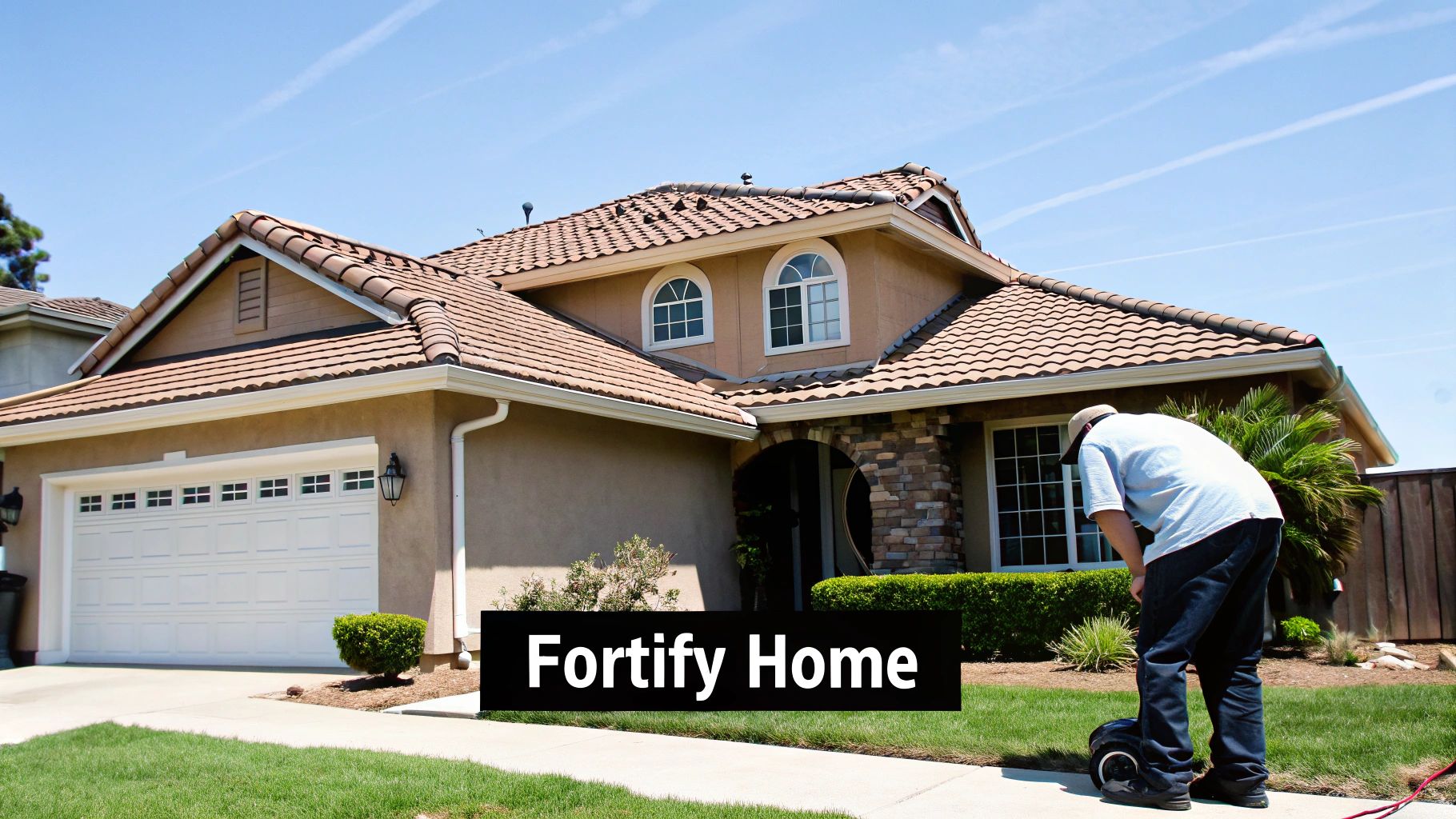
Strengthening your home against potential disasters does a lot more than just help you sleep better at night. From an insurer's perspective, every upgrade you make is a clear signal that you're a lower-risk homeowner.
In California, where we're constantly thinking about the next wildfire or earthquake, these proactive measures can lead to some serious long-term savings. Why? Because insurers reward homeowners who actively reduce the odds of filing a massive claim. Think of it as an investment that pays you back, both in a safer home and a lower annual premium.
Creating a Wildfire-Resistant Property
For so many of us in California, wildfire is the risk that keeps us up at night. Insurance companies feel the same way. When they see a property that has been properly hardened against fire, they're often willing to offer better rates and sometimes even more comprehensive coverage.
The single most important thing you can do is create defensible space. This isn't just about clearing a few weeds; it's a strategic buffer zone around your home designed to rob an approaching fire of its fuel. It can literally slow or stop a wildfire from ever reaching your structure.
Here’s the breakdown of how to build that buffer:
- Zone 0 (0-5 feet from your home): This is your non-combustible zone. Get rid of everything flammable. That means bark mulch, dead plants, and even that welcome mat. Swap it all out for hardscaping like gravel, pavers, or concrete.
- Zone 1 (5-30 feet): Think "Lean, Clean, and Green." Keep your grass cut short and watered. Rake up all the dead leaves and pine needles. You’ll also want to trim tree limbs so the lowest branches are at least 6 to 10 feet off the ground.
- Zone 2 (30-100 feet): This is all about breaking up the fire's path. Thin out the vegetation, remove dense clusters of shrubs, and make sure there’s plenty of space between trees.
Beyond your yard, the structure of your house itself is critical. One of the best investments you can make is installing a Class A fire-rated roof—we’re talking composite shingles, metal, or tile. Another huge, yet simple, upgrade is covering your attic and foundation vents with 1/8-inch metal mesh. This one simple fix can stop wind-blown embers from getting inside and burning your house from within.
Bracing for the "Big One"
While wildfires seem to dominate the news, earthquakes are the foundational risk of living in California. Strengthening your home to withstand shaking, a process known as earthquake retrofitting, can directly lead to a nice discount on your earthquake policy.
For older homes, the most common and effective technique is bolting the foundation. This literally anchors your home's wood frame to its concrete foundation, stopping it from sliding off in a quake. Bracing the "cripple walls" (the short walls between the foundation and the first floor) with plywood is another key step that adds crucial stability.
It's not a small project, but retrofitting can cut your earthquake insurance premium by as much as 25%. The upfront cost is real, but the peace of mind and decades of savings are hard to argue with.
Everyday Safety Adds Up to Big Savings
It’s not all about major disasters. Insurance companies also give you credit for protecting your home against more common problems like theft, fire, and water damage. These smaller upgrades can really add up.
Consider adding a few of these to your home:
- Monitored Security Systems: A system that automatically calls the police or fire department can knock 5% to 20% off your premium.
- Smoke and Carbon Monoxide Detectors: You already have them, but did you know that hardwired or centrally monitored systems often qualify for a small discount?
- Water Leak Sensors: These brilliant little gadgets can be placed near a water heater, washing machine, or dishwasher. They’ll send an alert to your phone the second they detect moisture, helping you stop a small leak before it turns into a wallet-busting water damage claim.
Every one of these improvements makes your home statistically safer, which is exactly what insurers are looking for. To learn more about protecting your property and uncovering savings, check out the other guides on the Mai & Associates insurance blog.
Uncovering Hidden Discounts and Loyalty Rewards
After you’ve tackled the big-ticket items like deductibles and home hardening, it’s time to go on a treasure hunt for savings. Insurers offer a ton of discounts, but here’s the thing: they often don't just hand them out. Many California homeowners are overpaying simply because they haven’t asked the right questions.
Think of it as a friendly audit of your policy. You need to be the one to initiate it. A quick call to your agent to specifically ask for a "full discount review" can uncover savings you didn't even know existed. You’d be amazed at what qualifies—from your job to lifestyle choices you made years ago.
Look Beyond the Obvious Savings
Everyone talks about bundling home and auto insurance. It’s a great start, but it's just the tip of the iceberg. Insurers are all about managing risk, and they'll happily reward you for being a responsible, low-risk client.
It really boils down to proving you're a good bet. Here are a few areas that often get missed:
- Who You Are: Are you a non-smoker? That's a discount right there, since it lowers your home's fire risk. Some carriers also offer breaks for retirees or seniors, who are often home more and can catch a small leak before it turns into a disaster.
- What You Do: Your career or the university you attended could be your ticket to a cheaper policy. Many insurers have special programs for certain professions like teachers, firefighters, and engineers, or for alumni of specific universities and members of professional groups. Always mention your affiliations.
- What You've Upgraded: Did you put on a new roof last year? Or maybe you finally replaced that ancient electrical panel? Don't just think of these as maintenance. They are major risk-reducers in the eyes of an insurer. Let your agent know about any new HVAC systems, plumbing overhauls, or updated wiring—they can all lead to discounts.
Expert Tip: Never assume your insurance agent is a mind reader. They have no idea you updated your plumbing unless you tell them. A five-minute call to update your profile can directly lower what you pay. It’s one of the easiest wins available.
Loyalty Has Its Perks (And So Does a Clean Record)
Insurance companies love sticking with good customers. If you've been with the same provider for a few years, usually three to five, you should qualify for a loyalty discount. It's their way of saying thanks, and it can easily knock 5% to 10% off your premium.
An even bigger reward comes from having a clean claims history. If you haven't filed a claim in the last three to five years, you should be getting a claims-free discount. This is one of the most significant discounts you can get because it proves you're a safe bet. This applies across various California insurance products, from home insurance to car insurance. It’s a powerful reason to think twice before filing a small claim for a minor repair you could handle out-of-pocket.
Your Credit Score Matters More Than You Think
In California, your financial health is directly linked to your insurance premium. Carriers use a special credit-based insurance score to gauge how likely you are to file a claim. It might seem odd, but years of data show that people who manage their finances well also tend to be more responsible homeowners.
A good credit score tells an insurer you're a lower risk. So, if you've recently improved your score by paying down debt or making consistent on-time payments, now is the perfect time to call your agent. Ask them to "re-rate" your policy with your new credit information. This one step could lead to a serious price drop, all because you’ve been financially responsible.
Shopping for a Better Rate in California
After you’ve fine-tuned your policy and fortified your home, your next power move is to shop around. I know the California insurance market can feel like a rollercoaster, but we're finally seeing it start to level out. This creates a prime opportunity for homeowners to lock in a better rate.
Many carriers that had slammed the brakes on writing new policies are slowly, cautiously, putting their foot back on the gas. For you, that means more competition and more options for your homeowners insurance.
Knowing how to properly compare quotes is what separates a good deal from a future headache. It’s all about looking past the monthly premium and digging into the details that define a policy's real worth. Trust me, the cheapest option is rarely the best, especially if it leaves you with gaping holes in your coverage that could cost you a fortune later.
This simple flowchart shows how your claims history, credit, and home upgrades can put you on the fast track to lower premiums.
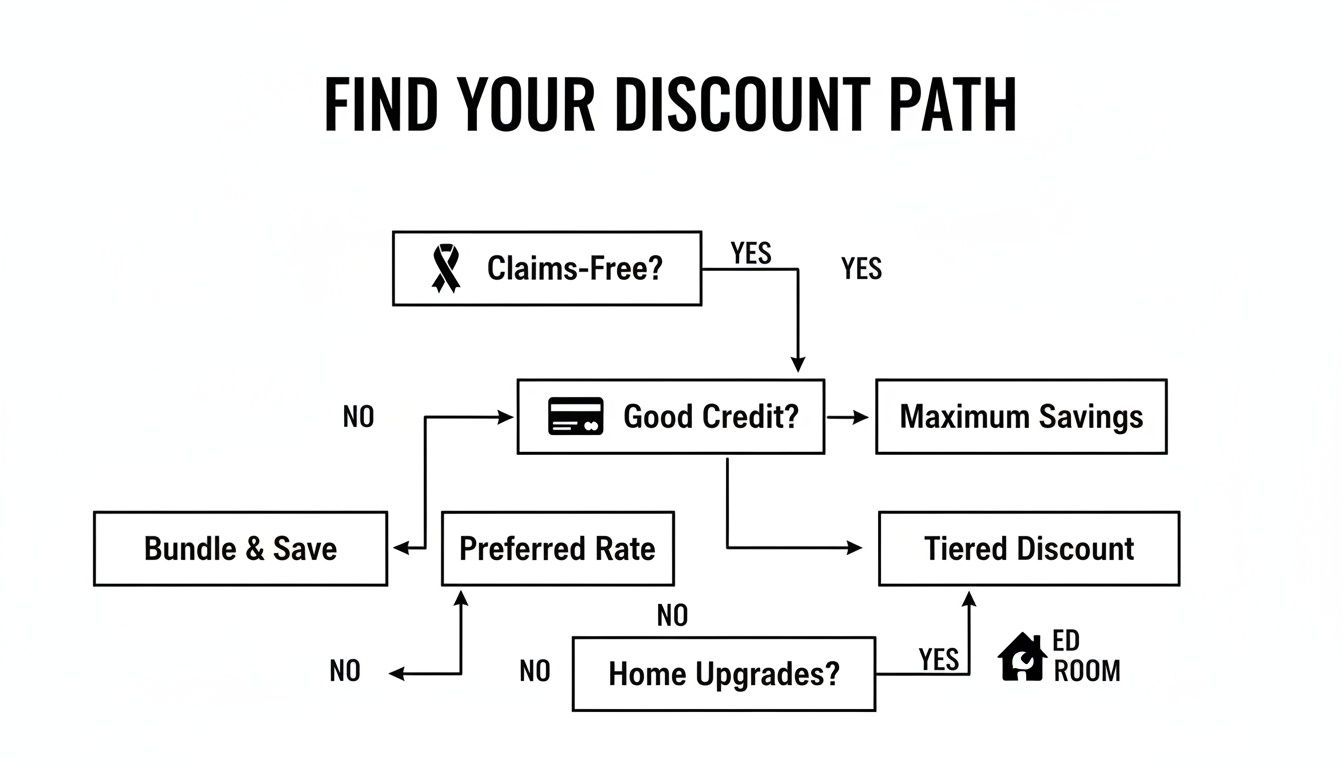
As you can see, staying claims-free, keeping your credit in good shape, and making smart home improvements are three of the most direct ways to get significant savings.
The Best Time to Shop is Now
The market is genuinely shifting in your favor. Recent numbers showed that homeowners buying new policies in 2024 got hit with an average rate increase of 17.4%—a much bigger jump than what existing customers saw at renewal.
As this trend cools and the market stabilizes, it opens a crucial, and likely limited, window to find and secure more competitive rates before they start climbing again. You have a real chance to find better terms than what was available even a year ago.
Look Beyond the Price Tag
When you have a few quotes in hand, it’s so tempting to just grab the lowest one. But a real comparison means getting into the weeds to make sure you're comparing apples to apples.
Use this table to look beyond the premium and evaluate the true value of each insurance quote you receive.
How to Compare Insurance Quotes
| Evaluation Factor | What to Look For | Why It Matters |
|---|---|---|
| Coverage Limits | Are the limits for Dwelling, Personal Property, and Liability identical on each quote? | A lower premium might mean dangerously low limits that won't cover a total loss. |
| Deductibles | Compare the standard deductible and any special deductibles (like for wind/hail or wildfire). | A policy with a $5,000 deductible will always look cheaper than one with a $1,000 deductible, but can you afford that out-of-pocket hit? |
| Exclusions | Read the fine print. What isn't covered? Look for specific exclusions for mold, certain water damage, or even dog breeds. | What a policy doesn't cover is just as important as what it does. This is where nasty surprises hide. |
| Carrier Reputation | Check the insurer's financial strength (A.M. Best rating) and customer service reviews. | A low price from an unstable or unresponsive company is a huge gamble when you actually need to file a claim. |
A quote isn't just a number; it's a promise. Make sure it's a promise you can count on when you need it most.
Navigating the FAIR Plan and Beyond
For many Californians in high-risk wildfire areas, getting coverage on the standard market can feel impossible. That's where the California FAIR Plan comes in. It acts as an "insurer of last resort," providing the essential fire coverage that traditional carriers won't.
But here’s the critical part: the FAIR Plan is not a complete homeowners policy. It leaves out huge risks like theft, water damage, and personal liability. To fill those gaps, you have to buy a separate Difference in Conditions (DIC) policy.
This is exactly where working with an experienced independent agency becomes a game-changer. At Mai & Associates, we specialize in these complex situations. We can review your FAIR Plan policy, find a solid DIC policy to wrap around it, and then shop that complete package to find the most comprehensive and affordable solution out there.
Our ultimate goal is always to get our clients back into the private market. We do this by advising on home-hardening steps and constantly watching the market for new opportunities, helping homeowners in tough spots eventually qualify for more traditional—and often much cheaper—home insurance policies.
The Advantage of an Independent Agency
Why spend days on the phone with different insurance companies when an expert can do the legwork for you in minutes? As an independent agency, Mai & Associates works for you, not for a single carrier. We're your go-to source for California insurance.
We have access to a huge network of top-rated insurers, letting us compare rates from multiple providers all at once. This delivers same-day quotes that save you both time and money. Our licensed agents are multilingual—speaking English, Spanish, Armenian, Russian, and Vietnamese—to make sure you understand every single detail about your home, auto, or renters insurance.
Let us do the heavy lifting. You can get an instant insurance quote and see how much you could be saving today.
Got Questions About Lowering Your Home Insurance Costs? We've Got Answers.
When you start digging into the details of homeowners insurance, it’s natural for questions to pop up. You’ve learned about deductibles, hardening your home, and shopping around, but what about the finer points? Let's tackle some of the most common questions California homeowners ask us every day.
Getting these details right is the secret to finding real, long-term savings.
Will Filing a Small Claim Actually Raise My Premium?
You bet it can. It's one of those things that seems counterintuitive, but filing even a small claim can come back to bite you.
First, it almost guarantees a rate increase at your next renewal. But the real kicker? You’ll likely lose your claims-free discount, which is often one of the most significant savings you can get. That discount alone can be worth hundreds of dollars a year.
Think about it this way: if a broken window costs $800 to fix and your deductible is $500, you’re only getting $300 from the insurance company. But losing that claims-free discount could cost you far more than $300 over the next three to five years. It’s almost always better to handle those smaller repairs out of pocket.
Before you call in a claim, call your agent. A quick conversation can help you weigh the immediate payout against the long-term financial hit. It’s a classic case of winning the battle but losing the war.
How Often Should I Really Shop for New Home Insurance?
Here’s a good rhythm to follow: do a quick policy review with your agent every single year, but plan on actively shopping for quotes every two to three years.
You’ll also want to shop the market anytime a major life event happens. Did you complete a big renovation? Add a pool? Has your credit score jumped up significantly? All of these are perfect triggers to see what else is out there.
The California insurance market is constantly shifting. A company that was way too expensive a few years ago might suddenly have the most competitive rates today. An annual check-in keeps your coverage current, and a bi-annual market check ensures you're not leaving money on the table.
Can I Even Get Insurance in a High-Risk Wildfire Area?
Yes, you can, but you have to be strategic. If you're getting turned down by standard insurance companies, your next stop is almost always the California FAIR Plan. It’s designed to be the insurer of last resort, providing essential fire coverage when no one else will.
But here’s the critical part: the FAIR Plan is not a complete homeowners policy. It only covers fire, lightning, and internal explosion. It leaves out huge risks like liability, theft, and water damage.
To fill those gaps, you'll need to purchase a separate Difference in Conditions (DIC) policy. This is where working with a good independent agent is a game-changer. They can help you find the right DIC policy to wrap around your FAIR Plan and, just as importantly, advise you on home-hardening steps that might eventually get you back into the standard market.
Does My Credit Score Really Affect My Home Insurance Rate in California?
It has a massive impact. In California, insurers rely heavily on a credit-based insurance score to set your premium. It might not seem fair, but years of industry data have shown a clear link: people with higher credit scores tend to file fewer claims.
From an insurer's perspective, a strong credit history suggests you're a responsible, lower-risk client. Simple things like paying your bills on time and keeping your credit card balances in check can directly translate into a lower insurance bill. If your score has improved lately, that’s your cue to ask your agent to rerun your rates—you might be pleasantly surprised.
At Mai & Associates, our licensed, multilingual agents live and breathe the California insurance market. We can take a look at your current policy, uncover discounts you might be missing, and compare rates from dozens of top-rated carriers for all your needs—home insurance, auto insurance, renters insurance, and life insurance. Protect what matters most without overpaying. Visit us at https://cahomeauto.com to get your free, no-obligation quote today.