How to Read a California Insurance Policy: A Guide to Auto, Home & Life Coverage
Let's be real—insurance policies are a tough read. They're packed with legal jargon and dense language that makes you want to just toss them in a drawer and forget about them. But skipping the fine print can be a financially devastating mistake, a lesson many Californians learn the hard way.
Think about it. A homeowner in a high-risk fire zone suddenly discovers their home insurance policy doesn't actually cover wildfire damage after their home is gone. Or a driver in gridlocked Los Angeles realizes their car insurance liability limits are way too low to handle a multi-car pile-up on the 405. These aren't just scary stories; they happen all the time, and they underscore why you absolutely must know what's in your California insurance policy.
To get it right, I always tell my clients to follow a simple roadmap. First, scan the Declarations Page for a quick summary. Then, jump straight to the Exclusions section—this is where the insurer tells you what they won't pay for. Finally, check for any Endorsements, which are special add-ons that change the standard agreement. This strategy helps you find the most critical details fast, long before you ever need to file a claim.
From Confusing to Confident
My goal here is to pull back the curtain on how to read an insurance policy, whether it's for your home insurance, car insurance, renters insurance, or even life insurance in California. We'll cut through the complex language and break it down into simple, understandable pieces. Your policy should be a tool that protects your family and your assets, not a source of confusion.
Taking a little time to really understand your coverage pays off in big ways:
- You'll Spot Coverage Gaps: You can easily see what's missing, like earthquake coverage for your California home or enough liability protection on your auto policy.
- You'll Avoid Claim Denials: When you know the rules and what's expected of you, you can sidestep common mistakes that get claims denied.
- You'll Make Smarter Choices: You'll be able to confidently compare quotes and pick a policy that genuinely fits your life in California, not just the one with the lowest price tag.
Getting a handle on your policy is more than just a smart move—it’s a crucial part of managing your financial health. People who take the time to read their documents almost always have a smoother claims experience.
It’s a fact. One analysis found that 95% of policyholders who took the time to review their policy's exclusions and definitions before filing a claim got their claim approved without a dispute. You can dig into similar data in this report on the global insurance landscape and claims data. A little bit of reading upfront can transform your policy from a document you dread into a safety net you can truly count on.
Decoding the Six Core Parts of Your California Insurance Policy
Think of your insurance policy as the rulebook for your financial safety net. It can look a little intimidating at first glance, but it's actually broken down into six main sections, each with a very specific job. Once you know what each part does, you'll know exactly where to look to understand what you're truly covered for—whether it's your car insurance, your home insurance, or your life insurance policy.
Breaking it down demystifies the whole document. You'll quickly find that the power to understand your coverage is completely within your reach.
To make it even simpler, here's a quick visual guide for the most efficient way to tackle your policy documents.
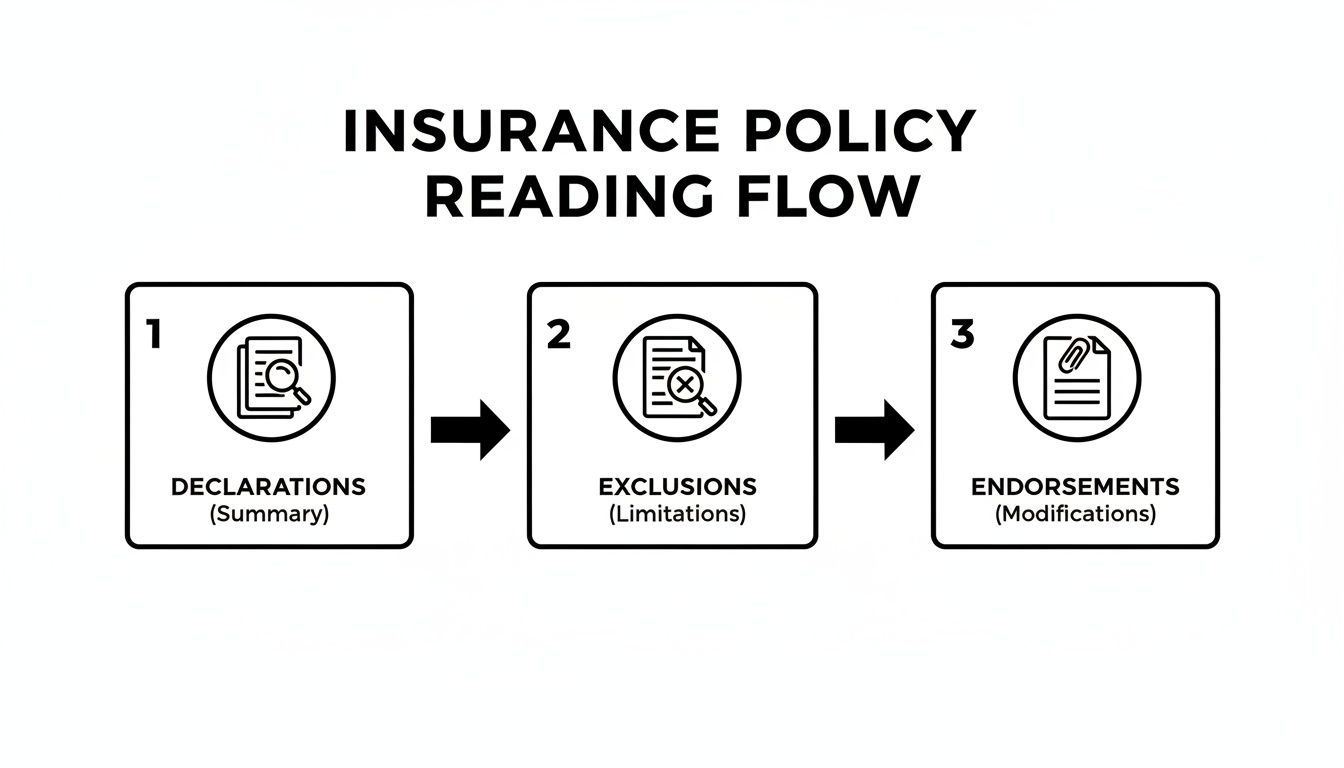
This little flowchart highlights the three spots I always tell my clients to check first: the Declarations page for a high-level summary, the Exclusions to see what isn't covered, and the Endorsements for any custom changes.
To help you get your bearings, here's a quick reference table. It's a handy cheat sheet for navigating your insurance documents and understanding the purpose of each major component.
Key Sections of Your Insurance Policy at a Glance
| Policy Section | What It Tells You | Why It's Critical |
|---|---|---|
| Declarations | The "who, what, where, when, and how much" of your policy. A personalized summary of your coverage, limits, and deductibles. | It’s your policy’s one-page cheat sheet. If you only read one page, make it this one. |
| Insuring Agreement | The insurance company's core promise to you. A broad statement of what they agree to cover. | This is the foundation of the entire contract, setting the general scope of protection. |
| Definitions | A glossary that explains specific terms used in the policy. | Words can have very specific legal meanings here. Never assume—always check the definition. |
| Exclusions | A list of people, property, or events that the policy will not cover. | This is where you find the gaps in your coverage. Ignoring this section can lead to denied claims. |
| Conditions | The rules you and the insurer must follow, especially after a loss (e.g., how to file a claim). | Failing to meet these conditions (like reporting a claim promptly) could jeopardize your payout. |
| Endorsements | Add-ons or "riders" that change, add, or remove coverage from the standard policy. | These customize your policy. They can add crucial protection or remove coverage you thought you had. |
This table gives you a roadmap, but let's dive into what each section really means for your California insurance.
The Declarations Page: Your Policy Cheat Sheet
This is almost always the very first page of your policy, and for good reason—it’s your personalized summary. The "dec page," as we call it in the industry, answers the most important questions: who, what, where, when, and how much.
For a California auto insurance policy, this is where you'll find:
- The names of every insured driver.
- The specific vehicles covered, usually listed with their VINs.
- Your policy number and the exact dates your coverage is active.
- Your liability limits (e.g., $50,000/$100,000/$25,000) and your deductibles for collision and comprehensive.
On a home insurance policy, it lists the property address, the dwelling coverage amount, and your deductibles for different perils like fire or theft. For a life insurance policy, it will name the insured, the death benefit amount, and the beneficiaries. Seriously, think of this page as the single most important summary of your entire contract.
The Insuring Agreement: The Insurer's Core Promise
Right after the declarations, you’ll find the Insuring Agreement. This is the heart of the policy, where the insurance company makes its fundamental promise to you. It’s a broad statement that outlines what they agree to cover in exchange for the premiums you pay.
It often uses formal but crucial language like, "We will pay for direct and accidental loss to your covered auto," or "We will pay for damages for bodily injury or property damage for which any insured becomes legally responsible." This section sets the stage for everything else, defining the general scope of your protection before the other sections narrow it down.
Definitions: The Policy's Dictionary
Every contract has its own language, and insurance policies are no exception. The Definitions section is your glossary, explaining exactly what specific words mean within the context of your policy.
For instance, the term "family member" might seem straightforward, but the policy will define it very precisely. This can have a huge impact on who is covered when driving your car. Likewise, a term like "occurrence" will be defined to clarify if a slow, continuous water leak counts as one event or several. Never assume you know what a word means; always check this section.
If you want to dig deeper, you can explore our complete California insurance glossary for more plain-language explanations.
Exclusions: What Is Not Covered
Pay close attention here. This is arguably the most critical section for any Californian to read. The Exclusions section explicitly lists the perils, situations, and circumstances that your policy will not pay for. Insurers use this section to manage their risk and keep policies from becoming astronomically expensive.
A common and devastating surprise for many California homeowners is finding out that standard home insurance policies almost universally exclude damage from floods and earthquakes. You have to buy separate policies for that kind of protection.
Here’s a real-world scenario I’ve seen happen: After a week of heavy rain, a homeowner in Costa Mesa finds their downstairs has flooded from rising groundwater. They file a claim, but it gets denied. Why? Their policy, like most, has a specific exclusion for "damage caused by flood, surface water, waves...or water below the surface of the ground." Reading this section beforehand would have highlighted that massive gap in their coverage.
Similarly, a California auto insurance policy will always exclude things like:
- Intentional damage you cause.
- Using your personal car for business like ridesharing (unless you have a special endorsement).
- Normal wear and tear, like needing new tires or fixing a mechanical breakdown.
Conditions: Your Responsibilities After a Loss
The Conditions section lays out the rules of the road for both you and your insurer. It details your duties if you need to file a claim and outlines the procedures the insurance company has to follow.
Think of it as the "if-then" part of your agreement. If you have a loss, then you are required to:
- Provide prompt notice to the insurance company.
- Protect the property from any further damage.
- Cooperate with the investigation, which includes providing records and documents they request.
Failing to meet these conditions can cause your claim to be delayed or even denied. For example, if you have a small kitchen fire but don't report it for six weeks, the insurer could argue that your delay hurt their ability to investigate properly and deny the claim on that basis.
Endorsements: Custom Tweaks to Your Policy
Finally, we have Endorsements, which are also called riders or amendments. These are simply add-ons that modify the standard policy. They can be used to add, remove, or change coverage.
For a California renters insurance policy, you might add an endorsement for "scheduled personal property" to get higher coverage limits for valuables like jewelry or expensive cameras. For car insurance, a common one is a "rental reimbursement" endorsement, which covers the cost of a rental car while yours is in the shop after a covered accident. Always review your endorsements carefully—they directly change the promises made in the main policy document.
Navigating California's Unique Insurance Landscape
If you're relying on generic insurance advice, you might be in for a rude awakening here in the Golden State. California insurance is a different beast entirely, with its own unique set of risks and regulations. To be truly protected, you have to read your policy through a local lens and plan for California-sized challenges.

This isn't just about home insurance. Whether it’s your auto insurance, renters insurance, or even your life insurance policy, the fine print has to match the reality of living here. From our notoriously crowded freeways to our beautiful but often hazardous landscapes, your coverage needs to be calibrated for the real world you live in.
The Problem with Minimum Auto Liability Limits
Let's talk about car insurance. California's state-mandated minimum liability limits are, frankly, terrifyingly low. The law only requires 15/30/5 coverage.
What does that even mean?
- $15,000 for injury or death to one person.
- $30,000 for injury or death to more than one person.
- $5,000 for damage to property.
Now, think about the cost of... well, anything today. A minor fender-bender on the I-5 involving a newer car could easily blow past that $5,000 property damage limit before the tow truck even arrives. And medical bills? They can skyrocket past $15,000 in a heartbeat.
If you cause an accident and the costs exceed these bare-minimum limits, the other party can come after you personally for the difference. We’re talking about your savings, your assets, even your future wages. The very first thing you should do is grab your auto insurance policy's Declarations Page and confirm you have much, much higher protection. To see what adequate coverage looks like, explore our complete guide on auto insurance in California.
Wildfire Risk and Home Insurance: The California FAIR Plan
For homeowners, the threat of wildfire looms large, and standard insurance carriers are getting nervous. As fire seasons grow more intense, many insurers are flat-out non-renewing home insurance policies in areas they deem high-risk, leaving homeowners scrambling.
This is where the California FAIR Plan enters the picture. It’s not a replacement for traditional insurance; think of it as a last-resort program for fire coverage when you can't find it anywhere else. It’s absolutely critical to understand what it doesn't do.
The FAIR Plan is a very basic policy. It typically only covers damage from fire, lightning, and internal explosions. It does not cover common risks like water damage, theft, or personal liability.
To be fully protected, you have to pair it with a separate "Difference in Conditions" (DIC) policy. This second policy "wraps around" the FAIR Plan to fill in the missing coverage gaps. When you have this setup, you’re actually reading and managing two policies to create a single, complete safety net.
Earthquake Coverage Is a Separate Conversation
Here’s a hard truth: your standard homeowners insurance or renters insurance policy does not cover earthquake damage. Full stop. It's a standard exclusion, right there in the policy language, yet it's a detail countless residents overlook.
You have to actively buy earthquake insurance as a separate policy. Most people get it through the California Earthquake Authority (CEA), though some private insurers offer it, too. Pull out your home or renters policy right now, flip to the Exclusions section, and find the part about "earth movement." It’ll be there. Seeing that in black and white is the clearest sign that you need this vital, separate coverage.
Debunking Common California Renters Insurance Myths
Too many renters in California operate under the dangerous assumption that their landlord's insurance covers their stuff. It doesn't. Not one bit. The building owner's policy is there to protect the physical structure—the walls, the roof, the pipes. It does nothing for you or your belongings.
Your renters insurance policy is what protects your world. When you read through it, look for these three key things:
- Personal Property Limits: Do you have enough coverage to replace everything you own if there’s a total loss? Your laptop, your clothes, your furniture—it adds up fast.
- Personal Liability: This is huge. It protects you financially if someone gets hurt in your apartment and decides to sue.
- Additional Living Expenses (ALE): If a fire or major water leak forces you out, this coverage pays for your hotel and other temporary living costs.
Imagine a pipe bursts in the unit above you, flooding your apartment and ruining your couch and computer. The landlord’s insurance will fix the ceiling, but they won't give you a dime for your destroyed property. Only your renters policy will step in. Understanding these distinctions is what separates a minor inconvenience from a financial catastrophe.
Understanding Your Duties After Filing a Claim
When something goes wrong and you need to file a claim, it’s natural to think about what your insurance company needs to do for you. But a successful claim is a two-way street. Buried in every policy, you'll find a section—usually called “Conditions” or “Duties After Loss”—that spells out your part of the bargain.
Think of this as your playbook. It's a list of steps you absolutely have to take to keep your claim on track. If you skip them, you could be looking at major headaches, from frustrating delays to a flat-out denial.
For instance, imagine a small kitchen fire damages your cabinets. If you wait a month to report it, your insurer could argue that the delay made it impossible for them to properly investigate what happened. Understanding your responsibilities is just as crucial as knowing your coverage limits.
Your Post-Loss Action Plan
Whether you’ve been in a fender bender on a busy California freeway or discovered a burst pipe flooding your basement, your policy demands you act quickly and responsibly. The exact requirements might differ slightly, but they almost always boil down to a few key things.
- Give Prompt Notice: This is the big one. You have to let your insurer know what happened as soon as you reasonably can. While "prompt" isn't set in stone, sooner is always better. Don't sit on it—a delay could put your entire claim at risk.
- Protect Your Property from Further Damage: You can't just walk away and let a bad situation get worse. If a storm shatters a window, you're expected to cover the opening with a tarp or plywood to keep the rain out. Your policy will usually cover the cost of these temporary, reasonable repairs because they prevent much bigger, more expensive problems down the line.
- Cooperate with the Investigation: Your insurance company needs your help to figure things out. This means making yourself available to answer questions, handing over documents they ask for (like a police report or a contractor's estimate), and letting their adjuster inspect the damage.
We see this all the time with water damage claims. A client might spot a small leak under their sink but decides to deal with it later. A week goes by, and now the cabinet floor is warped and mold is starting to bloom. The policy will likely cover the initial pipe burst, but the insurer could deny the expensive mold cleanup, arguing it could have been prevented if the homeowner had acted sooner to mitigate the damage.
Document Everything—Be Meticulous
Beyond these immediate actions, the "Conditions" section will also lay out how you need to formally present your claim. This is where good record-keeping becomes your superpower.
For a homeowners insurance or renters insurance claim, you'll need to create a detailed inventory of everything that was damaged or stolen. Be specific: list the item, when you bought it, what it cost, and include any photos or receipts you have.
If you're in a car accident, the list is a bit different but just as important:
- Get the other driver’s name, contact info, and insurance details.
- Take clear photos of the accident scene, the position of the cars, and the damage to all vehicles involved.
- File a police report, especially if there are injuries or significant damage.
This isn’t just busywork. This documentation is the proof you need to validate your loss. Without it, you're just making the process longer and more difficult for yourself.
Following these rules isn't just a suggestion; it's critical. In fact, there's a direct link between policyholders ignoring these duties and getting their claims denied. An analysis of major insurance markets found that an incredible 78% of denied claims between 2020 and 2024 were tied back to policyholders failing to meet their 'duties after loss.' You can explore the full global insurance outlook to see more on this trend.
Simply put, reading and following this part of your policy is one of the most powerful things you can do to ensure you get paid fairly and promptly.
Putting Your Knowledge to Work: How to Actively Review Your Coverage
Okay, so you’ve learned how to decode an insurance policy. That’s a huge first step. But the real goal is to turn that knowledge into a habit that protects your financial future. It’s about shifting from being a passive policyholder to an active manager of your own risk. This means setting aside time to review your policies and knowing exactly what to look for.

Life doesn’t stand still, and your insurance coverage shouldn't either. A policy that was a perfect fit last year could leave you dangerously exposed after a promotion, a renovation, or a new addition to the family. An annual review isn't just a good idea; it's essential.
Spotting the Red Flags in the Fine Print
When you sit down with your auto, home, or life insurance documents, you’re on a mission. You’re hunting for the subtle language and tricky details that can cause major headaches when you need to file a claim. These are the things that often lead to disputes with the insurance company.
Here are a few critical red flags I always tell my clients to watch for:
- Vague Wording: Be wary of phrases like "sudden and accidental." This is a classic term used in water damage claims. It's often interpreted by insurers to deny coverage for slow leaks or gradual damage that happens over time, even if you weren't aware of it.
- Percentage-Based Deductibles: This is a big one for California homeowners. Instead of a flat dollar amount, a special deductible for hurricanes or windstorms might be listed as 1% to 5% of your home's insured value. On a $700,000 home, a 5% deductible isn't $500—it’s $35,000 out of your pocket before the insurance company pays a dime.
- New Endorsements or Exclusions: Insurers are constantly adjusting their policies based on risk. Pay close attention to any new endorsements attached to your renewal. They might add new exclusions for things that were previously covered, like specific types of wildfire, mudslide, or landslide damage—all very real risks here in California.
Why an Annual Policy Review is Non-Negotiable
Treat your annual policy review like a financial health check-up. While a yearly look is the minimum, major life events should trigger an immediate call to your agent.
Don't just let your policy auto-renew without a second glance. A major life event is a signal that your old coverage is likely obsolete. Re-evaluating your needs at these moments is crucial to avoiding underinsurance.
For instance, did you just finish a major kitchen remodel at your Glendale home? The cost to rebuild your house has gone up, which means your dwelling coverage limit needs to increase, too. Did you buy a new, more expensive car? Your old liability limits might not be enough. Getting married or having a baby are also huge moments to reassess your life insurance and update your beneficiaries.
Smart Questions to Ask Your Insurance Agent
Your agent can be your best ally, but you have to guide the conversation. To get real value, you need to ask questions that go beyond "How can I lower my premium?" You want to dig into the nitty-gritty of your protection.
Arm yourself with these kinds of questions for your next review:
- "Looking at my specific home policy, what are the top three claim scenarios you see in my area that would not be covered?" This forces a practical conversation about the real-world gaps in your coverage.
- "If I caused a multi-car pile-up on the freeway, walk me through how my auto liability limits would work and where they might fall short." This puts the numbers into a high-stakes, realistic context.
- "Can you show me the 'Duties After Loss' section and explain my exact responsibilities? I want to make sure I do everything right so a claim gets paid." This proves you’re a serious partner in the agreement.
Taking this proactive approach changes everything. Your insurance stops being a bill you just pay and becomes a strategic part of your financial plan. For more tips on managing your policies, feel free to explore our library of California insurance guides.
Frequently Asked Questions About California Insurance Policies
Even after you've broken down all the sections of an insurance policy, it's the real-world questions that always come up. It's one thing to understand the jargon, but it’s another to see how it all plays out in your day-to-day life here in California. Let's dig into a few of the questions I hear most often from clients—the kind of details that can make a huge difference when you actually need to use your coverage.
These are the things that often get missed but can have a massive financial impact down the road.
What’s the Real Difference Between Replacement Cost and Actual Cash Value?
This is easily one of the most critical details in any policy that covers property, whether it's your home insurance, your condo, or your renters insurance. The choice you make here directly determines the size of the check you'll get after something goes wrong.
- Replacement Cost (RCV): Think of this as "new for old." This coverage pays what it costs to replace your damaged property with a brand new item of similar kind and quality. Crucially, there's no deduction for depreciation. So if your five-year-old couch is ruined in a fire, RCV coverage gives you enough money to go out and buy a comparable new couch today.
- Actual Cash Value (ACV): This is the much less forgiving option. ACV pays you the replacement cost minus all the depreciation from age and wear-and-tear. For that same five-year-old couch, you'd only get what it was worth the second before the fire—which is far, far less than what a new one costs.
When it comes to your California home and everything in it, RCV coverage is the gold standard. It might cost a little more in premiums, but it’s the only way to ensure you can truly rebuild and replace your life without dipping deep into your own savings.
How Often Should I Actually Read My Policy?
In a perfect world, you'd review all your policies—home insurance, auto insurance, life insurance, you name it—at least once a year when they come up for renewal. But treating this as just a once-a-year to-do item is a mistake.
Your policy isn't a "set it and forget it" document. A major life change is the most important trigger for a full policy review, because the coverage that was perfect last year might be dangerously inadequate today.
You absolutely need to pull out your policies and call your agent if you:
- Complete a major home renovation or add an extension.
- Buy a different car.
- Get married, divorced, or have a child.
- Start running a business out of your home.
- Acquire valuable items like jewelry, art, or electronics.
Any of these events can instantly change your risk profile and the value of your assets, making your old coverage limits obsolete. For more answers to common questions, check out our detailed California insurance FAQ page.
Is My Agent’s Summary Good Enough?
A great agent is worth their weight in gold. They can provide a fantastic summary and point you in the right direction. But here’s the hard truth: their summary is just a guide, not a legal substitute for the policy document itself. The actual, binding contract is the paper you sign, not the conversation you had.
An agent, no matter how good, might unintentionally miss an exclusion that happens to be uniquely important for your specific situation. The best strategy is to use their summary to get your bearings, then go back to them with sharp, specific questions about the Exclusions, Conditions, and Endorsements. At the end of the day, you're the one signing on the dotted line, and the responsibility for understanding what's in your contract is yours.
Navigating the ins and outs of an insurance policy can feel like a full-time job, but you don't have to go it alone. The licensed agents at Mai & Associates are here to help you compare quotes from different carriers, spot potential coverage gaps, and find the right protection for your California auto insurance, home insurance, renters insurance, or life insurance needs. Contact us today for a no-obligation quote and some straightforward, expert guidance.