How to Lower Insurance Premiums in California

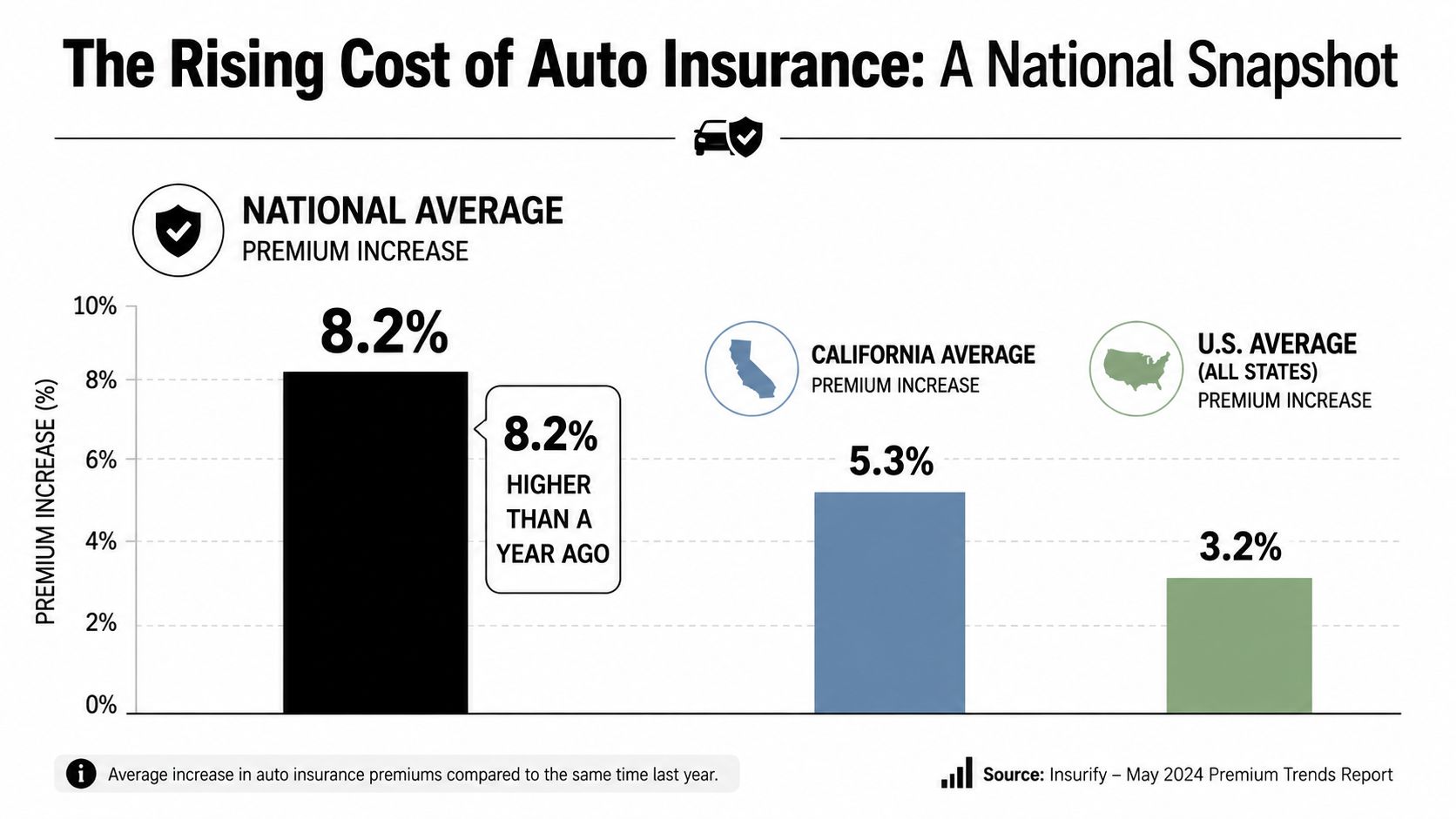
In California, insurance premiums keep climbing even when you don't file a claim. For auto coverage, Consumer Reports says nationwide premiums in the first half of 2025 were more than 8% higher than a year earlier and over 30% higher since 2023, and it also cites the U.S. Bureau of Labor Statistics as showing a 67% rise from April 2020 to April 2026. For homeowners, CNBC cited a Consumer Federation of America report showing average premiums rose 24% from 2021 to 2024 to $3,303 per year, with some high-cost markets going far higher, which is why how to lower insurance premiums now starts with the policy itself, not just your driving or maintenance habits.
If your renewal went up again, that doesn't automatically mean you did anything wrong. It usually means the carrier repriced your risk, your coverage no longer fits the asset, or you're paying for a structure that's too rich for the vehicle, house, or budget. In California, wildfire reinsurance pressure, repair inflation, and stricter carrier appetite make old “set it and forget it” policies expensive to carry.
If you want a baseline on policy review and comparison shopping, the consumer guidance at Mai & Associates' insurance resources aligns with what works in the market. The short version is simple, premiums fall when you match coverage to real-world exposure and stop overpaying for outdated assumptions.
Why California Premiums Keep Climbing
California pricing has two layers of pain, the national inflation trend and the state-specific risk load. The national auto picture is already ugly, with premiums running more than 8% higher year over year in the first half of 2025 and over 30% higher since 2023 according to Consumer Reports, while the BLS figure it cites puts the long-run increase at 67% from April 2020 to April 2026. That means even clean drivers are getting hit by a market that's repriced the whole category, not just bad drivers.
For homeowners, the pressure is even more direct. CNBC's reporting on a Consumer Federation of America analysis shows average U.S. homeowners premiums up 24% from 2021 to 2024 to $3,303 per year, and a U.S. Treasury analysis found premiums rose 87% faster than inflation from 2018 to 2022. In expensive states, Bankrate data cited by CNBC showed monthly premiums in Louisiana and Nebraska topping $500 per month, more than $6,000 annually, which is a reminder that this is a carrier pricing problem, not a household discipline problem.
Why California feels it earlier
California households are dealing with wildfire exposure, higher repair costs, and tighter carrier standards at the same time. That changes the game, because a spotless record doesn't erase the risk profile your carrier is pricing into the renewal.
Practical rule: if your premium jumped, assume the carrier changed the math before you assume your profile changed.
That's why a renewal review matters more now than it did a few years ago. The policy itself, deductibles, coverage limits, and endorsements, often contains the easiest savings. Consumer guidance from Consumer Reports shows that one of the clearest cost-cutting moves is raising the collision and deductible, and that kind of change only works if the policy still matches your real budget and risk.
Rank the Savings Moves That Actually Work
Stop treating every savings tip as equal. They're not. The biggest wins come from structural changes that alter how the insurer prices you, not from tiny discount tweaks that shave off a little without changing much else.
Here's the ranking I'd use in California if the goal is real premium reduction, not busywork.
| Tactic | Typical Annual Savings | Best For |
|---|---|---|
| Switch insurers | $520 to $890 | Drivers and homeowners whose current carrier is simply overpriced |
| Bundle home and auto | $485 to $715 | Households with both policies in place |
| Raise deductibles | $150 to $400 | Drivers and homeowners with emergency cash reserves |
| Stack discounts | $285 to $520 | Clean drivers, low-mileage households, and families eligible for multiple programs |
The market comparison published by MoneyGeek gives those annual savings ranges, and the order matters because it reflects strategic influence, not marketing. A cheaper carrier or a bundle can move the whole renewal. A discount stack helps, but it usually doesn't rescue a bad base rate. Consumer Reports and the Insurance Information Institute also say moving from a $500 to a $1,000 deductible can cut annual auto premiums by 20% to 25%, which is why deductible management deserves real attention, not a casual glance.
The move people underestimate
Most drivers obsess over discounts and ignore carrier pricing. That's backwards. The quote itself is the main battleground, and the cleaner your comparison, the faster you see whether your current policy is fair or just stale.
Bottom line: if you haven't shopped the market at renewal, you probably haven't done the highest-yield step.
For California households that also have a commercial or security-risk profile, an upgrade like business alarm system options can matter on the property side because risk reduction is part of the pricing conversation. But for many households, the first wins still come from the big four above, not from chasing a dozen tiny line-item discounts.
Run a Like-for-Like Quote Audit
A quote only helps if it compares the same risk transfer. That sounds obvious, but it's where many get fooled. A cheaper number with lower liability limits, a higher deductible, or stripped endorsements is not a true savings win, it's just a smaller bill today and a bigger problem later.
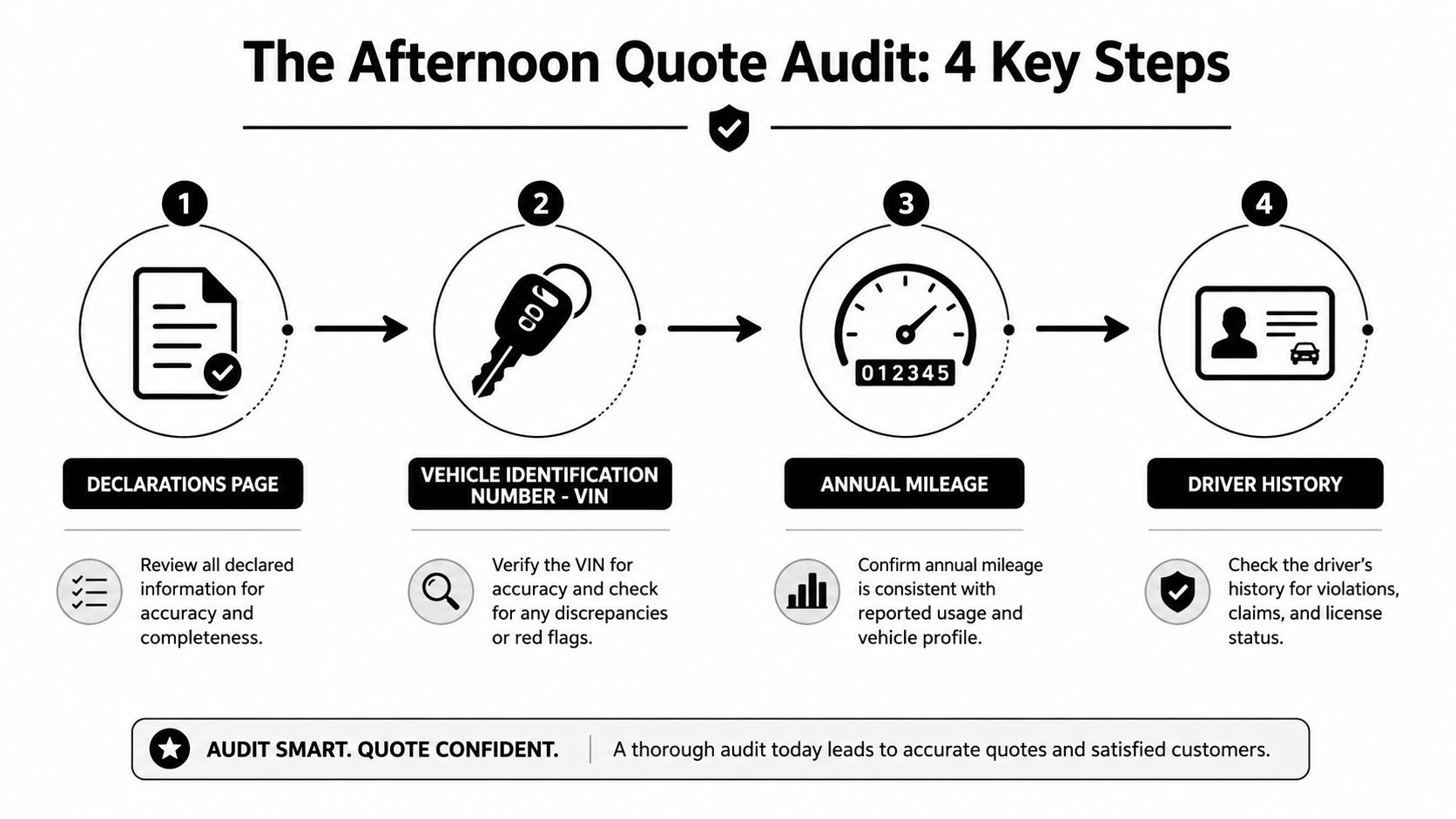
Start with the facts carriers use. Gather your declarations page, VIN, annual mileage, and driver history, then request 3 to 5 quotes using identical liability limits, deductibles, and endorsements. Consumer Reports and Triple-I both emphasize shopping around, and the practical guides say the process can often be completed in 30 minutes to a day when you have the documents ready.
What to compare line by line
The cleanest audit checks these items one by one.
- Liability limits: Keep bodily injury and property damage limits the same across every quote.
- Deductibles: Match collision and deductible amounts exactly, or you're not comparing savings fairly.
- Rental coverage: Watch for quotes that reduce it.
- Uninsured motorist protection: Don't let a “cheaper” policy cut this without you noticing.
- Endorsements: Remove only what you don't need, not what the agent forgot to include.
A quote that looks cheaper because it trims coverage is a false win. The right question isn't, “What's the lowest premium?” It's, “What am I giving up to get that number?”
For a clean starting point, use the quote request path at Mai & Associates' quote page and line up every option against the same coverage baseline. Timing matters too, because doing this 30 to 60 days before renewal usually gives you the most advantage with your current carrier.
Three California Households, Three Different Playbooks
A downtown Los Angeles driver with a paid-off Civic should not use the same playbook as a Bay Area condo owner. California pricing is too tied to mileage, location, and loss exposure for that. The right move depends on what the carrier thinks you're insuring.
The low-mileage LA commuter
If you drive a short distance, park in a controlled area, and your car is not a prestige asset, a usage-based program can make sense. Pair that with a higher deductible if you can absorb the out-of-pocket hit. The goal is to stop paying commuter pricing for a car that barely moves.
The Bay Area condo owner
A condo owner often has the easiest savings hiding in plain sight, redundant coverage and poor bundling. If the association already insures parts of the structure, your policy should not duplicate what you don't own. That household usually gets more value from a policy cleanup than from chasing every small discount.
The Inland Empire family with teens
A household with two teen drivers should focus on discount stacking, driver profile management, and a hard look at safety-related property adjustments. Good-student eligibility and multi-driver pricing often matter more here than cosmetic policy changes, and wildfire-related home reviews can affect the property side of the budget too.
If you're shopping locally, a focused review like auto insurance in Los Angeles is a better model than a generic national checklist because the same policy structure doesn't price the same way everywhere. That's the part many miss. California households don't just need cheaper insurance, they need the right lever for the right risk.
Useful shorthand: match the tactic to the household, not the headline discount.
Telematics, Mileage, and Payment Design
Telematics is not a magic savings button. It's a data trade. You give the carrier driving behavior and mileage patterns, and in return you may get a lower rate if the profile fits. That's useful for some drivers and a poor fit for others, especially if your mileage swings month to month or you rack up late-night trips and harder braking.
AARP's guidance on auto insurance savings points to telematics, low-mileage programs, pay-in-full options, and alternative payment schedules as common levers, but the question is whether the program matches your habits. If you're consistently low-mileage and smooth on the brakes, it can help. If your driving is variable, the discount can shrink or disappear once the carrier sees the full picture.
Payment design matters more than people think
Monthly billing often looks harmless, but it can make the total policy cost higher through installment fees. Pay-in-full avoids that drag, and autopay or EFT can be worth asking about if the carrier offers a clean billing discount.
The practical test is simple. If you can pay the policy in full without straining emergency cash, don't volunteer to pay more through installments. If you can't, then the monthly plan may still be the right choice, but you should know you're paying for flexibility.
Direct advice: telematics is for careful, low-mileage drivers who want to be measured accurately, not for anyone chasing a headline discount.
A device like CARLOCK GPS car tracker can also be useful for households that care about location monitoring and vehicle security, but don't confuse security tools with insurance savings. The insurer prices what it can verify, and that's where telematics either helps or hurts.
California-Specific Levers Most Guides Miss
The biggest California mistake is assuming the standard market is always the only market. It isn't. Some households end up in the California Fair Plan because standard carriers pull back, and a proper review can sometimes move a household back toward the standard market if the risk profile is better than the current placement suggests.
Wildfire mitigation is also not optional in California anymore. Brush clearance, defensible-space inspections, and Class A roof upgrades can all influence how a carrier views the home. If your property is in a higher-risk zone, those steps are part of premium control, not just property maintenance.
Credit-based pricing still matters
Many carriers use credit history in pricing. The Idaho Department of Insurance says many companies consider credit history when determining premiums, and CNBC reports that insurers frequently use credit-based insurance scores. The action steps are plain, pay bills on time, lower credit utilization, and correct reporting errors fast.
Earthquake coverage deserves a separate look too. California homeowners often treat it as an add-on to ignore, but the pricing and protection decision should be reviewed on its own merits, especially if your home value or location makes the risk hard to absorb out of pocket.
For state-specific policy structure, the California insurance resources are more useful than generic national advice because the market rules here are different. The point is not to collect every possible discount. It's to remove friction, prove the home is better protected, and make the carrier price you like a lower-risk account.
Best California habit: review the property side for risk reduction before you assume the premium is fixed.
When Self-Service Tactics Plateau and an Agent Helps
There's a point where DIY savings stop moving the number. That usually happens when a household has multiple policies, recent life changes, or coverage that needs to be coordinated across auto, home, renters, and life insurance. At that stage, the problem isn't lack of effort, it's that the policy puzzle is too layered for one-off changes.
A licensed agent can compare carriers across lines, spot coverage gaps, and tell you whether the cheaper option is the smarter one. That matters in California because Fair Plan placement, earthquake options, and wildfire exposure can change the best answer from one property to the next. A consultative review is especially useful when you've already raised deductibles, shopped around, and trimmed obvious extras, but the renewal still isn't where it should be.
Mai & Associates does that kind of cross-policy review across four California offices, with service in more than 50 cities, same-day quotes, 24-hour response, multilingual support, and a focus on Fair Plan reviews and wildfire protection strategies. If your premium has stopped responding to standard tactics, that's the moment to get a sharper review instead of guessing.
Don't keep renewing a policy that no longer fits your home, car, or budget. Mai & Associates helps Californians compare auto, home, renters, and life insurance with a licensed, consultative review that focuses on the changes that move a quote. Visit Mai & Associates to request a same-day look at your coverage and see where your premium can come down without creating a gap you'll regret later.