How to Lower Home Insurance: Save Big in 2026

You open your renewal notice, scan the premium, and your stomach drops. That reaction is common in California right now, especially if your home sits near brush, canyon, foothill, or older housing stock that insurers don't love. Add a prior claim, a low credit profile, or a roof that looks older on paper than it does in person, and the price can jump fast.
Most advice on how to lower home insurance is too shallow to help. It tells you to bundle, raise your deductible, and install an alarm. Fine. But if you own a home in a wildfire zone, need earthquake planning, or you're trying to coordinate home insurance with auto insurance, renters insurance for family members, and life insurance, you need a better playbook.
California homeowners also face a problem people in easier markets don't. You're not just shopping for a lower premium. You're trying to stay insurable, improve the risk profile of the property, and avoid paying for coverage that doesn't match the home you own.
Beyond Generic Tips for California Homeowners
A lot of online advice breaks down the second your house gets flagged as higher risk. That's the core issue.
Major consumer guidance often repeats the same standard moves, but it rarely answers the practical question homeowners want to know once they already have a tougher property: which savings steps still matter when the home is in a high-risk area or your profile isn't perfect? Liberty Mutual's guidance reflects that gap. The usual tips get listed, but the tradeoffs and real-world priority order often don't.
California risk changes the strategy
If you live in California, generic advice misses the underwriting reality. Carriers look harder at wildfire exposure, roof condition, brush clearance, home updates, and whether the house appears hardened against loss. In many parts of the state, the question isn't just “How do I save money?” It's “How do I become a better risk to insure?”
That means your policy should be treated like a working financial tool, not a fixed bill.
For example, these homeowners need different strategies:
- The foothill homeowner who can still qualify for better terms by improving defensible space and documenting upgrades.
- The FAIR Plan customer who may need a companion policy and should still shop private-market options when conditions change.
- The urban homeowner who may be overpaying because coverage limits drifted upward without a careful review.
- The family with multiple policies who should coordinate home, auto, car insurance for young drivers, renters insurance for a college-age child, and life insurance through one review.
Bottom line: The cheapest premium isn't automatically the best result. In California, the smarter goal is lower cost with stronger insurability.
Stop treating the renewal as non-negotiable
Too many homeowners assume the renewal offer is the market price. It isn't. It's one carrier's current appetite, pricing model, and view of your property.
Start with a clean review of your current California home insurance setup. Pull the declarations page, list every home upgrade from the last few years, and check whether your dwelling limit reflects rebuilding cost rather than resale hype. Then compare that against your broader household insurance picture. If your home policy lives with one company, your auto insurance with another, and your life insurance nowhere near either, you may not be in the most advantageous position.
If you need a starting point for California-specific coverage questions, review a focused overview of California home insurance options. It helps frame the market you're shopping in, not the one generic national articles pretend you're in.
Fine-Tune Your Coverage and Deductibles
The fastest savings often sit inside the policy you already have. Not in a flashy switch. In the details.
Start with the deductible decision
A higher deductible usually lowers premium. That part is simple. What is often overlooked is whether one can comfortably absorb the out-of-pocket hit after a loss.
Use a personal stress test instead of guessing:
- Pick the deductible amount on your current policy.
- Ask whether you could pay that amount this month, from savings, without using credit.
- Repeat the question for a higher deductible option.
- Choose the highest deductible that won't create a financial mess after a claim.
If your answer is shaky, don't force a higher deductible just to trim premium. A lower bill today isn't worth a bad cash crisis after water damage, theft, or a fire-related claim.
You should never pick a deductible based on optimism. Pick it based on liquid cash.
Review dwelling coverage the right way
A common mistake is insuring the home based on market value. That inflates premium and muddies the purpose of Coverage A. Home insurance is meant to cover the structure's rebuild cost, not the land value or neighborhood bidding wars.
Look at these items during your review:
| Policy item | What to check | Why it matters |
|---|---|---|
| Dwelling coverage | Does it reflect rebuild cost, not sale price? | Overstating it can push premium up unnecessarily |
| Extended features | Are optional add-ons still needed? | Some endorsements stay on a policy long after they stop being useful |
| Other structures | Do detached structures still exist and need coverage? | Old limits may remain even after sheds or fences change |
If you're unclear on terms like Coverage A, endorsement, scheduled property, or replacement cost, a plain-language insurance glossary helps translate the policy before you make changes.
Trim personal property with a scalpel, not a chainsaw
Don't slash contents coverage blindly. Instead, review what you're protecting.
Ask yourself:
- Have high-value items been sold or gifted away?
- Are you paying for special coverage on items you no longer own?
- Do you need separate scheduling for jewelry, collectibles, or business-related property in the home?
- Has your household changed, with kids moving out or a rental unit being furnished differently?
The goal isn't to strip the policy down. The goal is to stop paying for stale assumptions. California homeowners often carry old coverage decisions for years because no one revisited them after a remodel, downsizing move, inheritance, or shift in household makeup.
Find Every Available Home Insurance Discount
A lot of California homeowners overpay because nobody asked the second question.
They hear “you already got the standard discounts” and stop there. That is a mistake, especially in this market, where carrier appetite changes fast and small details can decide whether a credit applies, gets missed, or never shows up on the quote at all.
Start with discounts a carrier can verify quickly
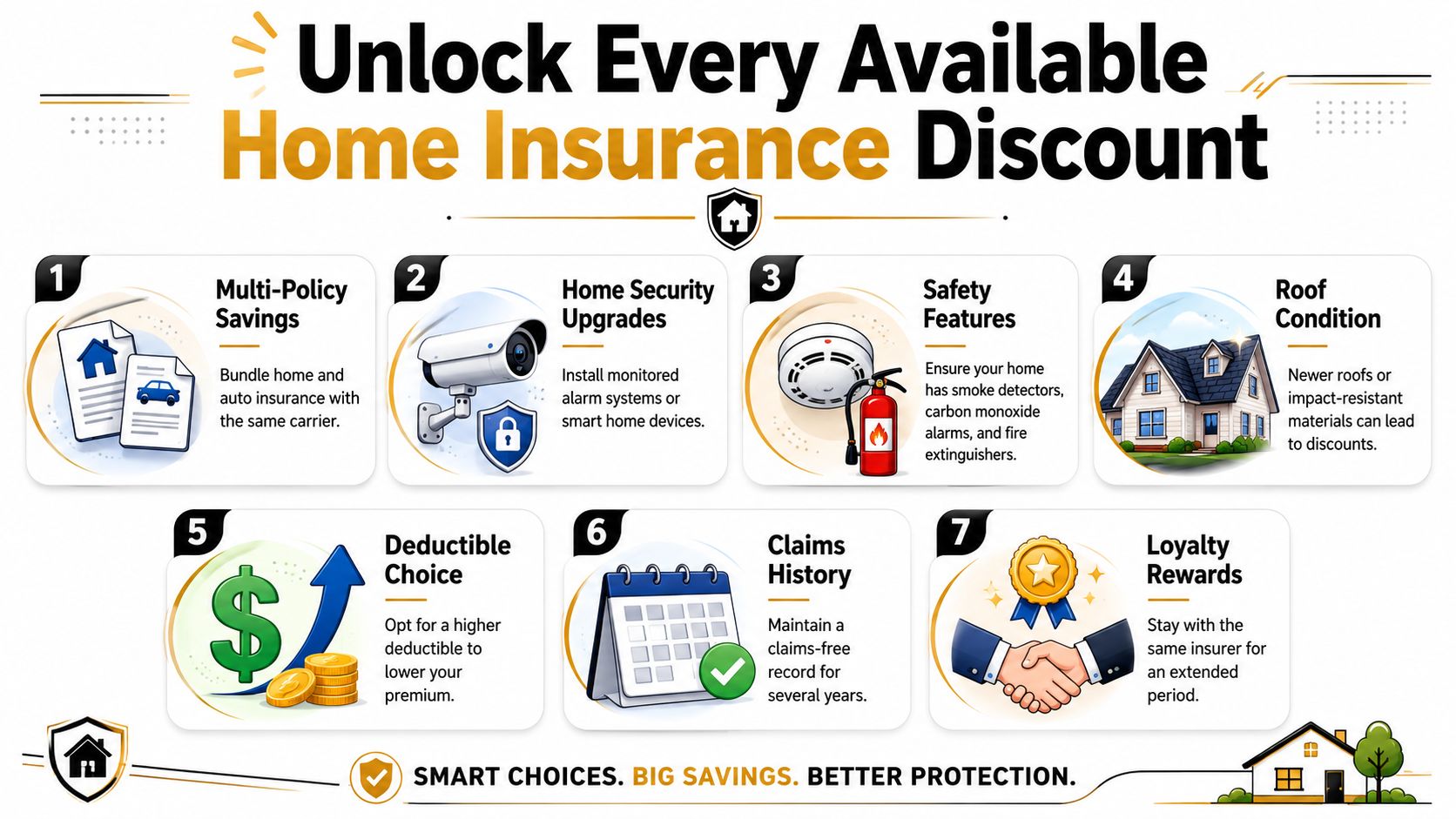
Begin with credits that are easy to prove and easy for underwriting to approve. In California, that usually means home and auto bundles, basic protective devices, and monitored systems.
Check these first:
- Home and auto together if the combined premium is better than separate placements
- Smoke detectors, dead-bolt locks, and burglar alarms
- Monitored alarm or fire systems with active service records
- Recent home updates that reduce loss potential, such as roof, plumbing, or electrical work
- Claims-free history if your record has been clean
Proof matters. If a carrier gives credit only for monitored protection, a self-installed device with no monitoring certificate may do nothing for the rate.
Bundle the whole household, not just the house
An independent agent earns their worth in this context. At Mai & Associates, we do not look at the home policy in isolation. We price the household together because that is often where substantial savings show up.
For California families, the smart comparison usually includes:
- Home plus auto insurance
- Home plus auto for multiple drivers in the household
- Home plus umbrella if you have significant assets to protect
- Home plus life insurance when the carrier rewards multi-policy relationships
- Split placements when one carrier is strong on home but weak on auto
Bundling should improve the total package, not just create one tidy bill. If the home rate is fair but the auto rate is bloated, it is not a good bundle.
Ask about California-specific credits that get missed
High-risk areas create extra complexity, but they also create openings. If your home is in wildfire territory, some carriers pay attention to documentation that shows the property is better protected than nearby homes. That can include exterior upgrades, ignition-resistant features, or better materials on the home itself. If you are updating the exterior, choices like durable siding for Sacramento may support the broader conversation about hardening the property and improving how an underwriter views it.
This does not replace the need to compare private carriers against FAIR Plan options when availability is tight. It does give your agent more to work with when they present the risk.
Keep a short file with receipts, inspection reports, alarm certificates, and upgrade dates. If you want a better way to organize that review, our California insurance guides for homeowners and families can help.
Don't ask, “Do I get any discounts?” Ask, “Which discounts did you test, which were declined, and what documentation would qualify me for more?”
That question gets specific answers. Specific answers save money.
Fortify Your Home Against California Risks
In California, the most durable way to lower premium isn't clever shopping alone. It's risk reduction that an underwriter can recognize.
A lot of homeowners still think mitigation is only about safety. It's also about insurability. If your home is less likely to burn, collapse, or suffer severe damage, the property becomes easier to place and easier to price.
Wildfire hardening matters in ways homeowners underestimate
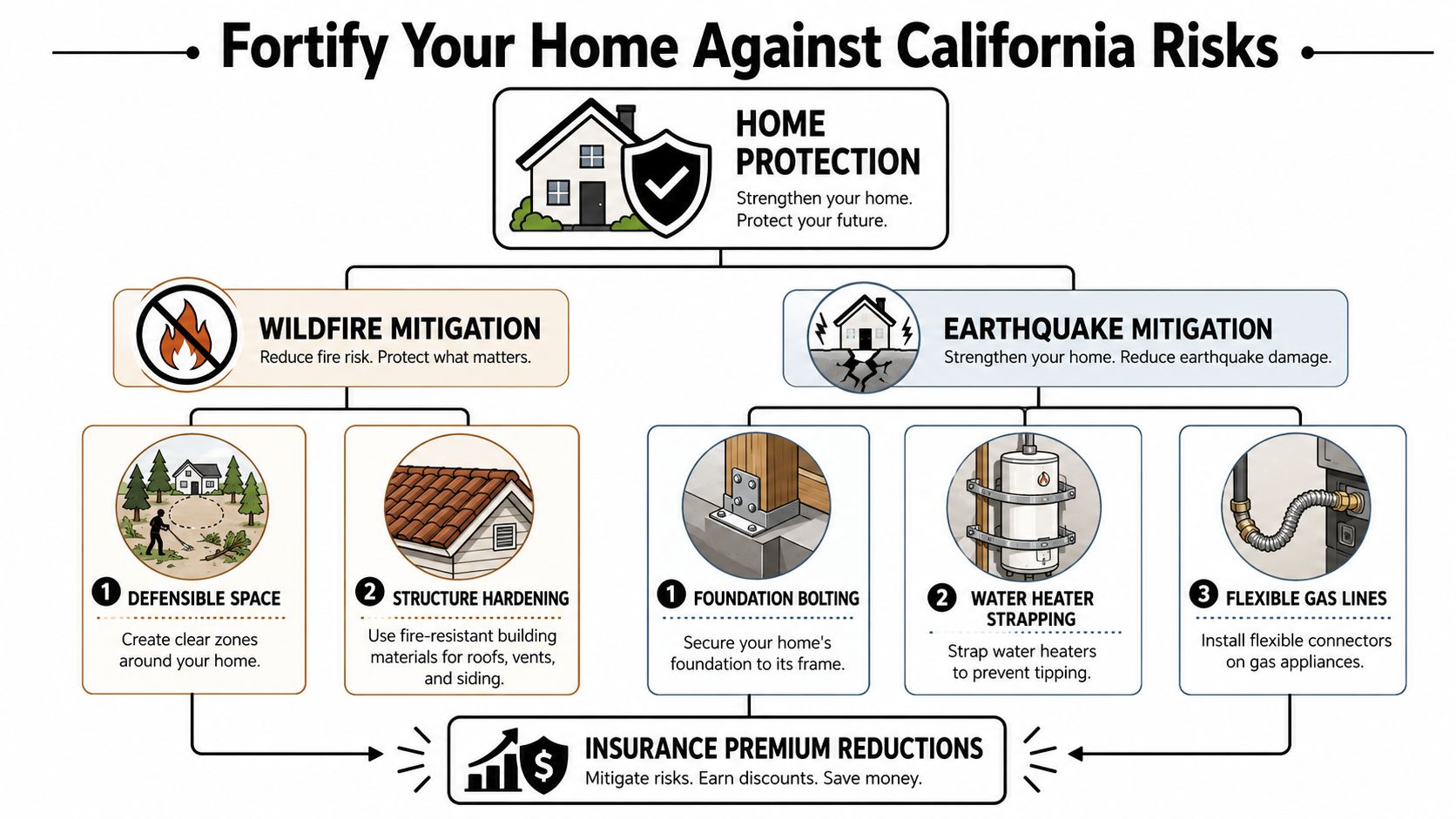
National guidance notes that insurers commonly reward lower-risk homes with premium reductions when owners improve roofing, add security, reinforce resistance to major hazards, or retrofit for earthquakes. It also specifically notes that fire-resistant landscaping, stronger roofing materials, and earthquake retrofits can reduce premiums in catastrophe-prone markets such as California (Nationwide's guidance on lowering homeowners insurance rates).
For wildfire country, focus on what an insurer can understand quickly:
- Defensible space around the home, especially near structures and attachment points
- Fire-resistant landscaping rather than dense, ignition-friendly planting
- Roof upgrades using stronger, more resilient materials
- Safer vents, siding, and exterior materials when you're remodeling anyway
If you're already planning an exterior renovation, material choice matters. Homeowners comparing cladding options can review practical examples of durable siding for Sacramento to understand why tougher exterior materials can support both resilience and insurance conversations in fire-exposed regions.
Earthquake preparation improves more than safety
Earthquake insurance in California is its own conversation, but earthquake mitigation still affects how your home is perceived as a risk.
Useful upgrades can include:
- Foundation bolting
- Bracing vulnerable areas
- Water heater strapping
- Flexible gas connections where appropriate
- Documentation of retrofitting work
Not every carrier credits every retrofit the same way. But the broader principle is strong: a better-prepared structure is a better underwriting story.
If you're on the FAIR Plan, mitigation can still help
FAIR Plan homeowners often feel stuck. You're not completely stuck.
The FAIR Plan can be a necessary bridge when the admitted market is tight, but it shouldn't end the conversation. If you improve the property, reduce visible hazards, and keep your documentation organized, you may improve your future options in the private market. You should also review whether the companion coverage around the FAIR Plan still fits the home and your liability needs.
Use this quick decision table when prioritizing upgrades:
| Upgrade type | Best reason to do it | Insurance value |
|---|---|---|
| Brush and landscaping changes | Lower ignition risk near the house | Helps present a cleaner wildfire profile |
| Roof and exterior improvements | Reduce vulnerability to fire and weather | Often easier for insurers to recognize |
| Earthquake retrofitting | Protect structure stability | Supports better risk positioning |
| Security and monitoring | Reduce theft and early-loss severity | May help with available credits |
A smart home upgrade in California does two jobs. It protects the house and improves the insurance conversation.
That's the filter to use before spending money.
Master the Art of Shopping for Quotes
A California homeowner gets three quotes for the same house and sees three completely different prices. That is normal. It also traps people into buying the wrong policy for the wrong reason.

Why California quotes swing so much
Carriers do not rate California homes the same way. One company may price a foothill property aggressively because it dislikes wildfire exposure. Another may be more forgiving if the roof is newer, the brush is managed, and the replacement cost estimate is clean. A third may only get competitive if it also writes your auto policy, and sometimes life insurance helps the household package make more sense.
The FAIR Plan changes the quote process too. If a standard carrier declines the home, you may be comparing a FAIR Plan setup plus companion coverage against a traditional homeowners policy. Those are not interchangeable. Treat them as different structures, then compare the full cost and the actual protection.
Build an apples-to-apples comparison
Price only matters after the coverage matches. If one quote strips out key protections or lowers limits, it is not cheaper. It is smaller.
Use this checklist when comparing home insurance quotes in California:
- Match dwelling coverage. A lower Coverage A limit can make a weak quote look attractive.
- Match deductibles. Savings are real only if you are comparing the same out-of-pocket risk.
- Review endorsements carefully. Water backup, ordinance or law coverage, scheduled valuables, and higher liability limits can change the value fast.
- Ask about wildfire-related restrictions. Check for coverage conditions, inspection requirements, or companion policy needs.
- Compare the full household price. Run the home by itself, then with auto, and then with auto plus life if the carrier offers meaningful package pricing.
- Ask why the quote landed where it did. Roof age, claims history, occupancy, dogs, brush score, and prior non-renewals all affect the outcome.
A simple table keeps the comparison honest:
| Quote factor | Carrier A | Carrier B | Carrier C |
|---|---|---|---|
| Dwelling coverage | |||
| Deductible | |||
| Key endorsements | |||
| Bundle included | |||
| Notable exclusions |
Use an independent agent, not a one-company sales pitch
Captive agents can only sell what one carrier allows. In California, that is a narrow lane. An independent agent can compare companies, flag underwriting issues early, and tell you whether bundling home, auto, and life is saving money or just sounding convenient.
That matters a lot for homes in higher-risk ZIP codes. You want someone who knows which carriers are still writing, which ones are tightening inspections, and which ones handle California wildfire exposure more reasonably. If you want a faster way to compare real options, request a California home insurance quote comparison using the same property details for every carrier.
One last rule. If a quote comes in dramatically lower, do not rush to bind it.
Ask three questions first: What changed? What was excluded? What assumptions did the carrier make about the property? Those answers usually explain the price.
Your Mai & Associates Home Insurance Savings Checklist
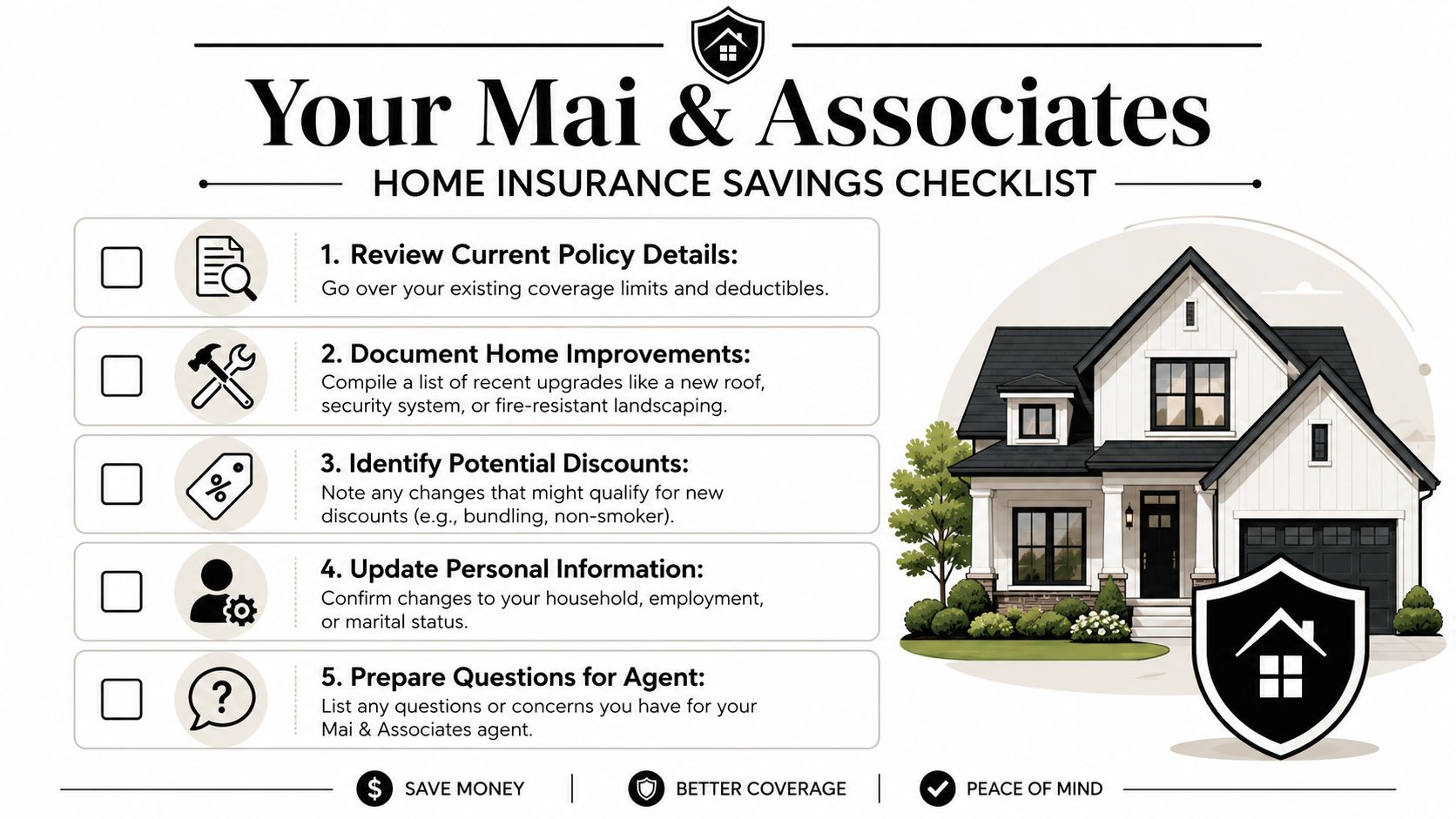
Information saves money only when you bring the right information to the review. A good policy checkup should feel less like paperwork and more like a financial tune-up.
Bring these documents
Before your call or review, gather:
- Current declarations page for the home policy
- Recent renewal offer showing the new premium and coverage
- Any competing quotes you've already received
- A list of home improvements such as roof work, electrical updates, security systems, landscaping changes, or retrofitting
- Photos or invoices that help verify upgrades
- Your current auto insurance, renters insurance, and life insurance details if you want package pricing reviewed
Ask better questions
Most homeowners ask, “Can you get this lower?” Ask sharper questions instead.
- Which discounts were checked and which weren't available?
- Does my dwelling coverage reflect rebuild cost or am I carrying excess?
- Would changing the deductible help enough to justify the risk?
- Would my household save more by bundling home and auto insurance, or by keeping them separate?
- Do any home upgrades improve my eligibility with other carriers?
- If I'm in a FAIR Plan setup, are there better companion options or new private-market opportunities to review?
- Should I coordinate life insurance and liability planning at the same time?
Use an annual review trigger list
Don't wait for a painful renewal to review the policy. Revisit it after:
- A remodel or major repair
- A roof replacement
- A security or monitoring installation
- Fire-hardening or landscaping work
- Household changes
- A vehicle change that affects auto bundle pricing
- A move that creates renters insurance needs for a family member
- A broader family planning discussion involving life insurance
That's how to lower home insurance without creating blind spots. You tighten coverage, improve the property, compare the market correctly, and use your full household insurance picture instead of treating every policy as separate.
If you want a real California policy review instead of generic advice, Mai & Associates can help you compare home, auto, renters, and life insurance options across multiple carriers, review FAIR Plan setups, and spot practical savings opportunities for high-risk properties without stripping away the protection you need.