How to Insure Jewelry: 2026 Coverage Guide
You're probably looking at a ring, watch, or bracelet that matters more than the receipt ever could. Maybe it's an engagement ring you wear every day, a family watch that's been passed down, or a gift you take off only when you remember to. If it vanished tonight, your standard policy probably wouldn't make you whole. That's the part many learn the hard way.
How to Insure Jewelry starts with one blunt truth, default home and renters coverage is rarely enough for meaningful jewelry. The fix is straightforward, but it has to be deliberate. You need the right policy structure, the right paperwork, and the right expectations about how a claim gets paid.
Why Standard Home and Renters Policies Often Fall Short
Most Californians assume their homeowners or renters policy covers jewelry because, on paper, it does. In practice, the jewelry limit is usually small, and there's often a separate per-item cap before a deductible even enters the picture. That's where people get blindsided. A $7,500 engagement ring can be stolen, and the policy may only pay a fraction of that loss if the jewelry sublimit is low and the deductible still applies.
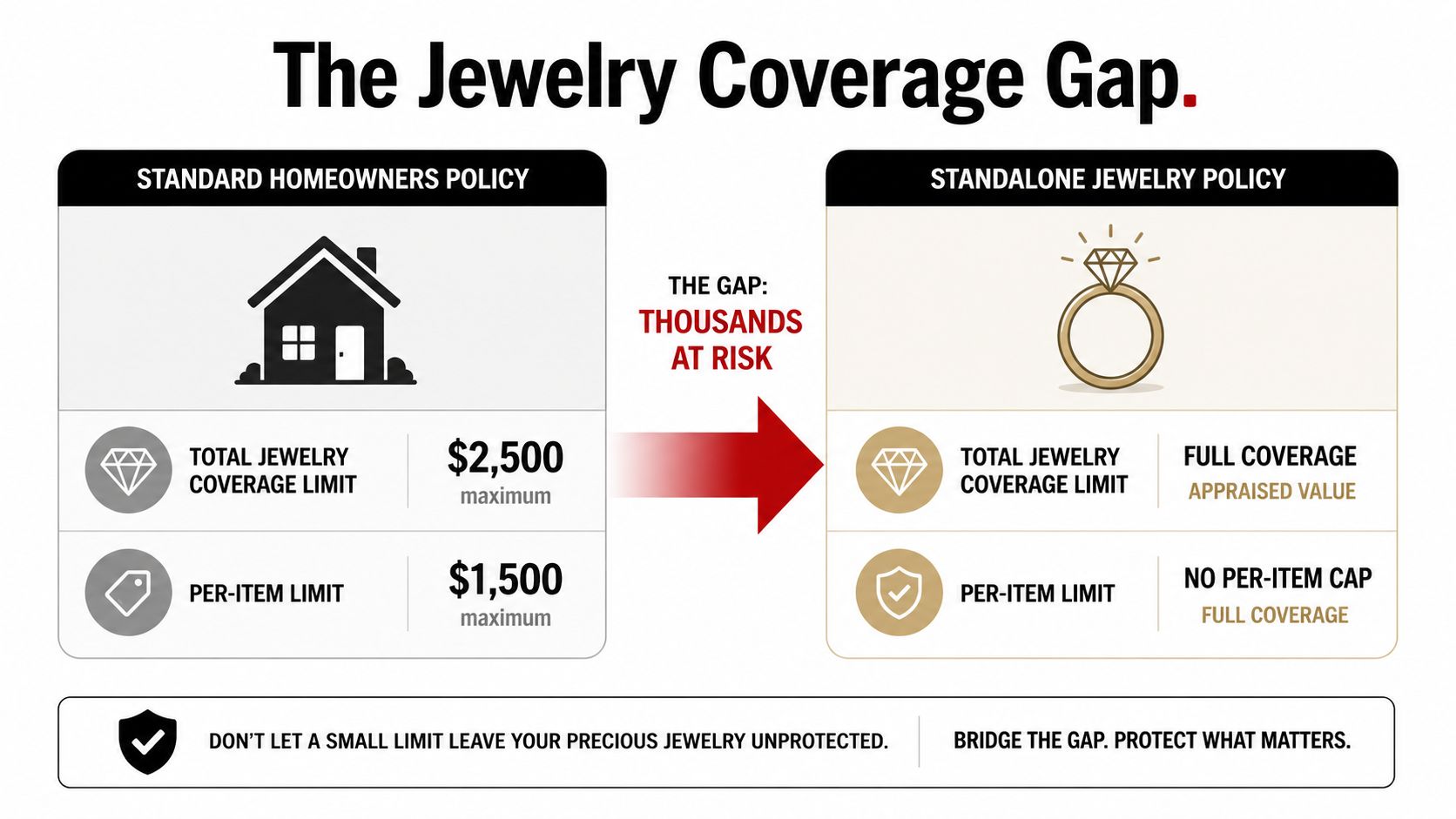
The coverage gap is the real problem
The gap is not theoretical. Jewelry insurance pricing is usually around 1% to 2% of the item's value, and a $5,000 engagement ring may cost roughly $50 to $100 per year to insure, according to the pricing range summarized by Travelers' jewelry insurance guidance. That's a small premium compared with the value at risk, which is exactly why relying on a default policy is a bad bet.
A basic homeowners or renters policy also tends to pay under policy limits, not against the replacement value of each piece. That means the actual payout can be much lower than the cost to replace the jewelry you lost. If you want real protection, you need to choose it, not assume it's already there.
The three paths that actually work
You've got three serious options. First, you can schedule the item on a homeowners or renters policy. Second, you can add a jewelry-specific endorsement through the same carrier. Third, you can buy a standalone jewelry policy from a specialty insurer.
The choice depends on what you own and how you use it. A daily-worn engagement ring is a different risk than a bracelet that stays in a safe, and both are different from heirloom pieces that travel with you. If you also need a broader renters baseline, this is the point where a California renter should review renters insurance in California so the jewelry decision sits on top of the right foundation.
Practical rule: if the piece would hurt to replace, don't leave it at the mercy of the default jewelry sublimit.
Scheduled Personal Property, Endorsements, and Standalone Policies Compared
You already know the gap. A standard home or renters policy gives you a blanket limit, then carves jewelry down with sublimits and conditions that can leave a big hole at claim time. If you own a ring, watch, or heirloom that would sting to replace, the question is not whether to buy extra protection, it is which structure gives you the cleanest payout for the way you keep and wear the item.
Coverage Paths for Insuring Jewelry
| Coverage Type | Best For | Deductible | Typical Cost Basis |
|---|---|---|---|
| Scheduled personal property | One-off valuable pieces, heirlooms, watches | Often no deductible on the scheduled amount | Based on appraised value |
| Jewelry endorsement | Existing home or renters policy customers who want a simple add-on | Depends on the carrier and policy form | Based on appraised value and policy terms |
| Standalone jewelry policy | Daily-worn pieces, travel, higher-value collections | Often zero or very low, depending on the policy | Usually around 1% to 2% of insured value |
The coverage gap
A scheduled personal property endorsement is the cleanest fit when you have one ring, one watch, or a short list of pieces that each deserve named coverage. It is built for itemized protection, so the insurer is looking at the specific piece, the appraised value, and the scheduled amount instead of treating it like just another household item. If the piece is valuable enough to get its own line on the policy, that is a signal to schedule it.
A jewelry endorsement sits inside your existing homeowners or renters policy and adds jewelry coverage without forcing you into a separate contract. That can be a smart move when you want to keep billing and claims under one carrier, but the policy terms still control the payout. A lot of owners miss that part and assume an add-on fixes every problem, then find out the deductible, travel terms, or coverage limits still matter at claim time.
A standalone jewelry policy is the stronger option when the item is worn constantly, taken on trips, or handled often. The broader peril list and worldwide coverage are what matter most here, especially for people who leave a piece on their body instead of locking it away. For a $15,000 heirloom necklace, a scheduled approach may sit closer to the appraised value on a home policy form, while a standalone policy is often priced as a small share of the insured value, which is why separate coverage can make sense for pieces that leave the house with you.
If you already carry home insurance in California, compare the jewelry add-on against the structure of the whole policy before you decide. That matters even more if you have a California home insured through a carrier that interacts with wildfire rules or, in some cases, a Fair Plan setup. The jewelry decision should fit the home policy, not fight it.
A standalone policy is usually the cleaner buy when the jewelry leaves the house often. If it stays put and you want simplicity, scheduling can work just fine.
Building the Documentation Package That Survives a Claim
This part is boring until it saves your claim. Insurers don't pay on sentiment, they pay on documentation. The single best move you can make is to assemble a file that proves what the item was, what it looked like, and what it was worth before something happened.
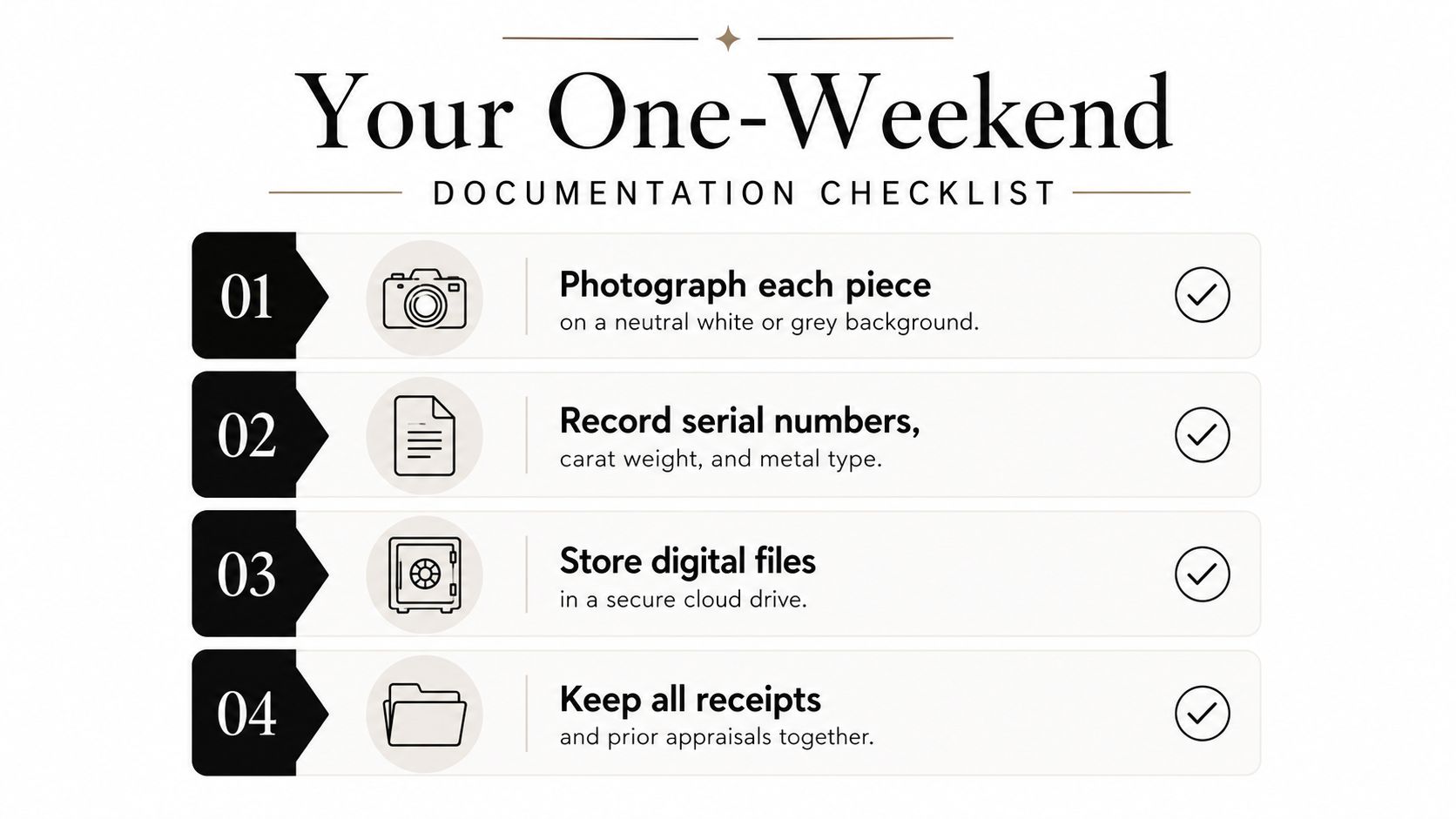
One weekend can do the job
Start with clear photos on a neutral background. Get the front, back, clasp, prongs, hallmarks, and any serial numbers or engraving. Then pull together receipts, grading reports, certificates, and old appraisals. If you've inherited the piece, document whatever provenance you have, even if it's just family notes and the jeweler's description.
Then get a professional appraisal that lists metal type, weight, gemstone quality, and current replacement value. That detail matters because under-documented pieces slow quotes and claims. Guidance on documentation and appraisal content in jewelry insurance workflows repeatedly emphasizes the same practical point, missing details create delay, and delay creates friction.
For organizing those files, the process is similar to what families use when they how to organize family documents. Keep the jewelry file just as disciplined, one place for photos, one place for receipts, one place for appraisals, and one place for policy pages.
Don't let the appraisal go stale
Appraisals should be refreshed every 2 to 3 years because gemstone and precious-metal values move over time, as noted in the practical guidance from JewelTrendPro's claims and appraisal workflow. An outdated appraisal creates an undervaluation gap at claim time, which can force a re-check against current market data and lead to a lower offer than you expected. That's the quiet mistake I see most often with heirlooms.
Store the originals in a fire-rated safe or a safety deposit box, then back up the digital copies in the cloud. If the item ever disappears, you want the insurer to see a complete story in minutes, not weeks.
Practical rule: if a jeweler can't see the item from your paperwork alone, your claim file is too weak.
How Premiums and Deductibles Are Actually Calculated
People either overpay out of fear or underbuy out of denial. The math is simple enough to sanity-check any quote, and you should absolutely do that before you sign. Jewelry insurance premiums are usually about 1% to 2% of the insured value each year, and the insured value is generally the appraised value, not the emotional value.
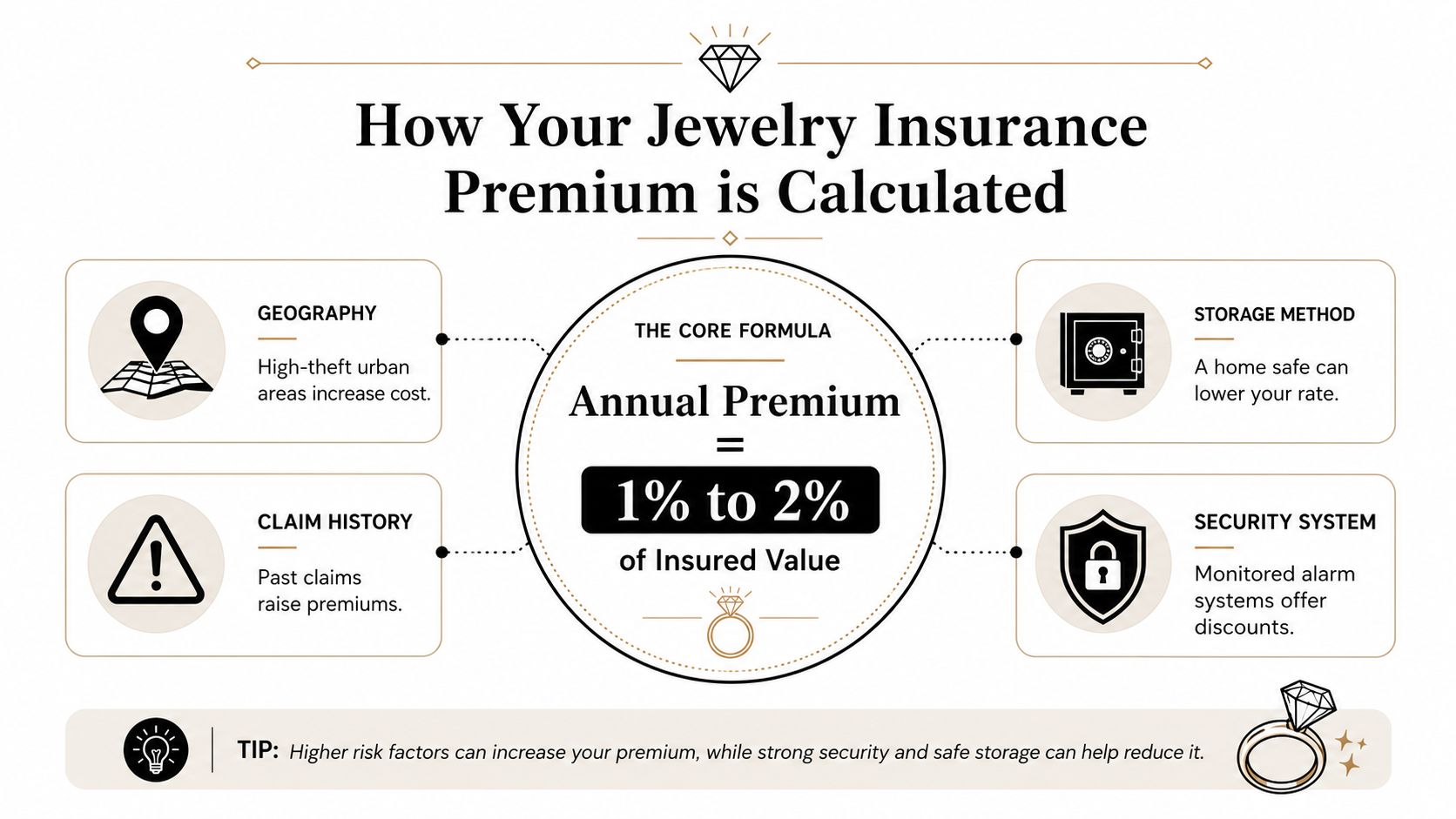
A quick way to think about the price
A $2,000 watch usually lands in the same general 1% to 2% annual range, so you're thinking in small yearly premium territory rather than a huge bill. A $5,000 engagement ring follows the same logic, and the earlier Travelers example puts that near $50 to $100 per year. A $20,000 diamond bracelet scales that same math upward, because the carrier is pricing the amount it might have to replace.
Three things move the price up or down. Geography matters, because theft patterns differ by location. Claim history matters, because carriers don't ignore prior losses. Storage method and security systems matter too, since a safe or monitored alarm can change how the risk looks to the insurer.
Deductibles are where the quote gets real
A $250 deductible versus a $500 deductible is not a small detail if you're comparing policies over time. The higher deductible usually lowers the premium, but you need to decide whether that savings is worth giving up more money at claim time. On a modest piece, the wrong deductible can erase the benefit of buying the policy in the first place.
Here's the rule I use with clients, if the deductible feels painful on day one, it'll feel worse after a loss. That's why lower deductibles often make more sense on rings and watches people wear.
Higher-value claims can also get dual review by an adjuster and a gemologist, which slows the timeline but usually improves accuracy.
Exclusions and Coverage Traps to Read Before You Sign
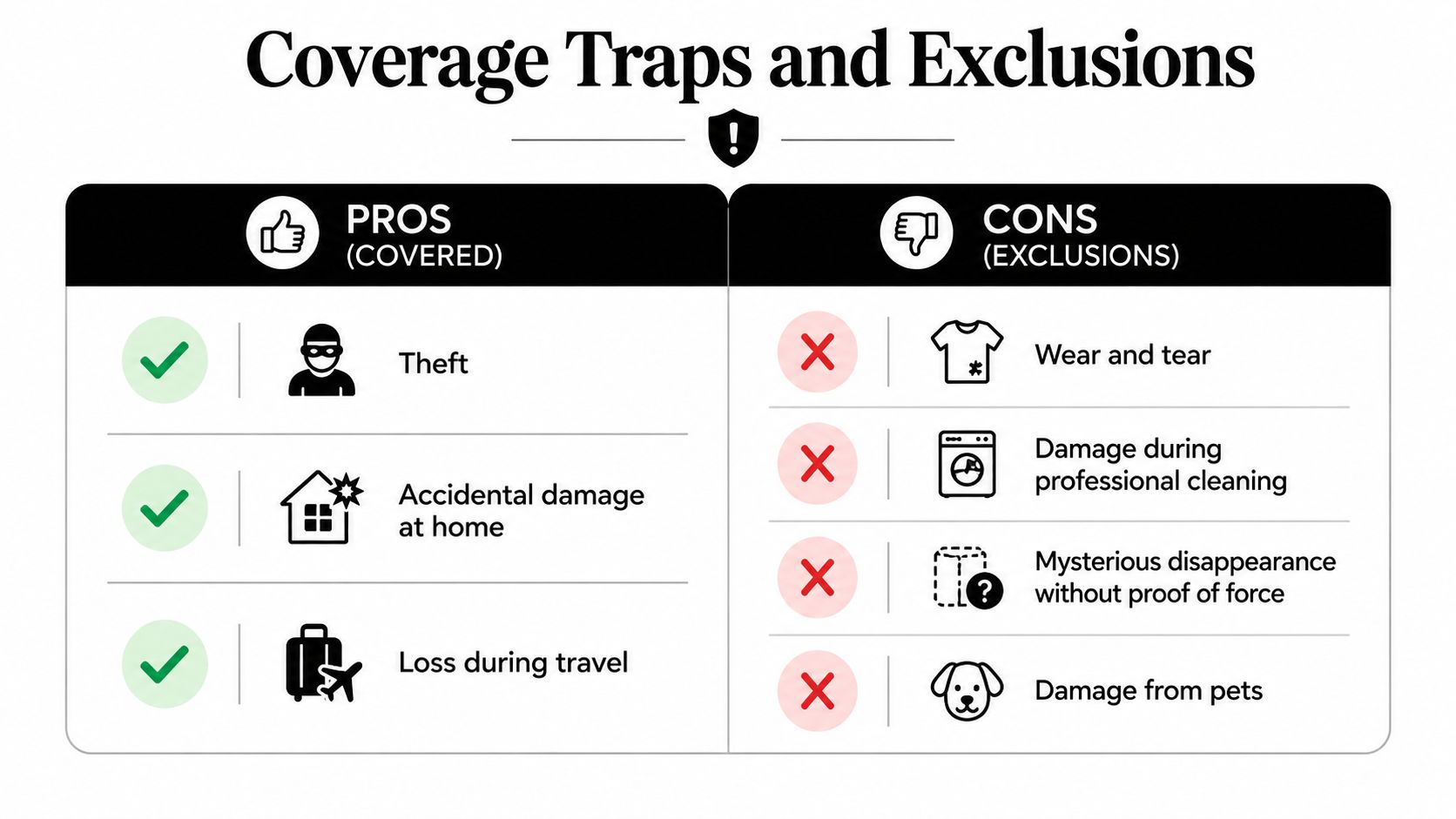
This is the section most buyers skip, and it's the one that hurts them later. Jewelry policies are useful, but they're not magic. If you don't read the exclusions, you can easily buy coverage that looks broad and still misses the exact loss you're worried about.
The exclusions that show up again and again
Wear and tear is almost always out. So is gradual damage, which means a ring that slowly loosens over time can turn into a maintenance issue, not an insurance claim. Manufacturer defect is another common exclusion, because that belongs in the jeweler's or warranty world, not the insurance world.
Shipping is another trap. If a piece is lost while unaccompanied in transit, the policy may not respond the way you expect. And mysterious disappearance clauses can get strict, especially if the carrier wants proof of forced entry or some other clear explanation for the loss.
Pairs, sets, and antique pieces need extra attention
The pair-and-set rule matters most for earrings. If you lose one earring, the policy only pays for the full set if the contract says it does. Don't assume symmetry means automatic replacement, because many policies are narrower than buyers expect.
Antique and custom pieces create a different problem, the replacement-versus-reimbursement gap. An insurer may pay repair cost or replacement cost within policy limits, but that's not the same thing as sourcing a true equivalent for a one-of-a-kind piece. Investopedia flags these exact questions as central to jewelry coverage, and NJM's scheduled personal property approach shows that some forms can cover replacement cost with no deductible, which is exactly the kind of clause you want to confirm before you buy.
Volatile gold and diamond prices also mean scheduled limits can drift out of date. If you don't re-evaluate the item, your scheduled value can lag the market, and that gap shows up at claim time.
Read the declarations page for what it excludes, not just what it covers. That's where the claim fight usually starts.
Working With Your California Agent to Add Coverage
Don't call an agent and ask for “more jewelry coverage.” That's too vague, and vague requests produce weak policies. Go in with a script and ask direct questions so the answer is usable at claim time.
Ask these questions in order
- Does the policy pay replacement value or something else?
- Is coverage worldwide or only at home?
- Does the deductible apply per item or per claim?
- How are pairs and sets handled if one piece is lost?
- What security discounts apply for safes or alarm systems?
- How does the carrier treat heirloom pieces versus modern purchases?
- Will the item be scheduled as its own line item?
- Can I keep my current auto, home, or renters policy and still add this?
- What happens if I cancel, and how is any pro-rata refund handled?
- What triggers a rate increase at renewal?
If you want a single comparison of carriers and policy options, use the same office to quote your auto, home, renters, or life coverage too. Multiline bundling can simplify the file and keep your protection under one roof. Mai & Associates serves more than 50 California cities with offices in Glendale, Westlake Village, Escondido, and Costa Mesa, and the agency offers same-day quotes plus a 24-hour agent response in English, Spanish, Armenian, Russian, and Vietnamese.
For a direct quote path, use this insurance quote page and ask for a written coverage comparison before you sign anything.
What you should ask for in writing
- A declarations summary that shows the scheduled item and its stated value.
- A deductible explanation so you know exactly when it applies.
- A coverage comparison between the rider and any standalone option.
- A renewal note that confirms how future value changes are handled.
Filing a Claim the Right Way When Something Goes Wrong
The worst day needs a sequence, not panic. If jewelry is stolen, start with a police report within 24 hours. Then notify the insurer within 48 hours, because delays make claim handling messier and can slow the review.
Submit the full package fast
Send the claim form, police report, appraisal, proof of purchase, photos, and any repair estimates through the insurer's secure portal. That packet is what lets the adjuster connect the item to the policy without chasing you for missing facts. The more complete the file, the less room there is for a lowball or delayed response.
High-value losses over $10,000 may get reviewed by both an adjuster and a gemologist, which lengthens the timeline but usually produces a more accurate payout. That's normal. It's not a reason to panic, it's a reason to document everything cleanly from day one.
California-specific issues to keep in mind
Wildfire displacement changes everything. If you evacuated jewelry in a go-bag, keep the inventory and photos with you, because the insurer will still want proof of ownership and value even if the loss happened while you were displaced. Earthquake damage to home safes creates another problem, because the safe may protect the contents but still leave the claim dependent on how the piece was damaged or lost.
If you're insured through the California Fair Plan, don't assume your jewelry is fully handled by that policy alone. Fair Plan coverage and private jewelry riders can interact, but they are not the same thing, and brush-zone homeowners should review both together. The same is true for renters who stored valuables in a damaged unit after a fire event.
Print this and keep it with your insurance file:
- Police report filed within 24 hours for theft
- Insurer notified within 48 hours
- Claim form, appraisal, proof of purchase, photos, and estimates ready
- Policy checked for pair-and-set, replacement, and deductible rules
- High-value items flagged for possible dual review
Mai & Associates can compare jewelry coverage alongside your auto, home, renters, and life policies so you're not guessing about what's protected. If you want a California agent to review the gaps on a ring, watch, or heirloom piece, visit Mai & Associates and ask for a written coverage comparison before you bind anything.