How to Get SR22: Your 2026 Guide to Affordable California Insurance
Getting an SR-22 filed in California isn't as daunting as it sounds. The process boils down to three things: finding a licensed insurance provider, getting a policy that meets state requirements, and having your insurer file the SR-22 certificate with the DMV on your behalf.
It's a common misconception, but an SR-22 is not a type of insurance. It's simply proof that you have it.
Your Quick Guide to California SR-22 Insurance
Getting that letter from the California DMV demanding an SR-22 is never welcome news. It usually comes on the heels of something stressful—a DUI, an accident where you were uninsured, or another serious ticket. But here’s the good news: navigating this requirement is completely manageable when you know the steps.
A lot of drivers think an SR-22 is some special, ridiculously expensive policy. It’s not. An SR-22 is just a Certificate of Financial Responsibility. Think of it as a form your insurance company sends to the DMV to vouch for you, confirming you have active, state-approved car insurance.
Let's break down the essentials with a quick reference table.
SR22 Quick Facts for California Drivers
This table gives you a snapshot of what an SR-22 filing means for California drivers.
| What It Is | Who Needs It | Required Period | Key Action |
|---|---|---|---|
| A certificate your insurer files with the DMV to prove you have at least the minimum required liability insurance. It is not an insurance policy itself. | Drivers convicted of major violations like DUIs, reckless driving, or causing an accident while uninsured. | Typically three years, but the exact duration can vary based on the court order or DMV mandate. | Find an insurer authorized to file an SR-22 in California and maintain continuous coverage for the entire required period. |
Knowing these basics helps demystify the process and puts you back in control.
What the SR22 Certificate Proves
At its core, the SR-22 filing simply tells the DMV that your auto insurance in California meets the state's minimum liability limits. It's a critical step for anyone the state has flagged as a higher-risk driver.
This requirement isn't random. It’s a direct consequence of specific violations that suggest a greater risk on the road. The most common triggers for an SR-22 order are:
- Driving Under the Influence (DUI) or Driving While Intoxicated (DWI)
- Causing an accident while you were uninsured
- A conviction for reckless driving
- Piling up too many points on your driving record
- Any other reason that leads to a license suspension
The SR-22 is the DMV's tool for keeping a closer watch on high-risk drivers. Its real purpose is to protect everyone else on the road by making sure you carry the legally required insurance.
Understanding the Scale and Requirements
Knowing what to do starts with understanding the numbers. The SR-22 proves you have at least $30,000 for bodily injury to one person, $60,000 for bodily injury per accident, and $15,000 for property damage. You'll typically need to keep this on file for three years without any lapses in coverage.
And you're not alone. SR-22s are more common than you might think. In 2026, for example, there were over 250,000 filings in California—a 12% jump from previous years. Los Angeles County alone accounted for a staggering 35% of that total, showing just how widespread this requirement is.
Why the DMV Is Asking You for an SR-22
Let's get one thing straight: the California DMV doesn't just hand out SR-22 requirements for fun. If you've received that notice, it’s because something specific on your driving record has flagged you as a higher-risk driver, and the state now needs you to prove your financial responsibility.
The most common reason people find themselves needing an SR-22? A conviction for Driving Under the Influence (DUI). It’s the big one. After a DUI, you’ll get notices from both the court and the DMV. While the court handles criminal penalties, the DMV deals with your license, and you can bet they'll suspend it and require an SR-22 before you can get it back.
It's Not Always a DUI
While DUIs are the main culprit, plenty of other serious violations can land you in the same boat. You might be surprised by what else can trigger the need to figure out how to get an SR-22.
Driving Without Insurance: Get into an accident that's your fault, and you don't have car insurance? The DMV will suspend your license, plain and simple. To get it reinstated, you'll have to file an SR-22 to prove you’re now properly insured.
Reckless Driving: A conviction for reckless driving sends a clear message to the DMV that you’re a danger on the road. This almost always leads to a license suspension and the accompanying SR-22 requirement.
Too Many Points on Your Record: California keeps track of your driving mistakes through the Negligent Operator Treatment System (NOTS). If you rack up too many points in a short time—for instance, 4 points in 12 months—the DMV will classify you as a "negligent operator." This often results in a suspension and an SR-22 order.
Any License Suspension: Honestly, just about any reason for a license suspension can come with an SR-22 requirement attached. This can even include things completely unrelated to driving, like failing to pay child support or not showing up for a court date.
Think of the SR-22 not as a punishment, but as a leash. It's the DMV's method for making sure drivers who have proven to be a risk are financially covered before they're allowed to drive again.
Knowing exactly why you’ve been asked for one is the first step. It gives you the context for the state's demand and shows just how important it is to stay compliant. This isn't just about filing a form; it's about proving you can be a responsible driver.
How This Looks in the Real World
Let's put this into perspective with a couple of common scenarios we see all the time.
Picture a driver in Los Angeles who gets into a small fender-bender. They were at fault, but to save a little cash, they'd let their auto insurance policy lapse the month before. Even though the accident was minor, the other driver reported it. The DMV gets the notification, and boom—our driver gets a license suspension notice with an order to file an SR-22.
Or, consider a young professional who needs her car for work. In a single year, she collects a couple of speeding tickets and one for running a red light. That's enough to push her over the point limit, triggering a negligent operator suspension. To keep driving and keep her job, she now has to get an insurance policy with an SR-22 attached.
These examples show that an SR-22 can come from one big mistake or a series of smaller ones. Whatever the reason, the path forward is the same: get a compliant insurance policy and have your provider file the certificate with the DMV. It can feel like a huge headache, but it’s a non-negotiable step to getting your driving privileges back.
The True Cost of an SR22 and Its Impact on Your California Insurance
Most people get caught up on the small, one-time filing fee for an SR-22. Your insurance company will charge you a fee to file the form with the DMV, usually just $15 to $25. But let's be clear: that fee is the least of your worries.
The real financial pain of an SR-22 comes from the dramatic and long-lasting spike in your auto insurance premiums. The moment the DMV orders you to get an SR-22, you're officially flagged as a "high-risk" driver in the eyes of every insurance carrier. This isn't just a label; it’s a trigger for them to completely re-evaluate what it costs to insure you. The rate hike can be massive and will stick with you for the entire three-year period you're required to maintain the filing.
How Much Will Your Car Insurance Actually Increase?
The exact price jump really depends on what landed you in this situation. A DUI conviction, for example, will send your rates soaring far higher than causing an accident while uninsured. Insurance companies are all about risk assessment, and a DUI is one of the biggest red flags in their book.
We're not talking about a small increase. Nationally, an SR-22 can cause premiums to jump by an average of 69%. But here in California, the sticker shock is often much worse, with increases after a DUI for car insurance reaching as high as 340%.
Think about what that means. A driver with a good record paying $1,500 a year could suddenly face a new annual premium of $5,100 or more. That’s the true cost of an SR-22, and it lasts for years. It’s also a high-stakes situation; any lapse in payment can restart the clock on your filing period, a trap that snares about 15% of filers annually. You can read the full research about SR-22 rate impacts to see the data for yourself.
Strategic Ways to Lower Your SR22 Insurance Costs
Seeing a premium that high can feel defeating, but you're not powerless. You just have to be smart about it. Knowing how to get an SR-22 is one thing; knowing how to navigate the world of insurance for high-risk drivers is how you save real money.
This is exactly where working with an independent insurance agency like Mai & Associates becomes a game-changer. Instead of just accepting the punishing rate from your current insurer, we shop your policy with more than ten A-rated carriers. This forces them to compete for your business, which naturally drives down the price.
The single biggest mistake drivers make is accepting the first SR-22 quote they receive. By shopping the market, we consistently find more affordable coverage, often slashing rates significantly compared to what a driver's previous insurer would charge.
Unlocking Savings with Bundles and Non-Owner Policies
Finding a competitive rate is the first step, but we can often dig deeper for more savings. A huge opportunity many people miss is bundling their auto insurance with other policies. If you have home insurance or renters insurance with another company, moving it under the same roof as your auto policy can unlock major discounts. We’re talking about savings that could put hundreds of dollars a year back in your wallet.
Here are a few of the most effective strategies we use to lower our clients' SR-22 costs:
- Policy Bundling: We’ll look at all your current policies—home insurance, renters insurance, even life insurance—to spot bundling opportunities. The multi-policy discounts are often substantial enough to offset a big chunk of the SR-22 rate hike.
- Carrier Comparison: We get instant quotes from over ten different insurance companies that are comfortable with SR-22 filings. This guarantees you’re seeing the most competitive rates available for your specific situation.
- Non-Owner Policies: What if the DMV requires an SR-22 but you don't even own a car? We can set you up with a non-owner policy. It's a much cheaper way to get the liability coverage you need to reinstate your license without paying to insure a vehicle you don't have.
The sticker shock from an SR-22 is real, but it doesn't have to sink your budget. By using an independent agent to compare carriers and find every possible discount, you can make the three-year requirement much more manageable.
Your Game Plan for Getting an SR-22 Filed Fast
Alright, so you’ve been told you need an SR-22. Let's cut through the confusion and map out exactly how to get this done. Knowing the right steps from the start can make a huge difference, getting you back on the road without the extra headaches.
Your very first move? Don’t call the 1-800 number for your current insurance company. I see this all the time—drivers call their standard provider only to get turned down flat, or worse, find a non-renewal notice in the mail. Instead, you need to talk to an insurance agent who actually specializes in SR-22 filings.
These agents work with insurance carriers who are comfortable with high-risk drivers and have the whole process dialed in. Once you connect with one, you'll provide your driving history and the violation details. Being upfront here is key to getting a quote that won't change later.
Finding the Right Insurance Partner
When it comes to an SR-22, choosing the right insurance partner isn't about chasing the absolute lowest price you see advertised. It's about finding an agency that will get it filed correctly and quickly. A good independent agent is your best asset here.
Think of it this way: they work for you, not a single insurance giant. In California, where rates can be all over the map, an independent agent will shop your policy across multiple carriers. Their goal is to find you a manageable car insurance rate and ensure the company can file your SR-22 electronically with the DMV—often on the same day.
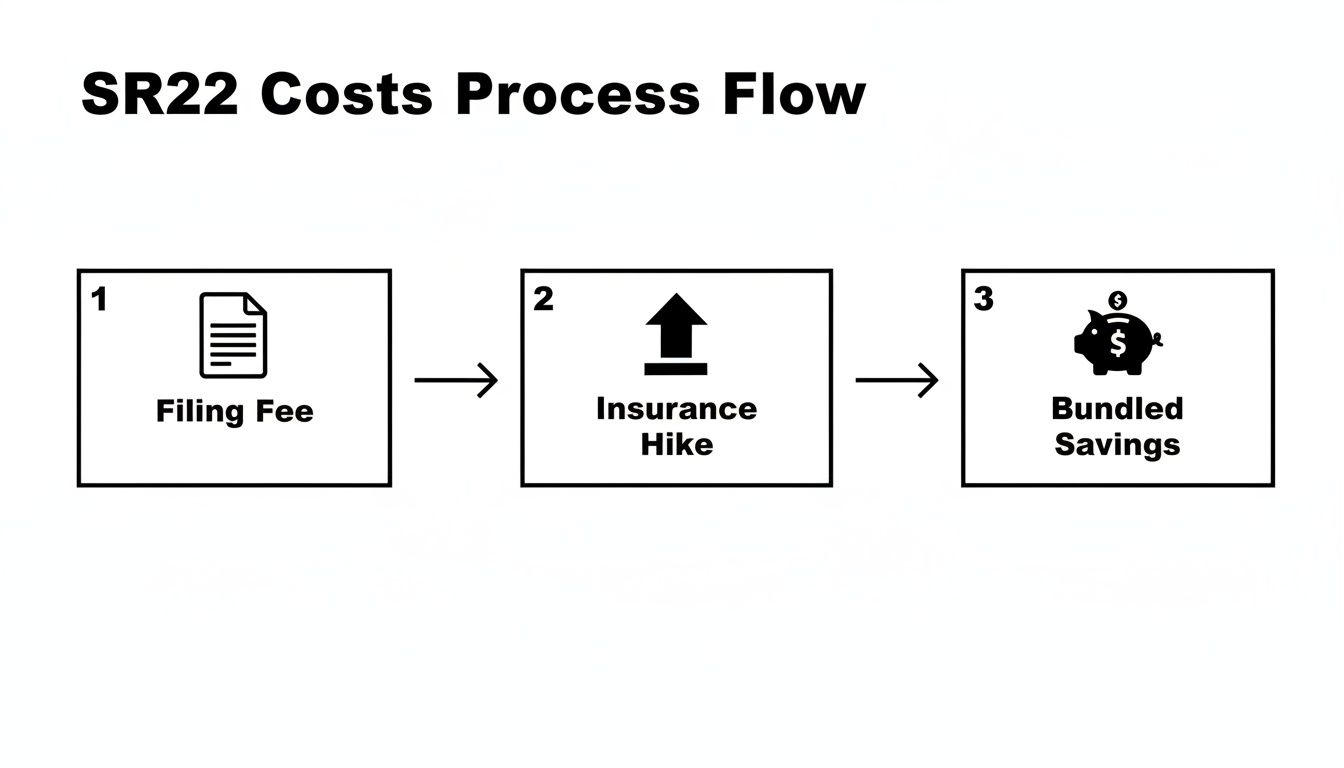
This process flow shows you what to expect. There's a small filing fee, and yes, the insurance rate will go up. But the real pro tip is bundling your policies, which can seriously offset the new cost. It’s all about playing the long game.
From Purchase to Filing: The Modern Process
Once you’ve picked a policy, you'll authorize your agent to file the SR-22 certificate directly with the California DMV. Thankfully, the days of snail-mailing forms back and forth are long gone. The entire process is now electronic.
This is a game-changer. The moment you pay for your policy, your agent can zap the SR-22 straight into the DMV’s system. For people who need their license back for work or to take care of family, this same-day service is absolutely critical.
The speed of same-day electronic filing can't be overstated. It cuts out weeks of waiting and wondering. The DMV gets instant proof you're insured, and you're one massive step closer to getting your license back.
Your agent will send you confirmation once it's filed. It’s still a good idea to follow up with the DMV yourself to confirm they’ve processed it and see if there’s anything else you need to do to get your license reinstated.
What Happens After the SR-22 Is Filed
Getting the SR-22 filed is a huge relief, but your job isn’t done. You’re now in a mandatory compliance period, which in California is typically three continuous years.
To avoid any setbacks, you have to follow these rules without fail:
- Keep Your Insurance Active: You absolutely cannot have a lapse in coverage. If your policy is canceled for any reason—even a missed payment—your insurer is legally required to report it to the DMV instantly.
- Don't Let the Clock Reset: A coverage lapse triggers an SR-26 form, which cancels out your SR-22. The DMV will suspend your license all over again, and your three-year requirement starts back at day one.
- Automate Your Payments: The easiest way to avoid a costly mistake is to set up automatic payments for your insurance premium. It’s a simple step that protects you from an accidental lapse.
Staying compliant during these three years is just as important as the initial filing. And as you get your long-term plans in order, you might find our other resources helpful. For more information, feel free to explore our other insurance guides that cover a range of topics from home insurance to life insurance.
Staying Compliant and Avoiding Common SR-22 Pitfalls

You’ve successfully filed your SR-22 and gotten your license reinstated. It’s a huge relief, but now isn't the time to get comfortable. The next phase is all about maintaining flawless compliance for your entire required term—usually three years. Think of it less like a single task you’ve checked off and more like a long-term commitment to the California DMV.
Many drivers think the hard part is over, but one simple mistake during these next few years can unravel all your progress. Understanding the common traps is just as vital as knowing how to get an SR-22 to begin with. These errors are frustrating, expensive, and can put you right back at square one with a suspended license.
The Dangers of a Lapsed Policy
The single worst mistake you can make is letting your auto insurance policy lapse. It doesn't matter if it's for one day or one week. The moment your coverage stops, your insurance provider is required by law to file an SR-26 form, which immediately notifies the DMV of the lapse.
This single form automatically triggers a new suspension of your driver's license. In most cases, it also completely resets your three-year requirement. All the time you’ve put in is lost, and you have to start the clock all over again.
I’ve seen it happen for the simplest reasons. A client once had their policy cancelled because their credit card on file expired, and they forgot to update the payment info. The result? Their license was suspended again, and the three-year clock they were just about to finish had to be restarted from day one.
To keep this from happening, you need to be proactive:
- Set up automatic payments. This is the most reliable way to ensure your premium is never missed.
- Use calendar reminders. Set an alert a few weeks before your renewal date to double-check that your payment method is current.
- Keep your agent's number handy. If you think you might have trouble making a payment, call your agent right away. They can often work with you to prevent a lapse.
Your SR-22 isn't a piece of paper; it’s a live monitoring system. The second your insurance coverage drops, an electronic alert goes straight to the DMV. The process is automated and unforgiving, which is why your payment habits have to be foolproof.
The Myth of Automatic Expiration
Another costly misconception is that the SR-22 requirement just disappears on its own after three years. That’s not how it works. The responsibility falls on you to verify the exact end date with the DMV and then instruct your insurance agent to remove the filing.
Never assume the date is exactly three years from your violation. More often, the clock starts on the date your license was officially reinstated. Before you even think about changing your car insurance or telling your insurer to drop the SR-22, you must get official confirmation from the DMV that your obligation is fulfilled. Acting too soon can look like a lapse in coverage, which can lead right back to another suspension.
Moving Out of California
What if you decide to move out of state? Your California SR-22 requirement follows you. Even if your new home state—like Pennsylvania or New Mexico—doesn't use an SR-22 system, you are still bound by California's rules for the full term.
You have to maintain an SR-22 compliant policy, no matter where you live. If you try to get a standard policy in your new state, the system will flag it, and California will suspend your driving privileges. This suspension can then complicate your ability to stay licensed in your new state.
California's enforcement has become especially strict over the years. Today, an estimated 92% of the 300,000+ high-risk driver cases filed annually in California require an SR-22 for a full three years. You can discover more insights about SR-22 state information to see how these rules compare across the country.
Get Expert Help with Your California Insurance Needs
Trying to figure out the SR-22 process on your own can be a nightmare. We’ve seen it all—the confusing paperwork, the sky-high quotes, and the constant worry about staying compliant with the DMV. Once you understand the basics of getting an SR-22, the most important step is finding an expert who can take the burden off your shoulders.
That's where we come in. At Mai & Associates, we simplify the entire process. We specialize in same-day electronic SR-22 filing, which means we can get your certificate to the DMV almost instantly. We then shop your policy across our network of top carriers to find the most affordable rate for your unique situation.
More Than Just SR-22 Auto Insurance
An SR-22 is often just one piece of the puzzle. Our team looks at your whole insurance picture to find more ways to save, often by bundling your policies. We're experts in all areas of California insurance and can help protect what matters most to you.
We can find you the right coverage for:
- Car Insurance for all your vehicles.
- Home Insurance to protect your biggest asset.
- Renters Insurance to cover your personal belongings.
- Life Insurance to provide for your family’s future.
If your SR-22 requirement is the result of a DUI, it's also smart to get legal advice. Learning how a criminal defense attorney can help you keep your license after a DWI can be a critical part of navigating this challenging time.
An SR-22 doesn't have to break the bank or disrupt your life. Our job is to handle the insurance details—finding you the best price and ensuring everything is filed correctly—so you can focus on moving forward.
We're proud to serve California's diverse communities and offer support in English, Spanish, Armenian, Russian, and Vietnamese. With local offices in Glendale, Westlake Village, Escondido, and Costa Mesa, plus the ability to serve clients in over 50 cities by phone, expert help is always close by. You don't have to do this alone.
Ready to get back on the road with peace of mind? Contact Mai & Associates today for a fast, no-obligation quote and let us take care of the rest.
Your Top SR-22 Questions, Answered
If the DMV has told you that you need an SR-22, you’ve probably got a ton of questions. It's a confusing topic. We get calls about this every day, so let's clear up some of the most common things people ask.
How Long Does an SR-22 Stay on My Record in California?
In California, you're generally on the hook for an SR-22 filing for three years.
The important thing to remember is that this three-year clock doesn't start on the day you got the ticket or had the accident. It begins on the date your driver's license is officially reinstated. A common mistake is letting your insurance lapse during this time. If that happens, your provider is required to tell the DMV, your license gets suspended again, and the three-year countdown starts all over.
Always, always call the DMV to confirm your specific obligation end date before you even think about canceling your policy.
Can I Get an SR-22 If I Don't Own a Car?
Yes, you absolutely can. This is a very common scenario. Maybe you sold your vehicle, or you just don't need one right now, but you still need to get your license back.
For this situation, you'll get what's called a "non-owner" car insurance policy. It provides the liability coverage the state requires and allows the insurance company to file the SR-22 for you.
A non-owner policy is usually much cheaper than a plan for a specific vehicle. It’s a smart, budget-friendly way to satisfy the DMV's mandate and get back on the road legally when you're borrowing or renting a car.
Will My Current Insurance Company Find Out?
Well, they will if you ask them to file the SR-22 for you. The problem is, many standard insurance companies want nothing to do with SR-22s. They might see you as too "high-risk" and could even non-renew or cancel your policy altogether.
Your best move is usually to work with an independent agency that knows the high-risk market inside and out. We can find a carrier that actually welcomes SR-22 clients, often at a much better price than you'd expect. You can find more general advice in our main insurance FAQ section.
How Quickly Can I Get an SR-22 Filed?
Believe it or not, this part can be incredibly fast—if you work with the right people.
An experienced agency can get you a quote, bind the policy, and file the SR-22 certificate with the California DMV electronically, often all in the same day. This is the fastest way to check that box with the DMV and start the clock on your license reinstatement.
Don't let an SR-22 requirement overwhelm you. The team at Mai & Associates is here to make getting affordable auto, home, renters, or life insurance simple and fast. Visit us at https://cahomeauto.com for a no-hassle quote and let our multilingual experts take care of the details for you.